Another reminder to you that there is no international law because there is no world government or world police and despite weird claims by present-day leftist intellectuals, treaties and conventions only apply to countries that have ratified them. And countries can ratify them with attached reservations and withdraw from them.
* Israel: Population 10 million, including 2 million Muslims (up from 150,000 in 1948). About 400 mosques.
* Arab world: Population 450 million, including 4,000 Jews (down from 900,000). There are functioning synagogues in Morocco and Tunisia, very few elsewhere. One has recently been opened in the UAE for foreign residents.
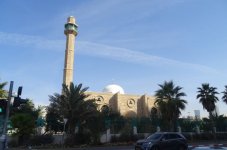
This first photo from 2016 shows the Hassan Bek Mosque in Tel Aviv. So far as I know it is the only mosque in Tel Aviv proper, which was founded in 1906 as a Jewish city. There are six mosques in Yafo, a Tel Aviv suburb which was formerly the Arab town of Jaffa and still has about 15,000 Arab residents.
The second photo from 2009 shows the enormous Sha'ar Hashamayim Synagogue in Cairo, which once served about 80,000 Jews but which has been closed and empty since 1956. Both synagogues are still legally the property of an Egyptian Jewish community which no longer exists. Many other synagogues in the Arab world have been destroyed.
As we are constantly reminded, about 700,000 Palestinian Arabs fled or were expelled from the territory which became Israel during the 1947-48 war. Their descendants, now numbering 5.9 million, are still officially classed as refugees. It's less well known that of the 900,000 Jews living in the Muslim world in 1945, the great majority were expelled (after being stripped of their property) at that time or over the following decade. These included Jews not just from the Arab states, but also from Iran, Turkey, Afghanistan and Pakistan. About 650,000 settled in Israel, while about 200,000 from North Africa settled in France. Their descendants (now also in the millions) are not classed as refugees and have made new lives for themselves.
These events could be seen as a population exchange between Israel and the Arab-Muslim world, rather like the exchange (involving 1.6 million people) between Greece and Turkey in the 1920s. Although that exchange was agreed by the Greek and Turkish governments, it was imposed on the affected populations, often by force. In the long run, however, it benefited both countries. The same might be said of the Arab-Jewish exchange if the politics of the Arab-Israel conflict had not dictated that several generations of Palestinians should not be resettled but instead should be held as hostages in UNRWA camps.
It may seem an unlikely proposition in the age of Netanyahu, when "Zionism" has become a dirty word in the mouths of all right-thinking leftists around the world, but it is a fact that Zionism and socialism were once closely aligned. Many of the pioneers of the Zionist movement were socialists, and socialist parties dominated the modern Jewish community in Palestine and Israel from its foundations all the way down to the 1977 election.
This history has been somewhat obscured by the fact that the three best-known figures in Zionist history - Theodor Herzl (1860-1904), Chaim Weizmann (1874-1952) and Ze'ev Jabotinsky (1880-1940) - were not socialists. Herzl was a conservative, Weizmann a liberal, and Jabotinsky a right-wing nationalist. But none of these three actually lived in the Land of Israel. The leadership of the Yishuv (the Jewish community in Ottoman and Mandate Palestine), always came from the labour movement.
From the early 1930s the dominant figure in the Yishuv was David Ben-Gurion (1886-1973), who in 1948 became Israel's first prime minister. Ben-Gurion came from what was already a long tradition of Jewish socialism. Not all Jewish socialists were Zionists. The largest Jewish socialist movement, the Bund*, was anti-Zionist, although in the face of persecution by both Nazis and Stalinists, many Bundists finished up in Israel anyway. But many Zionists were socialists, and many Jewish socialists were Zionists. Most non-Jewish socialist and labour parties (notably the French Socialists and British Labour) sympathised with Zionist aspirations.
Moritz (later Moses) Hess (1812-75) may be regarded as the father of socialist Zionism. He was a close friend of Karl Marx and a mentor to Friedrich Engels. With Marx, he took part in the failed German democratic revolution in 1848. His book "Rome and Jerusalem" (1862) correctly predicted that the rise of German nationalism would prove hostile to the Jews, and advocated a socialist Jewish commonwealth in Palestine. This was 30 years before Herzl's better-known book "The Jewish State" (1896).
Nachman Syrkin (1868-1924) led the socialist faction at the first Zionist Congress in Basle in 1897. In "The Jewish Question and the Jewish Socialist State" (1898) he argued that only the labour movement could build a Jewish state, and his advocacy of collective farming led to the establishment of the first kibbutz at Degania in 1910.
Dov Ber Borochov (1881-1917) was the founder of the Poale Zion (Workers of Zion) party. He was not just a socialist but a rigorous Leninist. In "The National Question and the Class Struggle" (1905) he argued that the Jews of Europe could only be emancipated by class struggle in their own state. He welcomed the Russian revolution and returned to Russia to fight for the Bolsheviks, but died of pneumonia in Kyiv. His ideas were highly influential in the Yishuv in the 1920s and 30s.
Berl Katznelson (1887-1944) was one of the founders of the Histadrut trade union federation, which dominated life in Mandate Palestine and through the first 30 years of Israeli statehood, and also a founder of the Mapai (Labor) party. Through the Histadrut he established Israel's socialised health system. He was a major influence on Ben-Gurion, Golda Meir and other Israeli leaders.
David Ben-Gurion (1886-1973) was born in Poland and emigrated to Ottoman Syria in 1906. He was an active Zionist from his school days, and also a revolutionary socialist. In 1923 he visited the Soviet Union, hoping to meet his hero, Trotsky, but was unable to do so. Later he became a more orthodox democratic socialist. He always saw Zionism and socialism as not just compatible, but essential to each other. The deaths of Haim Arlosoroff (1899-1933) and Katznelson left him as the undisputed leader of the labour movement and of the Yishuv. Although Weizmann remained the international face of Zionism, Ben-Gurion was its real leader from the 1930s until his death.
All of these leaders discussed the issue of the Arab population of Palestine. They argued (correctly) that Palestine was a poor, backward, thinly populated area which could absorb Jewish immigrants without displacing the Arab population. They argued (correctly) that Jewish immigration and investment would create growth and raise the living standards of the Arabs. They argued (correctly, at least at first) that the Arabs did not have a national consciousness and that Jews and Arabs could work together to create a socialist commonwealth. Like all socialists, they believed (incorrectly) that class was more important than nationality. They failed to foresee the rise of Palestinian nationalism after the establishment of the Mandate, and when it did arise, they failed to cope with it.
In all these assumptions the socialist Zionists were opposed by Jabotinsky, who argued that if the Jews wanted Palestine, they would have to fight both the Arabs and the British to get it. He also said that socialism would fail in Palestine as it would everywhere. The socialists bitterly resented Jabotinsky's eloquent attacks on their principles - Ben-Gurion called him "the Jewish Hitler." (Jabotinsky did have fascist sympathies in the 1920s but was a convinced democrat.) In the long run Jabotinsky was proved right, and his disciples Begin, Shamir, Sharon and Netanyahu have governed Israel for most of the last 40 years.
In the 1930s and 40s the socialist Zionists grappled with the conflict between their ideals and reality they faced on the ground. After the massacres of 1929 and 1936-39 they had few illusions about a Jewish-Arab socialist commonwealth. (Socialism has never had any appeal in the Arab-Islamic world, although dictators like Saddam and Assad claimed that their despotic statist regimes were "Arab socialism.") But they refused to accept Jabotinsky's prediction that the Arabs would have to be defeated.
This explains the incoherence of the Jewish leadership's attitude to the Arabs during the 1947-48 War of Independence. While in Jaffa, Lydda and Ramle the Arabs were being driven out at gunpoint, in Haifa the Jewish mayor was imploring the Arabs not to flee to Lebanon (they mostly fled anyway, but many came back). Contrary to later assertions, there was no plan to drive all the Arabs out of the Jewish state, which is why there were still 150,000 Arabs in Israel when the war ended. Today their descendants number 2.1 million.
The labour movement and its party Mapai ran Israel until Menachem Begin won the 1977 election. The last Labor prime minister, Ehud Barak, lost office in 2001 after Yasser Arafat's walkout at the Camp David summit. Labor staked all on the "land for peace" principle, and when Arafat sank that policy, Labor support collapsed and has never recovered. In July this year the remnants of the Labor party were absorbed into a new centre-left party, The Democrats. This brings to an end more than a century of socialist Zionism, although there are still some kibbutzim that are run as collective farms.
Meanwhile, in a process that began in the wake of the 1967 war and has steadily accelerated since, the international left has turned against Israel and Zionism. Parties of the left now uncritically endorse the Palestinian narrative that accuses Israel of "apartheid" and "genocide." The call to destroy Israel, drive out its 7 million Jewish inhabitants and establish a Jew-free Palestinian state "from the river to the sea" is now part of the standard rhetoric of the left everywhere. The Gaza war has raised the left's hatred of Zionism and Zionist Jews to new levels of hysteria and violence, particularly on the campuses of elite universities. It is now impossible to be accepted as part of the left without endorsing the slogans of genocidal anti-Zionism.
Part of the explanation for this is of course that Israel now has a militantly right-wing nationalist government, which people on the left understandably dislike (as do I). But the anti-Zionist turn also reflects the long-term degeneration of the left as a political force. With the disappearance of the old industrial working class and the decline of the trade unions, the left is now dominated by a new intellectual class based in the universities, whose main preoccupation is identity politics. Now that the left is completely divorced from whatever remains of the working class, the main focus of left activism is now "solidarity" with a succession of nasty Third World regimes and insurgencies. The Palestinians have successfully played up to this trend by posing as an oppressed people, while of course giving very short shrift to any symptoms of leftism or identity politics in the areas they control (as "Queers for Palestine" seem unable to notice).
As for the ICC:
1. I don't agree that courts should determine their own jurisdiction. That's how the US Supreme Court became the politicised monster it is today. Courts are instruments of public policy and their jurisdiction should be set by legislation. Judges are not politicians and should be prevented from acting as such.
2. We live in a world of sovereign states (the "Westphalian system"). We do not have a world government with jurisdiction over all states. States can choose to cede some of their sovereignty to supranational bodies (like the EU), but they can't be forced to.
3. Israel withdrew its signature on the ICC treaty precisely because it feared it would be weaponised by anti-Israel governments (who appoint ICC judges) in this way.
4. Israel (unlike most of the countries which attack it) has a robust independent judiciary which can and does punish Israelis who commit human rights violations.
5. I don't agree that Israel is "disrespecting the rule of law." Between states, laws only apply to those states who agree to be bound by them. Israel is a party to the Genocide Convention, so the ICJ clearly had jurisdiction in that case. But since Israel is not a party to the ICC treaty, the ICC has no jurisdiction over it (and does not claim to). The only way the ICC has bought its way into this case is by recognising the "State of Palestine" a fictitious and non-functional state which claims to govern Gaza.
View attachment 67496View attachment 67495




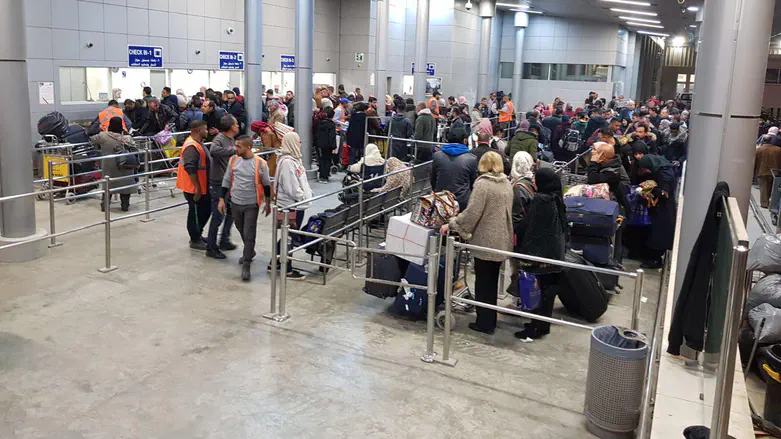














 That gesture warms the heart, as well, and gives one hope that the future might not necessarily be all bleak.


