• Quick note - the problem with Youtube videos not embedding on the forum appears to have been fixed, thanks to ZiprHead. If you do still see problems let me know.

The sinking of MS Estonia: Case Reopened Part VII

Thank you for the detailed, annotated narrative of the Brandenburg fiasco. And yes, everyone makes mistakes. Go back through the past few pages and see how many times I typed "Brandeburg." I know how the word is spelled. I just always mistype it, including embarrassingly on the printed program of a concert in which I played harpsichord for the "Brandeburg Concertos." The difference is that I know what the word is supposed to be.

Funnily enough, you're not the only person on this very forum to have that particular tic. There's several references in a political speech thread to the case of 'Brandeburg vs Ohio' from another poster who also, clearly, knows the correct name.


I'm putting this on moderated status as you seem unable to remember rules 0 and 12, and some seem to be struggling with 6 and 4

I'm not sure that generally abiding by the other rules is much of an achievement

Replying to this modbox in thread will be off topic  Posted By: jimbob
 
The BMTIG conclude that the most likely scenario causing the damage in the side of the Estonia was caused by a collision with a 3,000 to 7,000 tonne vessel.

Vixen has told us that other folks with the necessary qualifications and experience have supposedly shown to a standard acceptable in a court of law, that explosives were involved in the sinking.

What do you think Vixen, demolition charges or a collision with a vessel weighing several thousand tonnes? Or will you be silly and suggest demolition charges might have been planted at the bow visor AND the Estonia collided with a vessel weighing thousands of tonnes?

I've no doubt you're too much of an intellectual coward to actually commit in any way to either of these scenarios, because you need plausible deniability in order to weasel your way out of anything you can't defend yourself.

edit: Also, a reminder for you to post the bit of section 3.3.2 of the JAIC report that says the Atlantic lock was added to make people feel safer.
If - and it is a big IF - it was a pre-planned military or quasi-military attack (radio frequencies interference blocking MAYDAYs, EPIRB's inactivated, ship sailing via Sandholm and ending in relatively deep waters, Swedish midnight, military truck seen boarding) then yes, the attack would be on two fronts (check out 'frat boy' Hegseth and his 'no quarters' mindset in Venezualan waters).
 
If - and it is a big IF - it was a pre-planned military or quasi-military attack (radio frequencies interference blocking MAYDAYs, EPIRB's inactivated, ship sailing via Sandholm and ending in relatively deep waters, Swedish midnight, military truck seen boarding) then yes, the attack would be on two fronts (check out 'frat boy' Hegseth and his 'no quarters' mindset in Venezualan waters).

We already beat to death your daft RF interference suspicions. We all know the EPIRBs were never switched on by the crew. The ship should not have sailed at that speed in those waters in those conditions but that fatal error was not caused by any outside attacker. They did that themselves.

Did Hegseth attack that little boat on two fronts? No? Oh, well did he attack it at midnight? No? Hmm. Well did it have a military truck on board? Maybe a toy one?
 
What tonnage is that?
Gross, Dead weight or Displacement?

What kind of ship hit the Estonia?
The BMTIG Group state:

• 22 meters aft there is an equally large hole by the engine workshop, with exposed ship's plate and broken beams.

• Between the two holes is a zone that has at least seven separate damages – cracks, dents, flaking, crushed fender structure and overlapping sheet metal – indicating a longer contact course rather than a point impact. The overall pattern – a combination of intruding and extruded sheet metal, shearing, frame breakage and flapping deformations – is typical of a side collision in motion, not of bottom contact

<snip>

– The energy required to cause this damage on the starboard side is 140–180 megajoules. A bottom contact cannot cause this 22-meter long damage area, it is a physical impossibility, says Lars Ångström, who in addition to having been a member of parliament has also been editor and head of the Fokus Estonia investigation group.

– The damage requires a high-energy event at the surface. It involves a collision with a mass of 3,000 to 7,000 tons at a speed of 9–14 knots. https://www.varldenidag.se/nyheter/...ollision-orsakade-estonias-foerlisning/896200

In other words, like myself, they attempted to calculate how much force was exerted when the vessel hit the seabed. They calculate (and these are guys highly qualified in marine matters, unlike myself) that because the stern hit the bottom first, this modified the force of next impact of the starboard side hitting the rock, i.e., the force of the side hitting the seabed was diminished as a result of the stern hitting it first*. In addition, even the JAIC says most of it is lying in a muddy sediment - rather like a yoghurty type substance, with the ear of the ship (upper starboard side) lying against the rocky incline. As you know, it has since moved ten metres or so in the interim.


1765648403573.png

1765648436437.png


* To demonstrate this, try dropping a pencil horizontally, on its side, and then compare and contrast dropping it upright, vertically, and compare the difference in visual and physical impact when it falls to its side.
 
Does it matter if the ship sank stern first, if the stern landed on a silt incline with the consistency of yoghurt? That wouldn't absorb much of the impact, would it?

What proportion of the impact does Lars Ångström the engineer former MP claim that would have absorbed?
 
* To demonstrate this, try dropping a pencil horizontally, on its side, and then compare and contrast dropping it upright, vertically, and compare the difference in visual and physical impact when it falls to its side.
Do they make a 15,000 GT pencil? And what happens when it's full of sea water?

In other words, like myself, they attempted to calculate how much force was exerted when the vessel hit the seabed.
And they're just as bad as you are at this. These are not independent investigators, they are conspiracy oriented. They're no better than the doctors who pop up in the JFK assassination with claims of extra bullets and trajectories.

They calculate (and these are guys highly qualified in marine matters, unlike myself) that because the stern hit the bottom first, this modified the force of next impact of the starboard side hitting the rock, i.e., the force of the side hitting the seabed was diminished as a result of the stern hitting it first*.
And yet they do not attempt to factor in the storm currents effects on the water column or at the bottom, and how this would have influenced the ship all the way down, and in the hours after it landed on the bottom. We know those currents were strong at depth because they pushed the car ramp closed. These "experts" ignored all of that.

In addition, even the JAIC says most of it is lying in a muddy sediment - rather like a yoghurty type substance, with the ear of the ship (upper starboard side) lying against the rocky incline. As you know, it has since moved ten metres or so in the interim.
Yes, and these "experts" do not address why there are no holes where the wreck is in contact with the muddy parts, but only where the rocks are. And yes, it didn't just move, it rolled, further grinding into that rock outcrop, which is obvious in the photos.

This report is nothing more than a CTist smoke screen released ahead of the official report due this coming week (I think).
 
If - and it is a big IF - it was a pre-planned military or quasi-military attack (radio frequencies interference blocking MAYDAYs, EPIRB's inactivated, ship sailing via Sandholm and ending in relatively deep waters, Swedish midnight, military truck seen boarding) then yes, the attack would be on two fronts (check out 'frat boy' Hegseth and his 'no quarters' mindset in Venezualan waters).
This makes no sense at all.

Pete Hegseth had nothing to do with the Estonia attack, so what he says or does is entirely irrelevant. Even that clueless incompetent buffoon isn't so stupid as to be ordering US submarines to try sinking ships in the Caribbean by ramming into them.

Also, the attacks on the Venezuelan boats in the Caribbean are not "on two fronts". The case that's been making the use involves a boat being hit multiple times with missiles, not anything "on two fronts', so the comparison isn't apt in any way.

If for the sake of argument, it was a military attack, then it also doesn't follow that it would be "on two fronts", unless you think that attacking ships via 2 completely different methods (including one as dumb as deliberately crashing a submarine into the target ship) is somehow standard military practice.

What kind of fantasy world do you live in where the Russians (or whoever) would plant demolition charges to knock out the bow visor in order to sink the ship, and also decide to perform something as stupid and reckless as ramming a submarine into the Estonia at the same time?

Planting explosives in multiple places on the ship, timed to go off when no-one involved was on the ship, at least makes some sense if only in a spy thriller movie plot, rather than planting explosives and also crashing a submarine into the ship. Why on earth would any military conceive of such a stupid plan, and then actually carry it out? Who sinks ships by crashing submarines into them, and why? If a submarine WAS involved, wouldn't they just torpedo the ship?

You truly live in a fantasy world if you think such a scenario might have happened.
 
Last edited:
Due to the limitations on presenting and accessing the source material required for the discussion to continue here, I'll confine my wrap-up of the Brandenburg report to the excerpts already presented, under the presumption that they are still allowed.

As I mentioned previously, the entire report suffers the effects of inexpert translation—not just in its pidgin English but in its misapprehension of the technical details of the source material. These kinds of report are generally worded carefully in their native languages because they often will be considered evidence at law and may be tested as such. The present English translation misses the mark by a country mile. The bulk of the report is a technical description of the examinations performed and tables of resulting data, thus fairly unremarkable and nonprobative. However the operative language is in the apparently conclusory statements, some of which have been preserved in our record here. I was able to discuss them with my colleague, a native German-speaking engineer prior to the weekend. In some cases he was able to offer speculative reconstructions of the likely German text and offer other options for translation and expert interpretation.

Returning to the paragraph I excepted, I challenged our claimant to interpret these sentences.
A destruction of the lamellae has occurred which cannot occur by any comparable mechanical technological influence. The processes of explosive treatments of metallic materials as for example explosive hardening and explosive cladding have to be excluded. These processes show in surface-near areas comparable effects.

The phrase, "mechanical technological influence," is almost certainly a strained translation of a specialized German engineering idiom that we would best translate as "manufacturing process." It does not mean simply all conceivable mechanical effects. The mention of explosives here seems like a dog whistle, and the repetition of "comparable" (which may have come from any of several German words) seems to paint the conclusion that the author is here saying the observations are attributable to explosive effects apart from any other possibility. Instead the author is more likely saying that because they know where the specimen came from, they know how it was manufactured and can rule out any manufacturing process (including but not limited to explosive forming) as the cause for what they have observed. The author is not at all saying that the effects cannot be attributed to any purely mechanical process and must therefore be attributed by default to an explosion.

It's not really a nit-pick to say that "surface-near" is a poor translation of oberflächennah. It's unfortunate that English has no single word to succinctly translate to, but making up one is not how conscientious translation proceeds. Words matter, especially when translating something that was specifically worded to begin with.

The next excerpt is one we discussed already in our previous treatment of the Brandenburg report.
These plastic deformations in the micro range do indicate exposure to extremely heavy shock forces such as happens from the effects of a substance detonating.

In the previous discussion it was argued that this language means to dispositively attribute a cause. It expressly does not. It did not then, and it has not suddenly acquired that meaning in the interim. This language—whether in English or German—says merely that an explosion can have caused those effects. It specifically avoids saying it must have caused them. This is a very important distinction that may not simply be brushed aside.

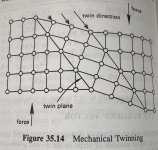
The "plastic deformations" mentioned here are the infamous twinning, which we have discussed at length at least twice previously. Here is the diagram from the engineering license exam study guide.

IMG_5799.jpeg

The statement in the report conveys the wrong impression that twinning is caused exclusively by shock forces that can only be produced by an explosion—or at least that's how some here have tried to interpret it.

That is absolutely untrue.

In fact, when twinning is introduced in metallurgy classes, causes such as explosives aren't even mentioned. High strain rates can cause it. But there are countless ways for high enough strain rates to occur. Ordinary forces applied at extremely low temperatures can cause twinning, but also larger forces at only relatively low temperature—forces consistent with the violent breakup of a ship. That's where our previous discussion of a running shear comes in. Cyclical loading can cause twinning, and we know the specimens came from a part of the ship highly likely to be subject to cyclical loading from waves and from the operation of the bow visor and car ramp. Ordinary fatigue forces can cause twinning, and also the highly localized hardening the laboratory observed.

The Brandenburg authors are not being dishonest for failing to mention these causes. Nor has the translator committed any grave sin in this passage. Their statement is true, but not the whole truth. It is neither dispositive and exclusive. We'll come back to this.

Our final excerpt happens to be the final statement in the summary portion of the report.
It has to be concluded that the pressure waves also in areas, where by means of light microscopes, only little deformation is recognizable, did result in hardening due to structure deformation in the micro range; (deformation of the perlite grain, change of the solidification density).

The highest hardening has been established in way of the immediate fracture area of the specimen being most strongly strained.

For this hardness increase as well as for the determined structure deformations detonative influence is probable.

My colleague offers three or four German words that can all have been translated as "probable." Two of them also embody lesser degrees of certainty, such that we would more accurately translate them as "plausible" or "credible." As you can imagine, the choice of English word here determines much of the question. And our translator has not earned a reputation for accurate word choices. To adopt the common English meaning of "probable" to indicate a likelihood, a comparative analysis must support it. No such comparative analysis appears in the Brandenburg report. The SwRI report indicates that they would be willing to conduct such an investigation for an additional fee. But because the Brandenburg report does not lay out a comparative analysis, "probable" is the wrong word. In keeping with the conservative nature of these reports, "plausible" or "credible" is the better translation.

Now we circle back to the loaded question. I noted that the SwRI report was worded carefully to support the notion that an explosion could have caused the effects they saw, but that it was by no means the only or best explanation. Brian Braidwood took it upon himself to interpret these reports, and we don't have to search very hard in his analysis to find his statements that indeed the labs were not told to perform a comparative analysis of potential causes, but were simply asked to determine whether the damage to the metal could have been caused by an explosion irrespective of any other cause. That is by no means an inappropriate question to ask a metallurgy lab to answer, since a fully comparative analysis is often beyond their scope. But to frame the findings as discriminatory of cause and a dispositive attribution is quite irresponsible. The comparative analysis must be done if a differential diagnosis is to ensue. The labs didn't do it, and Braidwood simply restated the findings of the laboratories misleadingly as dispositive. This is the kind of shuffle we see all the time among proponents of fringe theories.

Properly translated and properly contextualized into the laboratory's remit, the Brandenburg report does not provide evidence that preferentially establishes an explosive detonation as the cause for the damage to the steel specimens.
 
In other words, like myself, they attempted to calculate how much force was exerted when the vessel hit the seabed. They calculate (and these are guys highly qualified in marine matters, unlike myself) that because the stern hit the bottom first, this modified the force of next impact of the starboard side hitting the rock, i.e., the force of the side hitting the seabed was diminished as a result of the stern hitting it first*.
This is misleading. The manner they describe is how literally every ship hits the bottom. Almost none of them hit bottom squarely on the keel, side, or weather deck. Yet we find many examples of wrecks with seabed damage from this form of impact.

* To demonstrate this, try dropping a pencil horizontally, on its side, and then compare and contrast dropping it upright, vertically, and compare the difference in visual and physical impact when it falls to its side.
The kinetic energy is the same in all cases. Dropping a pencil is largely an elastic collision. Ship collisions are overwhelmingly governed by inelastic mechanics. It's a poor example for understand what's happening.

The group here is not wrong when they say that the collision transforms into a moment-arm problem. However, do you have any sort of intuition for the level of guesswork that has to go into such a model? I do. I'm sure their estimate of 30 MJ or so for seabed impact holds for a certain set of assumptions. But when this level of guesswork is required, it is rarely probative for a negative proposition. That is, if you want to support an affirmative proposition you can model the problem and solve it for a range of assumed values. If you can come up with one set of reasonable assumed values, you can say that the model shows the scenario is plausible (even if many different sets of parameters failed). However, you're on very shaky scientific ground if you present a broadly parameterizable model and claim that this proves something is impossible.

Your group goes onto state :—
Between the two holes is a zone that has at least seven separate damages – cracks, dents, flaking, crushed fender structure and overlapping sheet metal – indicating a longer contact course rather than a point impact. The overall pattern – a combination of intruding and extruded sheet metal, shearing, frame breakage and flapping deformations – is typical of a side collision in motion, not of bottom contact.

Sheer bollocks.

And for all its impressive, pretty graphics, the report is still reasoned backwards. The researchers believe they have thoroughly ruled out bottom contact as the cause of the damage, but then they just assume a surface collision as the default that must hold instead. That's utterly irresponsible. They have in no way subjected that hypothesis to any standard of proof. It's a pattern of reasoning that exists only in conspiracy theories. It is not followed by any responsible investigative group.

Further, Kurm seems utterly disinterested in any sort of hypothesis involving explosives. If the evidence for explosives is so strong, why is Kurm completely silent about it?
 
Last edited:
– The energy required to cause this damage on the starboard side is 140–180 megajoules. A bottom contact cannot cause this 22-meter long damage area, it is a physical impossibility, says Lars Ångström, who in addition to having been a member of parliament has also been editor and head of the Fokus Estonia investigation group.
Isn't "having been a member of parliament" a credential on par with "having been a member of the US Congress"?

Because that would suggest his opinions are worth every bit as much as opinions expressed by George Santos, Matt Gaetz, Paul Gosar, Marjorie Taylor Greene, Lauren Bobart, Michele Bachmann, Louie Gohmert, Tim Burchett, Ron Johnson, et cetera et al.

When appealing to the authority of your authorities, you invite examination of their alleged authority, knowledge, and competence in the matter on which they opine.
 
Isn't "having been a member of parliament" a credential on par with "having been a member of the US Congress"?

Because that would suggest his opinions are worth every bit as much as opinions expressed by George Santos, Matt Gaetz, Paul Gosar, Marjorie Taylor Greene, Lauren Bobart, Michele Bachmann, Louie Gohmert, Tim Burchett, Ron Johnson, et cetera et al.

When appealing to the authority of your authorities, you invite examination of their alleged authority, knowledge, and competence in the matter on which they opine.
Members of parliament indeed have no particular expertise on any topic whatsoever. Being elected is nothing more than a popularity contest. To imply such credentials indicate expertise on any aspect of the Estonia sinking is nothing more than a red surströmming.
 

At the press briefing on 16 December 2025 at 15.00 (EET), the Estonian Safety Investigation Bureau (OJK), the Swedish Accident Investigation Authority (SHK) and the Finnish Safety Investigation Authority (OTKES) will present the final report of the Preliminary Assessment of MV ESTONIA.
 
So I listened to the press conference. This is my summary:

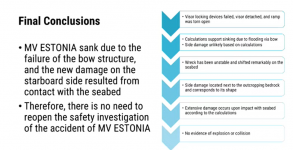
They have calculated/simulated the load on the side plating from Estonia resting on the hard bedrock, and came to the conclusion that it is enough with the Estonia weight to cause the damage, and that the damage matches expectation based on the shape of the bedrock.

They have done a simulation on loading on the Bow visor from the waves, and can visually show loads and when the different part break.

The Bow visor and ramp damage matches this simulation

They’ve looked at the flooding, and can see that the Center casing doors on the car desk were not water tight or weather tight, so small amounts would be leaking down.

They have simulated 3 scenarios. Bow door open, only a damage to the side, or a combination of the two. The Open bow fits best the actual sinking. Only side damage would not necessarily lead to a sinking.


They have invited all available survivors to be interviewed again. 68 agreed. That includes 1 out of 3 that had not been interviewed before.

Regarding military transports, there are two that claim they saw it, and 9 that disagree. Those 9 were all present at the car deck, or in the harbour at the time.


They’ve tried to find out I the load on the car deck was secured. They come to the conclusion that some lashings were used for cars/trucks, but unclear how much.


They interviewed people that were in the areas of the side damage (deck 1). None of them have information that supports that damage happened before sinking.

The conclusion around the ramp was that it was open during the accident progress, then fell back to closed when Estonia listed. This matches the witness statements.


A witness outside on the SB side when listing started saw no other vessel or collision.

The Stabilizer fins were extended during the trip, but retracted automatically when speed dropped. It is undamaged, so that also confirms that there has not been a collision.


Most witnesses had not read JAIC. They agree with JAIC, but are unhappy with the political decisions afterwards – for example covering the wreck.
1765894325493.png
1765894335980.png
 
A recording of the press conference can be seen here: I think it was pretty good at explaining things so that I could follow along.

That includes some Q&A at end end that I think gives a good indication on what the conspiracy theorists will focus on... As I see it mostly reiterating stuff that was complained about earlier. In some cases even reiterating stuff that the new investigation already explains.
 
Seems clear and mostly uncontroversial. Since the title of this thread is 'Case Reopened' and the case has now been shut via the issue of the report, I guess we can conclude that this thread has run its course.

Well we live in hope.
 
I have watched the press briefing and skimmed the written report. As a fan of the Estonian composer Arvo Pärt, I am indebted to the presenters for providing the correct pronunciation of the syllable -ärt. (One of the presenters has a similar name.) The nominal author of the report is Ohutusjuurdluse Keskus, which I shall refer to as OK.

These are my initial impressions, subject to revision upon more detailed examination.

From the Press Briefing​

The dynamics of the detachment of the visor were modeled. These support the conclusion that the visor detachment should have pulled open the bow ramp. The physical damage to the bow ramp is consistent with hammering against the forepeak and bulbous bow. Eyewitness testimony claiming both that the ramp was open and that it was closed are not deemed to be inconsistent because the ramp would likely have closed as the ship rolled. Water ingress through the open bow ramp is considered the primary cause of flooding on the car deck.

The mass of the vessel for physics purposes is given as "10,000 plus" tonnes. This should help alleviate the confusion among some posters that the gross tonnage of 15,000 has anything to do with the physics of this study.

Damage to the starboard side was modeled and correlated to the photogrammetric model. I will discuss this in more detail below. Witnesses on the starboard side of the ship did not see any other vessels.

Flooding models were constructed for three scenarios: bow ramp ingress, side impact damage, and both together. The scenario that best fit the foundering timeline was the bow-ramp-only scenario. The both-together scenario actually results in the ship sinking faster than 35 minutes. The side-damage only scenario resulted in the ship not sinking at all. Significant downflooding paths were identified in the ship's ventilation network irrespective of Deck 4 windows, and modeled in the flooding model. There is no need to suppose that water ingress on Deck 4 contributed. The car deck doors were fire doors and were not watertight or weathertight. Lower-deck flooding was observed far from the starboard side damage, counter-indicating flooding from that source. A scenario involving lower-deck flooding from a hull breach does not support the roll behavior observed and in fact would require the ship to stay more fully upright as she foundered. (I agree, and this shows that Anders Björkman is just that much more wrong.) The overall observation of flooding and the numerical flooding model is most consistent with car deck flooding followed by downflooding through ventilation ducts and subsequent weather-deck ingress.

Although evidence is inconclusive, there is physical evidence to indicate some cars were lashed down. The movement of other cars on the car deck can explain some of the scraping sounds heard by witnesses. The various noises reported by witnesses were investigated via modeling and determined to be plausibly caused by the transmission of noise from the banging bow visor through the hull structure.

Many of the survivors do not want the controversy raised again. Most of the witnesses accept the JAIC findings, but disapprove of some of the politically-motivated actions later, such as the attempts to cover the wreck.

Questions​

A number of correspondents asked about the BMTIG findings and challenged the OK panel to reconcile their claims with those of the BMTIG. The BMTIG findings rely on an energy formulation, while OK's does not. They are not directly comparable, although both sides have resolved to publish their models and data. The OK panel was asked if they were willing to participate an "official" dialogue with BMTIG. The OK panel indicated they would be willing to discuss their respective findings with anyone, but questioned how an "official" collaboration would proceed. (The cautionary quotes are in deference to the disagreement between the correspondent and the board over what "official" means in this context.)

From the Written Report​

In all fairness, the report needs a native English-speaking editor. Much better than the Brandeburg metallurgy report, but still awkward.

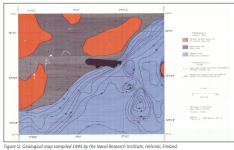
The seafloor near the wreck was extensively modeled, sampled, and tested. It is consistent with what is required to cause mechanical damage to shell plating. BMTIG's position, in contrast, seems to be that the seafloor is just mud. "Rocks? What rocks?"

Black markings on the shell plating were tested and found to be natural biological growth.

The photogrammetric model is complete and accurate. This is a detailed model of the shape of the wreck as it currently lies as derived from photographic data.

A finite-element model (FEM) of the ship was prepared and used to model the structural response of the ship using the ship's weight only. The model plausibly accounts for the penetrative damage to the starboard side.

BMTIG sought to create an energy-based model of the entire foundering sequence and an energy-based collision model to describe the damage to the hull. This is not an inappropriate way to do it, but as I suggested above, it requires parameters whose values simply cannot be known because they exercised their influence during the foundering sequence and cannot have been observed. Thus for them to claim it precludes a seabed-contact explanation is inconsistent with how faithful such a model can be.

OK's model is much simpler and incorporates only data that can be known faithfully. More importantly, in their words :—

The objective of the FEM modelling [sic] was not to replicate the damage visible on the wreck today, but to observe how the ship would behave in a theoretical collision with the seabed. (p.105)​

In other words, the model was not programmed to produce the observed condition of the hulll. It was programmed only to apply stresses that would result from the structure of the ship resting on the rocky portion of the seabed under its own weight. This is not an energy formulation. This is important for two reasons. First, it is not directly comparable to the BMTIG findings and does not seek to challenge them on the same grounds. Second, the OK model relies on orders of magnitude less guesswork. In fact, the parameters to a weight-only stress model can be known with great precision following the surveys conducted and from the structural plans of the vessel.

The geometry of the observable damage to the starboard side was produced with extremely high fidelity in the FEM. It is now clear to me why BMTIG does not want to talk about rocks—this is clearly a much better supported conclusion. That's how you do it. The OK method uses far fewer unknowns (yet is a completely physically faithful model). It is a stress-only model, which offers much less room for error with no loss of rigor. It considers the lower-boundary case of zero kinetic energy input and shows that the observed effects are still plausibly produced. It can only go up from there, so there is an affirmative evidence that the smallest values in the envelope credibly reproduce the observed effects with little wiggle room for estimation error or programming error.

This is especially dispositive.

Additional evidence of contact with the rocky portion of the seabed was presented. The ship's rotation in heading as the wreck shifts has its pivot at the starboard damage site. Further, the entire wreck is "hogging" (i.e., drooping at each end), indicating that it was being disproportionately supported at that point. These indicate that the bulk of the wreck's weight is or has been concentrated on the rocky outcropping. This is especially important as it provides an element of consilience in the findings.

The surface collision scenario was considered. Specifically, “There is no available evidence to suggest that the deformation, or any part of it, was caused by an explosion or a collision on surface.” (p.111)

Physical evidence presented to support this conclusion includes the absence of any paint or substance transfer, and the lack of metallurgical evidence of high strain rates. (A sample was retrieved for analysis.) Circumstantial evidence in favor includes observations that the dynamic stabilizers were observed in the extended position shortly after the bow visor detachment, but found stowed and undamaged in the wreck. The stabilizers would have stowed automatically as the ship's speed decreased below the threshold of usefulness. Since the starboard stabilizer is in very close proximity to the starboard-side damage, it would have received damage in a collision and would therefore not be able to be stowed.

Although not stated in the report, the opinion offered above in connection with BMTIG's statement that the two holes in the side separated by dents and abrasions "could only be caused by a collision" remains absolute bollocks. It's sheer fantasy. There is no credible collision scenario that causes an initial hole, subsequent sliding contact, and then another hole. OK's comparative analysis is sound while BMTIG's characterizations seem to be mostly wishful thinking.

 
Last edited:
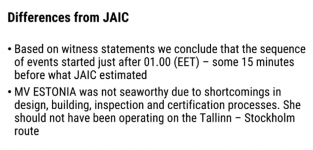
I think Chapter 7 in the report is a very nice description of the causes of the Accident. It starts like this:

The actual causes of the sinking of MV ESTONIA have been sidelined many times
or put in the background during discussions about alternative causes. Thus, both
media and the public may have had the impression that some aspects, e.g., ship’s
speed or maintenance standard, have influenced the accident more than they really
did. There is often a tendency to look for a single root cause of a disaster and to even
oppose different causes and contributing factors against each other. The purpose of
this chapter is to better emphasize and explain why the ship sank—that it did not
sink because of one root cause, but rather as a result of systemic failures within the
shipping industry. These systemic failures incorporated socio-cultural, regulatory,
design, construction, inspection, and certification aspects that together paved the
way for the accident. The formed latent unsafe conditions were extremely difficult
to identify at the operational level, in the beginning of the accident.
 
I think Chapter 7 in the report is a very nice description of the causes of the Accident.
This is indeed especially important because it describes the landscape of most transportation and industrial accidents. It's attractive to look for singular, sensational causes and to identify specific individuals, groups, or corporations to hold accountable. The true picture is almost never as malicious as that.

Similarly it's tempting to try to dismiss these new findings with the typically conspiracy-oriented logic, "The Ohutusjuurdluse Keskus didn't address __________, and therefore their conclusions cannot be considered conclusive." @Axxman300 covered this adeptly a few pages back. Conspiracy theories focus on outliers without generally being able to explain the total picture of evidence. Hence to revisit the accident is not to try to explain every single outlier. If it was difficult to do so previously with evidence, and little new evidence arises, it remains an outlier. If an alternative explanation is very good at explaining one or two outliers, but fails to provide a more consilient, evident overall scenario, it's automatically less explanatory, less evidence-based, and less credible.

Hence we find the BMTIG following a well-worn pattern of fringe reasoning. The undesirable theory is subjected to a very high standard of proof and is arguably deemed thereby "impossible." Then the desirable theory is presented as the default that must hold instead. But the desired theory is not subjected to as high a standard of proof, if to any standard of proof. BMTIG presents no evidence that a collision actually occurred. They compute that the 150 MJ or so of "required" energy could be supplied by a collision with a vessel of a certain size moving at a certain speed. But this is not even remotely evidence that any such collision actually occurred. Hence they are left with little more than conclusory declarations.

Conversely, the bulk of the OK report is spent in testing their own conclusions to a high standard of proof. And as is proper, they expect all the alternatives to meet the same standard of proof. Framed correctly in that manner, it's clear that the surface collision hypothesis fails to rise to even a cursory level of credibility according to the totality of evidence compared to the bottom-contact hypothesis.

Now a word of caution. When I say that the OK's FEM is simpler than the BMTIG's FEM, that is by no means to say that it is less explanatory or less faitfully based on physics. Both models rely on computing the response of steel structure to imposed stress. This is the LS-DYNA computational kernel developed by the U.S. Dept. of Energy. Engineers from the company I worked for at the time, including myself, participated in developing it. It is now owned and maintained by Ansys. The difference is in how those stresses are reckoned, characterized, and quantized. The BMTIG's model proposes to infer them from a kinetic-energy model of the falling vessel, as we've talked about many times. This requires considerable guesswork, as I said before. From such gross factors as reserve buoyancy down to the precision of the ship's attitude as it hits bottom, these are generally uknowable and untestable. From this the BMTIG proposes that the stresses applied across the vessel's stopping distance in the second phase of bottom contact (i.e., after the stern hit) are insufficient to result in the structural deformation observed.

In contrast the OK model simply places the structural model of the ship atop the rocks at the point of contact and merely applies the ship's gravity load with zero invocation of energy. It would be as if the ship magically appeared rolled on its side at the point of contact, with no downward momentum at all. If you set the egg gently on the counter and it cracks under its own weight, you don't have to contemplate how high you can safely drop it from. This is a limiting case because we know the ship had some energy. But if it's plausible in the limiting case, there is no combination of greater factors that makes it less so.

Incidentally we have to do this for a lot of structural models. You model the geometry as configured in static designs. But at this point there are no loads active in the model. It's as if the shape has zero weight and is just floating there. Then you set the gravity load—the dead load—and allow the structure to respond to that. When the model comes to equilibrium, it now has the stresses and deformations that correspond to the gravity load. This is the starting point for exploring whatever else it is that we're studying—a collapse scenario, thermal loading, a collision or other structural compromise. Normally we don't visualize that part of the process because it's a waste of time and computing power. But for illustration and education purposes, we might sometimes visualize it; it's sometimes entertaining. You get to watch a structure sort of "relax" into its environment as if it has settled into a comfy chair.

Something similar to this is what the OK model did. All they did was allow gravity to exert its roughly static, dead-load effect. And not only did the structure respond in a way that produced the deformations and perforations actually seen in the wreck, it did so to a very high degree of fidelity. The deformations have the "fingerprint" of the rocky outcropping all over them, not because the simulation was programmed to produce them, but because that's where the blinded physics led. This is hell-and-gone more reliable than any dynamic simulation. It still applies the same kind of stresses that the BMTIG model did, but its understanding of what those stresses were, where they came from, and how they were applied comes from a much smaller set of variables with very few unknowns.

The shape of the rock outcropping can be known with great accuracy. It was thoroughly surveyed. The hardness of the rock can be known with pure scientific accuracy, although for the purposes of economy once the hardness of the rock exceeds a certain threshold it is modeled as a non-deforming object. The structure of the vessel can be known with great accuracy and modeled with very high fidelity. Incidentally, you get a very reliable mass estimate for free from this method. The only unkowns are the intial position and orientation of the wreck as it is "magically" placed on the rock (again, with zero momentum). And these are not especially unknowns, because the wreck has been surveyed several times since the sinking. When these simple variables are programmed, to have the model produce such a close approximation of the photogrammetric model—and its fidelity can be reliably measured—is as reliable a finding as any investigator can hope for.

For lack of a better phrase, this is the smoking gun.
 
Glad it's all done. Nice to see they went the extra mile where they could on this.

Would be nice if a reporter asked the BMTIG took so long to issue their report since the bathymetric survey was released on 25 January, 2024? Why wait to drop their version just a week before the final report which gives little time for review? From my layman's view they A&E911 Truth'd it. Jay points out the flaw in the OK model, but it does provide an acceptable picture of the damage on the side. The BMTIG just ran a counter-claim using more than a few abstract numbers to support a surface collision. In short, their math was based on the assumption of surface impact verses the OK finding for X using the the hull structure and weight combined with the location of the gash as it relates to the rock outcrop. My guess is they'll argue their case with abstract equations while ignoring the basic landscape where the wreck settled on the sea floor.

Either way, the report along with its supporting reports make a clear case for the obvious.
 
Additional supporting material/reports was posted yesterday that I didn't link to. This page includes links to the calculations and testing on window break loads, as well as the sinking scenarios among other reports.
The report on the flooding model is especially interesting as it uses quite state-of-the-art methods. The takeaway that surprised me most was that the condition of the center casing doors (i.e., from the car deck to the rest of the ship) had such a little effect on the overall flooding progression. The notion that the doors remaining closed would prevent or significantly slow subsequent flooding is not supported by evidence. It also renews the standard chuckle at Anders Björkman's "crayons on a napkin" approach to flooding.

The report on the midships damage confirms that the only first-order unknown the investigators needed to consider was the vessel roll angle at contact. Three roll angles were modeled. The penetration injuries were caused by the especially convex edge of the outcropping.

Before the question arises why OK performed empirical window strength tests while JAIC did not, OK did not perform any such tests. They referred to the academic literature describing empirical tests previously performed by other researchers. They did this to validate their FEM findings. The preexistence of new empirical findings is an advantage, not strictly a necessity.
 
Jay points out the flaw in the OK model, but it does provide an acceptable picture of the damage on the side.
I'm not sure what flaw you're referring to. The OK methodology is simple, robust, and highly defensible. It is exactly as complete as it needs to be to correctly test the question, and no more so.

The BMTIG just ran a counter-claim using more than a few abstract numbers to support a surface collision.
Had the OK's static model failed to produce the observed damage, they would have had to resort to a more complex model, likely an energy formulation similar to that used by BMTIG. In other words, if you set the egg down gently on the counter and it does not break, then you have to move on to determining how high you have to drop it from to get it to break. Because such a model involves many unknowable unknowns, they cannot usually delimit any limiting cases to reliably preclude behavior—only to affirm it.

In short, their math was based on the assumption of surface impact...
Sort of. I'll break it down. Their argument involves three roughly independent models.

There is one model that gives them the amount of energy required to produce the observed damage to the ship, which they gave as 150-180 MJ. (For some reason the figure mentioned in the OK press briefing was 110 MJ.) Energy correlates to precise deformation and penetration according to assumptions of the direction in which the energy is applied to the other collident and the response of that structure. That assumption is critical.

Ship-to-ship collisions between large vessels are largely inelastic. The ships don't always bounce apart. The kinetic energy in the collision is expended in deforming the structure across some stopping distance. But which structure? In a ship-to-ship collision, both ships are deformed. The available energy is divided between the two structures, so the damage to one ship nominally results from roughly half of the available energy. In an elastic collision (such as dropping a pencil) the kinetic energy is mostly redirected and results in continued motion—kinetic energy is preserved as kinetic energy and not applied to the structure. The pencil eventually comes to rest as the energy is converted to heat, not expended in material deformation.

Imagine dropping a ball of bread dough on the floor. The floor is a non-deforming object at this scale, so all the kinetic energy goes to deforming the dough ball. But if you drop a ball of bread dough onto another larger ball of bread dough from the same height, the available energy is the same but both balls respond by deforming. The dropped ball deforms less in that case.

So when BMTIG says it takes more than 100 MJ to produce the damage seen, not only does that depend on unknowable geometric conditions of a collision, it relies heavily on assumptions of the inelasticity of the collidents. If the thing that ship collides with is an elastic (but largely immobile) rock. you only need roughly half that energy to produce equivalent deformation in the ship. This is why it's vitally important not to hit rocks with your ship.

Then there is another model that estimates the energy of the ship's final contact with the seabed. They have the broad strokes of the model correct. The ship falls as a free hydrodynamic body. When the stern hits, the problem converts to a moment-arm problem. The embedded stern becomes a hinge around which the arm of the ship's hull rotates downward, largely rigidly. This is all independent of surface collision or damage beliefs. They estimate that only 30 MJ of kinetic energy would be available from this physical mechanism. All of that depends on the elasticity of the original stern impact, and—most unknowably—the reserve buoyancy of the vessel. All that determines the rate at which the hull rotates toward its final position and therefore the kinetic energy of the midships contact. The 30 MJ is obviously based on their guesses for reserve buoyancy and other things, which they apparently hope remain reasonable.

With these two models down on paper, the BMTIG wants to reduce the problem to a simple arithmetic comparison that will make sense to a lay person: "You need X energy to make the damage, but only Y energy was available. Y < X, therefore 'impossible.'" All the assumptions and guesses are hidden away in physical mechanisms that most lay persons don't understand or care about. And now you can see why BMTIG assiduously does not want to talk about rocks. If the collident isn't inelastic, then their "required energy" estimate could be off by as much as a factor of 2. So maybe only 55 MJ would have been needed to deform the ship structure to that extent. They want you to believe the ship hit only inelastic, compressible mud. And what if their reserve buoyancy estimates are substantially wrong? What if the available kinetic energy from the moment-arm behavior could be as high as 50 MJ? BMTIG's alleged smoking gun suddenly turns into a water pistol as soon as you even start to look at its assumptions.

Finally you have the collision model itself. This is independent of the damage model and the dynamic sinking model. This model expressly assumes the collident is a seagoing vessel and estimates what the physical parameters of such a vessel would need to be in order to result in 110 MJ. This is easy math. KE = ½mv², so imagine values for m and v that are appropriate for a seagoing vessel and multiply out to 110 according to that formula. Of course you can also find compatible values for a 10 kg cannonball or a 2 million tonne iceberg. This model seems to want to prove something, but if the argument is that it supplies evidence of a ship-to-ship collision then that's a circular argument. If the argument is that it shows a ship-to-ship collision is credible, then that's a facile determination given what else is also equally credible by that simplistic math. I think they want you to believe they've "proven" it had to have been a ship because they found two numbers for m and v that are plausible for a ship.

...versus the OK finding for X using the the hull structure and weight combined with the location of the gash as it relates to the rock outcrop. My guess is they'll argue their case with abstract equations while ignoring the basic landscape where the wreck settled on the sea floor.
The BMTIG's reliance on scalar determinations only is somewhat disappointing. Scalar comparisons are easy for lay people to see. But the real physics is ruthlessly governed by geometry and materials properties. If BMTIG considers them, they do not reveal to their audience that those factors matter and that they controlled correctly for them. OK shows not only that the proper scalar amounts work out to a highly confident solution, but that the geometric observations are also accounted for to high fidelity by bottom contact with the only predetermination being the roll angle.

This seems to be why BMTIG has to wave its hands vigorously and claim that the geometry of the midships damage is highly characteristic of a ship-to-ship collision. It isn't. That opinion is pants-on-fire wrong. I haven't yet seen anything in their model or data that tries to support it. They make a giant leap of faith from "110 MJ" to "two holes and intervening dents." In the end it simply comes down to, "Because I say so."
 
The report on the flooding model is especially interesting as it uses quite state-of-the-art methods. The takeaway that surprised me most was that the condition of the center casing doors (i.e., from the car deck to the rest of the ship) had such a little effect on the overall flooding progression. The notion that the doors remaining closed would prevent or significantly slow subsequent flooding is not supported by evidence. It also renews the standard chuckle at Anders Björkman's "crayons on a napkin" approach to flooding.

The report on the midships damage confirms that the only first-order unknown the investigators needed to consider was the vessel roll angle at contact. Three roll angles were modeled. The penetration injuries were caused by the especially convex edge of the outcropping.

Before the question arises why OK performed empirical window strength tests while JAIC did not, OK did not perform any such tests. They referred to the academic literature describing empirical tests previously performed by other researchers. They did this to validate their FEM findings. The preexistence of new empirical findings is an advantage, not strictly a necessity.
My feeling (not based on any real experience from these type of reports) is that they have managed to get the theoretical models to line up pretty well with empirical tests as well as with the actual accident (what is known from witnesses, and from looking at the wreck).

Is that a fair way to interpret the reports?
 
My feeling (not based on any real experience from these type of reports) is that they have managed to get the theoretical models to line up pretty well with empirical tests as well as with the actual accident (what is known from witnesses, and from looking at the wreck).

Is that a fair way to interpret the reports?
That's a fair assessment. Both reports attempt to provide a theory for the observable midships damage, which was the impetus for renewed interest. Both reports attempt to model the physics of the known behaviors using sophisticated computer models generally relying upon finite-element methods. Both attempt to reach consilience by looking to different types of evidence to see where the best agreement can be found.

BMTIG does not seem to include empirical evidence, but I have not yet seen their supplementary materials. It is not clear whether BMTIG reinterviewed eyewitnesses or instead relied on their previous testimony to police. Importantly, BMTIG seems to be cherry picking eyewitness testimony whereas OK made affirmative attempts to explain outlier or variant testimony. OK's comparative analysis is much more thorough and fair. Hence in my opinion OK achieves a substantially higher degree of consilient agreement.
 
The larger issue with the BMTIG report is they don't provide a list of possible suspect vessels for their villain. They claim their model points to a surface impact. Okay, who hit the Estonia? Which ships pulled into a drydock with significant bow or stern damage within days of the sinking? There are few ports with covered drydocks to hide a large vessel from overhead photography, and casual observation, so why not list those types of facilities as possible destinations for this phantom ship? Show us suspicious activity at one of these ports in the weeks after the accident pointing to major hull damage repairs? Where are the testimonies from people who worked on these repairs?

And maybe this phantom ship wasn't significantly damaged, but would have been noticeable, so where are the reports of a ship putting into port with mysterious scraping marks on the bow? Plus, this phantom ship had a crew, so where are those guys? Nobody has come forward in all these years?

The ESIB report went all out this time for the latest investigation. They full explain the obvious this time. Someone complained about the JAIC just assuming window failure, this time we get their assessment for collapse loads for windows. And the bathymetry and benthic analysis in this report is comprehensive, and while I don't pretend to understand the physics the Estonia coming to rest on the bottom in relation to the hull gash, I do understand rocks...You don't want to hit rocks with your boat. And all of this is secondary to the visor coming off.
 
The larger issue with the BMTIG report is they don't provide a list of possible suspect vessels for their villain. They claim their model points to a surface impact. Okay, who hit the Estonia? Which ships pulled into a drydock with significant bow or stern damage within days of the sinking? There are few ports with covered drydocks to hide a large vessel from overhead photography, and casual observation, so why not list those types of facilities as possible destinations for this phantom ship? Show us suspicious activity at one of these ports in the weeks after the accident pointing to major hull damage repairs? Where are the testimonies from people who worked on these repairs?

And maybe this phantom ship wasn't significantly damaged, but would have been noticeable, so where are the reports of a ship putting into port with mysterious scraping marks on the bow? Plus, this phantom ship had a crew, so where are those guys? Nobody has come forward in all these years?

The ESIB report went all out this time for the latest investigation. They full explain the obvious this time. Someone complained about the JAIC just assuming window failure, this time we get their assessment for collapse loads for windows. And the bathymetry and benthic analysis in this report is comprehensive, and while I don't pretend to understand the physics the Estonia coming to rest on the bottom in relation to the hull gash, I do understand rocks...You don't want to hit rocks with your boat. And all of this is secondary to the visor coming off.
Also, why would a hole above the waterline sink the ship?
 
BMTIG does not seem to include empirical evidence, but I have not yet seen their supplementary materials. It is not clear whether BMTIG reinterviewed eyewitnesses or instead relied on their previous testimony to police. Importantly,
Their material seems to be the "press kit" available here: https://www.estoniainvestigation.com/ as a downloadable Zip file.

Report #6 refers to interviews by JAIC, and by Kurm, and seems to be the only report that has the word "Interview" in it. So from a quick glance BMTIG has not done any additional interviews.

Common to the reports from BMTIG is this text (this example from report #10):
The report does not take a position on the actual status of the visor or ramp
and
By leaving the visor on the ship, we avoid giving a preconceived view of the course of events. The model
is thus neutral on the question of when and how the visor separated, but takes full account of the
amount of water on the car deck required to recreate the actual stability processes.

Report #2 Ch3.3 say
Conclusion:
The exact role of the visor and ramp in the initial stage of the sinking remains controversial. As this
report primarily analyses the damage patterns in the stern and on the starboard side, a more detailed
analysis of the visor and ramp is beyond the scope of this report.


On another note, the executive summary describes report #5, and uses this text under 3. Divergences:
(ii)
over-reliance on sustained “float on superstructure” without prompt capsize at large
asymmetric water loads;
It is not clear what they are quoting here, and I can't find anything more of that in report #5.


I also think that the reports have a strange structure at times. For example report #8 in the "1.1 introduction to the sinking process" states what to me looks like conclusions rather than facts or parameters that are to be investigated. But I might be missing something here.
 
The larger issue with the BMTIG report is they don't provide a list of possible suspect vessels for their villain.
BMTIG's inability to identify anything the ship might have hit remains a major hole (pun intended) in their findings. This is why the conspiracy theory has to expand to include the nefarious forces required to hide the alleged other ship. Keep in mind that the purpose of a conspiracy theory is not to arrive at a firm conclusion, but to perpetuate the controversy and thereby maintain the apparent relevance of the proponents. Hypothetically, saying that "future work is needed" to identify the purported collident keeps the question open.

Report #6 refers to interviews by JAIC, and by Kurm, and seems to be the only report that has the word "Interview" in it. So from a quick glance BMTIG has not done any additional interviews.
It's not strictly necessary to do so. We know that memories shift and dim over time, so it is unlikely that new interviews will provide more accurate recollections. However, new interviews can ask specific questions about questions that arose after their first interview. Although not strictly evidence, questions about how the witnesses feel about the ongoing controversy are important in assessing the actual public faith in the JAIC investigation. If most of the people involved in the accident accept the JAIC findings and many or most of them don't want the causes endlessly debated, then the value of continuing to propose alternative theories must be more critically evaluated.

Common to the reports from BMTIG is this text (this example from report #10):
By leaving the visor on the ship, we avoid giving a preconceived view of the course of events. The model​
is thus neutral on the question of when and how the visor separated, but takes full account of the​
amount of water on the car deck required to recreate the actual stability processes.​
This is a red flag. The bow visor was found a full nautical mile away from the wreck proper. There is ample physical evidence on the recovered visor itself indicating that it separated early in the accident sequence, as well as ample eyewitness testimony. It is not "preconceived" to accommodate that event in the subsequent modeling. It is a relatively straightforward conclusion to draw based on elementary debris analysis. Their model is not at all "neutral." It's biased against a factual finding unambiguously indicated by the evidence.

Also, why would a hole above the waterline sink the ship?
It wouldn't, as OK's analysis demonstrated. According to a free flooding model, you need water ingress at the bow to make the midships damage operative. Other flooding has to cause the ship to roll so that the midships damage drops below the actual waterline, whereupon the ship sinks like a stone much faster than the actual measured time. Absent that roll, the ship takes on too little water through the midships damage alone (i.e., by wave action in the flooding model) and in the wrong places to cause it to capsize and/or founder. BMTIG simply seems to have magically made some water appear on the car deck where it was observed to be, without attempting to explain how else it could have gotten there.

This is overt cheating. BMTIG are making the model match the observed conditions by programming it that way, not by allowing the modeled forces and conditions to give rise to the observations, if they can.

Report #2 Ch3.3 say
Conclusion:​
The exact role of the visor and ramp in the initial stage of the sinking remains controversial. As this​
report primarily analyses the damage patterns in the stern and on the starboard side, a more detailed​
analysis of the visor and ramp is beyond the scope of this report.​
They explicitly admit they are only attempting to explain outliers and make no effort to show that their modeling expresses the entire accident sequence. The role of the visor is not controversial. It obviously fell off early in the accident sequence.

It is not clear what they are quoting here, and I can't find anything more of that in report #5.
They're clearly referring to Björkman. That particular phraseology and the invocation of the inapplicable intact-hull stability model is characteristic.
 

Back
Top Bottom