• Quick note - the problem with Youtube videos not embedding on the forum appears to have been fixed, thanks to ZiprHead. If you do still see problems let me know.

The sinking of MS Estonia: Case Reopened Part VII

Thank you for the detailed, annotated narrative of the Brandenburg fiasco. And yes, everyone makes mistakes. Go back through the past few pages and see how many times I typed "Brandeburg." I know how the word is spelled. I just always mistype it, including embarrassingly on the printed program of a concert in which I played harpsichord for the "Brandeburg Concertos." The difference is that I know what the word is supposed to be.

Funnily enough, you're not the only person on this very forum to have that particular tic. There's several references in a political speech thread to the case of 'Brandeburg vs Ohio' from another poster who also, clearly, knows the correct name.


I'm putting this on moderated status as you seem unable to remember rules 0 and 12, and some seem to be struggling with 6 and 4

I'm not sure that generally abiding by the other rules is much of an achievement

Replying to this modbox in thread will be off topic  Posted By: jimbob
 
The BMTIG conclude that the most likely scenario causing the damage in the side of the Estonia was caused by a collision with a 3,000 to 7,000 tonne vessel.

Vixen has told us that other folks with the necessary qualifications and experience have supposedly shown to a standard acceptable in a court of law, that explosives were involved in the sinking.

What do you think Vixen, demolition charges or a collision with a vessel weighing several thousand tonnes? Or will you be silly and suggest demolition charges might have been planted at the bow visor AND the Estonia collided with a vessel weighing thousands of tonnes?

I've no doubt you're too much of an intellectual coward to actually commit in any way to either of these scenarios, because you need plausible deniability in order to weasel your way out of anything you can't defend yourself.

edit: Also, a reminder for you to post the bit of section 3.3.2 of the JAIC report that says the Atlantic lock was added to make people feel safer.
If - and it is a big IF - it was a pre-planned military or quasi-military attack (radio frequencies interference blocking MAYDAYs, EPIRB's inactivated, ship sailing via Sandholm and ending in relatively deep waters, Swedish midnight, military truck seen boarding) then yes, the attack would be on two fronts (check out 'frat boy' Hegseth and his 'no quarters' mindset in Venezualan waters).
 
If - and it is a big IF - it was a pre-planned military or quasi-military attack (radio frequencies interference blocking MAYDAYs, EPIRB's inactivated, ship sailing via Sandholm and ending in relatively deep waters, Swedish midnight, military truck seen boarding) then yes, the attack would be on two fronts (check out 'frat boy' Hegseth and his 'no quarters' mindset in Venezualan waters).

We already beat to death your daft RF interference suspicions. We all know the EPIRBs were never switched on by the crew. The ship should not have sailed at that speed in those waters in those conditions but that fatal error was not caused by any outside attacker. They did that themselves.

Did Hegseth attack that little boat on two fronts? No? Oh, well did he attack it at midnight? No? Hmm. Well did it have a military truck on board? Maybe a toy one?
 
What tonnage is that?
Gross, Dead weight or Displacement?

What kind of ship hit the Estonia?
The BMTIG Group state:

• 22 meters aft there is an equally large hole by the engine workshop, with exposed ship's plate and broken beams.

• Between the two holes is a zone that has at least seven separate damages – cracks, dents, flaking, crushed fender structure and overlapping sheet metal – indicating a longer contact course rather than a point impact. The overall pattern – a combination of intruding and extruded sheet metal, shearing, frame breakage and flapping deformations – is typical of a side collision in motion, not of bottom contact

<snip>

– The energy required to cause this damage on the starboard side is 140–180 megajoules. A bottom contact cannot cause this 22-meter long damage area, it is a physical impossibility, says Lars Ångström, who in addition to having been a member of parliament has also been editor and head of the Fokus Estonia investigation group.

– The damage requires a high-energy event at the surface. It involves a collision with a mass of 3,000 to 7,000 tons at a speed of 9–14 knots. https://www.varldenidag.se/nyheter/...ollision-orsakade-estonias-foerlisning/896200

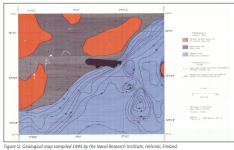
In other words, like myself, they attempted to calculate how much force was exerted when the vessel hit the seabed. They calculate (and these are guys highly qualified in marine matters, unlike myself) that because the stern hit the bottom first, this modified the force of next impact of the starboard side hitting the rock, i.e., the force of the side hitting the seabed was diminished as a result of the stern hitting it first*. In addition, even the JAIC says most of it is lying in a muddy sediment - rather like a yoghurty type substance, with the ear of the ship (upper starboard side) lying against the rocky incline. As you know, it has since moved ten metres or so in the interim.


1765648403573.png

1765648436437.png


* To demonstrate this, try dropping a pencil horizontally, on its side, and then compare and contrast dropping it upright, vertically, and compare the difference in visual and physical impact when it falls to its side.
 
Does it matter if the ship sank stern first, if the stern landed on a silt incline with the consistency of yoghurt? That wouldn't absorb much of the impact, would it?

What proportion of the impact does Lars Ångström the engineer former MP claim that would have absorbed?
 
* To demonstrate this, try dropping a pencil horizontally, on its side, and then compare and contrast dropping it upright, vertically, and compare the difference in visual and physical impact when it falls to its side.
Do they make a 15,000 GT pencil? And what happens when it's full of sea water?

In other words, like myself, they attempted to calculate how much force was exerted when the vessel hit the seabed.
And they're just as bad as you are at this. These are not independent investigators, they are conspiracy oriented. They're no better than the doctors who pop up in the JFK assassination with claims of extra bullets and trajectories.

They calculate (and these are guys highly qualified in marine matters, unlike myself) that because the stern hit the bottom first, this modified the force of next impact of the starboard side hitting the rock, i.e., the force of the side hitting the seabed was diminished as a result of the stern hitting it first*.
And yet they do not attempt to factor in the storm currents effects on the water column or at the bottom, and how this would have influenced the ship all the way down, and in the hours after it landed on the bottom. We know those currents were strong at depth because they pushed the car ramp closed. These "experts" ignored all of that.

In addition, even the JAIC says most of it is lying in a muddy sediment - rather like a yoghurty type substance, with the ear of the ship (upper starboard side) lying against the rocky incline. As you know, it has since moved ten metres or so in the interim.
Yes, and these "experts" do not address why there are no holes where the wreck is in contact with the muddy parts, but only where the rocks are. And yes, it didn't just move, it rolled, further grinding into that rock outcrop, which is obvious in the photos.

This report is nothing more than a CTist smoke screen released ahead of the official report due this coming week (I think).
 
If - and it is a big IF - it was a pre-planned military or quasi-military attack (radio frequencies interference blocking MAYDAYs, EPIRB's inactivated, ship sailing via Sandholm and ending in relatively deep waters, Swedish midnight, military truck seen boarding) then yes, the attack would be on two fronts (check out 'frat boy' Hegseth and his 'no quarters' mindset in Venezualan waters).
This makes no sense at all.

Pete Hegseth had nothing to do with the Estonia attack, so what he says or does is entirely irrelevant. Even that clueless incompetent buffoon isn't so stupid as to be ordering US submarines to try sinking ships in the Caribbean by ramming into them.

Also, the attacks on the Venezuelan boats in the Caribbean are not "on two fronts". The case that's been making the use involves a boat being hit multiple times with missiles, not anything "on two fronts', so the comparison isn't apt in any way.

If for the sake of argument, it was a military attack, then it also doesn't follow that it would be "on two fronts", unless you think that attacking ships via 2 completely different methods (including one as dumb as deliberately crashing a submarine into the target ship) is somehow standard military practice.

What kind of fantasy world do you live in where the Russians (or whoever) would plant demolition charges to knock out the bow visor in order to sink the ship, and also decide to perform something as stupid and reckless as ramming a submarine into the Estonia at the same time?

Planting explosives in multiple places on the ship, timed to go off when no-one involved was on the ship, at least makes some sense if only in a spy thriller movie plot, rather than planting explosives and also crashing a submarine into the ship. Why on earth would any military conceive of such a stupid plan, and then actually carry it out? Who sinks ships by crashing submarines into them, and why? If a submarine WAS involved, wouldn't they just torpedo the ship?

You truly live in a fantasy world if you think such a scenario might have happened.
 
Last edited:
Due to the limitations on presenting and accessing the source material required for the discussion to continue here, I'll confine my wrap-up of the Brandenburg report to the excerpts already presented, under the presumption that they are still allowed.

As I mentioned previously, the entire report suffers the effects of inexpert translation—not just in its pidgin English but in its misapprehension of the technical details of the source material. These kinds of report are generally worded carefully in their native languages because they often will be considered evidence at law and may be tested as such. The present English translation misses the mark by a country mile. The bulk of the report is a technical description of the examinations performed and tables of resulting data, thus fairly unremarkable and nonprobative. However the operative language is in the apparently conclusory statements, some of which have been preserved in our record here. I was able to discuss them with my colleague, a native German-speaking engineer prior to the weekend. In some cases he was able to offer speculative reconstructions of the likely German text and offer other options for translation and expert interpretation.

Returning to the paragraph I excepted, I challenged our claimant to interpret these sentences.
A destruction of the lamellae has occurred which cannot occur by any comparable mechanical technological influence. The processes of explosive treatments of metallic materials as for example explosive hardening and explosive cladding have to be excluded. These processes show in surface-near areas comparable effects.

The phrase, "mechanical technological influence," is almost certainly a strained translation of a specialized German engineering idiom that we would best translate as "manufacturing process." It does not mean simply all conceivable mechanical effects. The mention of explosives here seems like a dog whistle, and the repetition of "comparable" (which may have come from any of several German words) seems to paint the conclusion that the author is here saying the observations are attributable to explosive effects apart from any other possibility. Instead the author is more likely saying that because they know where the specimen came from, they know how it was manufactured and can rule out any manufacturing process (including but not limited to explosive forming) as the cause for what they have observed. The author is not at all saying that the effects cannot be attributed to any purely mechanical process and must therefore be attributed by default to an explosion.

It's not really a nit-pick to say that "surface-near" is a poor translation of oberflächennah. It's unfortunate that English has no single word to succinctly translate to, but making up one is not how conscientious translation proceeds. Words matter, especially when translating something that was specifically worded to begin with.

The next excerpt is one we discussed already in our previous treatment of the Brandenburg report.
These plastic deformations in the micro range do indicate exposure to extremely heavy shock forces such as happens from the effects of a substance detonating.

In the previous discussion it was argued that this language means to dispositively attribute a cause. It expressly does not. It did not then, and it has not suddenly acquired that meaning in the interim. This language—whether in English or German—says merely that an explosion can have caused those effects. It specifically avoids saying it must have caused them. This is a very important distinction that may not simply be brushed aside.

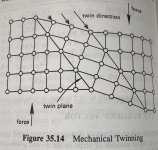
The "plastic deformations" mentioned here are the infamous twinning, which we have discussed at length at least twice previously. Here is the diagram from the engineering license exam study guide.
IMG_5799.jpeg

The statement in the report conveys the wrong impression that twinning is caused exclusively by shock forces that can only be produced by an explosion—or at least that's how some here have tried to interpret it.

That is absolutely untrue.

In fact, when twinning is introduced in metallurgy classes, causes such as explosives aren't even mentioned. High strain rates can cause it. But there are countless ways for high enough strain rates to occur. Ordinary forces applied at extremely low temperatures can cause twinning, but also larger forces at only relatively low temperature—forces consistent with the violent breakup of a ship. That's where our previous discussion of a running shear comes in. Cyclical loading can cause twinning, and we know the specimens came from a part of the ship highly likely to be subject to cyclical loading from waves and from the operation of the bow visor and car ramp. Ordinary fatigue forces can cause twinning, and also the highly localized hardening the laboratory observed.

The Brandenburg authors are not being dishonest for failing to mention these causes. Nor has the translator committed any grave sin in this passage. Their statement is true, but not the whole truth. It is neither dispositive and exclusive. We'll come back to this.

Our final excerpt happens to be the final statement in the summary portion of the report.
It has to be concluded that the pressure waves also in areas, where by means of light microscopes, only little deformation is recognizable, did result in hardening due to structure deformation in the micro range; (deformation of the perlite grain, change of the solidification density).

The highest hardening has been established in way of the immediate fracture area of the specimen being most strongly strained.

For this hardness increase as well as for the determined structure deformations detonative influence is probable.

My colleague offers three or four German words that can all have been translated as "probable." Two of them also embody lesser degrees of certainty, such that we would more accurately translate them as "plausible" or "credible." As you can imagine, the choice of English word here determines much of the question. And our translator has not earned a reputation for accurate word choices. To adopt the common English meaning of "probable" to indicate a likelihood, a comparative analysis must support it. No such comparative analysis appears in the Brandenburg report. The SwRI report indicates that they would be willing to conduct such an investigation for an additional fee. But because the Brandenburg report does not lay out a comparative analysis, "probable" is the wrong word. In keeping with the conservative nature of these reports, "plausible" or "credible" is the better translation.

Now we circle back to the loaded question. I noted that the SwRI report was worded carefully to support the notion that an explosion could have caused the effects they saw, but that it was by no means the only or best explanation. Brian Braidwood took it upon himself to interpret these reports, and we don't have to search very hard in his analysis to find his statements that indeed the labs were not told to perform a comparative analysis of potential causes, but were simply asked to determine whether the damage to the metal could have been caused by an explosion irrespective of any other cause. That is by no means an inappropriate question to ask a metallurgy lab to answer, since a fully comparative analysis is often beyond their scope. But to frame the findings as discriminatory of cause and a dispositive attribution is quite irresponsible. The comparative analysis must be done if a differential diagnosis is to ensue. The labs didn't do it, and Braidwood simply restated the findings of the laboratories misleadingly as dispositive. This is the kind of shuffle we see all the time among proponents of fringe theories.

Properly translated and properly contextualized into the laboratory's remit, the Brandenburg report does not provide evidence that preferentially establishes an explosive detonation as the cause for the damage to the steel specimens.

 
In other words, like myself, they attempted to calculate how much force was exerted when the vessel hit the seabed. They calculate (and these are guys highly qualified in marine matters, unlike myself) that because the stern hit the bottom first, this modified the force of next impact of the starboard side hitting the rock, i.e., the force of the side hitting the seabed was diminished as a result of the stern hitting it first*.
This is misleading. The manner they describe is how literally every ship hits the bottom. Almost none of them hit bottom squarely on the keel, side, or weather deck. Yet we find many examples of wrecks with seabed damage from this form of impact.

* To demonstrate this, try dropping a pencil horizontally, on its side, and then compare and contrast dropping it upright, vertically, and compare the difference in visual and physical impact when it falls to its side.
The kinetic energy is the same in all cases. Dropping a pencil is largely an elastic collision. Ship collisions are overwhelmingly governed by inelastic mechanics. It's a poor example for understand what's happening.

The group here is not wrong when they say that the collision transforms into a moment-arm problem. However, do you have any sort of intuition for the level of guesswork that has to go into such a model? I do. I'm sure their estimate of 30 MJ or so for seabed impact holds for a certain set of assumptions. But when this level of guesswork is required, it is rarely probative for a negative proposition. That is, if you want to support an affirmative proposition you can model the problem and solve it for a range of assumed values. If you can come up with one set of reasonable assumed values, you can say that the model shows the scenario is plausible (even if many different sets of parameters failed). However, you're on very shaky scientific ground if you present a broadly parameterizable model and claim that this proves something is impossible.

Your group goes onto state :—
Between the two holes is a zone that has at least seven separate damages – cracks, dents, flaking, crushed fender structure and overlapping sheet metal – indicating a longer contact course rather than a point impact. The overall pattern – a combination of intruding and extruded sheet metal, shearing, frame breakage and flapping deformations – is typical of a side collision in motion, not of bottom contact.

Sheer bollocks.

And for all its impressive, pretty graphics, the report is still reasoned backwards. The researchers believe they have thoroughly ruled out bottom contact as the cause of the damage, but then they just assume a surface collision as the default that must hold instead. That's utterly irresponsible. They have in no way subjected that hypothesis to any standard of proof. It's a pattern of reasoning that exists only in conspiracy theories. It is not followed by any responsible investigative group.

Further, Kurm seems utterly disinterested in any sort of hypothesis involving explosives. If the evidence for explosives is so strong, why is Kurm completely silent about it?
 
Last edited:
– The energy required to cause this damage on the starboard side is 140–180 megajoules. A bottom contact cannot cause this 22-meter long damage area, it is a physical impossibility, says Lars Ångström, who in addition to having been a member of parliament has also been editor and head of the Fokus Estonia investigation group.
Isn't "having been a member of parliament" a credential on par with "having been a member of the US Congress"?

Because that would suggest his opinions are worth every bit as much as opinions expressed by George Santos, Matt Gaetz, Paul Gosar, Marjorie Taylor Greene, Lauren Bobart, Michele Bachmann, Louie Gohmert, Tim Burchett, Ron Johnson, et cetera et al.

When appealing to the authority of your authorities, you invite examination of their alleged authority, knowledge, and competence in the matter on which they opine.
 
Isn't "having been a member of parliament" a credential on par with "having been a member of the US Congress"?

Because that would suggest his opinions are worth every bit as much as opinions expressed by George Santos, Matt Gaetz, Paul Gosar, Marjorie Taylor Greene, Lauren Bobart, Michele Bachmann, Louie Gohmert, Tim Burchett, Ron Johnson, et cetera et al.

When appealing to the authority of your authorities, you invite examination of their alleged authority, knowledge, and competence in the matter on which they opine.
Members of parliament indeed have no particular expertise on any topic whatsoever. Being elected is nothing more than a popularity contest. To imply such credentials indicate expertise on any aspect of the Estonia sinking is nothing more than a red surströmming.
 

At the press briefing on 16 December 2025 at 15.00 (EET), the Estonian Safety Investigation Bureau (OJK), the Swedish Accident Investigation Authority (SHK) and the Finnish Safety Investigation Authority (OTKES) will present the final report of the Preliminary Assessment of MV ESTONIA.
 
So I listened to the press conference. This is my summary:

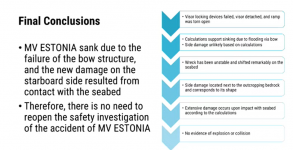
They have calculated/simulated the load on the side plating from Estonia resting on the hard bedrock, and came to the conclusion that it is enough with the Estonia weight to cause the damage, and that the damage matches expectation based on the shape of the bedrock.

They have done a simulation on loading on the Bow visor from the waves, and can visually show loads and when the different part break.

The Bow visor and ramp damage matches this simulation

They’ve looked at the flooding, and can see that the Center casing doors on the car desk were not water tight or weather tight, so small amounts would be leaking down.

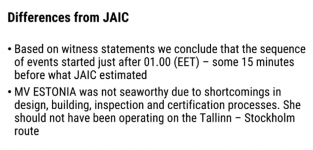
They have simulated 3 scenarios. Bow door open, only a damage to the side, or a combination of the two. The Open bow fits best the actual sinking. Only side damage would not necessarily lead to a sinking.


They have invited all available survivors to be interviewed again. 68 agreed. That includes 1 out of 3 that had not been interviewed before.

Regarding military transports, there are two that claim they saw it, and 9 that disagree. Those 9 were all present at the car deck, or in the harbour at the time.


They’ve tried to find out I the load on the car deck was secured. They come to the conclusion that some lashings were used for cars/trucks, but unclear how much.


They interviewed people that were in the areas of the side damage (deck 1). None of them have information that supports that damage happened before sinking.

The conclusion around the ramp was that it was open during the accident progress, then fell back to closed when Estonia listed. This matches the witness statements.


A witness outside on the SB side when listing started saw no other vessel or collision.

The Stabilizer fins were extended during the trip, but retracted automatically when speed dropped. It is undamaged, so that also confirms that there has not been a collision.


Most witnesses had not read JAIC. They agree with JAIC, but are unhappy with the political decisions afterwards – for example covering the wreck.
1765894325493.png
1765894335980.png
 

Back
Top Bottom