Thanks Akhenaten

I've put that to one side for now until I can get round to doing some more sums regarding speed/TAS and stuff, but may come back to it this afternoon.
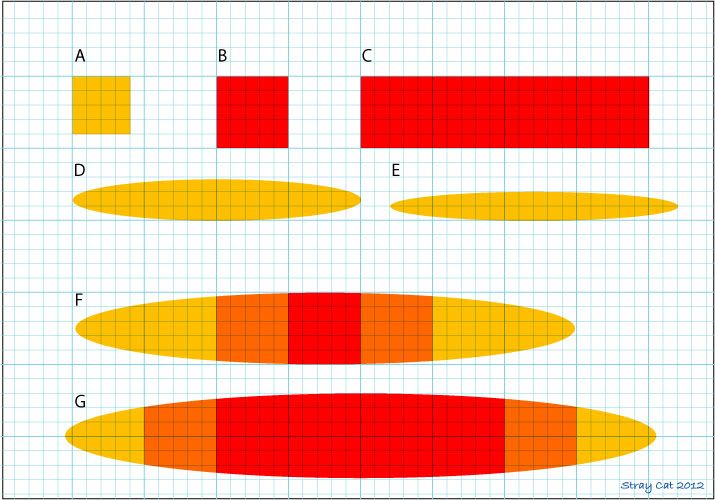
For now, I've been looking at this minimum resolution the human eye can resolve and would like to know from anyone if I'm understanding this correctly. So I've done a helpful diagram to explain it the way I understand it.
Each 5x5 square represents 1 arc minute.
Yellow = Impossible to resolve
Orange = May just be possible to resolve
Red = Can be resolved
A: It is impossible for the eye to see anything that is less than 1 arc minute so anything with an angular size this big can not be seen.
B: This is the absolute smallest unit that can be seen by the human eye (presuming 20/20 vision)
C: An object 4 arc minutes wide would look like this, presuming it was made up of 4 blocks each 1 arc minute square.
D: Sparks calculates the object to have been 4 arc minutes wide and Johnson describes the object as being an ellipse with a dimension between 7:1 and 10:1. If the object is simply 4 arc minutes across and 7:1, it is only 0.54 arc minutes in height and therefore can't be seen because it doesn't fit the criteria of being the minimum 1 arc minute that the eye can see.
E: The same as C only with an ellipse which is 10:1.
F: Using only the 7:1 ellipse (that's the most forgiving one in relation to Sparks' calculations), for anything to be seen the object must have been at least 1 arc minute in height, which makes it a lot wider than 4 arc minutes across. Using Sparks' calculations that an object 4 arc minutes would be 200' wide, we can see that even at it's minimum resolution, the object would be 7 arc minutes across, which would make it 350' wide (31' wider than the wingspan of the Spruce Goose).
G: For the ellipse of 7:1 to be 4 arc minutes wide and still be resolvable by the human eye, each of those arc minutes must be at least 1 arc minute in height. So to get an area within the ellipse that is at least 1 arc minute high for at least 4 arc minutes across we see the shape has to further increase in size to 8.2 arc minutes wide and 1.2 arc minutes high (at it's maximum). Again using Sparks' 4 arc minutes as being 200' wide, the ellipse would have to be over 400' wide to be resolved as a 4 arc minute wide object.
Am I correct with this or am I misunderstanding it?