
You are using an out of date browser. It may not display this or other websites correctly.
You should upgrade or use an alternative browser.
You should upgrade or use an alternative browser.
Split Thread Trump-Kennedy center sues artist for cancelling because of name change
- Thread starter Andy_Ross
- Start date
JayUtah
Penultimate Amazing

Barring any terms that address the specific circumstances, failing to perform a contracted-for service is straightforwardly a material breach.Sure. But it's also plausible that failing to perform will result in a breach of contract. The performer might view that as the better option, but that doesn't magically make it not a breach.
Emily's Cat
Rarely prone to hissy-fits

That's my NAL take on it. I'm under the impression that the performer could potentially sue for reputational damage due to the name change, assuming that can be demonstrated to a reasonable degree. But again... civil law in the US is very confusing to me.Barring any terms that address the specific circumstances, failing to perform a contracted-for service is straightforwardly a material breach.
acbytesla
Penultimate Amazing

- Joined
- Dec 14, 2012
- Messages
- 39,366
I agree with you.The name change of your lender isn't material. You borrowed the money, now you have to pay it. And if your mortgage is like mine, your lender can sell your loan. My question to you is what makes you think this is analogous? Are you saying this also is immaterial? My argument is that it definitely is. It changes the perception of the audience as well as the artist.Actually, Zig didn't say it doesn't matter. Zig said it probably doesn't matter, since the names of the parties on the contract are rarely material to the contract itself. If the parties stay the same, then the name change of one party or the other is almost never material.
My mortgage lender changed their name a couple of years ago. That doesn't allow me to shrug off my mortgage, because the name of the entity with whom I have an agreement isn't material to the contract itself.
There are some situations in which the name of the party *is* material to the contract, but they're not common.
I use to want to buy a Tesla. But now I refuse to. Still a great car, but it's association with Musk makes it toxic not only to me, but other prospective customers. Changing the name of Seattle's MLB stadium had little to no effect. It is simply not the case when your changing the name to a controversial figure. What if they changed the name to Nathan Bedford Forrest or Adolf Hitler Performing Art Center? At what point is a name change material? Is it ever?
JayUtah
Penultimate Amazing
Failing to perform as promised, absent any contractual excuse for not doing so, is a straightforward breach that incurs actual injury. It's a much more wobbly argument to say that you wouldn't have entered into the agreement in the first place had the conditions existed that have now lately been caused by the other party's willful actions. You have to convince a trier of fact that the other party's willful behavior has produced foreseeable consequences that rise to a level that undermines the basic formula of any contract: offer and acceptance. And then if you succeed with that, you have to convince the trier of fact that your "wouldn't've" is sincere and evident enough to compel the venue to bear the injury caused by the breach that you occasioned. Unilaterally withdrawing from a contract is almost always legally dangerous, in my experience."Your honor, I wouldn't have done this if it were different" isn't as strong a legal argument as you might think.
IANAL either, but I've sued and been sued enough times to have an intuition for some of the nuance.That's my NAL take on it. I'm under the impression that the performer could potentially sue for reputational damage due to the name change, assuming that can be demonstrated to a reasonable degree. But again... civil law in the US is very confusing to me.
My contracts are largely business-to-business for the procurement of goods and services. They are unremarkable in the public estimation and only tangentially involve reputational issues. However, a contract to perform as an entertainer at a venue necessarily involves a sharing of reputational value. A venue enhances its reputation among its target audience by engaging performers that will attract that audience. You won't see the Mormon Tabernacle advertising a concert featuring Lil Wayne. Conversely a performer's reputation is affected by the prestige of the venues he performs at in pursuit of his own target audience. Lil Wayne's fans are unlikely to attend a performance at the Mormon Tabernacle, but may flock to venues like a stadium in Los Angeles.
Part of the offer-and-acceptance formula of such a contract is the nature of the venue. When I weighed an offer to perform in a musical concert at the Dorothy Chandler Pavilion in Los Angeles years ago, my grounds for acceptance were predicated in large part on the reputation of the venue. I have no clue who Dorothy Chandler is or was, and I don't care. What mattered to me is that it was a prestigious venue for the kind of music I intended to perform, and I believed that by performing there I would improve my reputation among my colleagues and my intended audience.
A lot of the though experiments here have focused too closely on the name change. If, after the contract was finalized, some rich idiot bought the auditorium and changed its name from the Dorothy Chandler Pavilion to the Aloysius Bonkwomble Hall, it could be argued that no reputational damage occurred. As long as the same kind of entertainment is performed there for the same audience, my interest in the value of the contractual relationship is legally unaltered by the name change. But conversely if the owners of the Dorothy Chandler Pavilion turned it into a bar and grill sponsored by Taco Bell and still expected me to perform there in between monster truck rallies, then the terms of the offer and the calculus of my acceptance will have materially changed. I may indeed suffer damage to my reputation by being compelled to continue to be associated with something whose character has fundamentally changed.
And I would say you're right in that the more advisable thing to do would be to sue for equitable judgment in the form of rescission of the contract. If I just said, "I'm not showing up," then that forces me into a defensive position should the Pavilion wish to sue for my non-performance.
JayUtah
Penultimate Amazing
Back in the early days of my company we proudly contracted with Boeing to provide services to them. We considered it prestigious, as Boeing was at the time a highly reputable company. Now that Boeing's reputation has slid off the runway into the mud, what am I to do? Well, as a matter of fact I simply let our contracts expire years ago and did not renew them. But it raises the question of whether I would have been able to sue to be released from the contracts due to Boeing's failed reputation. The answer, as I understand it, is no. Once you accept a good-faith offer and as long as all the parties maintain their obligations in good faith under the contract, a party's reputation is not per se of consequence. Boeing's evident downfall is not necessarily an intended outcome, therefore all parties to such a contract must weather the ensuing storms.I use to want to buy a Tesla. But now I refuse to.
What I understand to be the operative difference here is in the intent of a party and the foreseeability of the consequences of its actions. If a party acts intentionally in a way that they knew or should have known would diminish the value of the relationship to the other party, then such beclowning may have legal consequences. Sadly those generally want to be spelled out in the contract. It's hard to convince a court of anything that you think a contract should have implied but which wasn't stated. If—Zeus forbid—I should contract conspicuously with the Mormon church for something, and then I expand my business to include the sale of alcohol and naughty LGBT+ underthings, I can expect that they will desire not to have to endure such an association. But for the courts to be of any help to them, the contract would probably have to say something to the effect that I won't do anything to besmirch the reputation of the church. Absent such language, they might have to show that my actions were intended to cause the reputational harm that ensued and were not just the consequence of me wanting to explore new market sectors.
Emily's Cat
Rarely prone to hissy-fits
I'm saying that unless the name of the venue is a material component of the contract, then a change to the name is immaterial to the contract.I agree with you.The name change of your lender isn't material. You borrowed the money, now you have to pay it. And if your mortgage is like mine, your lender can sell your loan. My question to you is what makes you think this is analogous? Are you saying this also is immaterial? My argument is that it definitely is. It changes the perception of the audience as well as the artist.
I honestly don't get this. It's performatively pointless. I swear, some people have convinced themselves that Trump and Musk are the literal antichrists, the evilest evils ever to have eviled the earth, and even being vaguely associated with either of them in any passing fashion will forever tarnish your very soul, it's like distilled original sin and condemns you to burn forever in the pits of hell.I use to want to buy a Tesla. But now I refuse to. Still a great car, but it's association with Musk makes it toxic not only to me, but other prospective customers.
Do you also avoid owning a volkswagen?
As I've said, from the perspective of a contract, it's material when the name is a material aspect of the contract itself - a franchise or use rights come to mind. In this case I suppose it's possible that Redd picked the center specifically because they felt they gained a reputational boost from John F. Kennedy being the name on the door... and if that's the case, then Redd would probably want that to be an aspect of their contract. But I think that's unlikely - it's not the association with JFK that makes it a great and well respected venue; it's the location, the appointments of the venue and systems, and the prestige of the acts who have performed there in the past that made it a desirable venue.Changing the name of Seattle's MLB stadium had little to no effect. It is simply not the case when your changing the name to a controversial figure. What if they changed the name to Nathan Bedford Forrest or Adolf Hitler Performing Art Center? At what point is a name change material? Is it ever?
So like I said, the name change itself is probably not sufficient grounds to void the contract. The Center lost revenue as a result of Redd breaching the contract.
"I don't want to be associated with this venue because you put the name of the evilest evil ever on the building and that makes me sad" is probably not an effective exit clause for the contract. Redd has every right to decline to perform - but in doing so Redd is open to legal action for breach of contract. Perhaps that's a trade-off they find acceptable, and if so fine.
acbytesla
Penultimate Amazing
- Joined
- Dec 14, 2012
- Messages
- 39,366
Do you think such a name change was foreseeable to the artist? Why would he feel it necessary to add such language to the contract for something he was unaware of? It was the memorial JFK Performing Arts Center for what? A half a century? From my perspective, you have changed the nature of the business association. You should have made the other party aware of such a possibility before the contract was agreed upon.What I understand to be the operative difference here is in the intent of a party and the foreseeability of the consequences of its actions. If a party acts intentionally in a way that they knew or should have known would diminish the value of the relationship to the other party, then such beclowning may have legal consequences. Sadly those generally want to be spelled out in the contract. It's hard to convince a court of anything that you think a contract should have implied but which wasn't stated. If—Zeus forbid—I should contract conspicuously with the Mormon church for something, and then I expand my business to include the sale of alcohol and naughty LGBT+ underthings, I can expect that they will desire not to have to endure such an association. But for the courts to be of any help to them, the contract would probably have to say something to the effect that I won't do anything to besmirch the reputation of the church. Absent such language, they might have to show that my actions were intended to cause the reputational harm that ensued and were not just the consequence of me wanting to explore new market sectors.
Emily's Cat
Rarely prone to hissy-fits
Lolololol... that's not how negotiations and contracts work. I mean, I get your desire for such, but "Oh hey, we're in talks with someone else about something completely different... would you like to add an exit clause to your contract about that" is just not something that happens.Do you think such a name change was foreseeable to the artist? Why would he feel it necessary to add such language to the contract for something he was unaware of? It was the memorial JFK Performing Arts Center for what? A half a century? From my perspective, you have changed the nature of the business association. You should have made the other party aware of such a possibility before the contract was agreed upon.
acbytesla
Penultimate Amazing
- Joined
- Dec 14, 2012
- Messages
- 39,366
I disagree.I'm saying that unless the name of the venue is a material component of the contract, then a change to the name is immaterial to the contract.
They're not the evilist. But they are both evil turds. I want absolutely nothing to do with either.I honestly don't get this. It's performatively pointless. I swear, some people have convinced themselves that Trump and Musk are the literal antichrists, the evilest evils ever to have eviled the earth, and even being vaguely associated with either of them in any passing fashion will forever tarnish your very soul, it's like distilled original sin and condemns you to burn forever in the pits of hell.
No, should I?Do you also avoid owning a volkswagen?
I disagree. JFK was a great President and remembered fondly.As I've said, from the perspective of a contract, it's material when the name is a material aspect of the contract itself - a franchise or use rights come to mind. In this case I suppose it's possible that Redd picked the center specifically because they felt they gained a reputational boost from John F. Kennedy being the name on the door... and if that's the case, then Redd would probably want that to be an aspect of their contract. But I think that's unlikely - it's not the association with JFK that makes it a great and well respected venue; it's the location, the appointments of the venue and systems, and the prestige of the acts who have performed there in the past that made it a desirable venue.
Yep. I don't want an association with Hitler, I don't want an association with Stalin. Or Goebbels, or The founder of the KKK. I also don't want one with Putin, Trump or Musk.So like I said, the name change itself is probably not sufficient grounds to void the contract. The Center lost revenue as a result of Redd breaching the contract.
"I don't want to be associated with this venue because you put the name of the evilest evil ever on the building and that makes me sad" is probably not an effective exit clause for the contract. Redd has every right to decline to perform - but in doing so Redd is open to legal action for breach of contract. Perhaps that's a trade-off they find acceptable, and if so fine.
MostlyHarmless
Critical Thinker
- Joined
- Apr 1, 2004
- Messages
- 263
This really makes me wish civil suits had grand juries and nullification!
JayUtah
Penultimate Amazing
No, you're thinking too specifically and concretely. Contract boilerplate generally includes language that requires the parties to do such things as take reasonable care to preserve the respective values of the things that are part of the contract. An argument that alleges a changed reputation of the center would have to be argued to fit into such a category. A person who withdraws unilaterally from a contract under circumstances not covered in the terms is liable for breach. An argument along the lines, "The center behaved in a way that diminished its value for my intended audience, and it should have reasonably foreseen that its actions would have those consequences," would have to be offered up in defense of the performer's obvious breach. It would have been better positioned as an action brought by the performer to rescind the contract.Do you think such a name change was foreseeable to the artist? Why would he feel it necessary to add such language to the contract for something he was unaware of?
That's a can of worms. Hence each party is generally responsible for representing its own interests in the formulation of a contract.You should have made the other party aware of such a possibility before the contract was agreed upon.
By and according to some. But Kennedy's reputation as a President is largely detached from the reputation of the Kennedy Center as a national performance venue. Many countries maintain national venues that are at least partially directed by the national governments. It's considered prestigious to perform in them, regardless of who they're named after. That's the reputation at interest here.I disagree. JFK was a great President and remembered fondly.
theprestige
Penultimate Amazing

As far as I can tell, the allegation isn't breach of contract, but rather loss of revenue.
Emily's Cat
Rarely prone to hissy-fits
So no Paypal for you I guess. Congratulations I suppose. Although I suspect you haven't bothered to dig in deep enough to figure out exactly how many things you need to boycott and have nothing to do with. I'm sure all of your 401-K and investments exclude anything that touches on Musk in any way at all. Yep, very sure you've done the due diligence.I disagree.
They're not the evilist. But they are both evil turds. I want absolutely nothing to do with either.
Um... do you know the history of Volkswagen? If your principles require you to have absolutely nothing to do with evil people, then you definitely should make sure you avoid Volkswagens like they're made of poisonous lava.No, should I?
Meh. JFK was an okay president for the 2 and a half years they were in office. Not the worst president, but a whole lot of the veneration for Kennedy is more a response to their very public assassination than anything else. There's a lot of mythologizing about Kennedy.I disagree. JFK was a great President and remembered fondly.
Again, you should probably look into Volkswagen then. And I assume you deplored Biden for their appreciation and fondness of their mentor and friend, a former leader of the KKK?Yep. I don't want an association with Hitler, I don't want an association with Stalin. Or Goebbels, or The founder of the KKK. I also don't want one with Putin, Trump or Musk.
Emily's Cat
Rarely prone to hissy-fits
Not entirely sure how you separate those two, given that the revenue was lost due to the performer failing to perform in breach of contract... But perhaps there's a legal nuance in there that makes it make sense.As far as I can tell, the allegation isn't breach of contract, but rather loss of revenue.
TragicMonkey
Poisoned Waffles

There's another factor in play, too: PR. Even if Boeing would have the legal right to force your company to honor the contract, it may not want to do so because the story might hit the press. Having the public know that your company thinks Boeing sucks so much it's trying to sue to get out of the contract might be more damaging to Boeing than just letting you out of the contract. They have to consider the future, and other companies they do and will have contracts with.Back in the early days of my company we proudly contracted with Boeing to provide services to them. We considered it prestigious, as Boeing was at the time a highly reputable company. Now that Boeing's reputation has slid off the runway into the mud, what am I to do? Well, as a matter of fact I simply let our contracts expire years ago and did not renew them. But it raises the question of whether I would have been able to sue to be released from the contracts due to Boeing's failed reputation. The answer, as I understand it, is no. Once you accept a good-faith offer and as long as all the parties maintain their obligations in good faith under the contract, a party's reputation is not per se of consequence. Boeing's evident downfall is not necessarily an intended outcome, therefore all parties to such a contract must weather the ensuing storms.
It takes two to tango but if one of them is weeping it really kills the mood and will put off potential dance partners.
theprestige
Penultimate Amazing
It's the "in breach of contract" claim that I'm not seeing in the complaint as reported. They're not saying the contract was breached. They're just saying they're mad the guy didn't show up as expected.Not entirely sure how you separate those two, given that the revenue was lost due to the performer failing to perform in breach of contract... But perhaps there's a legal nuance in there that makes it make sense.
Yes, I know my take is nuanced. On the other hand, there's nothing nuanced about not alleging a breach of contract.
JayUtah
Penultimate Amazing
They're alleging an injury in the form of lost revenue. In order to hold the performer responsible for that injury, they need a theory of liability. The only legally cognizable relationship between the performer and the venue is the contract for services. Therefore any action to hold the performer liable for the injury must arise out of the contract. A breach of that contract is the most likely cause of action. But there may be terms in the contract that oblige the performer to reimburse the venue for lost revenue in the case that the performer fails to perform. That's speculation, but it would be an example of money owed without a breach. A breach-of-contract claim is the most common theory of liability under contracts, and until we see the actual complaint that seems to be the most likely in this case.It's the "in breach of contract" claim that I'm not seeing in the complaint as reported. They're not saying the contract was breached. They're just saying they're mad the guy didn't show up as expected.
Courts rarely order "specific performance" because it's so hard to enforce. Monetary damages are eminently fungible and therefore the common solution. Boeing would be well motivated to settle the dispute for money rather than try to make a reluctant contractor continue to work for them in a most half-assed fashion. And yes, there may be some desire to avoid bad publicity.There's another factor in play, too: PR. Even if Boeing would have the legal right to force your company to honor the contract, it may not want to do so because the story might hit the press. Having the public know that your company thinks Boeing sucks so much it's trying to sue to get out of the contract might be more damaging to Boeing than just letting you out of the contract. They have to consider the future, and other companies they do and will have contracts with.
It takes two to tango but if one of them is weeping it really kills the mood and will put off potential dance partners.
Last edited:
Norman Alexander
Penultimate Amazing

Before we get too deep into yet another Trump-initiated court case, it's worth noting that Trump threatens to sue for millions for every slightest little annoyance that besets him every day. Another court case tossed out - one million! Someone on the internet dissed him - two million! Milk too warm on his Wheaties - a billion!A prayer for relief in an American civil complaint will typically ask for compensatory damages, punitive damages, attorney's costs, and a catch-all award for any other amount the court deems proper. A plaintiff may also pray for equitable relief such as release from a contractual obligation.
The amount of compensatory damages—actual loss incurred—must be supported in court by evidence and thus bear some resemblance to reality. The trier of fact will determine whether that evidence is credible and award an amount consistent with the strength of the evidence and the particulars of the claim.
In jurisdictions and specific cases that allow punitive damages, the plaintiff may ask for any amount and the jury may award any amount. But in general the amount of punitive damages generally may not exceed three times the amount of compensatory damages. The judge may adjust the amount awarded by the jury, but this is infrequent.
By default each party in a suit in America bears its own legal costs. But a prevailing plaintiff may ask for an award of attorney's fees as part of the judgment. A prevailing defendant generally has a higher burden of proof to move for an award of fees from an unsuccessful plaintiff. A prevailing defendant must show that the suit was frivolous or malicious. In the case of a contract dispute, the award of attorney's fees to the prevailing party in a suit arising out of the contract may be one of the terms agreed to in the contract itself.generally this is not done.
As near as I can tell, no lawsuit has actually yet been filed. The center has merely announced its intention to sue, so we don't know exactly in what form the relief is being sought.
theprestige
Penultimate Amazing
I'm certainly one of those who think breach of contract makes the most sense here. What I'm saying is that the complainant doesn't seem to have made that sensible complaint.They're alleging an injury in the form of lost revenue. In order to hold the performer responsible for that injury, they need a theory of liability. The only legally cognizable relationship between the performer and the venue is the contract for services. Therefore any action to hold the performer liable for the injury must arise out of the contract. A breach of that contract is the most likely cause of action. But there may be terms in the contract that oblige the performer to reimburse the venue for lost revenue in the case that the performer fails to perform. That's speculation. A breach-of-contract claim is the most common theory of liability under contracts, and until we see the actual complaint that seems to be the most likely in this case.
Unlike some, I don't automatically assume that Trump and his acolytes will be making the most - or even the only - sensible argument in any given scenario. If they're not alleging breach of contract, I think it's reasonable to suspect they haven't thought of it.
Last edited by a moderator:
dirtywick
Penultimate Amazing

- Joined
- Sep 12, 2006
- Messages
- 10,062
They're not the evilist. But they are both evil turds. I want absolutely nothing to do with either.
it's always funny to me when someone acts like it's some outlandish thing to have a strong dislike for musk and trump. they're pretty ◊◊◊◊◊◊◊ bad people, they've done some bad and some harmful things and some worse things than that, and for one of them looking like he's done some of the worst stuff you can imagine. and on the other hand, neither of them have done many good things.
so yeah, you can act like people disliking those two scumbag rat ◊◊◊◊◊ is some outlandish performance piece, but then i have to ask what's up with you? you like these ◊◊◊◊◊◊◊ guys? lol
acbytesla
Penultimate Amazing
- Joined
- Dec 14, 2012
- Messages
- 39,366
I find it doubly amusing when Trump on a minute by minute basis says the worst things about others. Not to mention a river of threats.it's always funny to me when someone acts like it's some outlandish thing to have a strong dislike for musk and trump. they're pretty ◊◊◊◊◊◊◊ bad people, they've done some bad and some harmful things and some worse things than that, and for one of them looking like he's done some of the worst stuff you can imagine. and on the other hand, neither of them have done many good things.
so yeah, you can act like people disliking those two scumbag rat ◊◊◊◊◊ is some outlandish performance piece, but then i have to ask what's up with you? you like these ◊◊◊◊◊◊◊ guys? lol
a_unique_person
Director of Hatcheries and Conditioning

Why don't they just get someone else like Kid Rock to do the gig.As far as I can tell, the allegation isn't breach of contract, but rather loss of revenue.
I think the loss of revenue is required to be there as evidence of material damage.
Ziggurat
Penultimate Amazing

- Joined
- Jun 19, 2003
- Messages
- 61,528
Who's going to tell him?No, should I?
...
Yep. I don't want an association with Hitler
Ziggurat
Penultimate Amazing
- Joined
- Jun 19, 2003
- Messages
- 61,528
Because he backed out the day before, making such a swap basically impossible.Why don't they just get someone else like Kid Rock to do the gig.
That's not the only possible claim to damage. Any money spent in prep for the cancelled performance might also be claimable, for example. Might not get them to a million, but wouldn't be nothing.I think the loss of revenue is required to be there as evidence of material damage.
theprestige
Penultimate Amazing
Seems like the court will be asked to decide whether Trump Derangement Syndrome indemnfies contracted parties from breach of contract.
Trausti
Master Poster

- Joined
- Apr 4, 2023
- Messages
- 2,379
There might also be a liquidated/damage clause in the contract in the event of breach.That's not the only possible claim to damage. Any money spent in prep for the cancelled performance might also be claimable, for example. Might not get them to a million, but wouldn't be nothing.
Ziggurat
Penultimate Amazing
- Joined
- Jun 19, 2003
- Messages
- 61,528
If a trial is held in DC, they might decide "yes".Seems like the court will be asked to decide whether Trump Derangement Syndrome indemnfies contracted parties from breach of contract.
acbytesla
Penultimate Amazing
- Joined
- Dec 14, 2012
- Messages
- 39,366
Are you talking WW2 Germany? Seems to me the country forgave and even rebuilt Germany. The Berlin Airlift was a mistake? We even made them an important ally and created airbases there. Should I also not have purchased a Krups Espresso machine? Or use T-Mobile wireless?Who's going to tell him?
W.D.Clinger
Philosopher

If Redd argues that the change of name had the effect of changing the institution's reputation, and the center counters by saying the name change enhanced the center's reputation, then factual evidence concerning the change's reputational effect would become fair game for discovery, would it not?And that's where the center's behavior may have stepped into material breach, which is unrelated to the formalism of a name change. Merely changing the name has no legal consequence as long as it is merely the name by which the contracted entity is publicly known. But if the change of name also changes something material such as the institution's reputation, then it can be one example of any number of such behaviors that may provide grounds to exit a contract.
According to the center's correspondence, adding Donald Trump's name enhanced the center's reputation. However, if by doing so the center concedes that the name change affected the center's reputation as a matter of intent, then it loses the ability to enforce the contract under the premise that the name-change was neutral. Then it devolves to the basic principle of material breach, whereby the other party can say it would not have entered into the contract under the conditions following the breach.
Evidence concerning the amount of that loss would also be relevant during discovery, I would think.As far as I can tell, the allegation isn't breach of contract, but rather loss of revenue.
So far as I know, no lawsuit has yet been filed. If and when Grenell starts to consider the information he and the center would have to provide during discovery, I suspect this lawsuit will just evaporate.
a_unique_person
Director of Hatcheries and Conditioning
The concert would have been cancelled anyway because Jazz is DEI.
Regnad Kcin
Penultimate Amazing

Go ahead and sue the performers. Any damages they may end up determined liable for will be Go-Fund-Me raised in about 13 minutes.
TellyKNeasuss
Illuminator
- Joined
- Oct 4, 2006
- Messages
- 3,776
Based on what the Kennedy Center posted on its Facebook page, I would think that performers would now have a solid case for being able to cancel performances based on the Kennedy Center driving away potential ticket buyers:
Under previous management, the Trump Kennedy Center functioned less as a national cultural hub than as a patronage mill for a narrow ideological circle—lavish salaries, cushy contracts, and pet projects rewarding friends and allies while the building itself literally fell apart.
TellyKNeasuss
Illuminator
- Joined
- Oct 4, 2006
- Messages
- 3,776
In most cases, yes, they would still be expected to honor the contract.
They could probably sue the counterparty for reputational damage or something, but that's an entirely different process. At the end of the day, unless the name of the party to the contract is directly material to the contract itself, a change in the name of the party doesn't void the contract. It's remotely possible that some aspect of the contract provided cancellation rights to the performer that the name change would trigger - but as Zig said, that's a matter for the lawyers to figure out and is specific to the contract in question.
So you're saying that a performer would not have the right to cancel a performance even if the venue took an action (e.g., changed its name to something controversial) that decreased the performer's ability to sell tickets?
W.D.Clinger
Philosopher
The New York Times (probably paywalled) is reporting other recent cancellations of performances that were to have taken place at the Kennedy Center:
I look forward to Grenell filing court documents that insist the Kennedy Center's reputation would be damaged if far-left political activists don't perform there.
- the Cookers (two performances previous scheduled for New Year's Eve)
- Kristy Lee (free performance previously scheduled for 14 January)
- Doug Varone and Dancers (two performances previously scheduled for April)
I look forward to Grenell filing court documents that insist the Kennedy Center's reputation would be damaged if far-left political activists don't perform there.
acbytesla
Penultimate Amazing
- Joined
- Dec 14, 2012
- Messages
- 39,366
It went from a Performing Art Center honoring an assassinated President and War Hero to one honoring the current living President. Convicted felon, and confessed sexual assaulter of women, a known grifter and suspected pedophile.
We're so proud.
We're so proud.
Norman Alexander
Penultimate Amazing
Here, let me help you.Seems like the court will be asked to decide whether Trump Derangement Syndromeindemnfies contracted parties from breach of contractexists.
Norman Alexander
Penultimate Amazing
Is that what they had on their official FB page??Based on what the Kennedy Center posted on its Facebook page, I would think that performers would now have a solid case for being able to cancel performances based on the Kennedy Center driving away potential ticket buyers:Under previous management, the Trump Kennedy Center functioned less as a national cultural hub than as a patronage mill for a narrow ideological circle—lavish salaries, cushy contracts, and pet projects rewarding friends and allies while the building itself literally fell apart.
 See, I don't venture into that hive of scum and villainy any more. And that sort of descriptor is hardly likely to encourage existing artists to stay, nor new ones to engage. Ditto patrons, donors and attendees.
That is more like out-of-control teenagers on spring break sending out a tweet to the gang: "Hey guys! Party our place! Mom and Dad always kept this place so clean! They're such squares! They're gonna be so pissed when they get back after they see what we are gonna do to it! It'll be hilarious! YAY!! PARTAY! WOO!"
arthwollipot
Observer of Phenomena, Pronouns: he/him

I am on the wretched hive of scum and villainy so that you don't have to be.Is that what they had on their official FB page??
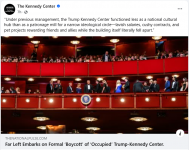
Now my Facebook algorithm is going to be poisoned with rightist crap.

Link to full article https://www.nytimes.com/2025/12/29/...e_code=1.AlA.hWta.px4lx4-fbbre&smid=url-shareThe New York Times (probably paywalled) is reporting other recent cancellations of performances that were to have taken place at the Kennedy Center:
A few hours ago, Richard Grenell, who styles himself as "President" of something called "The Donald J. Trump and John F. Kennedy Memorial Center for the Performing Arts", said these are “far-left political activists” whose performances had been booked by previous leadership.
- the Cookers (two performances previous scheduled for New Year's Eve)
- Kristy Lee (free performance previously scheduled for 14 January)
- Doug Varone and Dancers (two performances previously scheduled for April)
I look forward to Grenell filing court documents that insist the Kennedy Center's reputation would be damaged if far-left political activists don't perform there.