• Quick note - the problem with Youtube videos not embedding on the forum appears to have been fixed, thanks to ZiprHead. If you do still see problems let me know.

Electric Vehicles

Status
Not open for further replies.
No brake pads? So total regenerative braking?
Pretty much. Mechanical brakes are only used when braking hard, coming to a complete stop or when the battery is fully charged and can't take any more (another reason to not not charge fully, especially if you start off going downhill!).

According to Elon Musk, the brake pads on a Tesla literally never need to be replaced for the lifetime of the car. In reality some Tesla owners have reported over 200,000 miles on original brake pads. That's effectively forever for someone like me who does less than 3000 miles per year.
 
I hope those lifetime-pad Teslas have some kind of mechanism to keep the brakes from rusting up. Ordinary disk brakes can get very ineffective with age and disuse. It's one of the problems in cars with four wheel disk brakes, because the rears get relatively so little wear. The rotors glaze over and the pads stick.

Of course this can be gotten around with good design and maintenance, but I suspect it could become a problem. People tend to neglect their brakes until something awful happens.

I think there are plenty of situations where an electric car makes sense, even though there are others where it does not, but it will be a little while before it's a practical only car out here in the country. As a second car for grocery getting and the like, though, it will make sense when the price gets down nearer to that of a gas powered econobox, and a few more charging possibilities emerge.
 
I don't buy it... Even if you got full power for 10 Solar hours a day during mid summer you're topping off at 3 Kwh a day... During the winter, you're looking at most 3 to 4 solar hours a day maybe getting 1 Kwh if that.
It depends on how much sun you get. You also have to factor in that the Lightyear One only uses 83Wh/km (my Leaf uses ~150Wh/km).

And frankly even during mid summer I'm lucky to ever top 200 watts. That's because unlike a home installation you can't really tilt your panels toward the sun. They're fixed flat. During the winter, it's close to useless.
200W * 5 hours is 1kWh. 1kWh / 83Wh = 12km (7.5 miles). I did the sums and figured that in my location I would probably get less than 10 miles range per day. But I usually drive less than 5 miles per day so most of the time it would be enough.

OTOH I have a garage and wouldn't want to leave my nice new EV out in the weather, so the Lightyear One is not for me...
 
I hope those lifetime-pad Teslas have some kind of mechanism to keep the brakes from rusting up...

Of course this can be gotten around with good design and maintenance, but I suspect it could become a problem.
Yes, it could be a problem. The more important factor with EV brakes may be age rather than use. But either way you should expect much longer lifespan than in a typical gas car.

I think there are plenty of situations where an electric car makes sense, even though there are others where it does not, but it will be a little while before it's a practical only car out here in the country.
If you live so far 'out in the country' that an EV doesn't provide enough range then no, it would not be suitable. But you would be in a very small minority of car owners. And that's OK, we don't expect it to suit everyone - just like no single gas vehicle fits all.

it will make sense when the price gets down nearer to that of a gas powered econobox, and a few more charging possibilities emerge.
There are plenty of charging 'possibilities' already in most places, and as more people get EVs they will get more numerous. But if you don't need super fast charging then you just need a connection to the electrical grid and you have a 'charging station' - just bring your own charging cable and plug it in!
 
There are plenty of charging 'possibilities' already in most places, and as more people get EVs they will get more numerous. But if you don't need super fast charging then you just need a connection to the electrical grid and you have a 'charging station' - just bring your own charging cable and plug it in!

I don't know where you live, but 'charging possibilities' in a typical UK residential street are far from numerous, in fact you'd be hard pressed to find any at all. Most houses don't have an integral garage and you can't just run an extension cable out across the pavement/sidewalk to your car.

Charging stations at public car parks might sound plausible, but in the UK they're mostly 'pay for' and chock-a-block at the best of times. Also that wouldn't be much use if the nearest is half a mile away. Free supermarket car parks? They're generally 'no overnight stay' and often out of town. Nah, it'll be far from easy to install widespread EV charging facilities in many countries.

eta: And, of course, a lot of people live in flats, so even the extension cable plan wouldn't work.
 
Last edited:
The thing is we must address these problems if they are ever going to be solved. And once we make the commitment, we begin to find better and cheaper ways to address them.
Simply because we have to.
They issues are being addressed, e.g. Battery 2030 et cetera. New chemistries, more ubiquitous charging points, on-the-go charging...
 
Ok, I don't really know much about the details of electric vehicles. I accept that stopping for a charge would merely add several hours to my day.
No, it wouldn't. As has been pointed out.
 
So due to the unprecedented Covid situation, you had to drive 400km to a far way airport, then turn straight around and drive back home again? A 500 mile round trip with only 5 minutes break in the middle, and so unpleasant that you couldn't stand staying any longer? That's your example of how an electric vehicle would 'add several hours to my day'?
Also airports are excellent places to find charging point, usually a goodly number.
 
I don't know where you live, but 'charging possibilities' in a typical UK residential street are far from numerous, in fact you'd be hard pressed to find any at all. Most houses don't have an integral garage and you can't just run an extension cable out across the pavement/sidewalk to your car.

True, but for many people the charging requirements aren't that onerous. A 200 mile range covers a week's motoring for most people.

For commuters an alternative to charging at home could be charging at work (if there's a works car park) or at the station (if commuting by rail). I spend 30-45 minutes a week at the supermarket which would be plenty of time to recharge if there was a rapid charger there.

Nearly 55% of new cars in Norway are electric vehicles. Maybe we could look to Norway so see how their urban charging network scales to demand.
 
While I had a 25-mile commute each way, I drove a hybrid. I think it wound up quite economical for me, and if I still did that I would have looked into all-electric when I wound up replacing it last month.

However, my drives are very short now, so paying the extra for hybrid or electric would take a lot longer to pay off and I'm less certain the math adds up, especially since I am getting decent mileage anyway. It also means the reduction in my emissions is smaller, so the stakes seem lower as a green choice. That's probably not gone as a concern, and once it falls into a more practical window I'll happily switch.
 
Like it's already been said, it's a chicken vs egg situation when it comes to EV infrastructure.

It's very impractical right now to own an electric car unless you have a home with a garage or carport that has electricity available. That cuts out huge parts of the commuting population that don't have garages.

In the greater Boston metro area, you have to be pretty far out from the urban core or have some serious money to be buying a home that has this kind of setup. For many, street parking or simple paved, uncovered lots are the norm.

My Corolla only gets about 300 miles on a single tank of gas (approx 10 gallons), and my commute means I only have to fill it every 7ish days. I can't remember the last time I drove a trip that was long enough to exceed a single tank of gas or would exceed the range of an electric vehicle, excluding when I drove my car cross country during a move.

An electric vehicle would be perfect for my needs, but I have no means to charge it while it's parked behind my apartment, and I park it at a simple paved lot outside my workplace.

I suppose I could drive it to a quick charge station every few days, but the real convenience of an electric vehicle is to be able to charge it at home or work while parked.

Teslas are popular as luxury cars, which makes sense, because the people spending big bucks on a car are also probably the same people with a house and garage in the suburbs to charge it, or can pay the big bucks for a garage spot in the city that has charging outlets. Even if there were a cheaper EV available, it's going to be a major hassle for the average commuter who doesn't have access to these amenities at home or work to keep it charged.
 
Last edited:
Quick plug for plug-in hybrids as a transitional step to all-electric.

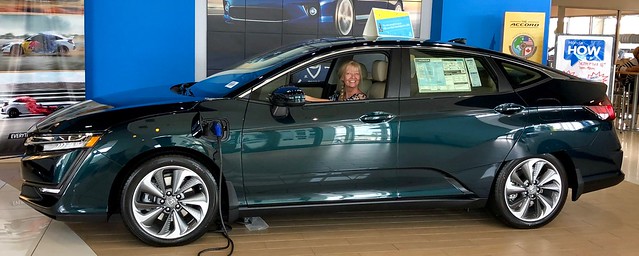
We bought a new Honda Clarity in 2018. Base model was $31,500, but 2018 was the one year when we could benefit from the $7,500 federal tax credit, so the net $24,000 cost was pretty reasonable for a new sedan of this class.

42503164170_77f2a5a2d5_z.jpg


We can go between 32 and 52 miles before the gas engine comes into play - cold temps and heater use really kill the EV range. Still, many, many local trips are all EV, those that aren’t have just a few gas miles tacked on at the end of a drive. The fuel economy is about 42 mpg, which is not bad at all for a car this size. It only has a 7 gallon gas tank, so fill ups are refreshingly cheap when they are needed. The car has performed quite well on several highway trips where recharging was not available enroute. So far about 45,000 trouble free miles.

Charging is slow with the provided 120v charger - about 4 miles per hour of charge. Still, our M.O. is overnight charging, so we’re always at a full charge in the morning. Stock charger handles 240v, which we have available at home, which slightly more than doubles the charge rate to about 10 miles per hour. Still, handy if a mid-day charge is called for. Proper Level 2 chargers can charge a lot faster, but to date we haven’t seen a need.

As an aside, depending on gas prices and electric rates, there is a point where running on gas is actually cheaper. That point generally hovers around $2/gal, again depending on electric rates in your area. Ours in E TN are relatively cheap, a vestige of the TVA projects of the 1930’s, I think.

But clearly the hybrids are transitional. Pure EV is the future. We have a $100 deposit on a Cybertruck, and hope by the time it delivers our 66 shares of Tesla stock will pay for it!

 
Last edited:
According to Elon Musk, the brake pads on a Tesla literally never need to be replaced for the lifetime of the car. In reality some Tesla owners have reported over 200,000 miles on original brake pads. That's effectively forever for someone like me who does less than 3000 miles per year.
Hey now, some of us plan on seeing in the twenty-second century.


OTOH I have a garage and wouldn't want to leave my nice new EV out in the weather, so the Lightyear One is not for me...
PVC on the roof?
 
I don't know where you live, but 'charging possibilities' in a typical UK residential street are far from numerous, in fact you'd be hard pressed to find any at all. Most houses don't have an integral garage and you can't just run an extension cable out across the pavement/sidewalk to your car.

Charging stations at public car parks might sound plausible, but in the UK they're mostly 'pay for' and chock-a-block at the best of times. Also that wouldn't be much use if the nearest is half a mile away. Free supermarket car parks? They're generally 'no overnight stay' and often out of town. Nah, it'll be far from easy to install widespread EV charging facilities in many countries.

eta: And, of course, a lot of people live in flats, so even the extension cable plan wouldn't work.
Curious. In suburban Dublin where I live I've seen at least a dozen driveway charging points for private vehicles and there are at least as many on-street points within walking distance. Both nearby shopping centres, neither particularly large, have several. One has installed a bank of four points close to the exist specifically for over-night use. The newer apartment building with car parks have charging points and the multi-story has them on every level.

In the city centre they're obiquitous, especially in the Digital Docklands area. Most office car parks have them too. In fact I know of none of my usual clients, mostly IT/tech, who don't provide the. My nominal employer put them in two years ago and also rents a section of their ground level exterior parking space to a by-the-hour hire company which has six bays for their EVs.
All four hospitals that I've visited in the last year or so have charging point, one has four (free) points outside on the street.
 
True, but for many people the charging requirements aren't that onerous. A 200 mile range covers a week's motoring for most people.

For commuters an alternative to charging at home could be charging at work (if there's a works car park) or at the station (if commuting by rail). I spend 30-45 minutes a week at the supermarket which would be plenty of time to recharge if there was a rapid charger there.

Nearly 55% of new cars in Norway are electric vehicles. Maybe we could look to Norway so see how their urban charging network scales to demand.
This seems to be the logical way forward and indeed is being done here.
 
True, but for many people the charging requirements aren't that onerous. A 200 mile range covers a week's motoring for most people.

For commuters an alternative to charging at home could be charging at work (if there's a works car park) or at the station (if commuting by rail). I spend 30-45 minutes a week at the supermarket which would be plenty of time to recharge if there was a rapid charger there.

Nearly 55% of new cars in Norway are electric vehicles. Maybe we could look to Norway so see how their urban charging network scales to demand.

Who pays for the electricity at all these semi-public charging stations? Is it billed to the consumer or is it just offered as an amenity by the businesses that operate the parking lot?
 
Here in the Knoxville, TN outskirts, charging stations are as rare a hen’s teeth. There are two at a local Whole Foods, but I haven’t gotten them to work with our car.

Just a few miles from us, however, is Melton Hill Dam. They have a total of four free charging stations as a showcase for alternative energy - in this case, solar. We’ve only used it a few times, but it’s a nice service, regardless.

47500410441_1b087bfd5c_z.jpg
 
Who pays for the electricity at all these semi-public charging stations? Is it billed to the consumer or is it just offered as an amenity by the businesses that operate the parking lot?

It depends.

In the UK, Some are free of charge, most are part of one of several national charging companies. As a driver you have an account with one or more of them and as part of that account you have an agreed cost per kwh.

Tesla and their Superchargers is one such national network as are Ecotricity, Polar and so on.....
 
Here in the Knoxville, TN outskirts, charging stations are as rare a hen’s teeth. There are two at a local Whole Foods, but I haven’t gotten them to work with our car.

Just a few miles from us, however, is Melton Hill Dam. They have a total of four free charging stations as a showcase for alternative energy - in this case, solar. We’ve only used it a few times, but it’s a nice service, regardless.

[qimg]https://live.staticflickr.com/7893/47500410441_1b087bfd5c_z.jpg[/qimg]

Are charging plugs not standardized? Seems like a major impediment to widespread adoption.
 
Status
Not open for further replies.

Back
Top Bottom