• Quick note - the problem with Youtube videos not embedding on the forum appears to have been fixed, thanks to ZiprHead. If you do still see problems let me know.

Bad ideas in war

The replacement for the Constellation class seems pretty rubbish too
 
The replacement for the Constellation class seems pretty rubbish too
It's pretty amazing how the USN has managed to screw up something as simple, important, and low-cost as a new class of frigates. Even buying the base design from someone else who's already figured it out seems beyond them.

For this reason alone, I'm not optimistic about them trying their hands at a new battleship class.

That said, I'm not convinced that a modern take on the battleship is a bad idea in principle. I do have concerns about the propriety of pitting a battleship against shore batteries in an artillery duel, though.
 
The RN are building a Frigate design that seems popular, at least two other countries are going for it.
Maybe the US could join the team
 
That said, I'm not convinced that a modern take on the battleship is a bad idea in principle. I do have concerns about the propriety of pitting a battleship against shore batteries in an artillery duel, though.
I agree with the previous parts of this post but wanted to expand on this part.

It seems to want to be everything except for a submarine and an aircraft carrier. But the pitting it against shore batteries is symptomatic, I think. A lot of its weapons are short range. Then it has some that are supposedly intended to be able to reach anywhere on Earth. Why put those together? I'm also unsure what capability the ability to carry a V22 gives to such a vessel? Wouldn't an assault ship do that better? Yes some helicopter and drone capability is vital, and I guess special forces might be able to use one but a 35,000t ship seems a very expensive taxi for such a niche role. It shouldn't have to perform the roles of a whole task force. It should probably be the lead vessel where a carrier is not appropriate, or possibly, like the fast battleships in the Pacific at the end of WWII l, as specialist air defence for a carrier group. But one reason they had that role was because they were already built and it was the best use of existing resources, and if they weren't there, other, cheaper ships would have to have been built for that role.
 
The RN are building a Frigate design that seems popular, at least two other countries are going for it.
Maybe the US could join the team
Hollow laugh.

But yes there are at least 3 appropriate modern frigate designs that would be better (four including the Constellation class)
 
I agree with the previous parts of this post but wanted to expand on this part.

It seems to want to be everything except for a submarine and an aircraft carrier. But the pitting it against shore batteries is symptomatic, I think. A lot of its weapons are short range. Then it has some that are supposedly intended to be able to reach anywhere on Earth. Why put those together? I'm also unsure what capability the ability to carry a V22 gives to such a vessel? Wouldn't an assault ship do that better? Yes some helicopter and drone capability is vital, and I guess special forces might be able to use one but a 35,000t ship seems a very expensive taxi for such a niche role. It shouldn't have to perform the roles of a whole task force. It should probably be the lead vessel where a carrier is not appropriate, or possibly, like the fast battleships in the Pacific at the end of WWII l, as specialist air defence for a carrier group. But one reason they had that role was because they were already built and it was the best use of existing resources, and if they weren't there, other, cheaper ships would have to have been built for that role.
Yeah, that's about where I'm at.
 
The RN are building a Frigate design that seems popular, at least two other countries are going for it.
Maybe the US could join the team
And then customize it to have less than 25% commonality, give the contract you a company owned by one of Trump's buddies, and cancel it after spending billions for nothing.
 
Hollow laugh.

But yes there are at least 3 appropriate modern frigate designs that would be better (four including the Constellation class)
Face it, the UK alone has two frigate designs that would be better, the type 31 and the type 26. Both of which have been exported at some level
 
Bad idea in war? Multiple missions for the win. Conflicting missions, like "defeat the penguin navy" AND "teach them polar bears a lesson!"
See also Battle of Midway. Original idea was to lure the US fleet out and destroy it. Then they got it into their heads they actually try to capture the place, which they had no use for or ability to sustain.
 
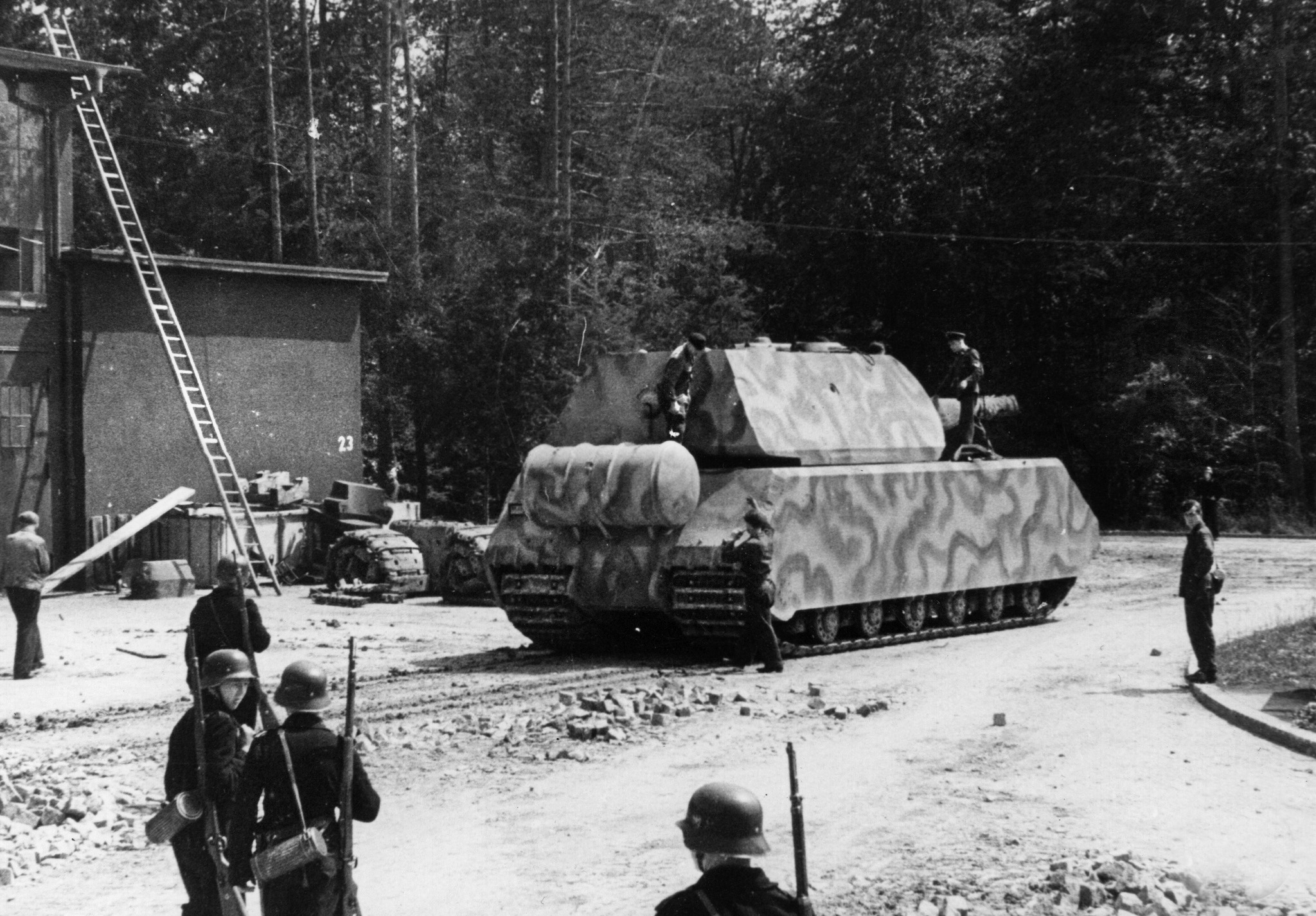
The Chieftain only partially agrees that the Maus was a folly as first proposed.
The Germans wanted to jump ahead in the 'size war' All sides were producing and designing bigger tanks and better anti tank guns.
But as usual they pushed it too far.
See also their plans for giant bombers and transport aircraft.
 
The whole idea of having three four classes of ships that all have the same role bugs me. Frigates, destroyers, cruisers, and battleships all used to have distinct roles. But two things have changed that paradigm forever. One is the advent of air power and the attendant aircraft carrier.

The other is the steady advance of technology, that has made it possible for a single ship to fulfill several roles at the same time. We saw the same evolution with armor. All the various kinds of tanks coalesced into a single concept that brought all the most important aspects together in a perfect form: the main battle tank. And we saw the same evolution with fighter jets. All the day fighters, night fighters, all-weather fighters, interceptors, and even tactical bombers coalesced into a single multi-role fighter-bomber platform.

And it's happened to warships, too. A modern surface combatant (i.e., not a carrier, not a submarine, and not some other kind highly specialized vessel like a minesweeper) has four basic roles, all having to do with the defense of the group:
  • Air defense, manifesting as powerful air search and track radars, and a battery of air defense missiles.
  • Anti-submarine warfare, manifesting as a hangar, one or two helicopters suitable for sonar and torpedo work, and perhaps a magazine of torpedoes on the ship itself.
  • Surface combat, manifesting as a deck gun and anti-ship missiles.
  • Land attack, also the deck gun, plus cruise missiles.
Notice that some of the weapons themselves can be multi-role to a certain extent.

Anyway, my view is that there's no point in building anything on the frigate-battleship spectrum that does not fulfill all four of these roles. There's only one real ship in this multi-role, "picket" category. For my convenience, I'll call it the destroyer. Firstly because the destroyer was originally conceived to screen capital from submarines. Over time, it came to be the screening class for the entire spectrum of threats against the group, same role, same name, makes sense to me. Secondly because the destroyer was the first type to become fully multi-role. Thirdly, because compared to WW2 classes, modern destroyers are often cruisers by tonnage, and battleships by firepower.

So nowadays, they're all destroyers. The only real question is how big do you want to build your destroyers. Do you want a baby "frigate" hull, with small magazines and limited ability to perform each of its roles? Sure, if that's consistent with your doctrine and budget. Or maybe you want vast arsenal, "battleship" hulls, capable of screening a carrier group for weeks on end. Maybe you want a mix. A few battleships as group leaders, lots of destroyers to fill out the ranks, and maybe some frigates as lightweight/low-intensity patrol boats.

But really, they're all just different sizes of destroyer. Which is why the Navy's desire for a new battleship class rankles. It's just a larger destroyer. And while I'm pretty sure a destroyer that's too small is useless in all roles, I'm not convinced that making really big destroyers is better than making medium-sized destroyers.
 
See also Battle of Midway. Original idea was to lure the US fleet out and destroy it. Then they got it into their heads they actually try to capture the place, which they had no use for or ability to sustain.
The occupation was never considered practical, too deep in "Indian Country" for the IJN. They hail mary'd the invasion on the basis of "let's see what happens." (I base that on reading I did while doing my Master's at Purdue. Fairly certain the pertinent tomes are still on the shelves there, not having moved since they were reshelved after that paper was done.)
 
Destroyers were originally designed to destroy torpedo boats then go on to torpedo attack enemy capital ships themselves.

By the 1st world war as well as a defensive role they started to take in an independent offensive role and between the wars grew in size to overlap with the smaller light Cruisers taking on some of rhe cruiser scouting roles.

Cruisers split in to two types
Heavy cruisers were designed to be long range, long endurance ships that protected trade routes. Light Cruisers scouted for the capital ships, attacked enemy scouting Cruisers and Destroyers and could deliver torpedo attacks against enemy capital ships.
Their scouting roles more or less vanished with the advent of Radar

Frigates evolved from convoy escorts and anti submarine ships.
As Destroyers grew in size and speed they were, with their hull forms adapted to high speed for delivering torpedo and fun attacks, not ideal for escort work where long endurance and sea keeping were more optimal.
This lead to a number of different ship types of varying size and capabilities, variously named as Corvettes, Frigates, Sloops and Destroyer Escorts.

As WW2 progressed the various types became more standardised and post war were sll just named as as Frigates.
Their main difference from Destroyers post war is they are optimised more for anti submarine work then offensive surface action.

Post war Destroyers grew in size and occupied the place previously taken by the Cruiser. The 1960s built RN County class Destroyers are the first example of this Not only being the size of a light Cruiser but also taking names traditionally given to Cruisers.

All ships can't be good in all roles unless they start to get big
There's still an important place for ships with specialisations. Anti submarine escorts are the obvious example.

Sorry if that's a bit of a ramble.
 
Anti submarine escorts are a waste of tonnage, fuel, personnel etc. if all they can do is screen for subs. Single-role surface combatants have been obsolete since the advent of the aircraft carrier.
 
Anti submarine escorts are a waste of tonnage, fuel, personnel etc. if all they can do is screen for subs. Single-role surface combatants have been obsolete since the advent of the aircraft carrier.
They are not if they have a significantly better chance of detecting a submarine that would otherwise sink your aircraft carrier.

Video on this. Unsurprisingly saying a lot of what @Andy_Ross said but with a bit more historical context.

 
As Destroyers grew in size and speed they were, with their hull forms adapted to high speed for delivering torpedo and fun attacks...
"People must not do things for fun. We are not here for fun. There is no reference to fun in any Act of Parliament." - Light LCJ in R v Haddock (1935) Herbert's Uncommon Law 24 at 28.
 
As for specialised AS escorts.
A general purpose ship is fine but you have to make compromises to fit everything aboard.
That's why more specialised Frigates still exist.
A full range of AS sensors and weapons on a Destroyer would push the displacement up even further.
One of the reasons the RN are good at Frigates is that for decades with NATO their job was to protect the North Atlantic convoy routes from Russian subs.
 
As for specialised AS escorts.
A general purpose ship is fine but you have to make compromises to fit everything aboard.
That's why more specialised Frigates still exist.
A full range of AS sensors and weapons on a Destroyer would push the displacement up even further.
One of the reasons the RN are good at Frigates is that for decades with NATO their job was to protect the North Atlantic convoy routes from Russian subs.
And, as well as that I can imagine differences between the optimisations for air defence and anti submarine vessels. For example, being as quiet as possible for hunting submarines or carrying a load of VLS cells and other anti aircraft weapons. If that affects your hull shape and makes it less optimal for submarine hunting, then it's not great.

And then there's the fact that you might even want several different types of frigate for slightly different types of mission.
 
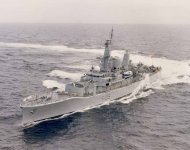
When I was in the RN they were all classed as General Purpose, although the Type 81 'Tribals' designed in the early 60s were the only ones that were really GP. They had been designed to be deployed 'East of Suez' and were expected to fulfil a number of roles.
With that in mind they were the first RN ships designed with a helicopter hanger and flight deck and a supplementary gas turbine engine for 'quick starts' and bursts of speed.
They were also the last ships with open gun turrets as they weren't fully NBC hardened. Also two singles fore and aft instead of a single twin mount.
First 'major' warship with a gas turbine engine, they were used as a try out for the County Class Destroyers just being laid down.
My first ship was a Tribal.

1767355838006.jpeg

Frigates designed for deployment in the Atlantic were optimised for AS work, they had extensive sensor fits and variable depth sonar as well as trailed sonar cable arrays. They still had two 4.5 inch guns and Seacat launchers for AA defence and deck tubes for AS homing torpedoes, the awesome 'Limbo' triple barreled AS mortars and helicopter launched AS torpedoes.
The helicopters could also carry gun packs, anti ship missiles and nuclear depth charges (Special Weapons as they were known)
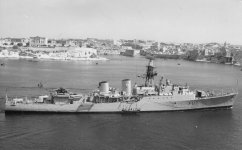
The first 'modern' AS Frigates were the Type 12 Whitby Class, With lessons learned from the helicopters aboard the Tribals an improved Type 12 was built with big hangers and flight decks.
Some of the Whitby Class were rebuilt to this type, the modified ships were the Rothesay Class.
Also the hulls were optimised for working in winter storms, large raised bows and fo'c'sle deck to keep them dry.
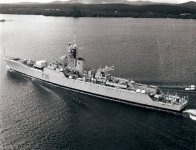
Leanders were the final versions of this type, 'Improved' Type 12s more than 30 were built for the RN, Australia and The Netherlands. They had flush decks and a completely enclosed Citadel for NBC protection.
In to the 80s some had the guns replaced by Exocet launchers or Australian 'Ikara' anti submarine systems, these were rocket powered drones tha dropped an AS torpedo.
Probably the best AS ships in service up until the RN Type 23s came in to service.
I spent several years on Leanders.

Whitby Class
1767357245511.jpeg

Rothesay Class
1767357373412.jpeg

Leanders
Gun
1767357521848.jpeg

Exocet
1767357647923.jpeg

Ikara
1767357722461.jpeg
 
This was my 'office'
Australian Leander HMAS Parramatta last gun shoot before paying off.
I can still smell it.

I did this for real in the South Atlantic.

 
Last edited:
There used to be a specialist Aircraft Direction and Radar Picket Frigates.
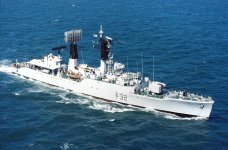
The Type 61 Salisbury Class. the size of radar systems in WW2 meant that Escorts, Destroyers and even Light Cruisers couldn't carry a full suite of long range air warning, surface warning, gun direction and aircraft direction systems without losing something else.
A specialized ship was needed and Destroyers had weapons stripped away to add radars to extend the range of coverage for a task force.
The Salisbury class were laid down in the 50s as dedicated radar ships.
As radar systems became more compact most were cancelled or finished as Type 12s but 4 were commissioned and served in to the late 70s.
They ended up modernised as command and control ships with the double stacked long range Type 965 radar (AKE-2) radar (the big one) and Type 982M radar for a degree of 3D cover and better air control over land. (the smaller one aft)
They had extensive communications, control rooms and extra accommodation.

1767368929835.jpeg
 
Anti submarine escorts are a waste of tonnage, fuel, personnel etc. if all they can do is screen for subs. Single-role surface combatants have been obsolete since the advent of the aircraft carrier.
That is, on the face of it, not true. Frigates and corvettes*** only appeared after the advent of aircraft carriers, during or just before WW2. These were vessels that had almost completely only one role: seek and destroy submarines, with surface guns really only good enough to outclass a surfaced sub. The USN called our frigates destroyer escorts, and the RN had a class of ships (Hunt-Class) they termed escort-destroyer designed before WW2, that was roughly the same concept.

*** in the steam ship era, the class types names being borrowed from the age of sail
 
Last edited:

Back
Top Bottom