• Quick note - the problem with Youtube videos not embedding on the forum appears to have been fixed, thanks to ZiprHead. If you do still see problems let me know.

A scientific fact/tidbit you recently learned that you thought was interesting

It's apparently the apparent lengths that chage.
And also, as I said in the other thread, nothing to do with aging or apoptosis, which are when the telomeres actually lose nucleotides off the end when the cell replicates. So yes, definitely interesting, but completely irrelevant in the context in which it was brought up.
 
Black mould thriving at radiation in Tchernobyl:

The mysterious black fungus from Chernobyl that may eat radiation

It appears that melanin can protect organisms from radiation, and this black mould is even attracted to radiation, and is now growing inside the reactor rooms, a behaviour termed 'radiotropism'.


There is also speculation about fungi being able to gain energy from radiation:

All of this stuff is not very recent, and I apologise if it has already been brought here, but I find it interesting enough to repeat!
Nit pick about headlines, what does that even mean to eat radiation? Don't plants all eat radiation, sort of?
 
Nit pick about headlines, what does that even mean to eat radiation? Don't plants all eat radiation, sort of?
Fungus is not a plant. It is something that lives off plants. Plants absorb radiaton of certain frequencies, but not radiation caused by the radioactive decay of elements.
 
Nit pick about headlines, what does that even mean to eat radiation? Don't plants all eat radiation, sort of?
Fungi are evolutionary much closer to animals than plants.

Plants contain the remnants of bacteria (related to blue green algae found in the sea), it is these bacterial remnants that can capture the energy from light allowing photosynthetic synthesis to occur; carbon dioxide is combined with water to make glucose and oxygen. The latter is a highly toxic gas, the build up of this gas in the atmosphere led to a terrible ecological disaster many years ago, leading to the extinction of many species.

 
Fungus is not a plant. It is something that lives off plants. Plants absorb radiaton of certain frequencies, but not radiation caused by the radioactive decay of elements.
I think the hypothesis is that melatonin can capture the energy from radiation (the article is unclear as to the type of radiation). The fungi can use the energy for some unclear metabolic process giving them some type of evolutionary advantage. The observation seems to be that melatonin producing species are more radiation tolerant. Radiation produces toxic effects by generating reactive oxygen species (why oxygen is toxic), melatonin is an anti-oxidant so may protect against radiation toxicity, a simpler explanation.
 
(the article is unclear as to the type of radiation)
From what I've been able to find out, the contamination would mostly be beta and gamma radiation from Caesium-137 and beta radiation from Strontium-90.

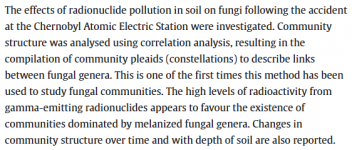
The actual paper describing the fungus is of course on an Elsevier site and therefore paywalled. If anyone has access via an institution, I'd be interested in seeing it. However, the abstract that I can view for free says this (screenshot):

1764583268254.png

So - the answer to your question appears to be gamma radiation aka high-energy photons.
 
A quick search with refseek found some hits. It looks like the fungi absorb the radioactive material
On my phone and don’t have the Unpaywall plugin. I find refseek way better than google scholar nowadays

 
I was not saying fungus are plants, I was complaining about the headline, using plants as an example of things that "eat radiation". This fungus really just seems tolerant to radiation.

Particularly the first article did nothing to substantiate the notion that the fungus was getting energy from the radiation. It could also just be that it is more tolerant than the competition so thriving due to the lack of competition. And still, what exactly does it mean to eat radiation. Like I said, is it doing something like chlorophyll in plants or something else? I think my tolerance hypothesis is more likely to be honest.
 
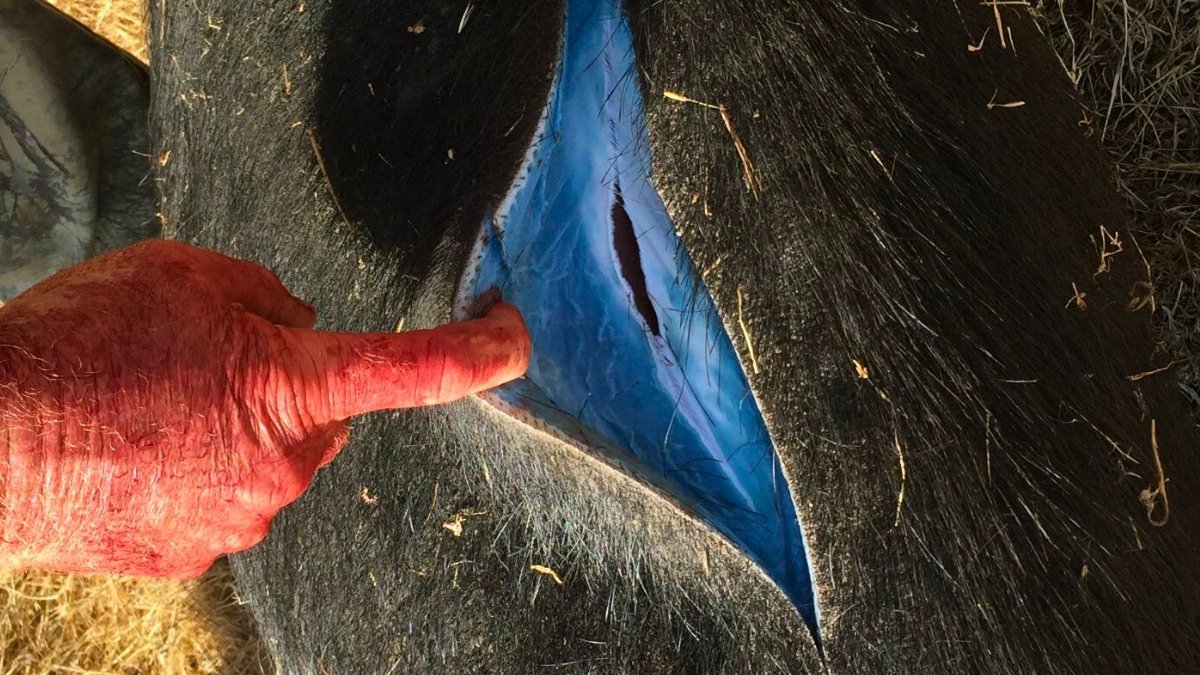
plenty of MAGA folk already have blue mouths from drinking hospital sanitizer fluid, they will probably pay extra for Blue Meat.
 
A very interesting video (from PBS Space Time) about the revolution in physics (quantum mechanics) that happened 100 years ago, in 1925:


2025 is … was the international year of quantum science and technology. Yes because quantum tech is increasingly important, but especially because quantum mechanics was invented 100 years ago this year. In 1925, our strangest true theory went from being a peculiar set of ideas to describe some funny results from experiments, to a full-blown theoretical framework that overturned how we think reality really works. So today, as the centenary year approaches its end I want to take you on a little journey through what may be the most paradigm-destroying several months in scientific history.
 
Last edited:
I haven't watched the video yet, but I was fascinated when I started learning to play an instrument at about 40 years old. I wanted to know why things were the way they are and learned a lot about music theory. I eventually made my own transposing wheels (which I later found out are available in several different forms, in abundance.)
 
I was a little bit suspicious at first about the heavy use of AI-generated imagery, but the content of the video was sound.

Yes, I used a pun. Deal with it.
 
Actually the video does not fully answer the question. We could equally have 16 notes in an octive. The main reason we cannot is that so much music has been written with the 12 notes.
 
Actually the video does not fully answer the question. We could equally have 16 notes in an octive. The main reason we
cannot is that so much music has been written with the 12 notes.
I think it does cover that. Not "cannot", but "do not". He explains that using more notes would make notation much more difficult but yes, it's not going to change now.
We've actually got 21 notes - the tonic, and the sharp and flat of each. Of course, many of those double up as being the same frequency.
 
Under equal temperament, D# is the same as Eb, but under other temperaments, it isn't.
Music notation must be, along with that of sub atomic particles, be the most unfriendly thing for noobs to fathom.
Either you are some musical specialist, or it is just some kind of secret code, you can't understand. There is no in between.:oops:

In other words.
Pretending (well there's no pretending, as it is actually true) that my knowledge of music is what I've learned at highschool and that there are 7 notes; do re mi fa sol la si (and then it starts again, but a bit higher in tone), and that I know that you can play notes of longer and shorter duration.

Could you explain in English please? :)
 
Music notation must be, along with that of sub atomic particles, be the most unfriendly thing for noobs to fathom.
Either you are some musical specialist, or it is just some kind of secret code, you can't understand. There is no in between.:oops:

In other words.
Pretending (well there's no pretending, as it is actually true) that my knowledge of music is what I've learned at highschool and that there are 7 notes; do re mi fa sol la si (and then it starts again, but a bit higher in tone), and that I know that you can play notes of longer and shorter duration.

Could you explain in English please? :)
Well, the linked video goes into pretty good detail in plain English. I really don't know that I could do a better job of it. But here goes:

Do-Re-Mi is what is called a diatonic scale. You have seven notes before the first one repeats in a higher register. The top and the bottom are both called Do because the higher one is double the frequency of the lower one. They sound like the same note - if you play the two together there is no harmony, there is just one note. It's called an octave because there are eight notes in a diatonic scale.

However, there are notes between the Do-Re-Mi. There's a note halfway between Do and Re. Do-and-a-half if you like. For this reason we will be swapping to the traditional letters to refer to the notes. Don't ask why it starts at C. (quick answer: it doesn't always)

Do = C (a deer, a female deer)
Re = D (a drop of golden sun)
Mi = E (a name I call myself)
Fa = F (a long long way to run)
So = G (a needle pulling thread)
La = A (a note to follow So (cop out!))
Ti = B (a drink with jam and bread)
Do = C' (an octave higher)

The note halfway between C and D is either C sharp or D flat. Sharp means a half-step up, and we use the hash symbol for it: #. So C# is C-sharp and is halfway between C and D. Flat means a half-step down, and we use a special symbol that is approximated in text by a lower case b. So Db is half way between D and C. So in fact there are more than 8 notes. For reasons that are complicated, E# = F and Fb = E. Similarly, B# = C and Cb = B. You'll need to accept that without explanation - it just is. So this means that there are in fact 12 notes in the scale.

Now, in Equal Temperament, which was only widely adopted in the 18th century, the frequency of C# is exactly halfway between C and D. So C# = Db always. In previous systems of tuning, this was not the case.

Remember how I said you shouldn't ask why it starts at C? Okay, now you can ask. Starting at C means you are in the key of C, but you can be in other keys. This means that while the intervals (distances) between notes are the same, you start at a different note. So this is Do-Re-Mi in D. Notice that you can only get the same intervals by using sharps. In the key of D it is traditional to use sharps and not flats.

Do = D
Re = E
Mi = F#
Fa = G
So = A
La = B
Ti = C#
Do = D'

Being in the key of D means that most (but not all) of the notes you will be playing come from this scale. If I were going to be precise, this is the key of D major, but that's not important right now. Know that there is also a D minor, in which the intervals between the notes are not the same.

Prior to Equal Temperament, an instrument was tuned so that this particular key was most harmonious, at the expense of other keys not being harmonious at all. If you wanted to play in a different key, you had to retune your instrument. Not particularly difficult for wind instruments, tedious and time consuming for stringed instruments, and all but impossible for keyboard instruments. Under these systems (and there were a variety of them) C# was not the same as Db.

J.S. Bach's 1722 collection The Well-Tempered Clavier was in essence a demonstration of how under Equal Temperament, a single instrument could play in all keys. It consists of a prelude and a fugue (those are musical structures or forms) in each of the major and minor keys, so 24 preludes-and-fugues all together. And then there are two books so in fact it's 48. It's beautiful - I recommend it.

 
Last edited:
Well, the linked video goes into pretty good detail in plain English. I really don't know that I could do a better job of it. But here goes:

Do-Re-Mi is what is called a diatonic scale. You have seven notes before the first one repeats in a higher register. The top and the bottom are both called Do because the higher one is double the frequency of the lower one. They sound like the same note - if you play the two together there is no harmony, there is just one note. It's called an octave because there are eight notes in a diatonic scale.

<snipped>
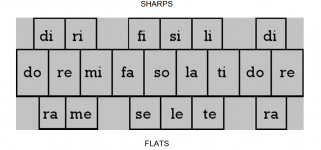
All that took me years to learn, but then I never had it explained so concisely. Everybody knows Do-Re-Mi, but far fewer know the interstitial Solfege names. Here's a full chart (The standard major scale is in the middle line, sharps above, and flats below their related notes):
Screenshot 2025-12-18 205201.png
One of the things that most confused me at first was, why are there no "extra" notes between B and C, and between E and F? (Note: those are the "missing" black keys on a piano.) I'm still not completely sure I know, but being aware of the different gaps or steps helped a lot.
Studying jazz and improv books, I'm move familiar with the Roman notations, I-IV-V progressions, and modes, and so on. Perhaps Solfege is more common in Europe and elsewhere?
But then, I encounter trumpet players in my own band that have been playing 50 years or more that don't know that their Concert B-flat is actually a C for their instrument's notation. I.E., when he plays a C, the note is actually a B-flat when played on a piano or other "concert" instrument.
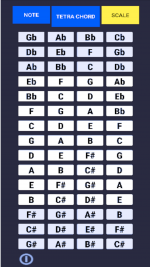
I even made an app where you can choose to play notes, chords (tetrachords), and scales. I'm really proud of it but had basically zero downloads. It's no longer available.
tcm screenshot.png
 
Last edited:

Back
Top Bottom