• Quick note - the problem with Youtube videos not embedding on the forum appears to have been fixed, thanks to ZiprHead. If you do still see problems let me know.

A scientific fact/tidbit you recently learned that you thought was interesting

I have found it difficult to find a single article that goes through the explanation properly, which is still non-technical enough to be readable. I've read quite a number of articles to put it all together.

The article that Pixel linked to gives a good account of Darwin's mistake. He was a relatively young man, just home from the voyage on the Beagle, and in the process of formulating his thoughts on the origin of species. He had become enamoured of a theory of "tectonic uplift", which posited that the continents were rising and falling with respect to sea level, in equilibrium and in balance. This theory, for reasons I don't quite understand, was at that time important to his theory of the origin of species, and he was looking for confirmatory evidence. He heard about Glen Roy, and thought this was the evidence he needed. He developed a hypothesis whereby Glen Roy (and the adjacent Glen Gloy and Glean Spean) had at one time been below sea level, and the "roads" were evidence of three shorelines that had formed at different times as the land rose out of the ocean. He put this together in a paper which he presented to the Royal Society, and it was this piece of work (which was complete nonsense) that got him his membership of the society.

Ironically, by the time he came on the scene in 1838, the real explanation had already been worked out by a couple of people, with a rich amateur naturalist by the name of Lauder getting very close to the answer. Earlier in the 19th century the idea that these were sea shores had already been considered and tossed out, for a number of very good reasons.
  • there were no sea shells anywhere in the glen, not on the "roads" or on the bottom
  • the "roads" are confined to Glen Roy, Glen Gloy and Glen Spean, without a dicky-bird to be found in, say, Glen Loy or the slopes overlooking Loch Eil or Loch Arkaig, never mind anywhere else in the country
  • the lines perfectly follow the contour lines, suggesting almost supernatural preservation of the contours of the landscape even as it rose a thousand feet out of the ocean
  • the roads are vertically narrow, inconsistent with tidal shorelines, or even ocean breakers
  • there was no explanation for the very precise heights of 355, 350, 325 and 260 metres forming these shorelines in different places as the land rose (why no 325 or 260 lines in Glen Gloy, why no 325 or 350 lines in Glen Spean?)
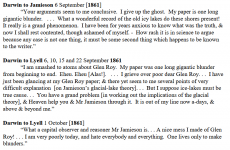
And I've probably missed some. It was a crashingly dumb idea. The competing theory was obviously much better, with only a couple of details still a bit in the air, but Darwin persisted, handwaving away these objections - which were urged on him by a number of people - and hammering away at the couple of minor points that still weren't wholly explained by the loch-shore theory. Some of this intransigence was probably explained by his adherence to the tectonic uplift theory (which I'm told by a lady about 10 years older than me was still being taught when she was at school), and some by his reluctance to give up on the hypothesis that had got him into the Royal Society.

Some years later, when his evolving theory of the origin of species no longer relied on the tectonic uplift theory, and when the most puzzling aspect of the loch-shore theory was finally elucidated beyond any doubt, he gave in, describing his adherence to the seashore theory as his "greatest blunder".
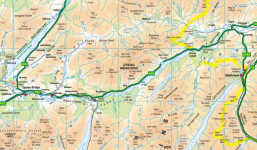
 
The real explanation, as originally advanced by Lauder and another local man called McCulloch, was that there had at one time been a natural dam across Glen Spean, which had prevented the water from that glen and the glens opening into it (principally Glen Gloy and Glen Roy, but Loch Treig and the Coire Làire also feature). If Glen Spean is dammed at about the level of the modern town of Spean Bridge (famous for the Thomas Telford bridge over the strikingly deep gorge of the fairly small River Spean), then the water falling into these glens can't flow out into the Great Glen and so to the Atlantic. Instead the only way out is over the Great Watershed, the spine of Scotland, into the upper waters of the River Spey, which is east-flowing and eventually flows out into the North Sea.

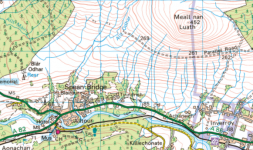
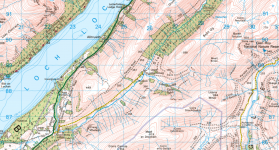
Here is a relatively small-scale map of the area in question.

1763227785782.png

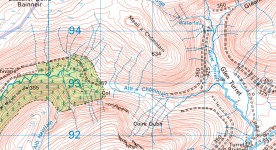
Glen Spean runs right across the middle, and everything in there flows down the River Spean, past Spean Bridge, into the River Lochy just south-west of Loch Lochy. Now imagine a dam across that lot at the level of Spean Bridge, also extending northwards to dam the entrance to Glen Gloy. This snip shows the northern side of the 260-metre shoreline petering out on the hillside about 200 metres above Spean Bridge, and that's believed to be the eastern end of the ice dam at the time when that shoreline formed.

1763234328957.png

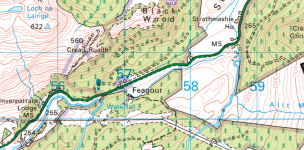
With that dam in place, the water backs up and backs up until it reaches the point named on the first map as Strath Mashie, over to the east. That is the watershed, and at that point it is at 260 metres. Larger scale map of that area.

1763228217549.png

It's a wee bit complicated (the other cols are easier), but the River Pattack, bottom left, which becomes the River Spean on the other side of Loch Spean, curls round and flows to the west, while the River Mashie on the right flows northwards at this point to join the east-flowing River Spey. You can see a couple of spot heights bottom left, 254 and 255 metres, and the watershed itself (which doesn't have a spot height marked) is at 260 metres.

This explains the 260-metre shore which is the lowest of the three(?) in Glen Roy and which can also be seen intermittently in Glen Spean and at the entrance to both Loch Treig and the Coire Làire. There was a huge loch with its surface at 260 metres encompassing both Glen Roy and Glen Spean.
 
Last edited:
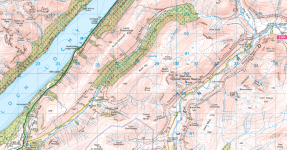
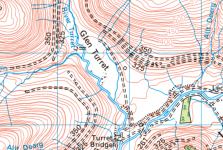
What about Glen Gloy, which doesn't flow out into Glen Spean, but goes straight into Loch Lochy in the Great Glen, and has no 260-metre shore, only a single shore right up at 355 metres? Here is Glen Gloy, and the upper part of Glen Roy, at a somewhat larger scale than the main map.

1763228971292.png

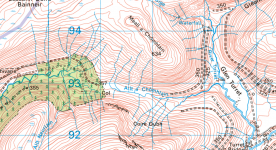
You can see the south-west ends of the single 355-metre road towards the bottom left of the map, helpfully plotted by the OS boffins. That glen has been dammed at that point to a height that prevented any water flowing out to Loch Lochy. What happened? The glen filled up until it reached the level of the next-highest outflow point, which in this case was the col between it and Glen Turret, in the top right of that snip. Here it is at a larger scale.

1763229390848.png

You can see the upper ends of the 355-metre shore, marked on the map at 355 and 357 metres. (The higher reaches of the southerly one seem to have been lost to the forestry plantation.) The 357 metre spot height is probably the col itself rather than the shoreline. The 350-metre contour line makes a V on both sides of the col, one just under where the 357 mark is printed, and the other some little way to the west, whereas the 360-metre line goes right across. The col is at 355 metres. (OK maybe 357 metres, let's not get too hung up on that.)

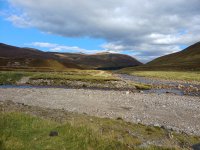
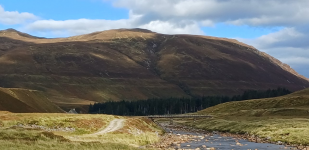
With the outflow to Loch Lochy blocked, there was a "Loch Gloy" with its surface at 355 metres, and its only outflow was what is now the Allt a' Chòmhlain, flowing down into the River Turret. I noticed when I cycled up to Turret Bridge, the far extent of the tarmaced road, that there were huge banks of silt over to my left, swept down by a river far greater than the burn that's there now, for a period of over 500 years.

20250926_151109.jpg

That river didn't get very far though, because the River Turret at that point is running at about 260 metres, and in those days almost immediately entered the head of the 260-metre "Loch Roy".
 
Last edited:
Important question, what dammed the glens? Ice, obviously. A glacier or two was the principle thinking, although I'm not sure that is exactly right. This all happened at a time when Scotland was cold enough for ice that remained all year round, and it was a huge wall of ice ending at the level of Spean Bridge (initially) that dammed the outflow rivers.

Close enough, but in fact not quite like that. You can see that Glen Roy itself is a glaciated valley, with steep sides and a flat floor and a meandering river and the odd hanging valley (I think). That's how it would have been during the great Ice Age, the glen full of ice, part of the ice cap that covered the entire country, with the ice forming a glacier that slowly shuffled its way towards the (equally iced-up) Great Glen. How does that square with the formation of the "roads"? This was part of Darwin's objection to the theory, and I'm not quite sure (I need to read up on more of the detail here) just when it was discovered that the formation of the shorelines post-dates the main Ice Age by a few thousand years.

"Peak Ice" in Scotland is believed to have occurred about 22,000 years ago. At that point the country was uninhabited and uninhabitable. Antarctica on steroids. After that the ice retreated and plants and animals began to re-colonise the landscape. The earliest record yet found of human habitation in Scotland is from 14,000 years ago, in an archaeological dig at Biggar, only about ten miles from where I live.

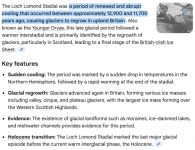
However, there was a later "little ice age" after that, something known as the "Loch Lomond stadial".

1763233152847.png

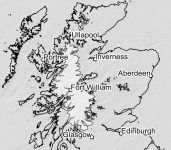
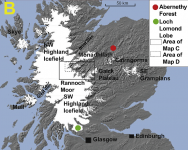
Here is a diagram of the maximum extent of the ice cap that formed during that 1,200-year period, taken from https://www.antarcticglaciers.org/g...-loch-lomond-stadial/the-loch-lomond-stadial/

1763233303326.png

It's slightly obscured by the word "Fort", but the eastern end of that ice cap is at the level of Spean Bridge.

So it wasn't precisely a glacier as such that dammed the river, it was the eastern edge of that ice cap. Glen Gloy, Glen Roy and Glen Spean were only involved in the ice cap at their lower ends, the upper parts of all three glens remained unglaciated - although it's accepted that the surfaces of the lochs that formed would of course have frozen in the winter, contributing to the erosion that formed the shorelines.

Knowing that, it becomes easier to understand how the two higher shorelines formed in Glen Roy.
 
Last edited:
The 350-metre line, the highest one, was quite easy to figure out, and Lauder got there well before Darwin even appeared on the scene. He hypothesised that the ice dam had advanced north-eastwards until it blocked the outflow from Glen (Loch) Roy into Glen (Loch) Spean. Block that, and the water is going to rise until it gets to the height of the next outflow point. The 350-metre outflow point wasn't difficult to find. Look again at the first map I posted, the one covering the entire area, and follow the River Roy all the way up to its source almost contiguous with the source of the River Spey, just above little Loch Spey. That again is the Great Watershed, the spine of Scotland. In effect, blocking Glen Roy at its outflow to Glen Spean forces Loch Roy to do the same as Loch Gloy did - flow out at the head of the glen, to the north-east and into the next glen.

So, once the ice had advanced enough to block the Glen Spean outflow, the water in Loch Roy rose to the level of that col, which, you guessed it, is 350 metres.

1763235280623.png

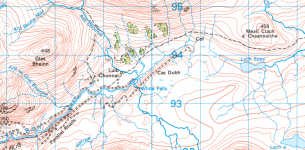
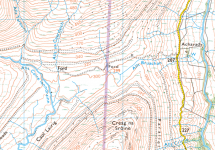
This map shows the headwaters of both the River Roy (left) and the
Edited by jimbob: 
River Spey (edited as requested)
(right). The "parallel roads" can be seen marked on the map at the 350 metre level, ending on both sides shortly before the col (there are interesting horse-shoe shapes shown, several on the north and one on the south side). The 350-metre contour line forms the classic V-shape on the Loch Spey side, and is a bit more irregular on the River Roy side. Again the 360-metre contour line crosses the gap. All we can say is that here, as with the Glen Gloy/Glen Turret col, the watershed level is over 350 metres and under 360 metres, but it's agreed that the Glen Gloy/Glen Turret col is about five metres higher than the Glen Roy/Glen Spey one, and they're nominally shown as 350 and 355 metres respectively. (Originally McCulloch thought that both the Glen Gloy road and the highest Glen Roy road were at the same level, but Lauder figured out that Glen Gloy was slightly higher.)

If we go back to one of the maps a couple of posts back (reproduced again for convenience), at this stage, with Loch Gloy at 355 metres and Loch Roy at 350 metres, the two must have been almost contiguous, with only a very short river joining them.

1763235885406.png

This was as far as Lauder got before Darwin came on the scene and shoved his oar in. He was pretty close to having figured the entire thing out (although he didn't know about the Loch Lomond stadial). The only two points still at issue were first, where did this ice dam come from and where did it go? A melting glacier leaves huge moraines to show where it has been, and Glen Spean is notably short of obvious big piles of gravel all over the place. And second, explain the 325 metre shoreline! You can't! Got you there! Obviously you're entirely wrong, and the tectonic uplift theory is right. Darwin wrote a lot about it, though he visited the glen rather infrequently. He did look for seashells, but like everyone else, drew a complete blank. That didn't stop him though.

Lauder had his answers, one of which in fact turned to be right on the nail, although the other one was dodgy to say the least.

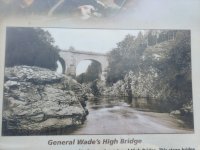
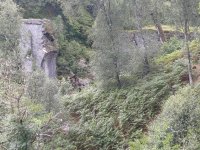
Why are there no clearly visible moraines in Glen Spean? It is actually obvious when you think about it. Moraines form when a glacier gradually melts back to nothing, and the stones and rocks it carries are deposited where they stand. But the ice dam at Spean Bridge couldn't possibly have melted gradually away to nothing. It was holding back an enormous weight of water, a huge loch filling Glen Spean and Glen Roy. As the climate warmed and the ice grew gradually weaker, there would come a point when it could no longer contain that mass of water. One very fine day, and it was going to collapse very suddenly and very completely. (And what a spectacle that must have been, if there was anyone there to see it.) The entire contents of that massive loch would have flooded abruptly and catastrophically down the lower reaches of Glenn Spean, taking all the stones and rocks from the melting ice dam with it, and carving that spectacularly deep gorge between Spean Bridge and the River Lochy, through which the River Spean flows today. (Got to get in a picture of High Bridge here, although that's an entirely different story of colonisation, military occupation and attempted genocide.)

20250713_160301.jpg

20250713_155943.jpg

In 1861 Thomas Jamieson, another amateur geologist, studied this aspect in more detail, in the light of more modern understanding of the behaviour of glaciers, and found evidence of scratched bedrock and moraines in Glen Spean that confirmed this was exactly what had happened.

But rewind a bit from that to the other anomaly, the 325-metre shoreline. This was the biggest sticking-point for Darwin.

Lauder's best stab at that was to postulate that there had been a time in the glaciated period when the upper level of the ice dam was held stable at 325 metres, and the water from Loch Roy flowed over the top of the dam, which was long enough for a shoreline to have formed at that level. I don't think he was all that convinced by that himself, but it was the best he could come up with. It was by now an article of faith that there was no 325-metre outflow, so what was left? Darwin wasn't convinced.
 
Last edited by a moderator:
The non-identification of the 325-metre col is a matter of amazement to me, and to pretty much everyone who has studied the subject. The mystery was solved seven years after Darwin first got involved the controversy, by David Milne, yet another gentleman amateur geologist. He originally went to Glen Roy convinced that Darwin was right, but after taking a much closer look at the landscape than Darwin ever did, ended up by confirming the loch-shore theory, and he FOUND THE 325-METRE OUTFLOW.

Now if I'd been Lauder, I'd have walked the 325-metre (OK, 1,068-feet) contour line right round that glen with my own bloody feet. But he didn't, and surveying wasn't as advanced then as it became later, and I think there was a mix-up going on as well. If you look at Glen Gloy, it has a dead-end arm called Glen Fintaig, which is almost irrelevant to the story.

1763238733789.png

The col between Glen Fintaig and Glen Roy is at 515 metres, which is way too high to have acted as a spillway in any of this, and you can see the 355-metre Glen Gloy shoreline going right round the corrie at the head of the glen. Nothing to see here folks. However (and this is just my speculation based on the fact that McCulloch was calling Gleann Glas Dhoire "Glen Fintaig" by mistake), it may be that some people got a bit confused between Glen Fintaig and a glen in roughly the same relation to Glen Roy.

1763239074367.png

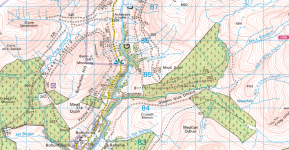
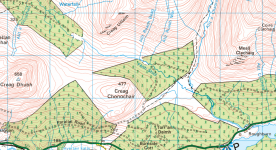
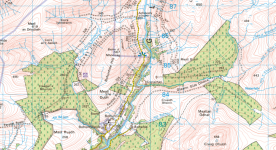
This is Gleann Glas Dhoire, which is called various things by the geologists, such as Glen Glastric and Glen Glaster. They seem to have been a bit stumped by some of the Gaelic place names. Anyway, unlike Glen Fintaig, Gleann Glas Dhoire (the glen of the grey-green woodland) has a col between it and Glen Spean, and you'll never in a million years guess the height of that. Oh, you did? Well done, 325 metres. (The "roads" are a bit obscured on the south side of that glen by the commercial forest, which was planted after much horse-trading between the conservationists and the Forestry Commission in the 1950s, but both the 260-metre and the 325-metre shores are quite clear on the north side. Only a fragment of the 350-metre shore is shown on the north side.)

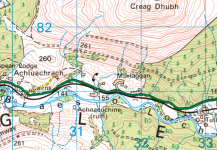
Here is the spillway over that col into the present Loch Laggan at a village called Roughburn, via a burn with the interesting name of Fèith Shiol. That map resolution seems to show the col as higher than 330 metres, but the higher resolution version confirms it as 325 metres.

1763239635663.png

You can also see a section of the Glen Spean 260 metre shoreline within the forested area to the north of the road at the bottom of the snip. Milne spotted the 325-metre col and went to Roughburn for a look. Sure enough, he found a delta that was entirely consistent with a much larger river having flowed into the loch from that spillway at some time in the past.

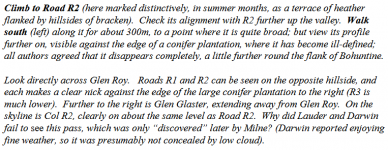
Much of my information is taken from this document, an account of a field trip to Lochaber by a group from London University in 2009 to view the evidence of the Darwinian controversy. https://www.darwinproject.ac.uk/sites/default/files/Rudwick_Glen-Roy-field-guide_DCP.pdf That has a lot of information, but the way it is organised makes it hard going in places, as it goes into all the mistaken theories with diagrams and quotations. Some of the quotes from Darwin excoriating and mocking the "lake shore" theory are absolutely hysterical in the light of later developments. This is where they observe that the existence of the Gleann Glas Dhoire col can be strongly suspected looking from the other side of the glen above the viewpoint.

1763241306720.png

I really wish they'd included a photo because I for one am not climbing all the way from the viewpoint (230 metres) to the 325-metre road. Or probably not, anyway. That this was missed all that time, in the middle of all that infighting, is a mystery for the ages. Its finding was the last straw for Darwin's theory, anyway. Lyall and Jameson's later work just nailed down the coffin.

1763242424389.png
1763242491915.png

Oh well, it could happen to anyone.
 
A few loose ends. What about Loch Treig and Coire Làire to the south of Glen Spean? While the 260-metre shoreline is quite clear at the entrances to these glens (and was apparently clearer before the forestry plantation, as evidenced by some interesting engravings from that time), that entire area is believed to have been under the ice cap, with Loch Treig (currently at 250 metres) being entirely glaciated. Thus the shoreline only shows at the foot of the glens, where they open into Glen Spean, which was the edge of the ice cap. The Great Glen was also filled with ice, and there is reference to a glacier in Loch Arkaig, which explains the absence of shorelines there too - there was no shore, just a whole heap of ice.

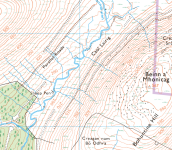
Caol Lairig, on the west side of Beinn a' Mhonicag (Bohuntine Hill) from the main run of Glen Roy, is interesting, because it has four shorelines, not three. Count them.

1763243790457.png

The 260-metre shore is visible on both sides of the burn on the bottom left-hand part of the snip. That would have formed when there was still a flow of water southwards out of that side-glen, into the lower part of Glen Roy. The 325-metre and 350-metre lines are visible on the east side of the glen towards the top right-hand corner, although only the 325-metre one can be seen on the west side. But what else is there? A very clear 300-metre line on both sides of the burn, a level not seen anywhere else.

Here's a wider view.

1763243455571.png

I think Lauder may have got this part (the geologists call this "Collarig", which is screamingly annoying - these names mean something, and shouldn't be mangled like this), but I haven't seen it explained in any of the modern treatments of the phenomenon. This can be explained by an intermediate stage in the shore formation. First the entrance to Glen Roy was blocked well south of Beinn a' Mhonicag, so that the side glen of Caol Lairig was still draining south into Glen Roy. However, as the ice advanced, it blocked this outflow even though the main outflow from Glen Roy to Glen Spean was still patent. Thus, for a period of time while Loch Roy was still at 260 metres and draining into Glen Spean to the south, "Loch Lairig" was at 300 metres and draining north of Beinn a' Mhonicag into Loch Roy. Here you go, col marked as 299 metres. (The col heights are marked almost obsessively around here, in stark contrast to practice elsewhere in the country - I really think the OS has a thing for this story.)

1763246772972.png

(Incidentally, how did the early proponents of the "roads" interpretation explain the damn things circling Beinn a' Mhonicag and going precisely nowhere? You can also see similar "roads" encircling other small hills which must have been islands at the time.)

A bigger puzzle is at the top of the glen where it bends eastwards, with Glen Turret coming in from the west to form a T-shape. Look at the map where the "roads" are running east-west on that very steep south-facing slope. The 350-metre shoreline is marked. Below it, the 325-metre shoreline is marked. But in between there is a third one, at 335 metres.

1763245016105.png

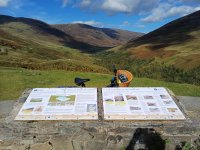
I believe I read somewhere that this was one of Darwin's objections to the lake-shore theory as well, that there wasn't a 335-metre spillway. There doesn't appear to be, and even if there were, why would this shore appear only on this one part of the hillside. On the other hand, this intermediate shore doesn't appear on my older map, which only shows 1,068 and 1,149 "roads". I wonder when and why they were added? I also wonder who is hallucinating, Darwin and the OS, or me and my camera? This is a zoom in on the relevant part of my own photo of that hillside which I posted above. (I was only trying to get a nice view, I had only read the bare bones of the "roads" saga on a tourist information display about six miles back down the glen and hadn't got beyond "wow that's amazing!")

1763245607225.png

The 260-metre shore is irrelevant here, I was standing at about 260 metres. How many lines? Two, I believe. Two which match the 325 and 350 lines as they appear elsewhere in the glen. Do you see anything in between them? No, me neither. There might be some marks above them, but I swear there's nothing at 335 metres. I don't get this at all. I hope to take another trip up there in the spring to look a bit more closely.

And finally. Glen Spean again.

1763245998447.png

Yes, we have the expected 260-metre shoreline (plotted at 261 metres) on both sides of the river. And then what? A "road" at 400 metres up a very steep hill, again with no counterpart anywhere, and obviously no possible explanation in terms of spillways.

Go home, Ordnance Survey, you're drunk.

Again I think I remember this was part of Darwin's objections, what's that doing there. I suppose I should read it all again. But is it there? I don't know, and I am sure as hell not climbing up a slope like that to find out. It might be possible to get a look from the road level I suppose and see if aything is visible. Unfortunately there's no access to the opposite slope, and what appears to be a footpath is actually a "dismantled tramway". A drone might come in handy...
 
Last edited:
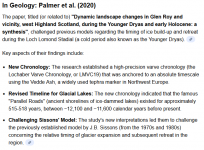
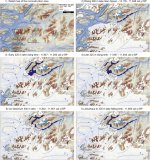
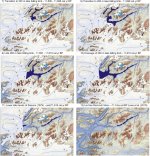
There is more, which I haven't fully read up on yet. More recent work has determined that the lochs existed for a period of 515-518 years, between 12,100 and 11,600 years ago, approximately.

1763247291154.png


This paper has full public access but frankly it is hard going. (Though special kudos points for naming Gleann Glas Dhoire correctly.) I don't even know what a varve is. This might be the meat of it.

1763247923493.jpeg
1763247983075.jpeg

This makes it clear that the lower shores were formed twice, once going up, once coming down. Once the 260-metre outflow was blocked, the shore at that level was submerged. Then in its turn the 325-metre outflow was blocked leading to the submergence of that shore in its turn. These shores may have been partly or fully washed away while submerged, but they re-formed again on the way back down, as the retreating ice freed the spillways in reverse order. I imagine you can work out from all that approximately how long each stage lasted, but I'm getting tired.

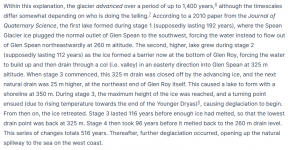
I did find a paper published last year that seems to have done the sums, though.

1763248506117.png

So, 192 years for the first 260-metre loch, 112 years for the first 325-metre loch, 116 years for the highest 350-metre level, 96 years for the second 325-metre loch, then it doesn't say how long at 260 metres before the ice dam collapsed altogether, so I think there may be some mistake as all that adds up to 516 years, which is the time Palmer et al. (2020) estimate for the entire sequence right up to the breaking of the dam. But something like that. However, this is actually getting its numbers from a 2010 paper the 2020 paper is said to supersede, so there are probably better numbers to be had.

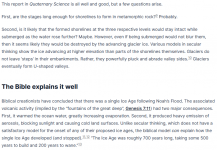
There are bigger problems with this source though. First they don't get the part about the lower shorelines forming on the way down. It goes on to say...

1763249229164.png

Yes, the source is https://creation.com/en/articles/glen-roy. Obviously, anything that illustrates Darwin getting things embarrassingly wrong is catnip for all sorts of nutters.
 
Last edited:
Finally, in whimsical mood, I wonder if anyone was there to see all that happening? One of the interesting things about this is that it's so recent in geological time. Under the ice and the water the landscape was almost exactly as we see it today. There's no - this was sedimentary and then heaved up by a giant earthquake, then carved out by a glacier - the landscape is the normal familiar one. We know there were people in Scotland for over a thousand years before the Loch Lomond stadial started. It seems to be received wisdom that they all scarpered when it got colder and a new lot re-colonised the country afterwards, but I'm not sure how they know that. If the ice was only confined to that area in the west, why would people leave the entire country? Even in these glens there was liquid water, and further east things surely weren't that bad. People have been surviving conditions like that for a long time, in northern Canada, Norway and so on. Here is a better map of the extent of the ice cap I found in that newer paper.

1763249988524.png

Maybe we just haven't found the evidence of the human inhabitants of the country during that wee cold snap. Maybe I can imagine some prehistoric fishermen casting their nets or their lines high up on the sides of Glen Roy. Or sailing in boats. Or even having a looney dook in high summer. It must have been interesting to see the fast-changing water levels if anyone was around at the times of flux, and even more so when the ice dam collapsed completely at the end (unless you were in the path of the water I suppose!)

And that concludes my presentation of the little scientific titbit I discovered while reading a tourist information board half way up Glen Roy on what was only intended to be a fun afternoon on my bike.

20250926_141105.jpg
 
Last edited:
Loch Lochy. And I thought we Australians were great at naming things.

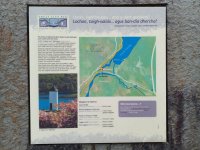
There's another River Lochy in a Glen Lochy in Argyllshire too. I'm a bit intrigued by the name. Here's what another tourist information board at Loch Lochy says.

20250713_134134.jpg

1763250816434.png

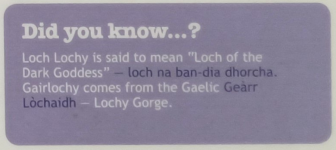
I'm really not sure about that. And I'm really not sure about their take on Gairlochy, because there are several Gairlochs around and they all mean the same thing, short loch. "Geàrr" is Gaelic for short, or to cut (to shorten), and indeed for castrate. (An Gearran is February, not the short month, but the month the calves are castrated.) It also means a hare, apparently because a hare is a short deer or something like that. It looks from the map as if this Gairlochy is at the end of a short arm of Loch Lochy, which to me sort of figures. It's what I had thought it meant before I saw the tourist information board. Also, the Lochy is not in a gorge at that point. Also, I have looked up the Gaelic for ravine and gorge and got just gleann itself, and beàlach (a mountain pass) and mòr-ghil which seems related to the Scots gill or the English ghyll, and clais-mhòr. No mention of the word geàrr at all.

So colour me a bit sceptical about the whole "ban-dia dhorcha" thing too, by inference. However, I'm not really getting anything beyond the place-names when I look up "Lòchaidh". Nevertheless, the fact that the name is attached to at least two entirely separate places suggests it does have a topographical meaning.

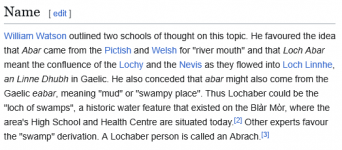
The whole area where the loch system is is called Lochaber, but there isn't a Loch Aber. (Aber is another form of inbhir, which means a confluence.) Wikipedia has this.

1763251817325.png
I did read once that it was thought that the name came from the notion that there had once been a really big loch there which was no longer in existence. So the whimsical part of me wondered if it was some sort of folk memory of the huge loch that was there when the ice dam was present. But the interpretation of it being the confluence of several lochs seems more realistic, and my memory of the "really big loch" story might be another version of the Blàr Mòr (that means Great Battle, though) mentioned in the Wiki article.

The old name for Fort William (An Gearasdan, the garrison, in Gaelic), from before the colonisers built their forts and their military roads, is Inverlochy. The confluence of the Lochy, where the Lochy flows into Loch Linnhe ("linne" means a pool). But it's pretty much the same word as Lochaber.
 
Last edited:
I read it all over and of course found some mistakes. I'm doing an errata list in case I ever want to turn this into a coherent piece of writing.

#919 the 260-metre shore is given as 250 metres in error (and it wasn't Ecuador, it was Chile)
#922 Loch Laggan is incorrectly named as Loch Spean. (The massive loch behind the ice dam is usually referred to as Loch Spean, but the much smaller loch that’s there now is Loch Laggan.)
#922 again, although I said there was no spot height marked at the Glen Mashie (Pass of Muckul) col, if you zoom in to the higher resolution map it is there, at 261 metres
#923 I said that the banks of silt (should really be gravel, Darwin thought it was shingle despite the lack of shells) had formed because the river ran down from Glen Gloy for over 500 years. Not so. These would only have formed during the time “Loch Roy” was at the 260 metre level. So a couple of hundred years? Less? Unless the ice took longer to clear from the entrance to Glen Gloy?
#924 no there aren't any hanging valleys, the entire land mass was under ice in the main Ice Age, so how would they form?
#928 Roughburn isn't a village, it's just a few cottages. And it's not on the shore of Loch Laggan, it's a section of the River Spean that has been widened by a (modern) dam a little way downstream
#929 the heights on the old map are given in feet, obviously, I forgot to type that

Well, that was a lot of fun. I'm going to bed now.
 
Last edited:
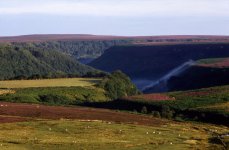
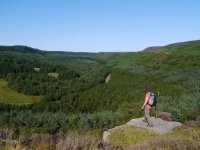
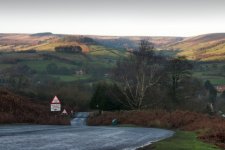
Similarly on the North Yorkshire Moors, Newton Dale was formed by glacial meltwater carving a path through the bedrock during the last Ice Age. Ice sheets blocked drainage routes to the north, east, and west, the water was forced to flow south, gouging the deep, narrow valley as it went and spilling into what would become the Vale of Pickering. It is thought that the dale was formed in just a couple of decades.
The flow of water is believed to have been 10,000 cubic metres (350,000 cu ft) per second; ten times the amount of water discharged by the River Thames when it is in flood.
The valley is 490 feet (150 m) above sea level on the valley floor, with steep walls at up to 790 feet (240 m) at the crest. At certain points, the narrow valley is only 1,600 feet (500 m) across.

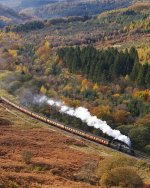
The Whitby to Pickering railway was built along Newton Dale in the 1830s and still operates today as the North Yorkshire Moors Railway


1763296071302.jpeg1763296150556.jpeg
1763296186401.jpeg
 
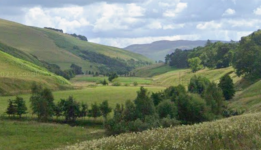
That's amazing. I particularly like the second picture, it gives a really good idea of how it is. So that was during the main Ice Age? I read that some parts of northern England were glaciated during the Loch Lomond statial, but the maps don't usually extend so far south. Of course there's nothing like that in Scotland from that period, because the whole country was buried under the ice. Just a bunch of round-topped ground-down mountains, U-shaped valleys with meandering rivers on their flat floors, and whole heaps of gravel people want to cart away to make roads.
 
, U-shaped valleys with meandering rivers on their flat floors.
We also have those over the North Yorkshire Moors but the Dales are better known for them.

Farndale and Rosedale are our best examples, they are smaller and more friendly.


1763307265022.jpeg
 
We also have those over the North Yorkshire Moors but the Dales are better known for them.

Farndale and Rosedale are our best examples, they are smaller and more friendly.


View attachment 66057

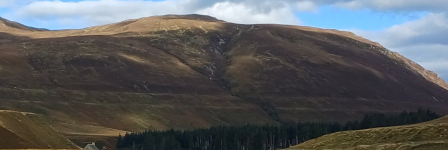
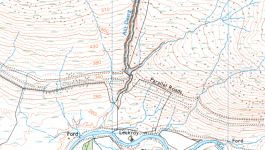
Pretty. There's an absolute cracker just about five miles from where I live, and I like to cycle there and just look at it.

1763312660968.png

It's odd how difficult it is to get even a half-decent view of it from Google Streetview. It's much better in real life. Maybe I should stop and take a photo sometime.
 
Last edited:
A few loose ends. What about Loch Treig and Coire Làire to the south of Glen Spean? While the 260-metre shoreline is quite clear at the entrances to these glens (and was apparently clearer before the forestry plantation, as evidenced by some interesting engravings from that time), that entire area is believed to have been under the ice cap, with Loch Treig (currently at 250 metres) being entirely glaciated. Thus the shoreline only shows at the foot of the glens, where they open into Glen Spean, which was the edge of the ice cap. The Great Glen was also filled with ice, and there is reference to a glacier in Loch Arkaig, which explains the absence of shorelines there too - there was no shore, just a whole heap of ice.

Caol Lairig, on the west side of Beinn a' Mhonicag (Bohuntine Hill) from the main run of Glen Roy, is interesting, because it has four shorelines, not three. Count them.

View attachment 66015

The 260-metre shore is visible on both sides of the burn on the bottom left-hand part of the snip. That would have formed when there was still a flow of water southwards out of that side-glen, into the lower part of Glen Roy. The 325-metre and 350-metre lines are visible on the east side of the glen towards the top right-hand corner, although only the 325-metre one can be seen on the west side. But what else is there? A very clear 300-metre line on both sides of the burn, a level not seen anywhere else.

Here's a wider view.

View attachment 66014

I think Lauder may have got this part (the geologists call this "Collarig", which is screamingly annoying - these names mean something, and shouldn't be mangled like this), but I haven't seen it explained in any of the modern treatments of the phenomenon. This can be explained by an intermediate stage in the shore formation. First the entrance to Glen Roy was blocked well south of Beinn a' Mhonicag, so that the side glen of Caol Lairig was still draining south into Glen Roy. However, as the ice advanced, it blocked this outflow even though the main outflow from Glen Roy to Glen Spean was still patent. Thus, for a period of time while Loch Roy was still at 260 metres and draining into Glen Spean to the south, "Loch Lairig" was at 300 metres and draining north of Beinn a' Mhonicag into Loch Roy. Here you go, col marked as 299 metres. (The col heights are marked almost obsessively around here, in stark contrast to practice elsewhere in the country - I really think the OS has a thing for this story.)

View attachment 66020

(Incidentally, how did the early proponents of the "roads" interpretation explain the damn things circling Beinn a' Mhonicag and going precisely nowhere? You can also see similar "roads" encircling other small hills which must have been islands at the time.)

A bigger puzzle is at the top of the glen where it bends eastwards, with Glen Turret coming in from the west to form a T-shape. Look at the map where the "roads" are running east-west on that very steep south-facing slope. The 350-metre shoreline is marked. Below it, the 325-metre shoreline is marked. But in between there is a third one, at 335 metres.

View attachment 66016

I believe I read somewhere that this was one of Darwin's objections to the lake-shore theory as well, that there wasn't a 335-metre spillway. There doesn't appear to be, and even if there were, why would this shore appear only on this one part of the hillside. On the other hand, this intermediate shore doesn't appear on my older map, which only shows 1,068 and 1,149 "roads". I wonder when and why they were added? I also wonder who is hallucinating, Darwin and the OS, or me and my camera? This is a zoom in on the relevant part of my own photo of that hillside which I posted above. (I was only trying to get a nice view, I had only read the bare bones of the "roads" saga on a tourist information display about six miles back down the glen and hadn't got beyond "wow that's amazing!")

View attachment 66017

The 260-metre shore is irrelevant here, I was standing at about 260 metres. How many lines? Two, I believe. Two which match the 325 and 350 lines as they appear elsewhere in the glen. Do you see anything in between them? No, me neither. There might be some marks above them, but I swear there's nothing at 335 metres. I don't get this at all. I hope to take another trip up there in the spring to look a bit more closely.

And finally. Glen Spean again.

View attachment 66018

Yes, we have the expected 260-metre shoreline (plotted at 261 metres) on both sides of the river. And then what? A "road" at 400 metres up a very steep hill, again with no counterpart anywhere, and obviously no possible explanation in terms of spillways.

Go home, Ordnance Survey, you're drunk.

Again I think I remember this was part of Darwin's objections, what's that doing there. I suppose I should read it all again. But is it there? I don't know, and I am sure as hell not climbing up a slope like that to find out. It might be possible to get a look from the road level I suppose and see if aything is visible. Unfortunately there's no access to the opposite slope, and what appears to be a footpath is actually a "dismantled tramway". A drone might come in handy...

I've been looking again at the question of the alleged 335-metre shoreline up above the Turret Bridge, and I really can't see it. Here's an even closer zoom in to the snapshot I took with my phone.

1763312901416.png

And here's the relevant part of the OS map, at the 1:25,000 resolution.

1763313140767.png

The deep ravine of the Allt Dearg (the red burn) is clearly visible in the middle of the photo. According to the OS map, this 335-metre shore should be visible to the left of the ravine, but not to the right. I can't see a dicky-bird. (Try to ignore the fence lines on the map - someone seems to have built a fence along the 325-metre shore on the left, then to the right of the Allt Dearg it's on the 350-metre shore for a bit.)

It may be that it's clearer even further to the left, which is cut off the photo by the huge bank of gravel that was swept down the Allt a' Chòmhlain at the time when "Loch Gloy" was draining down that into the headwaters of the 260-metre "Loch Roy". I'm going to go back in the spring, leave the car at the viewpoint to save cycling the boring bit up from Roybridge again (I might even camp at the viewpoint, although it's windy) and cycle back up there to get a better look at it. I'll try to cross the Turret Bridge and go on as far as the Luib Chonnal where the track ends, if possible. I'll also go the other way, round the end of the gravel bank and towards Glen Turret, which should give a much better view of the face of the hill where the 335-metre shore is marked most clearly.

If I can camp at the viewpoint for two or three nights I could try the climb up at least to the 260-metre shoreline above it, and maybe even to the 325-metre one as suggested by the field trip. I just find the whole thing completely fascinating.
 
I've had a closer look at the figures in the Palmer et al (2020) paper I reproduced above, and I think I have the chronology figured out now.

The figures are a little odd in that the authors are mainly concerned with the ice movements, and haven't shown the water flows consistently. Although all three principle cols (260 metres at Glen Pattack/the Pass of Muckul, 325 metres at Gleann Glas Dhoire and 350 metres at the Roy/Spey watershed) are shown, at no point is any water actually depicted as flowing over either the 260-metre col or the 350-metre one, though obviously it must have. Anyway, leaving that aside, this is how it goes.
  1. The first 260 metre loch was only Loch Spean, and Glen Roy and Glen Gloy continued to drain towards Loch Lochy as before with no loch formation. This is because Glen Spean was blocked by the "Làire/Treig" glacier, when it advanced northwards out of the mouths of Glen Treig and the Coire Làire, upstream of the confluence of the rivers Roy and Spean (at the present Roybridge). This period lasted for 187 years.
  2. More ice advanced to fill in lower Glen Spean right up to the mouth of Glen Gloy, damming both Glen Roy and Glen Gloy. The Gleann Glas Dhoire col remained patent as a spillway to Loch Spean, already established for 187 years by then. So at this stage Lake Roy first formed, and filled right up to the 325-metre mark with its outflow going down the Fèith Shìol (the channel where the fish spawn?) into Loch Spean at Roughburn. Meanwhile Loch Gloy formed, filling right up to the 355-metre mark with its outflow going down the Allt a' Chòmhlan into the headwaters of the new Loch Roy. Later in that phase the ice advanced further up both Glen Gloy and Glen Roy, but didn't alter the water flow patterns. This period lasted for 104 years.
  3. At the ice maximum (jokulhaup?) the spillway through Gleann Glas Dhoire was blocked, forcing Loch Roy to rise another 25 metres to drain over the col into the headwaters of the River Spey. At this point it was nearly as high as Loch Gloy, and the spillway over the Allt a' Chòmhlain was barely a kilometre long and fell only five metres. This period lasted a mere 35 years.
  4. As the ice began to retreat the Gleann Glas Dhoire spillway opened up again and Loch Roy fell to 325 metres again. The Allt a' Chòmhlann spillway was now somewhat longer and falling 30 metres again, as it had during stage 2. This period lasted for 108 years.
  5. Further retreat of the ice opened up the main channel from Loch Roy into Loch Spean, that is where the present River Roy flows into the Spean at Roybridge. This allowed the Gleann Glas Dhoire spillway to dry up, and the 260-metre Loch Roy to appear for the first time. The Làire/Treig glacier was no longer blocking Glen Spean so Loch Spean was contiguous all the way from Glen Pattack to the present Spean Bridge, where the 260-metre shoreline visible today ends. Lower Glen Spean was still blocked by ice (as it had not been in stage 1), so that Loch Roy (now at 260 metres) and Loch Gloy remained in existence. This is the period where the Allt a' Chòmhlain took the water from Loch Gloy all the way down to the headwaters of Loch Roy at the level of Turret Bridge, when I presume that huge bank of gravel formed. This period lasted for 79 years before the ice retreated sufficiently to let the water escape westwards again. It's not quite clear how catastrophic this was, but it is said to have occurred 11,618 years ago. (Presumably 11,623 years ago, now!) It looks however as if the water was still heading for the North Sea across the Great Glen, towards Inverness, as that glen was still iced up from about the south-west end of Loch Lochy.
Fascinating. So while the 260-metre Loch Spean existed for the entire 513 years of the "lake system" period, Loch Roy and Loch Gloy only existed for the last 326 years of that. Not that long, then.

The lowest 260-metre shore of Loch Roy only existed on the way down, for 79 years. In contrast the middle shore existed both on the way up (104 years) and on the way down (108 years). I don't know if the first shoreline would have been obliterated by the rising water or not. Maybe not entirely, because the highest level only existed for 35 years before the loch dropped back to 325 metres again. And yet, from a distance, all three shorelines look about even-stevens as far as their definition goes. I haven't seen the shore in Glen Gloy, which was there for 326 years, to see if it looks any better defined. Nor have I looked at the shoreline in Glen Spean, which was there for the full 513 years. However it's not that far above the floor of the glen and has been subjected to a lot of human interference. The A86 is actually built on it along the side of Loch Laggan, so it really is a "road" there.

The paper doesn't deal with the Caol Lairig at all, the authors don't seem interested in that 300-metre shore. I think this must only have formed on the way down. Initially Loch Roy filled to 325 metres, so Beinn a' Mhonicag was immediately turned into an island in the loch, with water at 325 metres on either side. Then it rose to 350 metres, of course, and back down. But when the main channel of Glen Roy opened up into Loch Spean and Loch Roy fell to 260 metres, there has been a period early on when the southern outflow from Caol Lairig was still blocked. This has led to the temporary formation of a small Loch Lairig at 300 metres, draining into Loch Roy down what is now the Allt Bruachan.

1763345370453.png

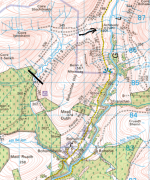
Hey, I managed to draw on a map! (Rather badly.) So the main channel where the River Roy runs at present was open, allowing Loch Roy to become contiguous with the 260-metre Loch Spean, but the ice was still blocking the Allt Iondrainn, which runs south out of Caol Lairig, at about the level of the black line (which joins the ends of the 300-metre shores as marked). So there was a 300-metre loch in there which was draining down the Allt Bruachan (arrow) into the now 260-metre Loch Roy, and that would have existed until the ice cleared from the Allt Iondrainn channel, allowing the water level to drop down to the common 260 metres, so that Beinn a' Mhonicag was simply an island in a 260-metre loch again, as it had been an island in the 325 and 350-metre lochs. It's an interesting wrinkle, although I've not seen it discussed.

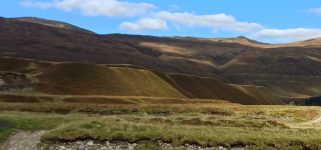
One final thing. I have changed my mind about that heap of gravel just above the Turret Bridge. (Darwin thought it was shingle!).

1763343721068.png

It's not in the right place to be formed from the run-off from Glen Gloy, and there's too much of it anyway. I think it's a proper moraine left from the time when Glen Roy was properly glaciated during the main Ice Age. I haven't seen any discussion about this, but it's the only thing that makes sense.

So that's the eighth course, I think, and I probably understand it all as well as I care to. I look forward to going back for a closer look, though I doubt if I'll go into the Caol Lairig, as the only practical way would seem to be to climb up to the 325-metre shore from the viewpoint and then walk north along it round Beinn a' Mhonicag for a mile or so. I'll see.
 
Last edited:
You're going to regret bringing this up, I promise you...

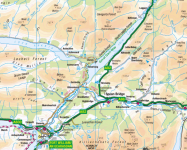
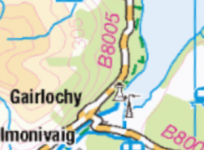
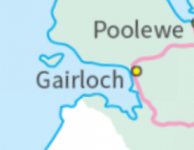
This is a point I have been slightly interested in for a while, and I haven't found a satisfactory explanation. Here's a map of the "Lochy" area we've been talking about so far. Note Loch Lochy, but also the River Lochy flowing out of it down to its confluence with Loch Linnhe. The town at that confluence used to be called Inverlochy (now An Gearasdan, with the Inverlochy name being given to a suburb), and you can see Inverlochy Castle marked (it's now a hotel).

(ETA: you can see what I mean about Gairlochy and "short loch" on that map.)

1763388456525.png

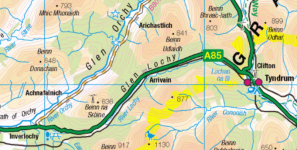
Here is somewhere else entirely. It's not actually all that far away, probably about forty miles as the crow (fithich) flies, but certainly not connected to the district shown above.

1763389027980.png

Here we have a Glen Lochy (which genuinely could be translated as the Lochy Gorge) and another River Lochy, and another Inverlochy, at the confluence where the River Lochy flows into the River Orchy. But no actual loch. The only loch involved there is a broadening of the river called the Lochan na Bì. Not Loch(an) Lochy.

It's one of these names that recurs in the Scottish landscape, like Tarbe(r)t and Gairloch and S(t)rone (there's actually a Strone on both of these maps too, it's Gaelic for nose, and describes a nose-shaped hill). I'm sure it must be topographical, referring to some common feature of the landscape that has been fixed on to name the features, but I don't know what it is. I'm wildly sceptical of this "ban-dia dhorcha" thing - why would ban-dia dhorcha come out sounding like Lochy? Even dhorcha (dark, pronounced in its lenited - feminine adjective - form as yorcha) on its own doesn't really fly. Which goddess anyway? Which goddess would it be in the Argyll occurrence? The absence of any loch in the Argyllshire Glen Lochy suggests to me it's not actually referring to a loch but to something else that has become transcribed as Lochaidh. Damned if I know what though.
 
Last edited:
Ooh, lucky you. I was standing by the flight of locks in Kilchuimen for a while, watching the cruise boats go by, and getting ideas. I even photographed the web addresses on one or two for future reference.
 
Ooh, lucky you. I was standing by the flight of locks in Kilchuimen for a while, watching the cruise boats go by, and getting ideas. I even photographed the web addresses on one or two for future reference.
Up the east coast to Inverness then through the canal. Shortcut to the Hebrides.
We would go up one year then overwintered the boat on the west coast to continue sailing the next year before retracing our course.
 

Thank you, I hadn't seen that. Seems an awful lot of speculation without any solid evidence to link "nigra dea" with the Lochaidh placenames in the first place. Or at least as far as I got. I did run out of steam after a bit. I see Gairlochy now means (according to this paper) "the roar of the Lochy". Clearly this is way beyond my pay grade. Just...

1763400081012.png 1763400184873.png

1763400561650.png 1763400712751.png

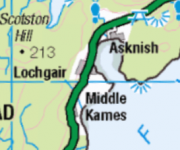
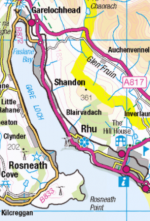
Notice anything similar about these locations, that might just possibly relate to the fact that the word geàrr in Gaelic means "short"? Obviously this is all too subtle and academic for me. As is how we get from nigra dea to ban-dia dhorcha, and how that relates to the word Lochy either which way. I get it that the paper seems to discuss this and I suppose he's right, but it seems awfully tendentious to me.
 
The largest black hole in the observable universe is the supermassive black hole TON 618. It has an estimated 66 billion times the mass of our sun. it is also 18.2 billion light years away from us which means that we are seeing it as it was 18.2 billion years ago. Though the concept of "now" is weird in general relativity, it is fascinating to speculate what TON 618 would look like 18.2 billion years later in its own timeline, ie, "now" for us. Is it even more massive?
 
Last edited:
The largest black hole in the observable universe is the supermassive black hole TON 618. It has an estimated 66 billion times the mass of our son. it is also 18.2 billion light years away from us which means that we are seeing it as it was 18.2 billion years ago. Though the concept of "now" is weird in general relativity, it is fascinating to speculate what TON 618 would look like 18.2 billion years later in its own timeline, ie, "now" for us. Is it even more massive?
Christ, how big is your kid???
 
The largest black hole in the observable universe is the supermassive black hole TON 618. It has an estimated 66 billion times the mass of our sun. it is also 18.2 billion light years away from us which means that
we are seeing it as it was 18.2 billion years ago. Though the concept of "now" is weird in general relativity, it is fascinating to speculate what TON 618 would look like 18.2 billion years later in its own timeline, ie, "now" for us. Is it even more massive?
I thought the universe was only about 14 billion years old? Well, according to The Big Bang Theory, anyway....
 
The largest black hole in the observable universe is the supermassive black hole TON 618. It has an estimated 66 billion times the mass of our sun. it is also 18.2 billion light years away from us which means that we are seeing it as it was 18.2 billion years ago. Though the concept of "now" is weird in general relativity, it is fascinating to speculate what TON 618 would look like 18.2 billion years later in its own timeline, ie, "now" for us. Is it even more massive?

My understanding is that 'now' is not really something that works over interstellar distances?
 

Back
Top Bottom