It is interesting how Vietnamese works. And quite simple compared to other languages.
Since ancient time, it has always been the central intention of the “alphabet people” for symbols to represent the speech sounds; since ancient time “alphabet people” has been looking into the human speech sounds for discovering the vowels and consonants, just like panning for the gold element. They knew those were the elemental sounds of the human speech.
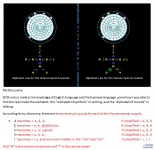
Latin Based Alphabets:
Both English Alphabet and Vietnamese Alphabet are Latin based Alphabets. English’s Latin based alphabet has it’s beginning many hundreds of years before Vietnamese’s Latin based alphabet. Vietnamese Writing has it's foundation laid down by Francisco De Pina, a Portuguese Jesuit missionary who arrived to Vietnam in 1617. English Writing has a helper, the IPA Association, which was established in 1886, and the IPA Alphabet which was published in 1888.
The English’s Latin Based Alphabet:
English Writing uses Spelling for its orthography. English Writing has 26 alphabet letters. Within those are five letters (A, E, O, U, and I) for making vowels, and one more letter (Y) which is also for making a couple of vowels and also it has the spelling power for making a consonant (a consonant which makes a sound that is similar to Z); and then the rest of the other remaining letters are B, C, D, F, G, H, J, K, L, M, N, P, Q, R, S, T, V, W, X, and Z are for making consonants with various nature: some, sometimes, are silent; and some are similar in sounds; and some have sounds like they have a vowel inside of them.
Most importantly, English Writing has names for those alphabet letters, because to remember their names is easier than to remember their sounds. And the most popular way to remember their names is to sing the Alphabet Song.
Vietnamese’s Latin Based Alphabet:
According to many internet websites, as of 20 of December of 2025, the Vietnamese Alphabet has 29 letters, and each letter has a name, a sound, an uppercase, and a lowercase, pretty much in line with “IPA Linguistics”. Several of those versions of alphabets have a slight different to each other. They all claimed it to be from the Ministry of Education and Training, (
www.moet.gov.vn, can’t be reach), and I have never seen the actual official alphabet.
The State of Linguistics:
Linguistics is in a state where it has not found any unified law for the alphabet other than the International Phonetic Association's IPA Alphabet, (which is why I named it “IPA Linguistics”).



