Wudang
BOFH

Because it's made like sausages? I heard that somewhere.Law is a Turkish invention. Everyone knows that!

Because it's made like sausages? I heard that somewhere.Law is a Turkish invention. Everyone knows that!
Because you don't want to see how the sausage or law is made!?Because it's made like sausages? I heard that somewhere.

Note how you were able to express a specific pronunciation using an idiom of English spelling and we all heard the sounds correctly in our minds.Similarly in A.P. Herbert's "Uncommon Law" one sketch has a lawyer pronouncing Latin as his school believed the way Romans pronounced it with "ooltra weeres" for ultra vires as one example and being rebuked by the judge. From my junkheap of a memory. I couldn't see it on Gutenberg despite its age.
The one legal podcast I listen to will occasional make note of judges and lawyers' ability to avoid saying certain words and phrases or note how everyone in a courtroom will pronounce a word differently.Similarly in A.P. Herbert's "Uncommon Law" one sketch has a lawyer pronouncing Latin as his school believed the way Romans pronounced it with "ooltra weeres" for ultra vires as one example and being rebuked by the judge. From my junkheap of a memory. I couldn't see it on Gutenberg despite its age.

The less enlightened use it as a derogatory term for LGBTQ+I just want to know who "the alphabet people" are.


I just want to know who "the alphabet people" are.
Everyone knows that Dutch law ultimately derives from Vietnamese law that was established under the Ngyuen Dynasty. So, still just one law.

That's the only way I've heard the term used.The less enlightened use it as a derogatory term for LGBTQ+
I did, and I got a series of children's books about famous women whose names start with the various letters. The term "alphabetties" had no matches on Google.(Sorry, couldn't resist, but Google "the alphabetties" or the alphabet women and you'll probably get the story. Someone has already spent time in jail for dropping hints. Amazingly, the central character is actually "woman H".)


 grousebeater.wordpress.com
Well, they do have "i"s.Maybe they're related to the Potato People?

Google employees?I just want to know who "the alphabet people" are.

"The Deseret alphabet was based on the 1847 version of Isaac Pitman's English Phonotypic Alphabet", it says.This has been one of the most entertaining things about moving to Utah: https://en.wikipedia.org/wiki/Deseret_alphabet
If you scour rare book stores (which I do), you can still find the occasional material printed in this alphabet. It also occasionally appears ironically around town when people want to make a heritage statement. Phonetic alphabets exist for English, and are used in such activities as transcription. But the common spellings arose organically and remain so despite all efforts from the various "alphabet people" to reform or standardize them.

Yes, and ... ?"The Deseret alphabet was based on the 1847 version of Isaac Pitman's English Phonotypic Alphabet", it says.
Who doesn't? Whoever thought it was a good idea to break up the encodings for the Roman alphabet and allow them to be a non-contiguous range? I assume that was all Hollerith's fault.I prefer ASCII to EBCDIC.
these are Google Ai answers:Written languages are constructed, based on spoken ones, which are organic, so reality rarely matches the map. Which is part of why languages are fun, if you ask me.
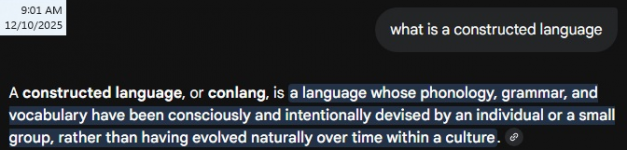

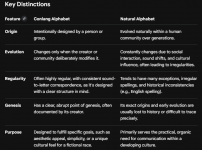
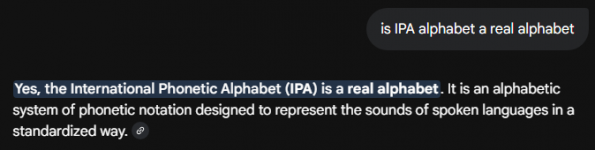
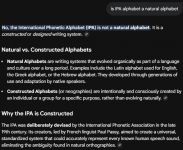
Yes, and ... ?these are Google Ai answers:
