Gord_in_Toronto
Penultimate Amazing

- Joined
- Jul 22, 2006
- Messages
- 26,451
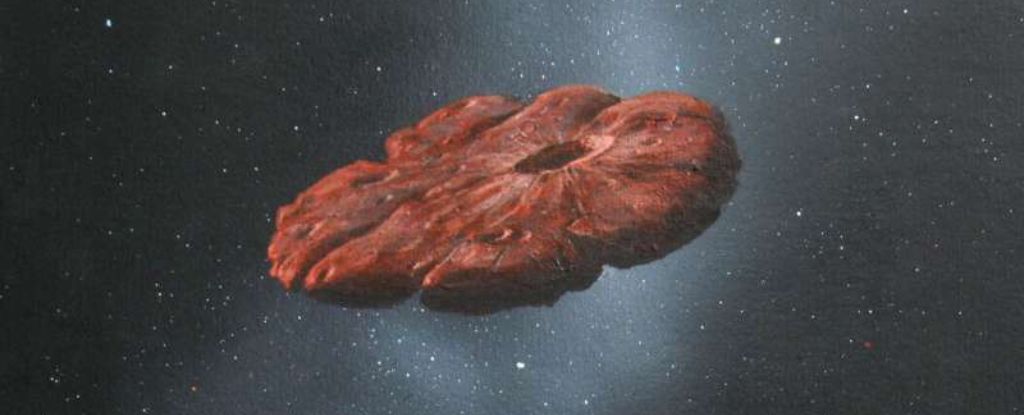
I was watching a UFO show on the History (or maybe it was Discovery) channel the other evening and it mentioned the mysterious alien origin of the Oumuamua alien interstellar space probe. "It speed up and slowed down," they said. "How much?" I wondered.
And then I found this:
1I/‘Oumuamua as an N2 Ice Fragment of an Exo-Pluto Surface II: Generation of N2 Ice Fragments and the Origin of ‘Oumuamua
Even plainer: "It's gas, man. Gas."
Disappointing?
And then I found this:
1I/‘Oumuamua as an N2 Ice Fragment of an Exo-Pluto Surface II: Generation of N2 Ice Fragments and the Origin of ‘Oumuamua
Plain Language Summary
Our Kuiper belt originally had much more mass than today, but an instability caused by Neptune's migration disrupted their orbits, ejecting most of this material from the Solar System, and simultaneously causing numerous collisions among these bodies. There were thousands of bodies like Pluto, with N2 ice (like the gas in Earth's atmosphere, but frozen) on their surfaces, and this instability would have generated trillions of N2 ice fragments. A similar fragment, generated in another solar system, after traveling for about a half billion years through interstellar space, would match the size, shape, brightness, and dynamics of the interstellar object 1I/‘Oumuamua. The odds of detecting such an object, as well as more comet-like objects like the interstellar object 2I/Borisov, are consistent with the numbers of such objects we expect in interstellar space if most stellar systems ejected comets and N2 ice fragments with the same efficiency our solar system did. This implies other stellar systems also had Kuiper belts and similar instabilities. There are hints that some N2 ice fragments may have survived in the Oort cloud of comets in our Solar System. ‘Oumuamua may be the first sample of an exoplanet born around another star, brought to Earth.
Even plainer: "It's gas, man. Gas."
Disappointing?
Last edited: