• Quick note - the problem with Youtube videos not embedding on the forum appears to have been fixed, thanks to ZiprHead. If you do still see problems let me know.

The Electric Revolution

Either would power a drill (most drills are about 400-600w for the 'home handyman' type, and even heavily loaded/stalled, won't exceed about 1800-2400w....) Although the LF is far superior for inductive loads like that than a HF.... (due to the short surge time on HF inverters...)

If you really wanted to, the 24v one would work- just stay WAAAY away from their supposed limits (I'd say half that at best lol) but yes- its high start voltage on the PV is of concern- you really need a fourth panel in series as the absolute minimum with its inbuilt charge controller.... (plus the whole 'unknown' brand thing- Amazon is FULL of crap... :mad: sadly)- at least the AIMS is a well known brand and has a decent reputation for reliability... not as good as Victron, but not the price either (they have been here in Australia for well over a decade...)
I don't really care about the voltage. I care about it just working and not breaking the bank. For the longest time I haven't understood why people spent all that extra money for Victron. But the Victron environment makes it easy to fully understand what is happening with their system. On my old van I use to use a cheap EPever MPPT controller and 3 AGM batteries. That powered a DC powered refrigerator and LED lights and an AC inverter that I used to charge laptop and power tool batteries. It worked flawlessly. My AC load was almost nothing. I did occasionally use a small blender. But I couldn't charge the battery bank at a campsite other than through the solar panel. The system was quite limited.

I want as much flexibility as I can get. I expect that 3 panels will provide up to 6 times the power that the 1 panel did.
And Lifepo batteries are both better and worse than AGM batteries. But the biggest disadvantage of Lifepo batteries were the cost of them. Now they might be cheaper. Still, you can't use the Lifepo batteries to jump start the starting batteries which I did from time to time.

But of course, all this extra power gives options. Especially with a 3 to 5KW battery bank. Nice to know I can plug in and quickly recharge the battery bank without depending on the sun. And the Pacific Northwest is kind of famous for dreary overcast winters.

I'm just going through the pros and cons of each. Higher voltage means thinner more inexpensive wires. For that reason 24 and 48 volt is better. But there are downsides to higher voltage. Mostly, almost nothing unless pricey runs at 48 volt. 24 volt doesn’t really have that problem. I looked at that price of the cheap hybrid and thought why not? But there are definitely reasons why not.

Victron is clearly better than everything else I've looked at. But not at that cost. I like the AIMS solution because it uses a low frequency transformer in its inverter charger. It's more expensive than the cheap hybrid inverter. The hybrid inverter does offer a nice slick one product to do it all solution. But it's not Low frequency and it's a no name brand. Could be crap.

Any way, thanks for helping me think through this.
 
I don't really care about the voltage. I care about it just working and not breaking the bank. For the longest time I haven't understood why people spent all that extra money for Victron. But the Victron environment makes it easy to fully understand what is happening with their system. On my old van I use to use a cheap EPever MPPT controller and 3 AGM batteries. That powered a DC powered refrigerator and LED lights and an AC inverter that I used to charge laptop and power tool batteries. It worked flawlessly. My AC load was almost nothing. I did occasionally use a small blender. But I couldn't charge the battery bank at a campsite other than through the solar panel. The system was quite limited.

I want as much flexibility as I can get. I expect that 3 panels will provide up to 6 times the power that the 1 panel did.
And Lifepo batteries are both better and worse than AGM batteries. But the biggest disadvantage of Lifepo batteries were the cost of them. Now they might be cheaper. Still, you can't use the Lifepo batteries to jump start the starting batteries which I did from time to time.

But of course, all this extra power gives options. Especially with a 3 to 5KW battery bank. Nice to know I can plug in and quickly recharge the battery bank without depending on the sun. And the Pacific Northwest is kind of famous for dreary overcast winters.

I'm just going through the pros and cons of each. Higher voltage means thinner more inexpensive wires. For that reason 24 and 48 volt is better. But there are downsides to higher voltage. Mostly, almost nothing unless pricey runs at 48 volt. 24 volt doesn’t really have that problem. I looked at that price of the cheap hybrid and thought why not? But there are definitely reasons why not.

Victron is clearly better than everything else I've looked at. But not at that cost. I like the AIMS solution because it uses a low frequency transformer in its inverter charger. It's more expensive than the cheap hybrid inverter. The hybrid inverter does offer a nice slick one product to do it all solution. But it's not Low frequency and it's a no name brand. Could be crap.

Any way, thanks for helping me think through this.
You most certainly can use LFP batteries to jumpstart with- the biggest issue is cheap LFP with very cheap (and current limited) BMS circuitry... decent cells have no issues- indeed I have self jumpstarted from the ones in the ute (only 60Ah capacity, starting a diesel ute!!!) thats one advantage of that Kickase dual battery isolator, the one like I have in the ute and pictured above- a flat start battery, just pop the bonnet, flick that switch on the front, wait a minute or so, and turn the ignition key....

Replaced the old L/A flooded (200Ah) originally fitted under the tub floor
1762941718677.jpeg
with a set of 60Ah LYP cells- which can yes, self jumpstart the ute, and give almost exactly the same runtime on the car fridge to boot lol (when the tub liner is fitted back in place- you don't even know they are there lol- 7kg of LYP replaced nearly 40k of L/A...
1762941849420.jpeg

The voltage thing is a bit of a furphy- once you move away from the 12v automotive scene (especially in the US) the price of 24v stuff goes up quickly... at least in TROTW we have 24v trucks and motorhomes (RVs) that bring our 24v prices down for led lamps, stereos, tvs, microwaves etc...

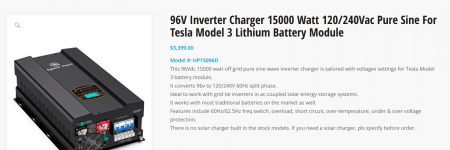
But as your system is a 12v based one in the vehicle- its always better to stay with that for that ability to 'self charge' the housebank while driving (and yes being able to self jumpstart is handy if you get a flat battery lol)- for really big systems in vehicles 48v is more common- but even thats not exactly common these days- offgrid housing in Australia is mostly 96v or high voltage DC hybrid systems (in the hundreds of volts 'powerwalls'- my 12kw 48v inverter was bought (back in 2019) at a 'half off' as 'new old stock' because its 48v, nobody wanted it lol- its newer version is the 96v 15kw one while motorhome stuff here is 24v (as thats what the truck/bus chassis they use are....)
1762942377127.png

Your system is so small- it makes no sense to go 48v- or even 24v- the bus is 12v, stay with that- it makes it all a lot easier in the end..... (if you were planning a 20kwh-50kwh battery bank and 10-15kw inverter then a 48v or higher system might make sense- at the sub 5kw level, its easier just to stay at the vehicle voltage and get that 'extra top up charging' while driving lol- at least that way you can use the wide range of native 12v stuff available for the automotive world- the cable runs and power limits on such a tiny system really make the 'voltage drop on the cables' thing a complete non factor in the system setup- high voltages only are needed for the multiple tens of kilowatts inverter levels, or for really LONG cable runs (like tens/hundreds of metres in a house- not an issue in a bus...)
 
You most certainly can use LFP batteries to jumpstart with- the biggest issue is cheap LFP with very cheap (and current limited) BMS circuitry... decent cells have no issues- indeed I have self jumpstarted from the ones in the ute (only 60Ah capacity, starting a diesel ute!!!) thats one advantage of that Kickase dual battery isolator, the one like I have in the ute and pictured above- a flat start battery, just pop the bonnet, flick that switch on the front, wait a minute or so, and turn the ignition key....

Replaced the old L/A flooded (200Ah) originally fitted under the tub floor
View attachment 65810
with a set of 60Ah LYP cells- which can yes, self jumpstart the ute, and give almost exactly the same runtime on the car fridge to boot lol (when the tub liner is fitted back in place- you don't even know they are there lol- 7kg of LYP replaced nearly 40k of L/A...
View attachment 65811

The voltage thing is a bit of a furphy- once you move away from the 12v automotive scene (especially in the US) the price of 24v stuff goes up quickly... at least in TROTW we have 24v trucks and motorhomes (RVs) that bring our 24v prices down for led lamps, stereos, tvs, microwaves etc...

But as your system is a 12v based one in the vehicle- its always better to stay with that for that ability to 'self charge' the housebank while driving (and yes being able to self jumpstart is handy if you get a flat battery lol)- for really big systems in vehicles 48v is more common- but even thats not exactly common these days- offgrid housing in Australia is mostly 96v or high voltage DC hybrid systems (in the hundreds of volts 'powerwalls'- my 12kw 48v inverter was bought (back in 2019) at a 'half off' as 'new old stock' because its 48v, nobody wanted it lol- its newer version is the 96v 15kw one while motorhome stuff here is 24v (as thats what the truck/bus chassis they use are....)
View attachment 65812

Your system is so small- it makes no sense to go 48v- or even 24v- the bus is 12v, stay with that- it makes it all a lot easier in the end..... (if you were planning a 20kwh-50kwh battery bank and 10-15kw inverter then a 48v or higher system might make sense- at the sub 5kw level, its easier just to stay at the vehicle voltage and get that 'extra top up charging' while driving lol- at least that way you can use the wide range of native 12v stuff available for the automotive world- the cable runs and power limits on such a tiny system really make the 'voltage drop on the cables' thing a complete non factor in the system setup- high voltages only are needed for the multiple tens of kilowatts inverter levels, or for really LONG cable runs (like tens/hundreds of metres in a house- not an issue in a bus...)
The LYP batteries aren't really available here at anywhere close to a competitive pricing. Lifepo4 has a few drawbacks but they're ubiquitous, fairly safe and are usually reasonably priced. I can buy good quality 5Kw server rack LIFEPO4 batteries at under $1000 US. Similar LYP batteries here if I could find them would be 3 times the price

I originally thought of being able to charge while driving was the way to go. (Using the alternator) But I concluded it's not worth the cost/risk. I've read lots of horror stories of ruining their Lifepo batteries and alternators. But why spend the money and risk it when the solar should be fine?
 
The LYP batteries aren't really available here at anywhere close to a competitive pricing. Lifepo4 has a few drawbacks but they're ubiquitous, fairly safe and are usually reasonably priced. I can buy good quality 5Kw server rack LIFEPO4 batteries at under $1000 US. Similar LYP batteries here if I could find them would be 3 times the price

I originally thought of being able to charge while driving was the way to go. (Using the alternator) But I concluded it's not worth the cost/risk. I've read lots of horror stories of ruining their Lifepo batteries and alternators. But why spend the money and risk it when the solar should be fine?
LYP is just the 'high temp' (or low temp) version of LFP (in fact they are almost identical with the exception of one doping additive to one of the plates- LFP is LiFePO4, LYP is LiFeYPO4...)

I use it due to the temperature extremes where I live- LFP (like L/A) needs to reduce its charging rate (and maximum discharge rate) above 40C (or below -10C) or you shorten the service life, LYP can handle temps up past 65C up to 85C (or below -10C down to -45C) at reduced rates... long after L/A or LFP has to stop.... and with my summer temps regularly in excess of 45C for weeks or even months on end at a time- the extra expense is worth it (if I had bought LFP, the price was about half- but I would also lose half the service life as well, and what service life I did get would be at both reduced storage capacity AND at reduced current limits to boot....

Hence in my case LYP makes the better economic sense.... (especially as this is going to be my 'forever' retirement home.... )

Again with the 'half truths' that some seem to like spreading about 'lithiums blows up your alternator!!!!!!!!!!! (add as many exclamation marks as you can lol)
No, no they don't- no more than any other LARGE CAPACITY storage bank (including L/A) does...
ALL standard automotive alternators are only rated at a 'partial duty cycle' for their full output- and large battery storage banks make them run at full output longer....
The only reason its more obvious with the lithium banks is they are just so much bigger than any previous chemistry fitted to mobile applications- a 20kWh LFP/LYP bank like mine can be carried in the back seat of a Mazda 3- along with a grumpy teenager- how do I know- thats how mine can home lol... its about quarter of a tonne... (250kg)
An equivalent L/A bank is well over a tonne (especially if you want it to last more than a few months before it needs replacing)- put that in the Mazda and the only place its going is to a wrecking yard!!!!!

The answer of course is to do what every person who has worked in the industry already knows (wonder who might be like that lol)- improve the cooling capacity of the alternator to improve its duty cycle- preferably to 100% then you can have truly massive battery storage capacity (be it L/A, LFP, LYP or powdered unicorn horns lol)

The battery bank of course can't be 'ruined' by using an alternator- its just electrons going in- they dont care HOW they are made lol.... (hell that set of LYP has been in use since 2016 in the ute- so thats 9 years of daily driving and some REALLY long trips, including a 'round Australia' trip over four months....)

Re 'server rack' batteries- I'd be checking around- most places they tend to be the MOST expensive way of buying storage- individual cells are cheapest (but you have to do all the work- assembly, fitting a BMS etc etc) then 'floor' mount' free standing batteries (4,8 or 16 series cells depending on voltage in a usually plastic or metal 'box') and 'rack mounts coming in last/most expensive...

I prefer individual cells myself- as they can be swapped out individually in the rare event one fails, unlike many sealed 'battery' pack ones, plus you can see what you are getting (unlike the sealed ones again, where you have no idea of the cell manufacturer...) I like my Winstons for the LYP's, and EVE for LFP, BYD make the best 'prebuilt' powerwall style systems, CATL are reasonable quality for LFP as well, but not quite as good as EVE imho.... In Australia the Kings brand '12v battery' ones have a pretty good reputation (especially for their price lol) not the best overall, but good value for money and can cop a hiding in the offroading world (popular for boats and 4wds where physical abuse ie rough ride/impacts can cause some brands to fail prematurely)
 
LYP is just the 'high temp' (or low temp) version of LFP (in fact they are almost identical with the exception of one doping additive to one of the plates- LFP is LiFePO4, LYP is LiFeYPO4...)

I use it due to the temperature extremes where I live- LFP (like L/A) needs to reduce its charging rate (and maximum discharge rate) above 40C (or below -10C) or you shorten the service life, LYP can handle temps up past 65C up to 85C (or below -10C down to -45C) at reduced rates... long after L/A or LFP has to stop.... and with my summer temps regularly in excess of 45C for weeks or even months on end at a time- the extra expense is worth it (if I had bought LFP, the price was about half- but I would also lose half the service life as well, and what service life I did get would be at both reduced storage capacity AND at reduced current limits to boot....

Hence in my case LYP makes the better economic sense.... (especially as this is going to be my 'forever' retirement home.... )

Again with the 'half truths' that some seem to like spreading about 'lithiums blows up your alternator!!!!!!!!!!! (add as many exclamation marks as you can lol)
No, no they don't- no more than any other LARGE CAPACITY storage bank (including L/A) does...
ALL standard automotive alternators are only rated at a 'partial duty cycle' for their full output- and large battery storage banks make them run at full output longer....
The only reason its more obvious with the lithium banks is they are just so much bigger than any previous chemistry fitted to mobile applications- a 20kWh LFP/LYP bank like mine can be carried in the back seat of a Mazda 3- along with a grumpy teenager- how do I know- thats how mine can home lol... its about quarter of a tonne... (250kg)
An equivalent L/A bank is well over a tonne (especially if you want it to last more than a few months before it needs replacing)- put that in the Mazda and the only place its going is to a wrecking yard!!!!!
Except, I can't seem to find K
The answer of course is to do what every person who has worked in the industry already knows (wonder who might be like that lol)- improve the cooling capacity of the alternator to improve its duty cycle- preferably to 100% then you can have truly massive battery storage capacity (be it L/A, LFP, LYP or powdered unicorn horns lol)

The battery bank of course can't be 'ruined' by using an alternator- its just electrons going in- they dont care HOW they are made lol.... (hell that set of LYP has been in use since 2016 in the ute- so thats 9 years of daily driving and some REALLY long trips, including a 'round Australia' trip over four months....)

Re 'server rack' batteries- I'd be checking around- most places they tend to be the MOST expensive way of buying storage- individual cells are cheapest (but you have to do all the work- assembly, fitting a BMS etc etc) then 'floor' mount' free standing batteries (4,8 or 16 series cells depending on voltage in a usually plastic or metal 'box') and 'rack mounts coming in last/most expensive...

I prefer individual cells myself- as they can be swapped out individually in the rare event one fails, unlike many sealed 'battery' pack ones, plus you can see what you are getting (unlike the sealed ones again, where you have no idea of the cell manufacturer...) I like my Winstons for the LYP's, and EVE for LFP, BYD make the best 'prebuilt' powerwall style systems, CATL are reasonable quality for LFP as well, but not quite as good as EVE imho.... In Australia the Kings brand '12v battery' ones have a pretty good reputation (especially for their price lol) not the best overall, but good value for money and can cop a hiding in the offroading world (popular for boats and 4wds where physical abuse ie rough ride/impacts can cause some brands to fail prematurely)
Now you have nailed the problem. There is so much disinformation out there. I shouldn't have to be an electrical expert or spend a fortune to do this right. I know more than most on this stuff. But certainly not enough to weed out the BS. The not jumping a lead acid starting battery didn't make much sense to me because there are lots of people using little lithium ion jump starting packs these days. But I had been told it could ruin the BMS in my house bank.

I was tempted a while back to build a battery from cells because that used to be the most cost effective way to build a battery bank. But it isn't anymore. At least not in the States. I think in Australia you can buy products from China we just can't get in the US and if we can, they are overpriced.
 
Except, I can't seem to find K

Now you have nailed the problem. There is so much disinformation out there. I shouldn't have to be an electrical expert or spend a fortune to do this right. I know more than most on this stuff. But certainly not enough to weed out the BS. The not jumping a lead acid starting battery didn't make much sense to me because there are lots of people using little lithium ion jump starting packs these days. But I had been told it could ruin the BMS in my house bank.

I was tempted a while back to build a battery from cells because that used to be the most cost effective way to build a battery bank. But it isn't anymore. At least not in the States. I think in Australia you can buy products from China we just can't get in the US and if we can, they are overpriced.
Thats what you get when you get morons running the country....
:mad:
The US is already decades behind 'TROTW' in so many aspects, and falling ever further behind- the xenophobia that is SOOOO common in the US public and government only hurts the US...

Which is why the 'electric revolution' is going on without the US- far from being the 'world leaders' in most of this stuff, the US is usually being laughed at- between the false info being fed to the US consumers (usually by your companies) that runs counter to what TROTW experiences, and your huge prices making it simply uneconomic to even try in many cases in the US, renewables simply aren't getting a fair run there- and I don't see that changing anytime soon.....

As an example, the gridtie system I had at the previous house cost $4k Au for a 6kw system, and literally zero'd our electricity bill (in fact we often GOT a bit of money back from the electricity company...) today I can get a 10kw gridtie system for not much more...
1762969289888.png
6.6kw for $3781Au fully installed, no more to pay, that would generate here about 35-36kWh a day...
Thats $2474.56 US- for a system fully installed, no more to pay, up and running that would completely zero most Australian homes electricity bills....
1762969409770.png

I usually hear the US prices being ten times that- or more....

Someone is being ripped off....
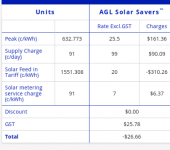
(the last electricity bill from the old place)
1762969642864.png
From a 6kw system, installed in 2016...
1762969708982.png
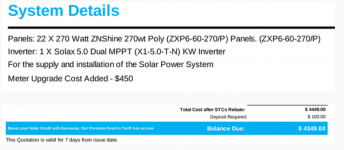
The meter box upgrade ($450) wasn't a legal requirement, but it was a very dated 1960's ceramic fuse fusebox, and as they had to pull it to pieces anyway, made sense to pay the extra and get it upgraded to a new 'guts' with ELB protection etc
1762969873403.png
I still hear people from the US (mostly on the right, where 'facts' seem to be whatever they say they are) babbling on about how 'panels only last ten years' or similar- where in Australia we have been using solar in gridties from the mid 1990's, and offgrid a decade earlier!!!!

If they only lasted ten years- we'd know about it- hell in my family along we have my uncles (1999, in Newington, part of the 2000 Sydney 'Green Olympics' village built for the games, my mothers installed in 1997, and my own first offgrid panels (first installed in 1984!!! all of which are still running fine...)- if the 'only lasts 10-15-20 years' brigade were right, none of those would still be working, and yet they are....
 
Last edited:
Thats what you get when you get morons running the country....
:mad:
The US is already decades behind 'TROTW' in so many aspects, and falling ever further behind- the xenophobia that is SOOOO common in the US public and government only hurts the US...

Which is why the 'electric revolution' is going on without the US- far from being the 'world leaders' in most of this stuff, the US is usually being laughed at- between the false info being fed to the US consumers (usually by your companies) that runs counter to what TROTW experiences, and your huge prices making it simply uneconomic to even try in many cases in the US, renewables simply aren't getting a fair run there- and I don't see that changing anytime soon.....

As an example, the gridtie system I had at the previous house cost $4k Au for a 6kw system, and literally zero'd our electricity bill (in fact we often GOT a bit of money back from the electricity company...) today I can get a 10kw gridtie system for not much more...
View attachment 65835
6.6kw for $3781Au fully installed, no more to pay, that would generate here about 35-36kWh a day...
Thats $2474.56 US- for a system fully installed, no more to pay, up and running that would completely zero most Australian homes electricity bills....
View attachment 65836

I usually hear the US prices being ten times that- or more....

Someone is being ripped off....
(the last electricity bill from the old place)
View attachment 65837
From a 6kw system, installed in 2016...
View attachment 65838
The meter box upgrade ($450) wasn't a legal requirement, but it was a very dated 1960's ceramic fuse fusebox, and as they had to pull it to pieces anyway, made sense to pay the extra and get it upgraded to a new 'guts' with ELB protection etc
View attachment 65839
I still hear people from the US (mostly on the right, where 'facts' seem to be whatever they say they are) babbling on about how 'panels only last ten years' or similar- where in Australia we have been using solar in gridties from the mid 1990's, and offgrid a decade earlier!!!!

If they only lasted ten years- we'd know about it- hell in my family along we have my uncles (1999, in Newington, part of the 2000 Sydney 'Green Olympics' village built for the games, my mothers installed in 1997, and my own first offgrid panels (first installed in 1984!!! all of which are still running fine...)- if the 'only lasts 10-15-20 years' brigade were right, none of those would still be working, and yet they are....
Don't get me started! Every time I think we have reached peak xenophobia, they prove me wrong. American consumers are getting screwed over and over.

I know better than that on solar. The panels do degrade over time, but only a tiny amount. Maybe 1/2 to 3/4 a percent per year. Who cares if those $400US 275 watt panels from 2005 max out at 220 watts today? Especially since I can buy 450 watt panels the same dimensions for under $200US today. And I don't need to replace. I can just make up the loss by adding a couple of panels and I'm basically back at square one.

Interestingly, you can buy great used panels super cheap from commercial solar farms replacing solar panels after 5 or 10 years because they can generate more power on the same farm with new panels. I could have bought 100ea 275 watt panels last year for $30 each. But I would have to buy them in lots of a 100 panels
 
The Atlantic: China’s EV Market Is Imploding:

In China, you can buy a heavily discounted “used” electric car that has never, in fact, been used. Chinese automakers, desperate to meet their sales targets in a bitterly competitive market, sell cars to dealerships, which register them as “sold,” even though no actual customer has bought them. Dealers, stuck with officially sold cars, then offload them as “used,” often at low prices. The practice has become so prevalent that the Chinese Communist Party is trying to stop it. Its main newspaper, The People’s Daily, complained earlier this year that this sales-inflating tactic “disrupts normal market order,” and criticized companies for their “data worship.”

This sign of serious problems in China’s electric-vehicle industry may come as a surprise to many Americans. The Chinese electric car has become a symbol of the country’s seemingly unstoppable rise on the world stage. Many observers point to their growing popularity as evidence that China is winning the race to dominate new technologies. But in China, these electric cars represent something entirely different: the profound threats that Beijing’s meddling in markets poses to both China and the world.

Bloated by excessive investment, distorted by government intervention, and plagued by heavy losses, China’s EV industry appears destined for a crash.
 
Don't get me started! Every time I think we have reached peak xenophobia, they prove me wrong. American consumers are getting screwed over and over.

I know better than that on solar. The panels do degrade over time, but only a tiny amount. Maybe 1/2 to 3/4 a percent per year. Who cares if those $400US 275 watt panels from 2005 max out at 220 watts today? Especially since I can buy 450 watt panels the same dimensions for under $200US today. And I don't need to replace. I can just make up the loss by adding a couple of panels and I'm basically back at square one.

Interestingly, you can buy great used panels super cheap from commercial solar farms replacing solar panels after 5 or 10 years because they can generate more power on the same farm with new panels. I could have bought 100ea 275 watt panels last year for $30 each. But I would have to buy them in lots of a 100 panels
Funnily enough, thats what my own 18kw of panels are- second hand gridtie panels from an installer- paid $1960 for 72x 250w panels- got $2k out of the bank, put $40 of diesel in my tilt-try, and the rest went on panels lol
1762974599134.png
$27 each lol
Now to finish the house so i can get them out of the shed and onto the roof of the house....
(6 of them are currently running this system in the shed lol)
 
Funnily enough, thats what my own 18kw of panels are- second hand gridtie panels from an installer- paid $1960 for 72x 250w panels- got $2k out of the bank, put $40 of diesel in my tilt-try, and the rest went on panels lol
View attachment 65844
$27 each lol
Now to finish the house so i can get them out of the shed and onto the roof of the house....
(6 of them are currently running this system in the shed lol)
I came close to buying the 100 panels. But it would mean getting to work building the ground mounted racks and cutting a lot of trees down. I was too busy and knew the panels would sit for a while. So I get it.
 
The Atlantic: China’s EV Market Is Imploding:


Whether that's a sign of real trouble depends on how prevalent it is, and the article doesn't go into specifics except to suggest the CCP disapprove and are trying to shame dealers out of doing it.

Pre-registered cars have been a thing in the UK market for many years and I rather assumed they were elsewhere too. Dealers register new cars to themselves (so they can then only sell them as used) in order to meet sales targets. If the benefit of meeting the target is a better incentive than the hit they take on the sales price of the cars it makes sense for them. It seems stupid, but perverse incentives abound and they aren't always a sign of trouble looming.

If it gets so prevalent that pre-registering is keeping needless production going and unsellable cars are piling up then China has a real problem.
 
Whether that's a sign of real trouble depends on how prevalent it is, and the article doesn't go into specifics except to suggest the CCP disapprove and are trying to shame dealers out of doing it.

Pre-registered cars have been a thing in the UK market for many years and I rather assumed they were elsewhere too. Dealers register new cars to themselves (so they can then only sell them as used) in order to meet sales targets. If the benefit of meeting the target is a better incentive than the hit they take on the sales price of the cars it makes sense for them. It seems stupid, but perverse incentives abound and they aren't always a sign of trouble looming.

If it gets so prevalent that pre-registering is keeping needless production going and unsellable cars are piling up then China has a real problem.
Considering the source (US media) and that China's car industry is struggling to meet demand in other countries- find it extremely unlikely its factual....
Sounds more like yet another US xenophobic scare story....
 
I came close to buying the 100 panels. But it would mean getting to work building the ground mounted racks and cutting a lot of trees down. I was too busy and knew the panels would sit for a while. So I get it.
Not a big fan of ground mounts (and yes I know I am currently using a pair lol)
Roof mounts are far preferable imho- ground mounts need constant cleaning, roof mounts hardly ever so....
(even the scarce rainfall around here is more than sufficient to keep them clean, where ground mounts here need cleaning every few weeks.....)

Problem is most dust is carried within a metre or so of the ground by the wind- so it is better to have the panels well above this, keeps the dust off them....
 
Considering the source (US media) and that China's car industry is struggling to meet demand in other countries- find it extremely unlikely its factual....
Sounds more like yet another US xenophobic scare story....

If so Russia is in on it. Claims of dumping scads of vehicles more than potential sales, poor quality, poor service network if any at all. And the screens are only in Chinese so it's useless unless you read that.

The trucks are suffering the same in addition to low performance compared to current diesel and frames cracking.
Russian conditions are more severe than other nations, the winters far more severe.
(to be fair these haven't had decades to be adapted to that severe cold)
Supposedly they have been taken off the road legally.

I know better than to outright trust Russian news but it's not just thier word on it. They aren't working recently.
 
Not a big fan of ground mounts (and yes I know I am currently using a pair lol)
Roof mounts are far preferable imho- ground mounts need constant cleaning, roof mounts hardly ever so....
(even the scarce rainfall around here is more than sufficient to keep them clean, where ground mounts here need cleaning every few weeks.....)

Problem is most dust is carried within a metre or so of the ground by the wind- so it is better to have the panels well above this, keeps the dust off them....
Depends on where you live. It is so green here that there is very very little exposed soil. It also rains here a lot. Most dust gets rinsed off quickly. Spring is tough because green pollen from the trees coats almost everything after a few weeks.
 
I forgot to ask, in the UK or Scandinavian areas, is there a decent service network for Chinese vehicles?
 
I have an MG4. The dealers aren't the best in the world, lots of complaints about difficulty getting them to do the work, but on the other hand some of them are very helpful. There's certainly a good-sized network, and MG has just opened a new parts warehouse in Daventry.
 
Considering the source (US media) and that China's car industry is struggling to meet demand in other countries- find it extremely unlikely its factual....
Sounds more like yet another US xenophobic scare story....
The Atlantic is usually pretty reliable. And they do cite Chinese sources for this report.

If I were to guess I'd say Chinese manufacturers are struggling to meet foreign demand because other countries have more demanding quality and safety standards.
 
For FAW in its ill fated attempt to build in Mexico they could import cars for one year and after that had to assemble them here.
Imports could be last years Chinese model but domestic made had to meet Mexican safety standards. That wasn't a lot but enough to add costs.

That ended when FAW couldn't get tax exemptions on all imports. The entire deal collapsed.
 
Last edited:
BYD didn't have any trouble meeting Australian Ancap safety ratings- they got 5 star ratings on every single model with them all rating 85% or higher- the newer ones rated over 90%!!!(mind you the RAM 1500 which is currently about the only US manufactured vehicle imported into Australia and even that is in tiny numbers) didnt rate above 76% for the 2025 model...
:jaw-dropp
 

Back
Top Bottom