I'm not saying that the stories are connected, what I'm saying is the hairy man or deceiver/mischief maker is an archetype that generates these various legends. It comes from the human psyche, not necessarily shared culture. I think it originates from a fear of insanity that people mistook for spirit possession before we had modern medicine or even understood the concept of mental health. You could also equate it with the magician, the archetype that seeks transformation since these legendary creatures are considered a mix between animal or human. Now other than being super tall there is very little difference between the story of King Kong and bigfoot. King Kong predates bigfoot by 30 years but it's essentially the same exact story ( big hairy monster running wild ).
I honestly don't think it comes from any one place, really. As has been mentioned earlier, a lot of depictions of "wild" men came from various places, and in some cases they were stories put out there to make a certain type of person seem uncouth and savage, it didn't literally mean that these people were ape-men or monsters, just that they were thought of as being less civilized. The Irish were depicted exactly like that by the English for a long time, even being shown in illustrations as wild, drunken ape-men:
https://thesocietypages.org/socimages/2011/01/28/irish-apes-tactics-of-de-humanization/
The thing to note in much of this "history" is that the press were nothing but a few drunks looking to sell stories, whether they actually had a story or not, which isn't too dissimilar from certain tabloids of today. An escaped chimp suddenly became a wild monster, wreaking havoc on unsuspecting virgins, eating unfaithful men and other such nonsense.
These stories come from so many different places, for many different reasons, and a lot of them are essentially fabricated to scare a younger generation. Monsters don't tend to change all that much from generation to generation. We've always had actual "monsters" in our very own towns and cities; child-killers being a very common form of that monster, and stories were created to explain how a regular person could be such a deviant, think Jekyll and Hyde, which ironically coincided on the London stage with the Whitechapel murders of 1888, that in itself fed the stories of Jack the Ripper, who was depicted in the press as a ghoul and a monster, probably also in turn fed by stories of Spring-Heeled Jack, and the "London Monster" from a century before in 1788. Things are connected for the sake of being connected, we see patterns and we go with it.
I don't agree re: King Kong being similar to Bigfoot in any way, really. One was an giant ape living in a far-off jungle island, brought by curiosity to the US to make money, whereas the other one is a confused story of a large ape-man who wanders around the forests leaving footprints in its wake.
A "big hairy monster" is so vague a description that it can encompass many unconnected stories throughout our history. Spiders are also something we envision as being "big hairy monsters," "Where the Wild Things are" is another famous depiction of big hairy monsters, it's just a combination of all of our fears: savage, hairy, smelly, uncivil beasts.



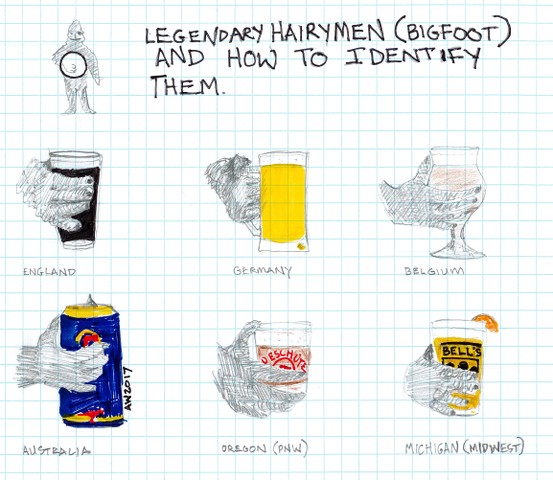

 That's probably the funniest one you've ever drawn.