• Quick note - the problem with Youtube videos not embedding on the forum appears to have been fixed, thanks to ZiprHead. If you do still see problems let me know.

"Futurists" from 1967 discuss their predictions for the 21st century

bigred

Penultimate Amazing
Joined
Jan 19, 2005
Messages
22,639
Location
USA
Wasn't sure where to put this. Just thought it was interesting:
I always thought it would be a kick to be able to go back in time and talk to these people, knowing what's what in 2025. Of course if you tell them that, you'd be dismissed as nuts, but as you describe what you know, I felt it might at least strike them as interesting. None really came close to predicting the impact computers would have on our lives...to them it was all still big hulking things that only the govt and big corps owned.
 
I have a few books on future speculation. The best one is perhaps July 20, 2019 by Arthur C. Clarke. It was written in 1986 and projected what life would be like on the 50th anniversary of the first Moon walk. I reread it on that date and while a few things were spot on, much was radically underestimated.
 
I find it interesting how things like the Dick Tracy watch was proposed, yet do you think they imagined an Apple Watch with over 5 billion transistors? I worked on circuit boards with a dozen discrete transistors and marveled at how far we had come from vacuum tubes.
 
What gets me is how no-one predicted radio-networked general-purpose computers in everyone's pockets, connected to a vast store of human knowledge and entertainment. And yet this is one of the defining features of our age.
 
What gets me is how no-one predicted radio-networked general-purpose computers in everyone's pockets, connected to a vast store of human knowledge and entertainment. And yet this is one of the defining features of our age.
I imagine many would have thought of it, but would have placed it a full century or two away, not just a few decades.
 
I like to refer to these predictions of the future from years ago as "Days of Future Passed." I note that some predictions are pretty good while others, not so much. There are a couple people warning about future wide-scale catastrophes from famine (which have not occurred). The science editor of the Times muses on a fusion reactor (still waiting on that one), but does go on to talk about the promise of batteries and fuel cells reducing air pollution. Buckminster Fuller postulates a black box which will take care of our every need (including recycling human waste). Herman Kahn discounts the possibility that China would emerge as a world power, and speculates that Japan's rapidly growing economy will continue to the end of the 20th century (they fell about a decade short).
 
I imagine many would have thought of it, but would have placed it a full century or two away, not just a few decades.
And I'm sure there have been many fiction stories which featured it, but as a prediction of the fairly near real future? Yeah, I don't think anyone got that one.
 
And I'm sure there have been many fiction stories which featured it, but as a prediction of the fairly near real future? Yeah, I don't think anyone got that one.
I think I mentioned elsewhere only recently getting around to reading Azimov's Foundation. 10,000 years in the future men will still get their information from newspapers, will pay for stuff with metal coins and will smoke countless cigars. And yes it's men. I think there are two female characters, one has a name but gets no dialogue and another is unnamed but about 90% of the way through the story gets to briefly scold her husband.
 
And I'm sure there have been many fiction stories which featured it, but as a prediction of the fairly near real future? Yeah, I don't think anyone got that one.
Heinlein had an artificially intelligent computer in The Moon is a Harsh Mistress, set in 2075, written in 1966.
 
Heinlein had an artificially intelligent computer in The Moon is a Harsh Mistress, set in 2075, written in 1966.

True, but that one acquired intelligence unintentionally, by serendipitous chance. No one in the setting (not even the AI computer itself) knew how to build one that way on purpose.

ETA: Accidental AI was a bit of a trope around that time. Bradbury and Clarke both wrote short stories (Bradbury's unpublished) about the telephone system spontaneously gaining sentience. (So many switches; how could it not?) Colossus's sentience in the 1966 novel and 1970 movie, depicted in nearly the present day, was also accidental. Spontaneous "emergent" AI's also showed up later in cyberpunk (e.g. Neuromancer), the Ender series, etc.
 
Last edited:
What gets me is how no-one predicted radio-networked general-purpose computers in everyone's pockets, connected to a vast store of human knowledge and entertainment. And yet this is one of the defining features of our age.
It's almost like predicting the future is hard, or something.

I think I mentioned elsewhere only recently getting around to reading Azimov's Foundation. 10,000 years in the future men will still get their information from newspapers, will pay for stuff with metal coins and will smoke countless cigars. And yes it's men. I think there are two female characters, one has a name but gets no dialogue and another is unnamed but about 90% of the way through the story gets to briefly scold her husband.
It was jarring to hear all of the men in this video referring to "man" meaning all of humankind. I may just be sensitive to it, but I very much noticed it, and the fact that there was not a single woman in the whole piece. 1967 wasn't all that long ago. I'm glad we've progressed as far as we have since then.
 
What gets me is how no-one predicted radio-networked general-purpose computers in everyone's pockets, connected to a vast store of human knowledge and entertainment. And yet this is one of the defining features of our age.

"Riding the Torch" by Norman Spinrad in 1972 came (IMHO) interestingly close. His version uses a neural interface ("tap") instead of a handheld device. Some moments seem quite prescient; for instance, a celebrity makes a joking remark and there's a pause in the conversation while everyone "taps for the reference" (cf: checking their phones, or googling during a live chat). In other ways he was dead wrong; in his future the tap's development reunited a society that had been hopelessly fractured, instead of the reverse.
 
1967 wasn't all that long ago.
I disagree. 58 years is a long time, at least technologically speaking in modern times. The extreme technological changes since then bear that out. I do think this discussion would have been different 10 or perhaps even as little as 5 yrs later, as the whole 60s cultural changes thing was just getting into full swing at the time, so that would have had more focus I think.

As for progress socially, in some ways we have, in some we have not, or have even regressed.
 
I think I mentioned elsewhere only recently getting around to reading Azimov's Foundation. 10,000 years in the future men will still get their information from newspapers, will pay for stuff with metal coins and will smoke countless cigars. And yes it's men. I think there are two female characters, one has a name but gets no dialogue and another is unnamed but about 90% of the way through the story gets to briefly scold her husband.
Arkady Darell is a 14-year-old girl who is a significant character in both Foundation and Empire and Second Foundation.
 
Where's my flying car? I've been promised a flying car for the past 50 years or so and I still can't buy one!

It's my impression that many futurologists predicted flying cars as very common by now, but most missed the computer revolution.
 
I think I mentioned elsewhere only recently getting around to reading Azimov's Foundation. 10,000 years in the future men will still get their information from newspapers, will pay for stuff with metal coins and will smoke countless cigars. And yes it's men. I think there are two female characters, one has a name but gets no dialogue and another is unnamed but about 90% of the way through the story gets to briefly scold her husband.
Second Foundation's main protagonist is a teenage girl.
 
Where's my flying car? I've been promised a flying car for the past 50 years or so and I still can't buy one!

It's my impression that many futurologists predicted flying cars as very common by now, but most missed the computer revolution.
1967 is really just on the cusp of the revolution that the invention of the MOS transistor kicked off.
 
Where's my flying car? I've been promised a flying car for the past 50 years or so and I still can't buy one!

It's my impression that many futurologists predicted flying cars as very common by now, but most missed the computer revolution.

Here you go:

 
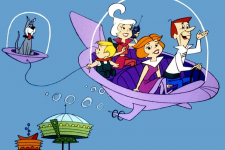
I heard various companies had looked at it, but couldn't get "Jane stop this crazy thing!" out of their heads and thought better of it :)
 
Where's my flying car? I've been promised a flying car for the past 50 years or so and I still can't buy one!

It's my impression that many futurologists predicted flying cars as very common by now, but most missed the computer revolution.
Close.


Back
Top Bottom