Split Thread The validity of classical physics (split from: DWFTTW)

Status
Not open for further replies.
Well we are getting into subtleties now. My claim is that surface moving under zero wind is identical to wind moving over a stationary surface. Yes if you decide one of those surfaces is the surface of the Earth (which happens NOT to represent an inertial frame) you'll run into problems.
No. As Drela says, it is conditional. The actual gradient will not be reproduced.
This would be a limitation (though perhaps acceptable) in the case of an object being dragged through the air by a belt or some other means of creating relative motion.

The treadmill fails, because the object does not move with the belt, but opposes it. This creates the paradoxical situation, where the belt's laminar flow (a partial recreation of the real world gradient) is in the wrong direction to that of the real wind. This has been often mentioned. The treadmill is the wrong way, and that allows the rather odd balance situation to leave the cart stationary.

I think my statement above is 100% accurate. I'll be very surprised if you disagree with it.

Try me.
 
I know that. Why do you insist that I do not. Answer: It does not fit your model.
Your original comment was:
The mass and shape do affect the outcome, yet it would seem odd that all objects can jump from being almost stationary, to being able to accelerate to waterspeed.
I am having a hard time understanding what you find odd about objects being acted upon by a force (the drag from the surrounding water) accelerating from rest. How is this fundamentally different from an object at rest suddenly being accelerated by gravity?
Please let me know when the force of gravity disappears.
It doesn't. Neither does the force from the flowing water. However, while the object is being held, that force balances the gravitational pull. Similarly, when it is dropped through a medium like air, the drag of the air (increasing with the relative velocity of the object through it) eventually balances the force of gravity, and acceleration ceases -- the object falls at a constant speed ("terminal velocity"). In the case of the flowing water, the relative velocities are highest when the object is first placed in the water, leading to the highest force. As it accelerates closer to the speed of the water, this tends toward zero, at which point acceleration ceases -- the object travels at a constant speed (the speed of the surrounding water).

OK, I will try to answer that, but first a question.
I don't believe you ever got around to answering that.
A physicist friend of mine once argued to his father, that if you push with your finger long enough upon an oil tanker, it will accelerate to a velocity of your choosing.
Correct or not?
That was answered in the message you quoted. In an idealized scenario absent frictional forces, yes. In the real world, no, due to frictional forces exceeding that which could be overcome by the force of a finger. What is your point?

[Aircraft carriers and supertankers] have engines.
Complete non-sequitur. Are you suggesting that they are not subject to the same effects from currents if they are coasting?

Interestingly, because of rising fuel costs, ships are now being modified for even lower drag. An estimated 10% saving. What do you say to that?
I say that's an admirable and utterly obvious goal. What the hell does it have to do with anything we're discussing??

This is baby physics.
Well, we keep trying to make it simple enough for you to understand (or to understand your objections), but we're apparently failing.

What you fail to see, is that in the real world, there are always opposing forces, and the driving forces are complex. To avoid them, requires and artificial environment, and gravity is all but inescapable.
Everyone here acknowledges that the real world differs (generally in quantifiable and acceptably minor ways) from an idealized one. What is your point? I still would like to know the magnitude of error you believe these complex forces (which we ALL acknowledge exist) impart, compared to the idealized case. For a specific example, suppose a constant 10 m/s flow of water down a canal. Everyone here maintains that a floating body of reasonable mass (say 10 kg, if you'd like a specific value) will quickly approach 10 m/s relative to shore, and remain at that speed. If all of your arguments have been to claim that it will really only be 9.99 or 9.98 m/s, then let's all just agree and move on, shall we? If you're claiming that it will fall significantly short of water speed (say, 9.5 m/s or less), then we still have a disagreement, and you'll have to explain why you believe this to be possible. That's a pretty easy question to answer, I would think. Somehow, though, I doubt you will favor us with a straightforward answer. Is the error from the ideal as much as one part in a thousand?

Tunny
 
I agree completely. Another way to do it would be to put the treadmill in the middle of a gym, and to surround it with a bunch more treadmills, all running the same direction. The airport people-mover conveyor, if can can manage to arrange to test on that, would be somewhat "better" than the home treadmill.
That would make a longer, but equally flawed model. It will not address the major issues, of the third dimension or reversal of flow.

Absolutely. (Depending on who you mean by "we all", of course.) How closely it matches the outdoors is simply a matter of how big the moving surface is compared to the cart, not whether it's the surface or the air that's "moving".

"We all" is defined as "you." Your remarks expose the bias in the questions you posed to Dr Drela.
The width has some effect of course, and the length will limit time variant parameters such as acceleration or distance covered, but that is all.
 
The treadmill fails, because the object does not move with the belt, but opposes it. This creates the paradoxical situation, where the belt's laminar flow (a partial recreation of the real world gradient) is in the wrong direction to that of the real wind. This has been often mentioned. The treadmill is the wrong way, and that allows the rather odd balance situation to leave the cart stationary.

I believe that I have said in the past that explaining the cart by likening the prop to a pair of iceboats sailing a helical path around a cylinder is, though correct, not usually a helpful explanation because it requires that the listener be capable of three-dimensional spatial imaging, which is something that many people struggle with.

Here we have evidence of someone who has no grasp of a one-dimensional situation. Not worth further discussion.
 
Well we are getting into subtleties now. My claim is that surface moving under zero wind is identical to wind moving over a stationary surface.

There are still subtleties if one wants to nitpick - for example "zero wind" means what, precisely? There will be some velocity gradients in the air flow (in both cases, of course).

One precise statement is that if those two situations are related by a boost (i.e. a change of inertial reference frame) then the velocity gradients are absolutely identical in every way.
 
Last edited:
spork: I think my statement above is 100% accurate. I'll be very surprised if you disagree with it.

humber: Try me

Clearly I was not speaking to you. You're on fast-scroll. I've made it clear that I don't expect you to agree with anything said by any sane person. This is why I keep asking if you agree with my assertion that 2 + 2 = 4

Even there you refuse to be willing to establish that there is ANY POINT where you could possibly have common ground with any sane person.

No matter.
 
By now humber made it more than clear that he will never ever accept any proof or reference that differs from his broken understanding, no matter how correct that given proof is. He just don't want to accept the reality.

No matter what people come up with, he outright rejects it. Even worse, he twists the meaning in a try to make it fit his broken physics world. Needless to say that he is doomed to failure with that approach each and every time. All that while he himself refuses to give any proof, evidence or references at all. Of course he can't give any, so he tried to blame us for that.

If humber would insist that the sky is pink with green dots, while all others say it is blue, there would be no thing on earth that could change his mind. One could measure it and he would blame that person of "experimental fitting". One could ask an expert, he would accuse that person of asking the wrong question. No matter what one tries, he will continue to refuse it.

His ramblings are so far out of reality, it ain't no fun anymore. Either he is playing a really silly game on us, or he is just incapable of comprehending even the simplest things.
 
Last edited:
His ramblings are so far out of reality, it ain't no fun anymore. Either he is playing a really silly game on us, or he is just incapable of comprehending even the simplest things.


Heck, as far as I know he thinks we all agree with him. Certainly that's his take on any documentation or quotes we've provided by any reference or expert that 100% disagrees with him.
 
The treadmill fails, because the object does not move with the belt, but opposes it. This creates the paradoxical situation, where the belt's laminar flow (a partial recreation of the real world gradient) is in the wrong direction to that of the real wind...
What?
Take a look at what you drew (correctly): Boundary layers for both situations in the lower two figures.
attachment.php

Now tell me how they are different, because I can't see it. Both depict flow over a surface from left to right, and in both situations the flow speed is zero relative to the surface at the surface.

This has been often mentioned. The treadmill is the wrong way, and that allows the rather odd balance situation to leave the cart stationary.
No, it's you who has it the wrong way. Just think about this systematically and without bias, that's how I figured it out.

Happy new year.
 
Belt generated wind flows in the wrong direction.
You've said something like this in several recent posts but I have no idea what you mean. So how about giving me a completely unambiguous explanation of exactly what is in the "wrong direction". You don't have to say why it happens for now, I just want to see the direction.

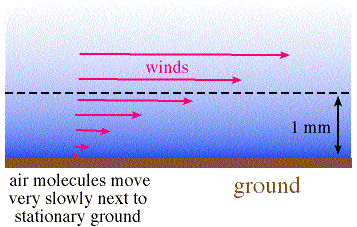
Diagrams would probably be best, one showing the ground/air interface where there is "real wind" moving (say left to right) over "still ground", and another showing the belt/air interface on the treadmill with the belt moving right to left under "still air". Please use reference frames that put the ground at rest in the first case, and the belt at rest in the second. That will make it clear what is different in direction of the apparent wind.

The diagram below is roughly what I expect to see for both cases (ground or belt). The point that others are discussing is that the magnitude (length) of the arrows might not be exactly the same in the two cases (ground versus relatively small treadmill), even though the direction will still be correct.

internal_frict.free.gif


Now humber, you are saying something is in the wrong direction, and I want to know what that is. In other words, which arrows in the diagram are you saying should be reversed (or pointing somewhere else altogether?) if the ground is replaced by the belt?. Note the arrows show air velocity relative to the ground/belt (which we're showing as stationary in the diagram because we've chosen a reference frame to make that happen) and (just to be clear and complete) the length of the arrows represent the relative speed of the air at that height above the belt (or ground).
 
spork: I think my statement above is 100% accurate. I'll be very surprised if you disagree with it.

A foregone forlorn conclusion.

humber: Try me

Clearly I was not speaking to you. You're on fast-scroll. I've made it clear that I don't expect you to agree with anything said by any sane person. This is why I keep asking if you agree with my assertion that 2 + 2 = 4

That never stopped you, Spork, but you two girls carry on chatting.
I don't think that is an assertion, you have there BTW.

Even there you refuse to be willing to establish that there is ANY POINT where you could possibly have common ground with any sane person.
No matter.

You are doing it again, hiding behind a skirt.

It's amazing. The use of my language is expanding. Even Dr Drela "hover" "wheelslip" and now "fast-scroll".
 
What?
Take a look at what you drew (correctly): Boundary layers for both situations in the lower two figures.
Happy New Year, to you, H'ethetheth.

Now tell me how they are different, because I can't see it. Both depict flow over a surface from left to right, and in both situations the flow speed is zero relative to the surface at the surface.

No, it's you who has it the wrong way. Just think about this systematically and without bias, that's how I figured it out.

Happy new year.

Yes, H'ethetheth. The profiles are the same. The average velocity of the real drag porfile is opposite to the cart. Look at the arrows.

In real downwind, the wind near the road interface lags the real wind, but the average is still downwind, in the direction of the cart

Not so on the belt. The flow follows the belt, it sticks to it, and flows against the cart.
Video #7 kindly shows this. The paper moves to the left opposite the cart.
That will not happen in real wind.

So how can the laminar flow move opposite to the supposed tailwind?

That is a clue as to what is really happening.
 
That is a clue as to what is really happening.

That's the best laugh I've had today. If there's one thing you've made clear in your 1000+ posts, it's that you definitely don't have a clue as to what is really happening.
 
So how can the laminar flow move opposite to the supposed tailwind?
Relative to the belt, the laminar flow is moving in the same direction as the "tailwind". You are trying (again) to mix reference frames.

If we say the ground is still, then we might say that we see the wind moving left to right, (and that the windspeed nearer the ground is lower than it is at higher points).

On the treadmill, we see the belt moving right to left. Relative to that belt, all the air above it is moving left to right (as in ground scenario in the previous paragraph), and once again the relative airspeed nearer the belt is lower than at higher points.

That is a clue as to what is really happening.
What is really happening is that you apparently have no clue!

Come on humber - I'm sure you can do better than this.
 
You've said something like this in several recent posts but I have no idea what you mean. So how about giving me a completely unambiguous explanation of exactly what is in the "wrong direction". You don't have to say why it happens for now, I just want to see the direction.

Diagrams would probably be best, one showing the ground/air interface where there is "real wind" moving (say left to right) over "still ground", and another showing the belt/air interface on the treadmill with the belt moving right to left under "still air". Please use reference frames that put the ground at rest in the first case, and the belt at rest in the second. That will make it clear what is different in direction of the apparent wind.

The diagram below is roughly what I expect to see for both cases (ground or belt). The point that others are discussing is that the magnitude (length) of the arrows might not be exactly the same in the two cases (ground versus relatively small treadmill), even though the direction will still be correct.

[qimg]http://apollo.lsc.vsc.edu/classes/met130/notes/chapter9/graphics/internal_frict.free.gif[/qimg]

Now humber, you are saying something is in the wrong direction, and I want to know what that is. In other words, which arrows in the diagram are you saying should be reversed (or pointing somewhere else altogether?) if the ground is replaced by the belt?. Note the arrows show air velocity relative to the ground/belt (which we're showing as stationary in the diagram because we've chosen a reference frame to make that happen) and (just to be clear and complete) the length of the arrows represent the relative speed of the air at that height above the belt (or ground).

I hope my reply to H'ethetheth, covers that Clive. If not, let me know.

This is not equivalence. It is 'Gallileon Relativity". It is that notion that allows the object to be "held". "Equivalence" is otherwise. It is real time. Nothing must change at all, because that is what the whole idea is about. It cannot be modified in anyway, at all, including time and velocity.

This is "Gallileon Relativity"
An object dragged through oil, is the "same as" a fixed object in moving oil.

The distinction is perhaps subtle, and Drela notes it as "a misconception"

It is important to make that distinction when constructing a model. That is what the treadmill model is employing; Gallileon Relativity. The only way that it is "equivalent", is that you can view the model from the belt or ground or cart. They must be the same. Not the "same as" the real equivalent view, because that is impossible.

Do you see? You can test your model, from any "equivalent view" and should get the same result, but for the model, not reality. The model is connected to the theoretical and real world, by the accuracy of the model.

Drela:
"But the treadmill test can certainly validate the theoretical models, which assume there's no wind gradient to begin with."

The treadmill is severely flawed, and you can see it, if you just step back a little bit, and view it for what it is, and not what it is said to be.

 
If we say the ground is still, then we might say that we see the wind moving left to right, (and that the windspeed nearer the ground is lower than it is at higher points).

You're really making this far too difficult. If you want humber to say the treadmill and the ground are the same, just tell him they're different. I'm sure you know how this game is played by now.
 
That's the best laugh I've had today. If there's one thing you've made clear in your 1000+ posts, it's that you definitely don't have a clue as to what is really happening.

You never see the truck that hits you.
 
Spork, what's wrong with you? Humber says the treadmill is going the wrong way. Turn the damn thing round. It's not nailed to the floor.
 
Relative to the belt, the laminar flow is moving in the same direction as the "tailwind". You are trying (again) to mix reference frames.
No the tailwind must be left to right. The flow is right to left w.r.t. the cart.

If we say the ground is still, then we might say that we see the wind moving left to right, (and that the windspeed nearer the ground is lower than it is at higher points).

On the treadmill, we see the belt moving right to left. Relative to that belt, all the air above it is moving left to right (as in ground scenario in the previous paragraph), and once again the relative airspeed nearer the belt is lower than at higher points.

Ducks and drakes, Clive!
Stand on the belt so that you face the cart. The "wind" impinges on your back. Now "jump". The laminar flow passes from toe to heel.

Stand in the real downwind. The wind is on your back "Jump". The laminar flow is from heel to toe, but the wind is at your still on your back.

Come on humber - I'm sure you can do better than this.

I hope so.
 
Status
Not open for further replies.

Back
Top Bottom