You've said something like this in several recent posts but I have no idea what you mean. So how about giving me a completely unambiguous explanation of exactly what is in the "wrong direction". You don't have to say why it happens for now, I just want to see the direction.
Diagrams would probably be best, one showing the ground/air interface where there is "real wind" moving (say left to right) over "still ground", and another showing the belt/air interface on the treadmill with the belt moving right to left under "still air". Please use reference frames that put the ground at rest in the first case, and the belt at rest in the second. That will make it clear what is different in direction of the apparent wind.
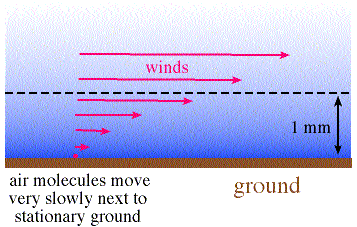
The diagram below is roughly what I expect to see for both cases (ground or belt). The point that others are discussing is that the magnitude (length) of the arrows might not be exactly the same in the two cases (ground versus relatively small treadmill), even though the direction will still be correct.
[qimg]http://apollo.lsc.vsc.edu/classes/met130/notes/chapter9/graphics/internal_frict.free.gif[/qimg]
Now humber, you are saying something is in the wrong direction, and I want to know what that is. In other words, which arrows in the diagram are you saying should be reversed (or pointing somewhere else altogether?) if the ground is replaced by the belt?. Note the arrows show air velocity relative to the ground/belt (which we're showing as stationary in the diagram because we've chosen a reference frame to make that happen) and (just to be clear and complete) the length of the arrows represent the relative speed of the air at that height above the belt (or ground).
I hope my reply to H'ethetheth, covers that Clive. If not, let me know.
This is not equivalence. It is 'Gallileon Relativity". It is that notion that allows the object to be "held". "Equivalence" is otherwise. It is real time. Nothing must change at all, because that is what the whole idea is about. It cannot be modified in anyway, at all, including time and velocity.
This is "Gallileon Relativity"
An object dragged through oil, is the "same as" a fixed object in moving oil.
The distinction is perhaps subtle, and Drela notes it as "a misconception"
It is important to make that distinction when constructing a model. That is what the treadmill model is employing; Gallileon Relativity. The only way that it is "equivalent", is that you can view the
model from the belt or ground or cart.
They must be the same. Not the "same as" the real equivalent view, because that is impossible.
Do you see? You can test your model, from any "equivalent view" and should get the same result, but for the model, not reality. The model is
connected to the theoretical and real world, by the accuracy of the model.
Drela:
"But the treadmill test can certainly validate the
theoretical models, which assume there's no wind gradient to begin with."
The treadmill is severely flawed, and you can see it, if you just step back a little bit, and view it for what it is, and not what it is said to be.