• Quick note - the problem with Youtube videos not embedding on the forum appears to have been fixed, thanks to ZiprHead. If you do still see problems let me know.

Cont: The Sinking of MS Estonia: Case Re-opened Part IV

Status
Not open for further replies.
One of Visens odder proclamations. If my dentist found a bunion in my mouth, she would say WTAF is that and ship to ER pronto. I would expect no less from a professional.

Apparently, Vixen has very different expectations. Rather odd expectations. I am inclined to recommend that Vixen change GP but there is no chance she will listen to that. <snip> What convinces her of that? I have no clue and Vixen won't say. So there is not a whole heap anyone can do with that, is there?

I was going to point out where bunions are found, but then I remembered, reading your post, 'foot-in-mouth' syndrome.
 
To find evidence of explosives damage, you have to look for it. It is not always self evident.

You say this from your vast experience in forensic engineering? Again, what part of "I've done this for living for 30 years" escapes you?

For example, Ida Westermann had to cut off a sample of the material from the bow visor and attach it to a plate in order to analyse it. It has t be ground and polished.

She was asked to perform a full metallurgical examination, which she did. She was looking for all evidence that might be discovered by such methods, not looking for specific causes and effects that would dictate perhaps different methods. She did not find evidence of explosives, and declined to opine as much when prompted. She found evidence of high temperatures consistent with welding.

Evidence of explosives is a naked-eye determination in part, and a microscopic evaluation in part. The microscopic evaluation provides additional information about explosive effects, but the determination simply that explosives were used is the naked-eye part.

You're wrongly assuming that the analysis Westermann was asked to do and the analysis that Hoffmeister was asked to do are directly comparable. They are not, inasmuch as they had different goals and necessarily used different methods. That's because you aren't properly qualified in this field and have no business trying to say how it was or should have been practiced, or trying to interpret its findings.

Hoffmeister was looking at corrosion, fractures and stress in the sidelock bolts and lugs.

Hoffmeister was looking for anything that would affect the strength of the materials whose failure he was asked to analyze using finite-element methods. Corrosion makes that portion of a component weaker, and that must be accounted for in the parameters of the finite-element model. Fractures make that portion of a component weaker, and that must be accounted for in the parameters of the finite-element model. Anything that affects the material strength locally must be considered. And that includes effects of explosives. Had evidence of explosives been present, he would have needed to note it and account for it in his model. He didn't find any, and so didn't need to account for it. The omission is dispositive.
 
The superstructure of the Estonia comprises Decks 2 - 8 and the bridge.

We know ships float on their hull, or even upside down but how does it float on its side?

Why can't a ship float on its side? Orientation and stability in the roll axis are dictated by one set of physics. Buoyancy is dictated by an entirely different set of physics. You still haven't figured this out.
 
But the effect of explosives would have been obvious on the parts he inspected if they had been strong enough to blow the locks apart.

Not necessarily. If the explosives, which Braidwood explains can be a small amount (1kg) are placed behind the plate on the for'ard bulkhead that takes the brunt of the bang whilst the screws and bolts are loosened. I dare say, were you to examine these hardware materials there may well be evidence of key explosion deformation.
 
Rightly IMV - as the Atlantic lock is merely an accessory and the bulk of the tension is borne by the side locks - he found that it was likely the starboard side lock would have failed first, then the port lock and then the Atlantic lock.

I addressed this already.

This is important.

Then you should have responded to where I addressed it.

I am sure the thought of testing for explosives is terribly more exciting that testing for common or seawater rust but it is extremely compelling that it does not agree with the JAIC.

No, you don't get to flee back to the bailey of "the JAIC is still somehow wrong anyway." You were asked for evidence that MS Estonia was sabotaged. You cited the Hoffmeister findings in conjunction with the Braidwood claims pertaining to the alleged use of explosives.

There is nothing in the Hoffmeister report that provides evidence for explosives. Since Hoffmeister omitted from his description of strength-altering factors any mention of explosive effects, the omission is not merely an accident or the product of limited "remit."

You were asked to provide evidence of sabotage. Either provide it or concede the point.
 
Last edited:
Not necessarily. If the explosives, which Braidwood explains can be a small amount (1kg) are placed behind the plate on the for'ard bulkhead that takes the brunt of the bang whilst the screws and bolts are loosened. I dare say, were you to examine these hardware materials there may well be evidence of key explosion deformation.

And you say this from your vast experience in the use of explosives in engineered systems and materials? Now you're just imagining evidence, not providing it.
 
Let's think this through. From the Channel 16 transcript, we learn that at about 01:25 (01:24.50 according to the reconstruction at the link I gave), someone on the Estonia said the following:


So at 1:25, the list was 20 to 30 degrees. I am guessing this does not count as "floating on its superstructure" yet, or even close to it. According to the transcript, the last message from the Estonia came at about 1:30 (01:29.39). Since that message didn't message didn't mention further listing or capsizing, it is reasonable to conclude that the Estonia was not listing at close to 90 degrees at that time, either.

Assuming the Estonia sank at 1:48 as you claim, we can then reasonably conclude that if there is such a thing as a ship floating on its superstructure, the Estonia did it for considerably less than 18 minutes (from some time after 1:30 until 1:48).

The example you gave of what you consider to be normal ship behavior is 9 minutes "floating on its superstructure."

Putting it all together, your claim is that 9 minutes is normal, but an unspecified time less than 18 minutes is impossible. This is the kind of evidence you use to support your conclusions, whatever they are.

My personal assessment of this line of reasoning: Weak.

Whilst Tammes did say the list was 30°, by the time of getting through his Mayday call, it was probably more like 70° at that stage and 90° by 0130.

Truth is, the only thing that stopped it from capsizing completely (turning over) is the fact that its hull was bottom heavy with water coming in via a probable breach (and the three engineers were all in the Engine Room, Deck0 busy doing something_.

It sank stern first.
 
Truth is, the only thing that stopped it from capsizing completely (turning over) is the fact that its hull was bottom heavy with water coming in via a probable breach...

A ship sinking stern first can't possibly have anything to do with the big heavy engines being back there, can it?
 
So when your doctor gives you an examination and says you have a couple of moles to keep an eye on as they might be of concern and then says "by the way, did you know you've been shot?" you'd be surprised and annoyed that he checked stuff outwith the remit of what you asked for.

Never insult an expert specialist by asking him or her to have a look at your tonsils whilst they are at it.

A plumber does plumbing. An electrician, the electrics. A car mechanic, your car repairs.
 
Can you define precisely what you mean by “float on its superstructure”? You seem to have introduced the term here, but without defining it, or quoting the JAIC using the green so the context can be seen.

While you’re at it, can you explain exactly what you mean by “superstructure”? From your previous posts it looks almost as if you think it means “everything above the waterline”.

Everything including the car deck from decks 2 - 8 plus the bridge.
 
It did not 'float on it's superstructure' It was still flooding in the hull.
After it capsized it took just 9 minutes to sink. How is that 'floating' on anything.

So you concur a ship does not float on its superstructure and it is only an illusion it does before its final rapid death throes under the water?

This is like trying to extract crap from a rocking horse.
 
A plumber does plumbing. An electrician, the electrics. A car mechanic, your car repairs.

Funny you should say that. I had an electrician tell me that water leaking from a pipe was the cause of the electrical problems I had called him out to fix. I guess I should have simply ordered him not to bother with the plumbing since it wasn't his "remit."
 
No, I haven't seen him yet.
I don't think he would have any opinion on the micro structure of steel components though.

I did speak to another friend who I have mentioned previously, he is in NDT, he says to identify the stress fractures he would use either a die penetration method or use pulse echo ultrasonic.
Which one he used would depends on the circumstances. He might even use both methods.

I asked if, while performing these tests he would have noticed if the part had been damaged by explosives.
He says it would be far easier to spot than fatigue cracking.

His experience with explosive damage is a contract he did for an engineering company on Tyneside refurbishing British Army Mine Ploughs being returned from Iraq and Afghanistan.

I asked if given a steel structure to test he would know if damage was caused by stress and fatigue or explosives.
He said if he couldn't he wouldn't be fit to do his job.

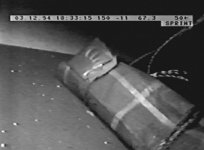
Thanks. What about these pictures Braidwood spotted on the Rockwater videos?
 

Attachments

  • exp4.jpg
    exp4.jpg
    46.9 KB · Views: 6
  • pg1101.jpg
    pg1101.jpg
    32.9 KB · Views: 5
  • pg1100.jpg
    pg1100.jpg
    54.8 KB · Views: 6
To find evidence of explosives damage, you have to look for it. It is not always self evident.


For example, Ida Westermann had to cut off a sample of the material from the bow visor and attach it to a plate in order to analyse it. It has t be ground and polished.

Hoffmeister was looking at corrosion, fractures and stress in the sidelock bolts and lugs.

How do you think he was looking at it?
How do you think he would test for fatigue and corrosion damage?
 
I think the mistake is in thinking that a ship's superstructure is watertight in any way other than a superficial sealing against rain or spray as a house or building is.
A ship's superstructure is not expected to ever be in the sea and in fact contains lots of large openings to let air in to the ship for engines, generators, air conditioning etc.

No, the superstructure is NOT water tight, unlike the watertight compartments in the hull. However, OTOH a vessel doesn't float on the superstructure, either. It is not designed to.
 
Hirschfeldt presented his investigation findings to the Rikstag in 2005. He merely confirmed Sweden had indulged in smuggling Russian military equipment 14th and 21st September 1994. He did not specify what this materiel was nor provide any other detail. It is classified for 70 years. Hirschfeldt burnt all of his research and investigations documents. More recently he said he now regrets he did this, in light of the recent reopening of the case.

So no evidence you can show us that there were any weapons on the Estonia or truck loads of US Marines on previous sailings?
 
I begin to think the "mistake" is nothing more than Vixen's declaration that the JAIC claimed the Estonia was "floating on its superstructure" as if to mean they thought the superstructure was air and watertight. Whereas they specifically argued that the higher deck windows would have broken in and increased the rate of flooding.

Nope.
 
Status
Not open for further replies.

Back
Top Bottom