• Quick note - the problem with Youtube videos not embedding on the forum appears to have been fixed, thanks to ZiprHead. If you do still see problems let me know.

Closed System Thrust

Kage

Critical Thinker
Joined
May 4, 2006
Messages
455
Thrust without propellant

http://emdrive.com/

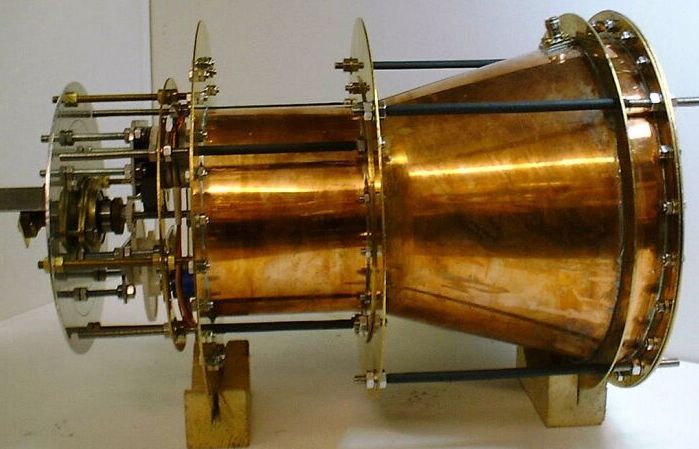
Explanation: This system claims to create thrust from a closed system. A resonant cavity is pumped with microvaves. The cavity is conical, which causes a difference to be formed in the group velocity of the waves at both ends. This difference is said to create thrust.

Pretty sure that there is some force on the walls of the cavity which negates the thrust. In fact very sure.

I thought this was a great example of how a simple misunderstanding of relativity (the system isn't close because of the different reference frames) can be used to justify bunk.
 
I read through it back when it was first announced, and I was . . . let's say . . . profoundly unconvinced. Certainly, I never saw anywhere that "thing a" was pushing on "thing b" without "thing b" pushing back equally on "thing a", which is what we'd need for this to work. A friend and I spent a fair amount of time working though the concept, and I don't remember the specifics anymore, but I believe that we also came to the conclusoin that they were (deliberately or inadvertently) misapplying relativity.

If this was producing actual, documented results, it would be revolutionizing the space industry, even if it was just an engineering model.

The space industry is not in the process of being revolutionized.

Unfortunately.
 
I'm just thinking... photons can be used to propel things. A light sail for example, can propel a small spacecraft using sunlight, or a laser as an energy source.

So, what if you put the energy source on the spacecraft being propelled by light? A light source sandwiched between two panels so the light is exiting in all directions perpendicular to the intended direction of the craft, with a conical light-sail around it, so the light bouncing backwards from the tilt of the light sail will exert a small forward thrust on the craft.

Is there some reason why this is not a possible, if unwieldy, means of propelling a spacecraft? Of course, you wouldn't need to use visible light. You could use always use microwaves instead:

Wikipedia said:
Research by Dr. Geoffrey Landis in 1998-9, funded by the NASA Institute for Advanced Concepts, showed that various materials such as alumina for laser lightsails and carbon fiber for microwave pushed lightsails were superior sail materials to the previously standard aluminium or Kapton films.


The "light sail" in this case would effectively be a conical wave guide, making a device almost identical to the one described in the OP.

(Of course, you'd get thousands of times the thrust for the same amount of energy by using a standard ion drive, so it wouldn't be much use to the space industry - or anyone, really.)
 
So, what if you put the energy source on the spacecraft being propelled by light? A light source sandwiched between two panels so the light is exiting in all directions perpendicular to the intended direction of the craft, with a conical light-sail around it, so the light bouncing backwards from the tilt of the light sail will exert a small forward thrust on the craft.

Is there some reason why this is not a possible, if unwieldy, means of propelling a spacecraft? Of course, you wouldn't need to use visible light. You could use always use microwaves instead

The light is leaving the system, so it's not a closed system. A light bulb taped to a mirror would have a tiny, but theoretically measurable thrust.

In the Emdrive doohickey (technical term) the light is just bouncing back and forth. Regardless of his misunderstanding of general relativity, you can't assign separate frames of reference to the opposite ends of your waveguide. They're physically connected, and constrained to move together. They have different areas, so the pressure on them will be different, but the area of the small end plus the area of the cone in the direction perpendicular to the large end is exactly equal to the area of the large end. All your vectors sum up to a big fat goose egg zero, and your creation spectacularly just sits there.

An analogy, using gas pressure rather than radiation pressure, would be a conical tank filled with compressed air. The ends aren't the same size, so the force on them isn't the same, but when you factor in all the forces on the inside of the tank, they equal out. The forces exerted in a tank of compressed gas are many orders of magnitude greater than those exerted by microwaves in a waveguide, yet we don't expect a tank of gas to just go sailing off forever. It would certainly sail off if we cut off one end: then the pressure would be only on the intact end, and a force would be generated, at least till the gas was all gone.

A
 
Explanation: This system claims to create thrust from a closed system. A resonant cavity is pumped with microvaves. The cavity is conical, which causes a difference to be formed in the group velocity of the waves at both ends. This difference is said to create thrust.

Pretty sure that there is some force on the walls of the cavity which negates the thrust. In fact very sure.

This was discussed in considerable detail several months ago. You're right, the inventor is neglecting the force on the walls, which is equal and opposite to the difference between the forces on the ends. He claims that this force can be neglected if the angle is sufficiently small, but he's wrong; the difference between the forces on the ends decreases in exactly the same way, so the difference is always zero. He waffles a lot about general relativity, but at the heart of this he's just misunderstood a piece of very simple geometry.

So, what if you put the energy source on the spacecraft being propelled by light? A light source sandwiched between two panels so the light is exiting in all directions perpendicular to the intended direction of the craft, with a conical light-sail around it, so the light bouncing backwards from the tilt of the light sail will exert a small forward thrust on the craft.

That would work fine. Just pointing the light source in the opposite direction to the required direction of thrust, and putting a paraboloid reflector around it, would work rather better (because the output light cone would be narrower, hence there'd be less sideways thrust that self-cancels and hence does nothing useful), and would be simpler, lighter, smaller and more robust, though.

The "light sail" in this case would effectively be a conical wave guide, making a device almost identical to the one described in the OP.

No, it wouldn't be almost identical in operation; it would be very fundamentally different. The whole point of the device in the OP is that it's a closed cavity, so no photons can escape. Your light sail is an open cavity that allows photons to escape in one direction only. The fundamental difference, therefore, is that your light sail doesn't need to violate the law of conservation of momentum in order to work.

Dave
 
Last edited:
I hadn't realized the end was capped off (the phrase "closed system" should have alerted me, but I guess I wasn't thinking too clearly). It's not too obvious from the image on the site.

emdrive.jpg


I suppose if you took the cover off the end at the right, you would have something that produces a minuscule amount of thrust, while still matching the claim on their website. :)

The EmDrive

A New Concept in Spacecraft Propulsion

Satellite Propulsion Research Ltd (SPR Ltd) a small UK based company, has demonstrated a remarkable new space propulsion technology. The company has successfully tested both an experimental thruster and a demonstrator engine which use patented microwave technology to convert electrical energy directly into thrust. No propellant is used in the conversion process. Thrust is produced by the amplification of the radiation pressure of an electromagnetic wave propagated through a resonant waveguide assembly.
 
http://www.assassinationscience.com/johncostella/shawyerfraud.pdf

That is quite short and quite low level to comprehend.

:clap:Good one!

I think the last part of the document deserves to be quoted here.

Shawyer’s paper basically describes particles bouncing elastically off walls; that is the way that he derives the force that gives the ‘thrust’ for his ‘drive’. But the stuff he injects into his truncated conical device is microwaves. Most people would ask: how does that work?

Microwaves, like everything in the Universe, can be described in terms of ‘waves’, or in terms of ‘particles’. If asked to explain how they reheated my spaghetti bolognese this evening, I would use the ‘wave’ description as the easiest one. But Shawyer is absolutely justified in switching between a ‘wave’ description and a ‘particle’ description, whenever he felt like it (in fact, practically every other sentence of his paper). The only problem is that, unless you intimately know the equations that he throws around like confetti at a wedding, his unclear and badly explained twists and turns are likely to leave you wondering whether he really must be a genius of Einsteinian proportions. (This is an unfortunate misconception that many people have: that a genius is someone who says things that no one else can understand. The truth is that a genius is someone who can make every-one understand.)

The net result is the following. Forget all of the stuff in Shawyer’s paper that talks about ‘group velocities’ and ‘wavelengths’ and ‘Q factors’. Just concentrate on his diagrams of little photons (microwave particles) bouncing around inside his contraption, and the physics equations he writes down to go with those bouncing particles. Take it from me that he’s right about that, and strip out all the really scary looking equations that have Greek letters in them.

Now remember your high school physics, and look at what’s left.

Start with Shawyer’s Figure 2.4. He shows his truncated conical contraption, with a particle bouncing around inside it. It must have a constant energy, because it’s being reflected elastically at every wall. That means that the magnitude of its momentum, p, is constant.

As Shawyer correctly shows, the particle reflects off each wall in the way that you learnt at school (angle of incidence equals angle of reflection). But because the walls are inclined to the ‘axial’ direction (the axis going down the middle of the cone), this means that the angle that their momentum
makes with the axial direction becomes ‘steeper’ at the narrow end of the cone, and ‘shallower’ at the bigger end of the cone. If you draw a few diagrams, and use some high school geometry, you can work out how much ‘steeper’ and ‘shallower’ the particle’s momentum angle gets, each time it bounces off a wall. Shawyer’s Figure 2.4 correctly shows this phenomenon.

Now look at the arrows below the diagram in Shawyer’s Figure 2.4. If you remember your high school physics, these are force vector arrows. They show the direction and strength of the force that the particle imparts on each wall as it hits it.

Shawyer’s F1 is the force on the ‘large’ end of the cone, and F2 is the force on the ‘small’ end of the cone. As he correctly shows, F1 is bigger than F2, because the particle’s momentum is much closer to ‘head on’ to the large end. (Remember, the size of the particle’s momentum does not change, only the direction it is heading in.)

After going through a few more trips into wave-land, Shawyer computes the difference between F1 and F2. That’s where his ‘drive’ comes from. All the complicated equations he throws in are just fluff around this basic result.

What’s wrong in Shawyer’s paper

Now we get to the point that a number of people have already made, but perhaps not confidently enough. Look at the arrows that Shawyer labels ‘Fs1’ and ‘Fs2’ on his Figure 2.4. These are supposed to be the forces that the particle imparts to the wall of the conical part of his contraption.

But hang on a minute! When a particle bounces elastically off a wall, doesn’t the wall feel a force that is perpendicular to the wall? Of course it does: if you remember your high school physics, you subtract the initial momentum vector from the final momentum vector, and the resultant force points into the wall. (OK, it’s actually called the ‘impulse’, not the force, but it’s effectively the same thing for what we’re talking about here).

Now look back at Shawyer’s Figure 2.4. He has Fs1 and Fs2 pointing perpendicular to the axial direction, not perpendicular to the cone’s walls.

His arrows are wrong.

This is the fundamental blunder that renders Shawyer’s paper meaningless. If you remember your high school physics, it is simple enough to draw a diagram to prove to yourself that, when a particle bounces off the wall of the cone, the increase in the particle’s momentum in the axial direction is exactly balanced by the impulse imparted to the cone in the opposite direction.

This is what has already been argued by those who have bothered to wade through Shawyer’s paper. It is not affected by all the ‘wave-land’ equations that Shawyer throws in. It is the fundamental error in his analysis.

So what do we really find out from this analysis, when we do it correctly? Simply this: when a particle bounces around elastically inside a closed container, neither of them go anywhere. If you start in the right reference frame, then when the particle is moving left, the container is moving right; when the particle is moving up, the container is moving down; and so on. When the particle and the container collide, the directions of motion change, but their momenta still add up to zero. Nothing accelerates.

There is no ‘drive’.

How does Einstein’s theory of relativity change things?

That heading should be enough to have scared most people off reading this sentence. Relativity is really complicated, right? Must be—Einstein invented it.

Shawyer throws relativity into his paper, if only because he really can’t avoid it for a particle that moves at the speed of light (well, is light, or its cousin, anyway). Maybe some weird spooky relativistic effect makes Shawyer’s scam drive work?

Fortunately (for us, not Shawyer), relativity doesn’t change a thing. I purposefully described everything above in terms of momentum. It turns out that one thing that relativity does not change is that momenta can still be added together, just like they can in Newtonian mechanics.

So the answer to the question in the previous heading is: Not at all.

Shawyer’s ‘electromagnetic relativity drive’ is a fraud.

 
I have seen similar technology in the "How to Build a UFO book."

There is a simpler design for a personal flying machine.

1. Get a strong piece of rope
2. Stand on the rope and hold the ends of the rope in your hands
3. Pull up really hard until you start to fly.
 
There is a simpler design for a personal flying machine.

1. Get a strong piece of rope
2. Stand on the rope and hold the ends of the rope in your hands
3. Pull up really hard until you start to fly.

Actually, if you used a tapered rope and made some argument about how the different cross-section areas at the top and bottom of the rope meant that the rope would be exerting more 'up' pull on your feet than the 'down' pull on your hands, you'd be pretty close to the device in the OP.

And just as likely to fly.
 
For Some ReasonTM this reminds me of the joke about the truck driver with a truck load of canaries who stops every now and again to bang of the side of the truck to make the birds take to the air inside the truck and thus make his load lighter.

For Some ReasonTM :D
 
This seems to be the most recent Emdrive thread I could find so I'll post the update here.


The quest for a propellant-less drive took a significant turn in 2001 when British Electrical Engineer Roger Shawyer introduced the EmDrive. Dubbed the “impossible drive,” it was said to be reactionless, challenging the principles of physics, particularly the conservation of momentum. The scientific community greeted this claim with skepticism, given the revolutionary nature of such a discovery.


Over the next two decades, the EmDrive underwent extensive testing, with scientists eager to see if it could truly defy the laws of physics. By 2021, the consensus was clear: the EmDrive could not deliver on its promises. Despite the device’s failure, the pursuit of a propellant-less drive did not end there. Researchers continued to explore new possibilities, driven by the dream of unlocking a new era of space travel.
As the EmDrive faded into scientific history, a new contender emerged, led by Charles Buhler, a former NASA scientist. Buhler’s work at the Kennedy Space Center’s Electrostatics and Surface Physics Laboratory laid the foundation for his current endeavors. Now, as a co-founder of Exodus Propulsion Technologies, he claims to have developed a drive powered by a “New Force” that operates outside the known laws of physics.


This innovative drive is said to generate a sustainable force through electric fields alone, allowing for center-of-mass translation without the expulsion of mass. Such a discovery, if verified, would fundamentally alter our understanding of physics and open up new possibilities for propulsion technology. However, Buhler acknowledges that independent verification is crucial to confirm these groundbreaking claims.

More details here: https://www.exoduspropulsion.space/

Soon to be Nobel prizes all around?

:pigsfly
 
It would be cool to be surprised, but I do not expect there will turn out to be a previously undiscovered force caused by electrostatic fields.
 
While I wouldn't be a bit surprised to learn that there's a 5th force, I would be very surprised if:
a) unlike all the other forces, the 5th force was non-conservative, and
b) electrostatic fields caused another force:
b1) without using any energy from the electrostatic field, effectively creating energy from nothing, or
b2) using energy from the electrostatic field but nobody had ever noticed that energy was being inexplicably lost by electric fields
 
Last edited:
...snip...

More details here: https://www.exoduspropulsion.space/

Soon to be Nobel prizes all around?

:pigsfly

And here we go the typical cackhanded videos.

The one using the scales - they don't start with the scales tared to 0g - whyever not? We see quite a few fluctuations with the scale's display even before they are meant to be switching "it" on.

One simple press of a button at the start before anything is switched on to give them a stable starting point but for some reason they can't do that.

Perhaps they need to get together with Brilliant light to use their power generator.
 
I think that the most likely future propulsion method is Elf Propulsion. Just store a nearly infinite number of elves on the ship. When you need to move forward, just throw an elf out the back door.

Makes about as much sense.
 

Back
Top Bottom