• Quick note - the problem with Youtube videos not embedding on the forum appears to have been fixed, thanks to ZiprHead. If you do still see problems let me know.

Another Problem With Big Bang?

I'll remember to tell TV's Frank that next time he demands I supply explainations for all his numbers. ;)

You misunderstand me. I said you cannot use the lack of an explanation of something. If the alternative theory doesn't provide any explanation either, then pointing it out is meaningless.

But seriously, when observational data is in direct contradiction to the theory or the major assumption on which the theory is based, then that is an argument against the theory, unless it can be modified to work.

Correct. It shows that something about the theory is not quite right.

But the modification shouldn't invoke magic and non-falsifiable objects, forces, interactions and events to fit the data. Not if it want's to be called science.

Of course not. Neither does the big bang theory. Please point out to where it is. And be careful. "Unable to detect" does not mean "unfalsifiable".

And you call Dark Matter, Dark Energy and Inflation an explanation? :D

Why not? What is to say that the universe behaves nicely? What is to say that the universe is entirely made up of things we can directly detect? You seem to be making a large assumption.

Frankly, I'm not qualified to provide more than rudimentary explanations for what the plasma cosmologists (and these are prize winning scientists with degrees in electrical and plasma physics) describe. I've pointed you folks to many sources and papers where you can get a better picture. If you won't look at them, I can't help that. If you want to know the detailed explanations, I suggest you go get Alfven's book on Plasma Cosmology. I'm sure he describes the physics and computers models he used to study the creation and behavior of galaxies in great detail. I suggest you start with a book like Donald Scott's. It's at a technical level most people should be able to understand if they try and very conscisely shows the scope of the problems with Big Bang and how Plasma Cosmologists are answering those problems. The latest in Plasma Cosmology is fascinating but not something you will find covered by the mainstream media or even in a book at your local bookstore. But that doesn't mean it's wrong.

I may be biased, but I try to not get my information from books, but from peer review journals.

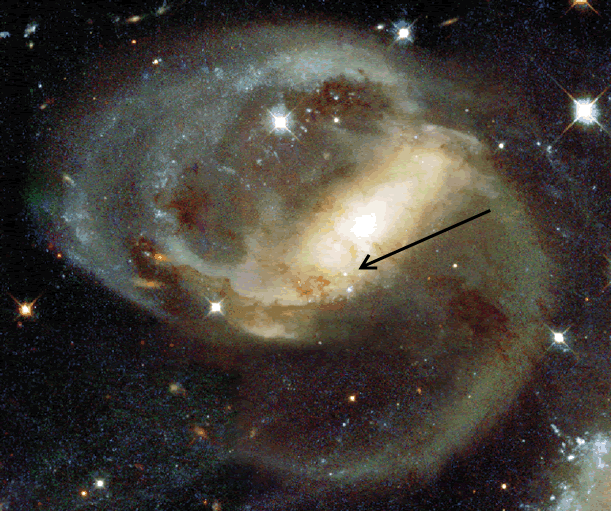
By the way ... do you have an explanation for what is seen in the photo of NGC 7319? I'm still waiting for *someone* to offer one and salvage BB. :)

Perhaps I missed it, but where did you prove that it was, in fact, not very far away?
 
I clicked on the link but nothing came up. My answer is that it does not. There's lots of space between stars in a galaxy, so objects behind the galaxy could show through if they are bright enough. I am not aware of any accepted theory for a 'faux redshift'. My understanding is that redshifts occur due to the doppler effect of objects moving away from us or by expansion of the universe. The light from the most distant objects has been traveling through space for billions of years while the spacetime it travels through is expanding. This stretches the wavelength.

Thanks, Puppycow. So no one's done the work necessary to estimate the distance of this quasar vs the galaxy? THen I think there's no need to worry about it until someone does.

I brought up a faux redshift because BAC has stated that its red shift is greater than the galaxy's but he thinks that it's actuall closer than said galaxy. So, I'm thinking that this body is fairly unique and perhaps isn't a quasar after all but some new type of body. That seems to me to be a simpler explanation than dooming a theory with so much evidence behind it. So, I would defer judgement until all the facts are in. I might seem too patient for some but, in truth, it's just well-honed laziness!
 
I see you have some technical questions above to answer, and I am sure you are getting round to them.

I did, and I hope you read and understood my answers. You will also see that I've been offering some technical questions of my own. And so far they are all going unanswered. Is that fair? Or is that just the way the Big Bang community works?

In laymans terms what is Plasma Cosmology?

Just so there is no confusion, Plasma Cosmology is not the steady state model.

It seems to me, above all else, that Plasma Cosmology begins with the view that electromagnetic phenomena (which is stronger than gravity) and plasma (which is subject to electromagnetic forces and far more common than uncharged matter) dominate the formation and behavior of the bodies we see in the cosmos.

That doesn't mean that gravity has no effect or no role, but the majority of the phenomena that are seen can be explained by a combination of gravity and electromagnetic-plasma linked phenomena where the latter usually dominates.

The physics of electricity, magnetism and plasmas are well understood. When scientists in those disciplines apply that knowledge to a universe filled with plasma and electrical currents (which produce magnetic fields), they find that the natural result is the filamentary structures we see everywhere we look.

There are many different plasma phenomena that seem to play a role in space. A very important phenomena is that when high intensity electric current passes through a plasma (they are excellent conductors), the currents naturally align themselves with the magnetic fields, causing the current carrying plasma to take on a corkscrew (spiral) shape. These are called Birkeland Currents and they usually occur in pairs.

It was discovered that pairs of Birkeland Currents interact, accreting and compressing even non-ionized matter between them. They sort of wind up like two ropes spun together. And these joined pairs can then can interact with other Birkeland Currents. Anthony Peratt has demonstrated that pairs of Birkeland Currents (we are calling them currents but we are still talking about the plasma that is carrying the currents) can evolve the spiral like shapes seen in galaxies, as well as all the other galactic types that are seen.

A phenomena called a z-pinch can occur in these windings that can further concentrate matter and produce major electromagnetic effects. Plasma Cosmologists say these knots are where objects form ... stars, quasars, and galaxies ... in large Birkeland Currents. It has been demonstrated that z-pinches can produce jets composed of synchrotron radiation (something produced by new stars, quasars, and even seen in active galaxies), as well as everything else you can imagine in the way of particles and electromagnetic energy.

Nuclear physicists have been trying to use this pinch effect to create sustained fusion because the density/temperature/time conditions in these z-pinches can fuse material but they haven't as yet found them stable enough to sustain fusion for commercial use. But they might explain the generation of certain particles and elements found coming from the surface of stars.

Another important plasma phenomena is the Double Layer. Double Layers (DL) allow plasma to isolate electrically one section of itself from another. The isolating wall is made of two closely spaced layers, one consisting of positive charges and the other of negative charges. Most of voltage difference will be contained in it, thus, this is where the strongest electric fields are found. DLs form around lots of objects and can explain many phenomena that are seen in space, stars, galaxies.

The model that plasma cosmologists have for stars and galaxies once they form is also worth noting. It is called a homopolar motor and was first developed by Michael Faraday in 1831. Alfven developed an electric star model that is a homopolar motor. It can explain many aspects of solar behavior and the plasma currents that are seen streaming into and out of the sun. Alfven also applied the homopolar model to galaxies. Lerner modified that to explain the electromagnetic phenomena seen in the center of many galaxies and in quasars. Now remember, we are talking physics that is well understood and has been around for a long time. And there has been no need to invent magical particles, forces, interactions and events that no one has ever detected. Big Bang has inferred those thing to explain phenomena that plasma cosmology seems able to explain with well established physics.

How did the universe start or has it always existed ? How is it changing and what will it change into ?
What did is change from?

You might want to read the paper by Alfven that I linked above titled "On Hierarchical Cosmology". It presents his view of it back in the 1980s. There are changes to the theory since then, but I think it is still fundamentally intact. He also has a book titled Cosmic Plasma that goes into even more detail.

Probably the biggest change is the growing belief that the source of the energy output of stars is a plasma/electrical/magnetic phenomena rather than nuclear fusion driven. Don't laugh. They present a pretty convincing case. (See Donald Scott's book).

Also what will cause the change in opinion to Plasma cosmology?

Failure of the Big Bang community to address the contradictions with observations will eventually catch up to it. They won't be able to hide behind magical gnomes for ever. :)

What special prediction does it have that the other theories don’t?

I think I discussed this in the previous several posts. Suffice to say that Plasma Cosmologist has actually predicted many more observations than Big Bang Cosmology erroneously claims to have predicted. Most of Big Bang's predictions do not qualify as predictions as they have required major modifications to their model (often involving magical gnomes) to make the model fit the data that is observed.

And keep in mind that the resources that have gone into trying to support the Big Bang model are staggering in comparison to what resources have gone into investigating and supporting Plasma Cosmology. If those resources had been spent on investigating the latter, who knows where our understanding of the universe would stand today. Consider the implications to other fields if some of what plasma cosmologists say is true. The notion that the energy production of stars is an electric process would have a staggering effect on the whole field of energy production. Even the underlying notion we have of what matter is, might be different today because a lot of our investigation of particle physics has been driven by the need to support the Big Bang.


You are welcome.

 
The mechanics of how the universe works now are seperate from the mechanics of how it came in to being in the first place.

So tell us, Cuddles, did the theory of the Big Bang when dreamed up include Dark Matter and Dark Energy? No? They were added later? But that *matter* and *energy* (I add astericks to emphasis that they are totally unlike any matter and energy we are used to experiencing) was created in the Big Bang, right? So where in the equations for the Big Bang do they include these terms now? They do include them, don't they? Hmmmmmm?

And let me get this straight. You are saying that since inflation occurred after the singularity exploded to create all there is, it's not part of the Big Bang theory either? I see. That's very interesting. (chuckle)

And you are also saying that whether the universe actually did expand or not after the singularity exploded is immaterial to whether the Big Bang occurred? Seems that way. That would be very interesting too. :D
 
You talk like some sort of religouys fanatic, and one with an axe to grind.

*I'm* the religious fanatic, David? ROTFLOL!

And apparently, unlike some on this thread, I have absolutely no financial stake in whether Big Bang or Plasma Cosmology is correct. I'll probably have to pay taxes for cosmology research either way. I'd just like the research dollars to not be wasted like so many government dollars. :D
 
Evidence for the Big Bang:

1) Cosmic Microwave Backgroud radiation. The theory predicted this before it was discovered by the way.

http://www.physorg.com/news76314500.html "Big Bang's Afterglow Fails an Intergalactic Shadow Test ... snip ... The apparent absence of shadows where shadows were expected to be is raising new questions about the faint glow of microwave radiation once hailed as proof that the universe was created by a "Big Bang." ... snip ... "Either it (the microwave background) isn't coming from behind the clusters, which means the Big Bang is blown away, or ... there is something else going on," said Lieu. "One possibility is to say the clusters themselves are microwave emitting sources, either from an embedded point source or from a halo of microwave-emitting material that is part of the cluster environment. "Based on all that we know about radiation sources and halos around clusters, however, you wouldn't expect to see this kind of emission. And it would be implausible to suggest that several clusters could all emit microwaves at just the right frequency and intensity to match the cosmic background radiation."

http://metaresearch.org/cosmology/BB-top-30.asp "The expression "the temperature of space"? is the title of chapter 13 of Sir Arthur Eddington's famous 1926 work. Eddington calculated the minimum temperature any body in space would cool to, given that it is immersed in the radiation of distant starlight. With no adjustable parameters, he obtained 3°K (later refined to 2.8°K), essentially the same as the observed, so-called "background" temperature. A similar calculation, although with less certain accuracy, applies to the limiting temperature of intergalactic space because of the radiation of galaxy light. So the intergalactic matter is like a "fog"?, and would therefore provide a simpler explanation for the microwave radiation, including its blackbody-shaped spectrum. Such a fog also explains the otherwise troublesome ratio of infrared to radio intensities of radio galaxies. The amount of radiation emitted by distant galaxies falls with increasing wavelengths, as expected if the longer wavelengths are scattered by the intergalactic medium. For example, the brightness ratio of radio galaxies at infrared and radio wavelengths changes with distance in a way which implies absorption. Basically, this means that the longer wavelengths are more easily absorbed by material between the galaxies. But then the microwave radiation (between the two wavelengths) should be absorbed by that medium too, and has no chance to reach us from such great distances, or to remain perfectly uniform while doing so. It must instead result from the radiation of microwaves from the intergalactic medium. This argument alone implies that the microwaves could not be coming directly to us from a distance beyond all the galaxies, and therefore that the Big Bang theory cannot be correct."

By the way, Plasma Cosmology predicted the filamentary nature of the universe before it was discovered. Big Bang did not. So there. :p

2) The abundances of the elements observed.

See my comments on that bogus claim to TV's Frank.

3) Hubble's law (the farther away objects are, the greater the redshift)

Big_bang_dead.jpg


Now, I don't know about this "jet" from the galaxy to the quasar because that link doesn't seem to work

This?

http://www.journals.uchicago.edu/ApJ/journal/issues/ApJ/v620n1/60493/fg4.h.jpg

Works for me. And it's mentioned on a dozen other websites on NGC 7319. Just use your browser.

, but what is the alternative? A Steady State model?

No, Plasma Cosmology. Haven't you been paying attention?

it does seem like the Big bang is the current consensus theory.

I'm not arguing that it's not the consensus. I'm arguing that it's not right based on the observations. :)
 
If the plasma universe explains it all... and current theories can't... Where is the revolution?...

It's coming. ;)

Are all scientists conspiring to hide all the evidence you're posting?

Donald Scott had a lot to say about this ... just as Eric Lerner did decades ago. Scott says what you see is what you get when deductive method replaces empirical method, and the scientists controlling the peer review and funding process have a vested interest in keeping the beast alive. Big Bang has piled one magical gnome on top of another for years until the process of science has been thoroughly corrupted. But the edifice is wobbling. :D
 
Oh, and by the way BeAChooser, we've already gone looking for Baryon Acoustic Oscillations...and we've found them! Current proposals are to study them in more details, since they offer a good chance at constraining dark energy.

Contraining? What's that mean?

Do the oscillations change if you change the percentage of dark energy?

If you do, does that cause problems with the age estimate of the universe?

And couldn't other things produce "sound" in space? Like the sort of cataclismic matter/antimatter explosions that Alfven/Klein theorized in Plasma Cosmology?

I suggest, for future reference, that you thoroughly study a topic before posting.

Have you studied this, genius?

spiralgalaxy.new.gif

From http://ucsdnews.ucsd.edu/newsrel/science/mcquasar.asp
 
Donald Scott had a lot to say about this ... just as Eric Lerner did decades ago. Scott says what you see is what you get when deductive method replaces empirical method, and the scientists controlling the peer review and funding process have a vested interest in keeping the beast alive. Big Bang has piled one magical gnome on top of another for years until the process of science has been thoroughly corrupted. But the edifice is wobbling. :D

See, when you say things like this, you seem vastly less credible.
 
1. Can it be determined if the quazer is associated with the galaxy or it is in alignment,

Doesn't matter since the point is that the high redshift quasar is on THIS SIDE of the low redshift galaxy in the central core region where no light can pass through the galaxy. Ergo, the Big Bang is dead. Redshift is not always an indicator of distance and velocity, as Big Bang cosmologists have assumed for decades and decades.

whichs eems unlikely but is possible.

Funny you should say that an alignment like that is unlikely given that Arp and others have detailed hundreds of unlikely alignments. A fact which the Big Bang community simply ignores or dismisses with a wave a the hand.

2. Is it possible that a high redshift is accounted for by plasma in some objects and by universal reccesion in others.

Of course. But that will still force a reexamination of every redshifted object that has every been found and used in Big Bang explanations. And the size of the universe according to the Big Bang will likely shrink since the highest redshifted objects are usually quasars or highly energetic galaxies where electromagnetic effects on plasmas are most noticeable. And a smaller universe means a younger universe ... and the age of the Big Bang universe is already too small to account for the age of some stars and other observations as I noted earlier. Ergo ... the Big Bang is in Big Trouble. :D

There appears to be an article that is cited at least eight times regarding the anamolous redshift, so hardly being squashed there.

But do you know that Arp and his colleagues, who first discovered this, say they submitted their paper for publication and it was many months before the journal finally approved it. Scott says it was widespread dissemination of the result on the internet that forced publication.

And by the way, according to Scott, as of July 2006 several other images of quasars in front of disks of low redshift galaxies have been published. I believe I linked a page with some of those examples earlier in this thread. :)
 
What happened at Eniwitok? Teller thought it was fusion. i would like to hear the alternative.

It could be, so what happened at Eniwitok? The hydrogen bomb?

David, do know what I meant by sustained fusion?

It's one of a duration that could be used in power generation continuously, not the brief fusion of a nuclear weapon.

It's one with the duration thought going on in the sun (by ignore plasma physicists), not that of a nuclear weapon.

http://en.wikipedia.org/wiki/Fusion_power
 
But do you know that Arp and his colleagues, who first discovered this, say they submitted their paper for publication and it was many months before the journal finally approved it. Scott says it was widespread dissemination of the result on the internet that forced publication.

What rubbish. I have never seen a paper which does not have several months between the paper being recieved and the paper being accepted. It takes time to review all papers.

And by the way, according to Scott, as of July 2006 several other images of quasars in front of disks of low redshift galaxies have been published. I believe I linked a page with some of those examples earlier in this thread. :)

And what, exactly, are they using to determine that the quasars are, in fact, in front of the galaxies? Given that one of the brightest known quasars outputs the energy of 100 milkyway-like galaxies, I do not find it hard to accept that the light can pass through a galaxy before reaching us.
 
But there's many times when I wonder if the Big Bang theory is our attempt feel as though we know something that we're just not sufficiently evolved to understand.

Or perhaps there are people who are evolved enough to understand it ... they are called plasma cosmologists. ;)
 
Or perhaps there are people who are evolved enough to understand it ... they are called plasma cosmologists. ;)

And are these the same guys who also don't believe in nuclear fusion, special and general relativity and quantum mechanics? Or was that just on the website you linked to?
 
It seems to me, above all else, that Plasma Cosmology begins with the view that electromagnetic phenomena (which is stronger than gravity) and plasma (which is subject to electromagnetic forces and far more common than uncharged matter) dominate the formation and behavior of the bodies we see in the cosmos…………….
Hang on can you go back a bit. You are talking about how matter ‘sticks’ together. Where did that matter come from ? What created the electromagnetic field in the first place? Where did the plasma come from ?

You might want to read the paper by Alfven that I linked above titled "On Hierarchical Cosmology". It presents his view of it back in the 1980s. There are changes to the theory since then, but I think it is still fundamentally intact. He also has a book titled Cosmic Plasma that goes into even more detail.
Realistically it ain’t gonna happen. If you don’t explain it I guess I will have to wait for science to catch up :)

I think I discussed this in the previous several posts. Suffice to say that Plasma Cosmologist has actually predicted many more observations than Big Bang Cosmology erroneously claims to have predicted. Most of Big Bang's predictions do not qualify as predictions as they have required major modifications to their model (often involving magical gnomes) to make the model fit the data that is observed.
You know criticising other people’s model is the wrong way to win them over. The earth centric model of the universe worked very well. Even when it was acknowledged that the sun was at the centre of the solar system the earth centric model provided more accurate calculations. It was only when the heliocentric model was improved that it took over and was fully accepted.
This model will take over only if it proves better. Even if some astounding information came to light that disproved the big bang model, it would still be used until a better replacement was found.
If your model is better you need to sell it not criticise and snipe at the big bang. Intended or not you come across like a creationist, criticising evolution rather than selling your alternative.
You are welcome.
Thanks again for your response.
 
See the sort of illogic that some of those advocating Big Bang promote, folks? Cuddles insists these things have nothing to do with the Big Bang theory, yet Big Bang cosmologists seem almost desperate to find them. I wonder why.

You seem to be under the misapprehension that there is such a thing as a "Big Bang comsmologist". There is not. Cosmologists study everything they can about the universe, which includes both it's origin and how it works now. One observation is that everything seems to be moving away from everything else, for which a big bang is the best explanation so far. Another observation is that the motion of many objects suggests that there is more mass than we can see. The best explanation so far for this is that there is matter that we can't see. Neither of these observations or explanations have anything to do with each other. We could live in a steady state universe and stars would still be orbiting galaxies too fast. We could live in your plasma universe and it would still need to have come from somewhere. Plasma cosmology is a genuinely interesting theory, but what it actually says and what you think it says have very little to do with each other.

Really? Then explain that photo.

There are several possible explanations. The most likely is that it is not closer. Objects can be seen through others, especially when the object in front is not solid but made up of lots of points. It is not at all unlikely that something as incredibly bright as a quasar could be seen through another galaxy. There is also the possibility of gravitational lensing making it appear to be behind the galaxy when it is really off to one side.

Another explanation is that it is in front of the galaxy, as you claim. However, if this is the case then it is not a quasar. Quasars are extremely large and bright. This object is thought to be a very long way away, and therefore it's apparent magnitude is explained by it being a quasar. If it is actually muh closer then its real magnitude and size are much, much less, and it cannot possibly be a quasar.

There is therefore nothing that actually needs explaining. Either it is behind the galaxy and extremely bright or it is in front of the galaxy and isn't that bright at all. Either way, your argument is nonsense.

If you are looking for an explanation of the redshift, again your argument fails to understand very basic science. Redshift is caused by the Doppler effect. If space itself is expanding, everything in space will appear to move away from everything else with speed that increases with distance. This means that the further away something is, the greater its redshift. However, this does not mean that redshift doesn't arrive from local moverment as well. It does. If something is moving very fast, the light from it will experience the Doppler effect as well. For example, the local group of galaxies should all be moving away from each other due to expansion of space, but gravity pulls them together much stronger than this and so many of them actually have a blueshift instead.

In the case of the object you are whining about, the redshift has two possible explanations. Either it is very far away and the shift is the result of the exapansion of space, or it is just moving very fast. If you assume that it is in fact closer to us than the galaxy, that doesn't mean distant things don't have a redshift, it simply means that in this particular case the redshift is due to local movement.
 
I'm not an astronomer or a physicist so I can't really add much to this discussion. Sad, cuz I find it fascinating. I am enjoying all the purdy pitchers though.

BAC, could you explain to me why the quasar has to be in front or inside the pinwheel galaxy? I can't understand how this was established. Also, if this thing is that unique and unusual, why is it being called a quasar and not being considered something that somehow gives a faux redshift reading?

Not an astronomer of physicist here, there are a number of theories about quasars. One is that they are galactic cores stripped of their stars or massive singularities.

The reasons that there is wonder about the quasar in the photo is that there is no evidence that the galaxy is in front of it, IE there are not absorption spectra lines imposed upon it.

This is a really cool area because there are a number of quasars that might be associated with close objects.
 
Thanks, Puppycow. So no one's done the work necessary to estimate the distance of this quasar vs the galaxy? THen I think there's no need to worry about it until someone does.

I brought up a faux redshift because BAC has stated that its red shift is greater than the galaxy's but he thinks that it's actuall closer than said galaxy. So, I'm thinking that this body is fairly unique and perhaps isn't a quasar after all but some new type of body. That seems to me to be a simpler explanation than dooming a theory with so much evidence behind it. So, I would defer judgement until all the facts are in. I might seem too patient for some but, in truth, it's just well-honed laziness!

the fact is that the quaser does not show the absorbtion spectra of the galaxy imposed on it.
 

Back
Top Bottom