• Quick note - the problem with Youtube videos not embedding on the forum appears to have been fixed, thanks to ZiprHead. If you do still see problems let me know.

Another Problem With Big Bang?

I've read your response to my "challenge", BeAChooser, and at no point did you actually do what I asked. So, out of politeness, I will repeat it. Please PROVIDE PREDICTED VALUES for the following:

-the age of the universe (at least older than the solar system!)
-the abundance of light elements (e.g., hydrogen, helium, and lithium)
-the existence of the CMB (e.g., temperature)
-the power spectrum of the CMB (e.g., the l=200 peak, isotropy)
-the spectral index of CMB fluctuations
-the flatness of spatial curvature
-the matter power spectrum (e.g., scale of non-linear growth, presence of BAO peak)
-the lyman-alpha forest
-the luminosity-distance relations of type 1a supernova

For example:

If I were to go out and measure the spatial curvature of the universe, what does plasma cosmology predict to be the answer?

If I go looking for CMB anisotropies, at what multipole should I find the largest peak?

If I look for spectral index of CMB fluctuations, what does plasma cosmology say I will find?

If I go looking at the distribution of matter in the universe, what are the RMS fluctuations in 8 Mpc spheres?

You should get the idea. The above 4 questions have answers, from observations, that are simple numbers. There are very basic, fundamental aspects of our universe. So, from plasma cosmology, what should these numbers be? Feel free to give estimates and uncertainties with your answer, but try to be precise.

That's all I want. 4 numbers. That's all your post has to be. That's all. If you can't limit your post to 4 numbers and associated discussion, then I will not read it. If you start going on about "conspiracies" or anything like that, I will ignore it. If you start discussing standard cosmology, I will ignore it (you should be able to discuss the success of plasma cosmology independently of any perceived failings of standard cosmology).

It's time for plasma cosmology to get with the program. If you can't produce these very basic predictions, then it's not even wrong!

Standard LCDM cosmology has produced predictions for these 4 numbers. Can you?
 
So bring your game-brain, OK? I'm a keen reader on the subject, but no expert like they are.

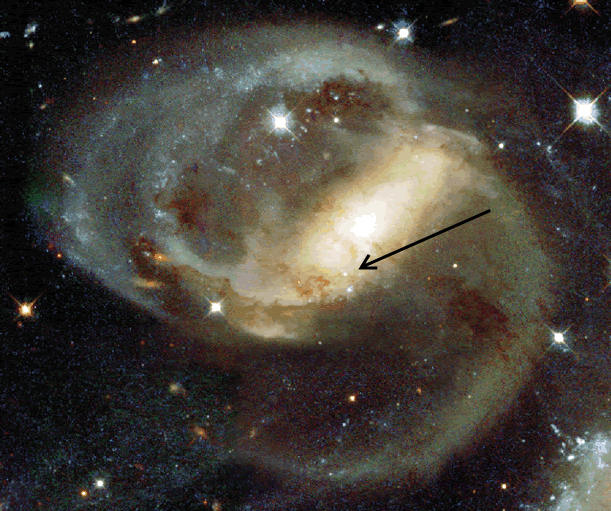
Ok. I've posted a lot of facts that seem to contradict Big Bang in the past few posts but I'll focus on one ... just for you. See this image?

spiralgalaxy.new.gif

From http://ucsdnews.ucsd.edu/newsrel/science/mcquasar.asp

That galaxy is NGC 7319. The arrow in that image points at a quasar. The redshift data as interpreted by Big Bang cosmologists indicates that quasar is 93 times farther away than the galaxy. But it looks to me and a whole lot of people like it's in front of the galaxy. But it gets even better. Look at this image:

http://www.journals.uchicago.edu/ApJ/journal/issues/ApJ/v620n1/60493/fg4.h.jpg

You will see a jet coming from the core of the galaxy towards the quasar. So let's see your game-brain explain this. :) Because if redshift doesn't equate to distance,

Big_bang_dead.jpg


OK, let's break your question down by its components:

1) ...99% of the matter in the observed universe consists of plasmas which respond to electromagnetic forces...: Evidence? Source?

http://www.plasma-universe.com/index.php/99.999%_plasma

2) ...electromagnetic forces have been observed everywhere we've looked in the universe...: Evidence? Source?

Read my previous three or four posts. I've provided plenty of examples showing electromagnetic forces in action ... from here on earth to well outside galaxies. If that's not enough, listen to this:

http://mediacloud.libsyn.com/astronomycast/AstroCast-070625.mp3 "Magnetism Everywhere"

Here's the transcript from it to make it easy for you:

http://www.astronomycast.com/transcripts/AstroCast-070625_transcript.pdf

3) ...they [electromagnetic forces] are vastly stronger than gravity forces...: Evidence? Source?

http://www.sciencemag.org/cgi/content/summary/302/5646/795 "Gravity is by far the weakest of the four known forces. The gravitational attraction between two protons is 35 orders of magnitude weaker than their electromagnetic repulsion."

http://en.wikipedia.org/wiki/Fundamental_interaction lists the relative strength of electromagnetic to gravatic fields as being 10^^36 with their long distance attenuation being equal (both 1/r^^2 and with both having infinite range.

http://www.naturalhistorymag.com/index_time.html also has a table listing the relative strength and range of the four forces. It gives electromagnetic force a strength of 10^^-2 and long range. It gives gravity a strength of 10^^-39 and long range.

And there are a million other source that say the same thing?

4) ...why do you think that electromagnetic forces have played no role in the formation and operation of galaxies or the interactions between galaxies? Care to reference how you know I think that? (This is called a "strawman" argument, btw.)

Fair enough. Do you believe that electromagnetic forces have played no role in the formation and operation galaxies or the interactions between galaxies given demonstrated the truth of the first 3 claims I made? And if you don't, how significant do you think that role has been given the truth of the three claims I stated?
 
I'd also like to ask BeAChooser how he thinks a controversial theory like MOND ever got into the astonomy literature, and how it continues to get time and space there, since it also directly contradicts the Dark Matter theory.

That's easy. MOND doesn't challenge Big Bang. It's just another desperate attempt by Big Bang proponents to prop up Big Bang by inventing something out of the blue to make Big Bang fit the data. So now they are trying to adjust the laws of gravity so that they can explain the rotation curves of galaxies ... even though an answer to that problem has been staring them in the face using known and proven physics for the last 30 years. And again, what they propose is not testable here on earth. It's validity can only be inferred based on motions of objects far in the distance. But then lots of things might be inferred. Maybe flying gnomes are giving the galaxies an extra push? :D
 
why do some posters, who are clearly grossly unqualified to do research into practical plasma physics (and would have to admit so, faced with an actual plasma chamber), feel that they are able to seriously critique cosmological models? Is it because at some level cosmology intrudes on religion (and that amateur philosophy can have serious theological impact)? I'm not critical of peoples' rights to hold opinions, but where opinion conflicts with learned convention, ought not a person to do more listening and less talking? Convention may be incorrect, but it will not be overthrown by internet babbling...

I assume you were referring to me, but I also believe you know far less about plasmas than the experts at the heart of Plasma Cosmology. I also doubt you are the type to wade through the posts I made above with the intent of defending Big Bang from them. You'll just accept convention.

But since you believe in "learned convention", let's see you defend the Big Bang belief that redshift equates to distance. You can take the Jep challenge. See this image?

spiralgalaxy.new.gif

From http://ucsdnews.ucsd.edu/newsrel/science/mcquasar.asp

That galaxy is NGC 7319. The arrow in that image points at a quasar. The redshift data as interpreted by Big Bang cosmologists indicates that quasar is 93 times farther away than the galaxy. But it looks to me and a lot of very qualified people like it's in front of the galaxy. And it gets even better. Look at the image on this webpage:

http://www.journals.uchicago.edu/ApJ/journal/issues/ApJ/v620n1/60493/fg4.h.jpg

You will clearly see a jet coming from the core of the galaxy towards the quasar. Now how can that be if that quasar is 93 times farther away than the galaxy. Any explaination you'd care to offer?
 
This doesn't seem to have been clarified so I'll put this as clearly as I can. The big bang has absolutely nothing to do with dark matter, the standard model, MOND, plasma physics, dark energy or any other theory about what makes up the universe. The big bang is based on one single point - everything in the universe is moving away from everything else, therefore at some point it must have all been in the same place. That's it.

Folks, do you see the sort of illogic Plasma Cosmology proponents have to put up with from Big Bang proponents? :rolleyes:
 
Indeed planets and dwarf stars are still on the list of explanations that can't be ruled out. So are neutrinos which I would think fall in to the category of "regular matter" if that phrase means "particles we already know about".

Actually, both of those pretty much can be ruled out as a significant portion of what's missing at this point in time.
 
BeAChooser, you seem to have a lot of questions regarding a "big bang" explanation for certain phenomenon. I just wanted to point out that the inability of a theory to explain something is not an argument against that theory, unless an alternative theory exists which does provide an explanation. A theory must be able to explain all available phenomenon to be better. So far, I have yet to see you present any actual explanations.
 
Beachooser. I see you have some technical questions above to answer, and I am sure you are getting round to them.

I have no astronomical background but have read a pop-science book on the subject. I understand that universal expansion has been long predicted and recognised, the question I understand was what caused it. The big bang model became more popular than the steady state model in the 60s/70s as a result of background radiation (?) predicted by the big bang model being found. The steady state theory is, I understand, that the universe has always existed; as it expands new galaxies pop into the space left behind.

In laymans terms what is Plasma Cosmology ? In particular

How did the universe start or has it always existed ?
How is it changing and what will it change into ?
What did is change from ?

Also what will cause the change in opinion to Plasma cosmology ?

What special prediction does it have that the other theories don’t ?

Thanks
 
Folks, do you see the sort of illogic Plasma Cosmology proponents have to put up with from Big Bang proponents? :rolleyes:

Hello? Is this thing on? Testing.
Dark matter is not the big bang. Dark energy is not the big bang. Rotational curves are not the big bang. Nothing you have said has any bearing whatsoever on the big bang.

Feel free to argue about plasma cosmology all you like, it's an interesting theory. However, please stop trying to pretend it says anything about the big bang. The mechanics of how the universe works now are seperate from the mechanics of how it came in to being in the first place. You are using exactly the same argument as creationists - you are trying to use a theory about evolution to disprove abiogenesis. In the words of Johnnie Cochran (sort of) "This does not make sense".
 
Plasma cosmologists have no problem with the actual work of Hubble. He measured the distance to a small number of galaxies using Cepheid variable stars and developed a relationship between brightness and distance. He then looked at redshift and saw an apparent linear relationship between redshift and the distances he'd measured. BUT, he did not feel that redshift was necessarily caused by an object's velocity. He said it MIGHT be. He said that "IF the redshifts are doppler shift ... the observations as they stand lead to an anomaly of a closed universe, curiously small and dense, and it may be added, suspiciously young. On the other hand, IF redshifts are not doppler effects, these anomalies disappear and the region observed appears as a small, homogenous, but insignificant portion of a universe extended indefinitely in space and time."

Plasma cosmologists will agree with the above statement. The key words, however, are MIGHT and IF. Astronomers never really looked into the question of whether something else might cause redshift. They simply dropped the IF from the first part of the Hubble's statement and made it dogma. Plasma cosmologists, however, have looked into the possibility of other causes and they say other phenomena than just velocity can cause redshift. And they can prove that must be true because they can SEE clear links between high and low redshift objects and even see high redshift objects that must be in front of low redshift objects. :)


You are a demanding fellow. :rolleyes:

You want some sources? Sure ...

http://quasars.org/ngc7603.htm I discussed this case ... NGC 7603 ... earlier in this thread. Have any comment about that? Do you know that a request by Arp to have the Chandra X-ray observatory look at the two quasars in the plasma bridge was turned down? Why would they do that in a instance so controversial? Wouldn't you want to know if they are x-ray sources? :)

Here are examples of apparent clustering of high redshift objects around low redshift galaxies: http://quasars.org/galaxies/default.htm

Here are some images of the MANY cases where high redshift objects are in close association with low redshift objects: http://quasars.org/qso-gals/default.htm

Here are some examples from Arp, directly: http://www.journals.uchicago.edu/ApJ/journal/issues/ApJ/v525n2/39505/39505.html

Taken collectively and looked at statistically, all these *coincidental* (according to the big bang crowd) alignments are difficult if not scientifically impossible to explain away. In fact, Arp concluded in the above paper (which was, by the way, published in the peer reviewed Astrophysical Journal in 1999) that "Physically the alignments are confirmed by the evidence for ejection of material in opposite directions from nuclei of active galaxies. There is a clear tendency for these ejections to be along the least obstructed direction, the minor axis of rotating galaxies." He calculated the probability that the quasar triplets found in two fields surveyed by the Westerbork radio telescope would be close to the central object, have an alignment across the central galaxy and have similar redshifts to each other is 10^^-8 to 10^^-9. Highly unlikely, wouldn't you say? And that was in a peer reviewed paper.

He further noted that "medium-redshift quasars are brighter and fall farther from the active galaxies. The higher, z >= 2 quasars are fainter and fall closer to the active galaxies. When the active galaxy is severely disturbed, the quasars fall closer, are more numerous, and are fainter and more similar in redshift." These are all consistent with the notion they were ejected from the galaxies. It's papers like this that the Big Bang community is increasingly reluctant to publish ... perhaps because they can make no rational response and can see the writing on the wall. But do you want to try? Time to put your cards on the table. ;)

Here's another case ... one that was presented by Halton Arp in his book "Seeing Red" and discussed in Scott's book. You can see what all the hubbub is about if you go here: http://perso.orange.fr/lempel/red_shift_NGC_4319_uk.htm. It has photos that clearly show what appears to be a bridge linking NGC 4319 (a spiral galaxy with z=0.006) and Mark 205 (a quasar with z=0.07). Yet Mark 205 is supposedly 15 times farther away. At Arp's website ( http://www.haltonarp.com/articles/rebuttals ), he discussed the apparent effort of the mainstream astronomy community to hide this evidence from the public, as well as some other dishonesty by the Big Bang community. Any comment?

ESO 1327-206 is another example where a very high redshift quasar is seen along a plasma tail that appears to be from a very low redshift object: http://www.astr.ua.edu/keel/agn/redshifts.html

Here ( http://www.astronomy-mall.com/Adventures.In.Deep.Space/arpredshift.htm ) you will find images of some very interesting galaxy/quasar pairs. There is quasar NGC 1232A along one of the arms of NGC 1232. There is quasar NGC 1097A visibly connected to the Fornax galaxy (NGC 1097) along one of its arms. And there is M82, a galaxy that has gaseous filaments exploding from it in a direction that also lines up with a radio source and 4 nearby quasars. What a coincidence ... or is it?

Here's a peer reviewed article by Arp (http://www.journals.uchicago.edu/ApJ/journal/issues/ApJ/v549n2/51780/51780.html) discussing the relationship between quasars and clusters of galaxies. He has a graphic that shows clearly how remarkable the M82 cluster is in that area of the sky. Arp's conclusion from that and the other examples in his paper? "It is suggested that in the examples in the present paper the continuing ejection and activity occurring in evolving quasars leads to a breaking up of some of these objects into clusters of small galaxies as they travel farther out along the ejection paths. It is noted that many of the galaxy clusters discussed here are strong X-ray sourcesthe only large class of extragalactic X-ray sources known besides quasars and AGNs." Not unlike what the plasma cosmologists have been suggesting. ;)

Here's material from Donald Scott's book http://www.electric-cosmos.org/arp.htm showing (among other things) a visible feature connecting NGC 7320 and NGC 7320C, respectively low and high redshift objects. That web page also contains a GREAT picture of NGC 7319, which is a low redshift galaxy that has a high redshift quasar right near the middle of it ... near the brightest part of NGC 7319. And a close up of the image even shows a jet extending out from the center of the galaxy in the direction of the quasar. Oh oh... care to comment?

Here's an interesting article: http://www.astr.ua.edu/keel/galaxies/arp.html Note where it stated that "Galaxies are known to be associated with low-redshift QSOs both around the QSO itself and nearby ... snip .... It seems too much to ask that whole groups of galaxies can share the same disease and exactly mimic distance, or that there be two populations of QSOs so contrived as to have no observable distances but be of vastly different luminosity. ... snip ... Gravitational lensing will work only if the lens and QSO are at approximately their Hubble-law distances; this argument has been set out explicitly by Dar 1991 (ApJLett 382, L1). At the least, the QSO must be beyond the lens galaxy, which already has redshifts of order 0.5. Again, one must invoke quite a coincidence otherwise. Huchra has admitted orally that his first thought on discovering the Einstein cross was the chilling thought that Arp might have been right all these years."

Here's Arp with another gem showing that the Big Bang community has been snookering folks. http://www.haltonarp.com/articles/astronomy_by_press_release "When X-ray telescopes found strong X-ray sources in galaxies they said, aha, this is too strong to be an X-ray star so it must be a black hole in orbit around a star - a binary with a massive black hole revolving around it. Discovery of these now MASSIVE Black holes was so exciting that innumerable papers have appeared showing the X-ray positions and deep photographs at the positions the objects. Strangely, when these objects were seen optically no one took spectra in order to see what they actually were. Finally a paper appeared in a referred Journal where the authors showed the spectra of two of them to be that of high redshift quasars! Just to cement the case they looked at previously identified quasar in or close to galaxies and in 24 out of 24 cases the quasars belonged to the class of Ultra Luminous X-ray Sources. This result is a double disaster in that the massive Black Holes turned out to be high redshift quasars, not a Black Hole in a binary star. Perhaps worse, they have been accepted as members of nearby galaxies and therefore cannot be out at the edge of the universe. Bye bye Big Bang and all that fundamental physics." :) Comment?

From the same source above "Ever more recent press releases report the finding in cosmic microwave background radiation, of cooler spots about one degree radius around supposedly very distant galaxy clusters. One of the authors was quoted as saying Our results may ultimately undermine the belief that the Universe is dominated by a cold dark matter particle and even more enigmatic dark energy. Well that is standard closing for many press releases. But seriously, the 1 degree radius agrees with observed quasar families evidentially being ejected from active parent galaxies" Comment? Or shall we just move on to your next complaint? :)


ROTFLOL! Neutrinos aren't magic. They are just ordinary physics that we clearly understand.

In 1930 Wolfgang Pauli proposed the existence of a particle to account for the missing energy in nuclear beta decays (which they could directly measure in the lab). They didn't have to infer it was energy that was missing ... the could measure it. :) In 1933 Perrin showed the mass of this particle had to be very small and Anderson discovered the positron, verifying Dirac's theory and confirming the idea of the neutrino in Fermi's mind. Fermi named the particle and built his theory of beta decay. But they quickly realized it was going to be real challenge to detect it because it would be able to penetrate light years of ordinary matter. It wasn't until 1951 that someone felt the means were available to do the job. Fred Reines at Los Alamos took up the challenge, built a detector and failed. It wasn't sensitive enough. So they built another better one, and by 1956 had detected them ... in quantity.

Contrast that with the dark matter situation. First, we don't really know what's missing out there. You say it's mass. Plasma cosmologists say its an understanding of electromagnetic effects on plasmas. And have convincingly demonstrated that, I think, for some situations. :) Second, how long has the Big Bang community been looking for dark matter. Over 30 years? Any closer than you were 30 years ago? Now be honest. :) And by the way, the scientific principle that led Wolfgang Pauli to imagine the particle was Conservation Of Energy. How ironic that the Big Bang community throws conservation of energy out the window in their theory. :)


The pion was again a particle whose discovery stemmed from the realization that something (which could actually be seen and measured here on earth) was missing in nuclear interactions that were being studied in labs here on earth. And again, the time between realizing they were missing something (1935) and actually detecting that something (1947) was a fraction of the time astrophysicists have been looking for dark matter, even with a World War getting in the way, and confusing that something with something else (the muon) along the way. Oh and one more thing. They've detected pions in cosmic rays. Have they detected dark matter? :)


So can I. What went on in physics in those years wasn't magic. It was an application of scientific empirical method with experiments to confirm the proposals built on a solid already proven foundation. As opposed to the deductive method that the Big Bang proponents rely on in making almost all of their claims. :D


You don't even understand what I'm saying ... or you do and to avoid answering you try to change the subject. Well I think I answered your question so why don't you now answer mine ... since when did science start using circular reasoning? :)


Well now that I have, what are you going to do? Ignore it? Or admit you were wrong? ;)


No, I didn't contradict myself. The problem is that a priesthood that relies on deductive method to explain things is now in control of most of the mainstream astronomy and cosmology publications, and funding sources. They feel threatened by the empirical method so that they automatically turn down articles that support plasma cosmology using empirical methods and automatically accept articles that postulate black holes, call plasma "gas" and theorize other magic to explain the observations. Which is why the plasma community is going it's own way and war is on.

Scott has many good examples in his book of how NASA and the mainstream astronomers slant the presentation of the facts and refuse to publish alternative explanations. Recall the M82 case mentioned above. From Scott's book, here is how NASA describes what they saw when they had Chandra look at it: "Massive stars are forming and expiring in M82 at a rate ten times higher than in our galaxy. The bright spots in the center are supernova remnants and x-ray binaries. There are some of the brightest objects known. The luminosity of the x-ray binaries suggest that most contain a black hole. The diffuse x-ray light in the image extends over several thousand light years, and is caused by multimillion-degree gas flowing out of M82." Now what do you see missing in that explanation? Hmmmmmm?


Well let's see what you have to say about some of the data I've now provided and the way the two cosmologies treat it. :)


Apparently you are unaware that Big Bang cosmologists say that 96 percent of the universe is missing. They say ordinary matter of the kind that makes you and the stars is only 4 percent of the cosmos. They say dark matter is 20 percent of the total. Dark energy is 76 percent. What was that you were saying about it not being "some huge amount of particles"?


It's a lie, as I think the material the plasma cosmologists have (just some of which I've quoted or linked here) clearly shows. A lie that indicates the desperation of your side in this argument.


And this comment by you shows why you are desperate. And why the average person should care about this issue. The cost of the many observatories and space probes that have been designed primarily to help prove Big Bang is in the billions. Particle accelerators (like the Large Hadron Collider) have also cost the world billions and have been justified on the basis they will recreate the conditions near the start of the Big Bang. Scores of research teams have been active for decades around the world looking for proof of the various particles the Big Bang community hopes will explain the missing mass and the particles missing from the sun's emanations. They've built expensive instruments in tunnels, mines and caves in numerous countries. And then we have the salaries of all those Big Bang cosmologists and astrophysicists over the last 30 years.

And during that time, what do you think they've spent on Plasma Cosmology and the instruments needed to study it's underpinnings?


So an effort to look for a form of dark matter that is only imagined because something is missing in the Big Bang model, isn't BB physics at all? Do you ever listen to yourself? ROTFLOL!


But of course none of the particles you offered are dark matter. So again, I ask, ANY success in finding it after 30 years? Or will you continue running from the question?


Well now that I've shown where and how they explain the rotation curves of galaxies (which is what I think you actually meant to say), how about you answer the question I asked?

And if you really did mean star, I'll be happy to explain why the plasma cosmologists think they rotate at the speeds they do, after you try to explain using gravity-only why they do. (Folks, this should be interesting. :) )


I will respond to your post when I have the time.

You talk like some sort of religouys fanatic, and one with an axe to grind.

You still haven't shown where an article should have been published that wasn't, so you are a religous fanatic (by appearnce if not intent) who also doesn't know how to answer a direct question. Getting time on various pieces of equipment is a struggle for many people and the constant complaint of many people. If as yous ay it is a subject of controversy then they will get thier time, in due order, just like evryone else. the process is long and tedious and something everyone complains about.

Second be sure to ignore Cuddles, prove you are a troll. If you are not a troll then you will talk with them, they do know what they are talking about.
 
Evidence for the Big Bang:

1) Cosmic Microwave Backgroud radiation. The theory predicted this before it was discovered by the way.

2) The abundances of the elements observed.

3) Hubble's law (the farther away objects are, the greater the redshift)

Now, I don't know about this "jet" from the galaxy to the quasar because that link doesn't seem to work, but what is the alternative? A Steady State model? Now I will admit that I'm no expert, but I recently read a book specifically on this subject and it does seem like the Big bang is the current consensus theory.
 
"Um dude", I hate to tell you that I proved at the start of the last post that you clearly don't even know what you are talking about.


ROTFLOL! "Intra" galactic ... you mean inside galaxies? Are you serious? I suggest you take a close look at some of the material I been posting the last two days. You are WRONG.


Oh goody ... I get to prove you wrong again.

You've heard of the Large Hadron Collider? You do know what it is, right? For those who don't it's the biggest and most expensive yet!

Excerpts from their own FAQ: http://public.web.cern.ch/public/Content/Chapters/AskAnExpert/LHC-en.html#q12 "What are the main goals of the LHC? (BAC - they list three reasons and here are two of them) ... snip ... A very popular idea that could partly explain why all the matter we see in the Universe counts for only 4% of the total mass (BAC - that's the Big Bang theory folks with all it's invisible dark matter and energy), is called supersymmetry, or SUSY. SUSY predicts that for each known particle there is a 'supersymmetric' partner. If SUSY is right, then supersymmetric particles should be found at the LHC. ... snip ... The LHC will also help us to solve the mystery of antimatter. Matter and antimatter must have been produced in the same amounts at the time of the Big Bang. From what we have observed so far, our Universe is made of only matter. Why? The LHC could provide an answer. (BAC - yep, they are talking about answering a problem with the Big Bang again)"

And for those (like David) who don't think this is expensive and who don't think a lot of careers depend on selling it, here's another source:

http://seedmagazine.com/news/2006/07/why_a_large_hadron_collider.php "The Large Hadron Collider (LHC) currently under construction at CERN is the greatest basic science endeavor in history. Roughly half of the world's particle physicists, 7,000 individuals, make the Collider their workplace."


And now that I have, you've reached the point where you need to respond to the specifics I've noted. Let's see if you do. :)

That is just a great debate tactic now isn't it, haul up apost and respond to it, and then act as though i have already read it. I will read it but you are still playing the wild eyed fanatic, perhaps not your intent but still your apparent style. I am reading what you have provided and will respond.

Please continue to wave your arms, i rather enjoy the breeze.
 
@ BeaChooser

If the plasma universe explains it all... and current theories can't... Where is the revolution?...
Are all scientists conspiring to hide all the evidence you're posting?
 
Oh, and by the way BeAChooser, we've already gone looking for Baryon Acoustic Oscillations...and we've found them! Current proposals are to study them in more details, since they offer a good chance at constraining dark energy.

I suggest, for future reference, that you thoroughly study a topic before posting.
 
You mean neutrinos? :)


I suggest you do a search on the published work of Anthony Peratt at LANL.


No, the problem I'm referring to is the flatness of the curve as one moves out into the outer regions of the galaxy. If the mass in the galaxy follows the same pattern as the luminosity (i.e., visible mass), the rotation speeds in the outer reaches of the galaxy should drop off, but direct observation shows that's not the case. Instead, the rotation rate reaches a peak and then remains more or less constant as you move outward. Anthony Peratt has demonstrated that plasma cosmology can explain this. Big Bang cosmologists have to call on a yet to be determined and yet to be found (after more than 30 years of looking!) halo of dark matter to produce the same result. :D


Your wish is my command but let me first point out that actually, our government has been putting YOUR money into finding that dark matter (and dark energy). Lots and lots of it. ;)

Now in case you don't know by now, in 1937 Hannes Alfven (you know who he is, right?), proposed that our galaxy contained a large-scale magnetic field and that charged particles moved in spiral orbits within it, owing to forces exerted by the field. Plasma carried the electrical currents which create the magnetic field. Now Anthony Peratt used that model, and the large particle in cell codes at LANL on their really big computers, to model galaxies. Here is a paper by Peratt (who was once a graduate student of Alfven, btw) entitled "Advances in the Mathematical modelling of Astrophysical and Space Phenomena". It has lot of interesting material in it. See Section 3.3 which focuses on Rotational velocities and the results from that modeling. Also check out Section 4.

http://public.lanl.gov/alp/plasma/downloads/AdvancesII.annotated.pdf

And here's another article by Dr Peratt on the subject:

http://www.cosmology.info/2005conference/wps/gallo_1.pdf

Here's a portion of what he says ... "When Plasma Physicists add known ElectroMagnetic Plasma effects into the Gravitational dynamics of Spiral Galaxies, they obtain the observed rotational dynamics of Spiral Galaxies. For scientifically published references, see the very extensive list below. Although EM Plasma Physics is well known and experimentally tested, the detailed calculations are very complex and require supercomputers that operate for months. There is no question that EM Plasma effects dominate the early formation of a Spiral Galaxy from an ionized plasma. As time progresses, matter is accreted into star formation. Then gravitational effects become stronger, as EM plasma effects become weaker as the inter-stellar plasma density decreases with time evolution. These effects are sufficiently complex that I can not describe them with simple arguments or simple mathematics. Supercomputers are necessary. ... snip ... PRIMARY REFERENCES. (1) “Physics of the Plasma Universe” by Anthony Peratt. (Springer-Verlag, 1992). ... snip ... (3) “Evolution of the Plasma Universe: I. Double Radio Galaxies, Quasars, and Extragalactic Jets”, A. L. Peratt, IEEE Trans. Plasma Sci. Vol. PS-14, N.6, pp.639-660, December 1986.(1.7M), (4) “Evolution of the Plasma Universe: II. The Formation of Systems of Galaxies”, A. L. Peratt, IEEE Trans. Plasma Sci. Vol. PS-14, N.6, pp.763-778, December 1986 (1.9M). In the above references, the evolution of galaxies from plasma inhomogeneities (which yield electric fields, currents and magnetic fields) is simulated. These calculations indicate a time evolution from Elliptical to Irregular to Spiral Galaxies."

Now why don't you put your cards on the table and tell everyone how much money has been wasted in the last 30 years looking for dark matter? :D


You can only claim that if you invoke a highly UNscientific explanation ... a theory that claims vast amounts of non-falsifiable, invisible matter with bizarre properties (as the subject article of this thread suggests) in located in the halo of galaxies. Read the paper above and you'll see that Peratt has something to say about the consistency of observations to that, too. :D


If your are referring to the velocities of stars in the outer regions of galaxies, the answer is clearly yes, as Peratt has proven. Or are you talking now about why the objects moving around the galactic core are moving at the rate they do? That has more to do with believing in a black hole than dark matter, per se.

But let's examine that belief, including the belief that black holes explain the high energy jets seen emanating from active galaxies and quasars.

Eric Lerner proposed decades ago that since there is considerable evidence to suggest that galaxies have very large currents moving in a manner similar to that of a plasma focus (a device that works somewhat like Alfven's electric galaxy model), quasars are in essence the energy being released by plasmoids (Peratt might call them "pinches") at their center (an effect that happens in a plasma focus device).

According to Lerner, the filaments that form a plasmoid might be at most a hundred light years across, and within that plasmoid, there will be a much smaller region, consistent with the deduced size of quasars, that is actually emitting the high energy jets seen in the laboratory. These jets are supposedly necessary if a galaxy is to even form. He also noted that his theory explains why jets are sometimes observed in only one direction at a time.

Now I find this theory far more compelling than postulating the notion that there is a invisible black hole in every galaxy. There is an inherent appeal in the idea that physics observed here on earth can explain physics observed light years away. Now I'm not suggesting that black holes don't exist. Maybe, maybe not. I'm only asking whether the cause of the phenomena seen in most quasars, active galaxies and even ordinary galaxies might not be something far more mundane than a black hole, especially given evidence that points to the presence of intense electromagnetic fields in space and our ability to produce jets in laboratory experiments that, at least crudely, model galactic magnetic fields?

Here's an excerpt from a description, by a mainstream astronomer, of recent observations of a quasar (http://www.physorg.com/news73057202.html): " Astronomer Rudy Schild of the Harvard-Smithsonian Center for Astrophysics (CfA) and his colleagues studied the quasar known as Q0957+561 ...snip ... This quasar holds a central compact object containing as much mass as 3-4 billion Suns. Most would consider that object to be a "black hole," but Schild's research suggests otherwise. "We don't call this object a black hole because we have found evidence that it contains an internally anchored magnetic field that penetrates right through the surface of the collapsed central object, and that interacts with the quasar environment," commented Schild. ... snip ... Through careful analysis, the team teased out details about the quasar's core. For example, their calculations pinpointed the location where the jets form. "How and where do these jets form? Even after 60 years of radio observations, we had no answer. Now the evidence is in, and we know," said Schild. Schild and his colleagues found that the jets appear to emerge from two regions 1,000 astronomical units in size (about 25 times larger than Pluto-Sun distance) located 8,000 astronomical units directly above the poles of the central compact object. ... snip ... However, that location would be expected only if the jets were powered by reconnecting magnetic field lines that were anchored to the rotating supermassive compact object within the quasar. By interacting with a surrounding accretion disk, such spinning magnetic field lines spool up, winding tighter and tighter until they explosively unite, reconnect and break, releasing huge amounts of energy that power the jets. "This quasar appears to be dynamically dominated by a magnetic field internally anchored to its central, rotating supermassive compact object," stated Schild. ... snip ... "Our finding challenges the accepted view of black holes," said Leiter. "We've even proposed a new name for them - Magnetospheric Eternally Collapsing Objects, or MECOs," a variant of the name first coined by Indian astrophysicist Abhas Mitra in 1998."

Now compare the above description to the model of a quasar proposed by Erin Lerner. It's not incompatible. And Schild is actually attacking Big Bang's Black Hole concept but introducing a new, unproven entity of his own. But while he might be right about black holes not fitting the observations, astronomer Schild is inventing physics when he talks of anchored magnetic fields, breaking magnetic fields and reconnecting magnetic fields. Just ask an electrical engineer like Donald Scott. He has a whole chapter on that topic in his book. :)

And consider recent discoveries such as this: http://ucsdnews.ucsd.edu/newsrel/science/mcquasar.asp "Discovery By UCSD Astronomers Poses A Cosmic Puzzle: Can A 'Distant' Quasar Lie Within A Nearby Galaxy?" Is this compatible with the notion that Quasars are what the Big Bang community has long held they are? No, the black hole concept is in trouble.

Now I've already mentioned that Peratt has created large scale super computer models of galaxies, based on known electromagnetic and plasma physics. These produce jets with the time, spatial and intensity characteristics actually observed coming from quasars. Peratt noted that the synchrotron radiation produced in computer simulations using such a model produces jets with an energy level comparable to that of Cygnus A, which the Big Bang community claims must be a black hole. Those models are able to "evolve" galaxies of all types observed (including spirals). And as I pointed out above, the rotation curves of the simulated galaxies are flat, negating the the need for large amounts of dark matter in a halo.

Now as to what his models say about the the velocity of stars very near the center of galaxies, there is Peratt said, again in http://www.cosmology.info/2005conference/wps/gallo_1.pdf: "Following are the measured velocity profiles for four specific Spiral Galaxies from Ref 4, Fig 14. “Velocity Profile” means the rotational speed of the spiral galaxy as measured from the center of the spiral galaxy. The peculiarities are that the rotational speed is very low at the galactic center and rises quickly to an approximately constant rotational speed away from the center. This is completely different than expected from gravitational forces alone. For instance, in the simplest Solar System model, the planets closest to the center rotate at the very fastest speeds, and gradually decrease in speed at larger distances from the center. ... snip ... Above is another measured velocity profile for a specific Spiral Galaxy (Ref 4, Fig 14), again with behavior completely different than anticipated from gravitational forces alone. Following is a computer simulation of the velocity profile for a Spiral Galaxy from Ref 4, Fig 14 including ElectroMagnetic Plasma effects. Notice the similarity of the measured velocity profiles with the computer simulation including ElectroMagnetic Plasma effects for these Spiral Galaxies. “The plasma core rotates very nearly as a solid body, while the spiral arms grow in length as they trail out along the magnetic isobars.” See Ref 4 for explicit details. The measured behavior is all very different than that obtained from gravitational effects alone, but the inclusion of ElectroMagnetic Plasma effects mimic the observed behavior. That is, the rotational speed is very low at the galactic center and rises very quickly to an approximately constant rotational speed at distances away from the center."

Does that answer your question?

Now let me continue with the rest of the story.

As to the source of energy in a quasar, Lerner stated it is "the rotational energy of an entire galaxy, augmented by the gravitational energy released as the galaxy contracts," "converted to electrical power by the disk-generator action and concentrated in the smaller filaments moving towards the galaxy core." He said that without the periodic release of energy from the plasmoid, galaxies would not even form. He went on to suggest that a similar phenomena is probably responsible for the jets coming from objects such as protostars since in forming they have to shed rotational and gravitational energy, as well, and he notes that black holes cannot be used to explain those jets. Can anyone yet explain Herbig-Haro jets like this

[qimg]http://www.thunderbolts.info/tpod/2005/images05/050228starformation.jpg[/qimg]

in a completely non- electromagnetic cosmology? I don't think so.

Check out the book "Colliding Galaxies: The Universe in Turmoil" by Barry Parker, copyright 1990. I don't think this author had any bias towards plasma cosmology as he didn't mention anything but gravity and black holes. And I don't believe the picture of the galaxy he presented has significantly changed. In a section titled "At The Core" in a chapter titled "Is Our Galaxy Exploding", Parker noted that "Kwok-Yung Lo of the University of Illinois has been studying" the region near the core "for the last several years. He recently made a detailed radio map of it using the VLA." Lo is quoted as saying "The whole cavity inside the ring of whirling matter is filled with streams of ionized gas." Parker then writes that "the most intense energy source, both in radio and infrared regions, is right at the center of the clear region." He states that astronomers once thought that the mass of the object at the center was over a million solar masses but as the region has been studied in more detail, this figure has become controversial. Now, "According to Lo the mass range for the object at the center is between a few hundred solar masses and a million. Lo and his colleages have shown that the radio source at the center is exceedingly small. 'It's only about the size of the solar system,' he said. 'This seems to be evidence in favor of a black hole.'" But as I just noted, black holes are not the only theory where horrendous amounts of energy are produced in a very small region.

A section titled "Filaments" in the above book is also intriguing. It shows evidence of the type of currents and magnetic fields postulated by plasma cosmologists. Even back in 1990 they had evidence of these ... unlike dark matter, dark energy and strings. Parker wrote the following: "Another strange feature of the central region is the presence of huge filaments. In 1984 Mark Morris of UCLA and Farhad Yusef- Zadeh and Don Chance of Columbia University, using the VLA, discovered three enormous parallel arks of gas approximately 10-20 light-years thick. They are over 150 light-years long and project out from the plane of the disk. Studies soon showed that arcs of this type had to be composed of high-speed particles trapped by extremely strong magnetic fields. ... at this time we still do not know what causes them." "Soon after these filaments were discovered, much larger filaments were discovered by a Japanese team of radio astronomers of the University of Tokyo's Radio Observatory. They are horseshoe- shaped, and rise about 700 light-years above the galactic plane. They resemble the giant arches of gas that are sometimes seen on the sun, but they are, of course, billions of times larger. It is believed that they are high-speed particles trapped in magnetic fields."

Note that there is an artist's illustration in the book depicting the core region. What struck me back then is that it looks very much like the plasma device photograph and plasmoid model that Lerner has in his book "The Big Bang Never Happened". In other words, it depicts multiple filaments that fountain out of a small central core then loop around and reenter on the opposite side of the core ... just like Alfven, Lerner and Peratt postulated. Furthermore, if the mass is near the lower end of the range Lo mentioned, I see no reason why Lerner's plasma model could not be valid. The central plasmoid hypothesized by Lerner would certainly be a very massive object.

So, tell me, do you know whether the group advocating black holes in the last 20 years has come up with an explanation for these "filaments" based on gravity alone and without resorting to some other mathematical construct or substance that can't even be detected? Because Plasma Cosmology could explain them more than two decades ago with a highly coherent model. In fact, this should count as a prediction by plasma cosmologists that's been satisfied. After all, Lerner submitted his paper describing such features in galaxies well before the VLA results were ever published.

Let me repeat. Lerner's book, Peratt's writings and Donald's Scott's books are actually full of referenced data showing the existence of currents and magnetic fields at all scales. They describe *observed* filamentary phenomena starting at laboratory scale all the way up to radio telescope data that proves the existance of filaments in our own galaxy that are over a hundred light years long and several light years wide. Peratt states that those fields are "nearly identical in geometry and strength with simulations of Birkeland currents in studies of galaxy formation." He and Lerner go on to indicate that there is no "known" reason to preclude the existance of filaments of much larger size and suggest that the large scale "bubble-like" grouping of galaxies may be evidence that such filaments exist. Something to that effect. If you accept that "super" filaments carrying "super" currents exist, then they contend that they will naturally produce galaxies and quasars, based on known electromagnetic and plasma physics. Without having to resort to missing mass or any other esoteric notion.

So I challenge you to check out the foundations for plasma physics before simply dismissing it. You will see that not only are electromagnetic forces sufficently powerful to form and shape galaxies, but this fact has been demonstrated in large scale computers models that produced results that explain a number of observations in the universe that Big Bang cosmology has failed to explain ... and without inventing black holes in every object, missing mass, inflation, super strings, dark energy, or cosmological constants and physics that change over time. Alfven and others have already shown that the physics we understand scale from the laboratory to the earth's magnetosphere (a factor of a billion). By scaling these physics another billion, Anthony Peratt "formed" galaxies with computer models that match observations of ordinary and radio galaxies in terms of structure, rotation, jetting and other features. Experiments at Los Alamos confirmed that the same phenomena apply to currents from microamps to megaamps, a trillion fold jump. So the physics necessary to explain even the formation and behavior of galaxies is there at all scales. Not without gravity but with the HELP of gravity. And with, at least, forces and physics we are sure exist.

Therefore, I think it is wise to keep an open mind rather than simply declare Big Bang Cosmology "the reality". The truth is that if anyone is ignoring facts and physics, it is the Big Bang cosmologists. The various sites which propose the gravity only solution never even mention the alternative ... never even mention the effect of phenomena like http://public.lanl.gov/alp/plasma/CIV.html "IMMENSE FLOWS OF CHARGED PARTICLES DISCOVERED BETWEEN THE STARS". The proof is that I can pick up most books on big bang cosmology and never find the words plasma or electromagnetism listed in the index. You can barely find the word plasma on NASA's websites (but they sure like to talk about black holes). They almost always refer to "gas" when when they are actually talking about are plasmas. Don't let them keep you in the dark. Educate yourself. :)


I have to read this as well to come up with a response. You still haven't made a chorent case, a case but it is incoherent at this time.

First off is the meme that i assume you just parrot of Lerneres about "all the money being poured into big bang research", which suddenly becomes "monet poured into dark matter research".

I will try to follow you but there seems to be a real lack of organization.

meanwhile try to answer Cuddles points,

esp.

Dark matter is not needed for the BBE theory to be accurate, you keep confalting the two. But please continue with your confaltion and ignore whatever people try to discuss with you.
 
I looked at this and will look for more on it than the Thunderbolt citations.

http://ucsdnews.ucsd.edu/newsrel/science/mcquasar.asp

If you read the article on plasma redshift at harvard then it does seem possible that the red shift of this object is not related to distance in an expanding universe.

However this article raises some good questions:

1. Can it be determined if the quazer is associated with the galaxy or it is in alignment, whichs eems unlikely but is possible.

2. Is it possible that a high redshift is accounted for by plasma in some objects and by universal reccesion in others.

These are things to research and it would appear that again the story got some press. It certainly wasn't squashed.

regards

http://quasars.org/ngc7603.htm

There appears to be an article that is cited at least eight times regarding the anamolous redshift, so hardly being squashed there.

http://adsabs.harvard.edu/cgi-bin/nph-ref_query?bibcode=2004A&A...421..407L&refs=REFCIT&db_key=AST
 
Last edited:
So, by your own data, intergalactic space is neutral at scales bigger than 100 000 km.

And the data I presented also shows that doesn't mean structures larger than 100,000 km can't form. :)

Quote:
But note that while the distance between two charge separation regions may be quite small, the overall size of each each region may be enormous. For example, the jet emerging from the galaxy M87, has been estimated to be 5400 light-years long.

This is nothing in cosmological scales. Cosmology deals with 107 light years at least (this is the scale at which the universe can be considered homogeneous).

But it isn't homogenous, is it?

And what is important isn't whether a current carrying plasma can affect something a million light years away but whether it can affect plasma that's only a short distance away. Space is filled with charged plasmas and currents, and the electromagnetic fields they produce. These naturally form filaments of plasma that will grow and interact over time, forming galaxies and strings of galaxies. This has been proven in the computer models using known and well understood physics by Anthony Peratt.

Explanations of filaments don't require the insane amounts of this magical, non-interacting, unobserved, untestable dark matter that the Big Bang cosmologists claim must exist to appear. It's a natural process resulting from physics that we already understand, can duplicate on earth, and have seen in space at the scale of galaxies. Explanations of rotation curves in galaxies don't require immense halos of dark matter. It's a natural process resulting from the physics that scientists like Maxwell and Langmuir and Alfven formalized long ago.

When Big Bang astrophysicists can't even acknowledge those facts, one grows more than a little skeptical of their claims regarding what can and cannot happen at cosmological scales. One grows skeptical (and afterall, that's what this forum is about) when to explain most of the observations that have been made since the notion of Big Bang became dogma, they've had to invoke countless invisible, untestable, bizarre particles, forces, interactions and events to explain those observations. :)

When will the Big Bang community acknowledge that the deductive method has led them far astray of the truth? After they spend another tens of billions in futile search for it?

You said that 99% of the visible matter was plasmas and that plasmas are ionised and so susceptible to EM forces.

And all that is still absolutely true.

I said that it isn't so simple, because plasmas are still neutral at large enough scales, so the fact that there is a lot of plasma is not enough to justify a cosmological effect. If there is one, you need better and subtler arguments than its abundance.

Well then maybe plasma cosmologist should make up some invisible, undetectable, untestable entities like the big bang cosmologist have done. I now declare there is something out there called **SUPER PLASMA**, which doesn't obey the same rules as plasma here on earth and accounts for all we see. Now prove me wrong. See my point? That's where the deductive method has led you. :)

And I know a bit about plasmas, I have in fact done some research work in plasma turbulence in fusion reactors.

Yeah, let's talk about that a moment. How long have you physicists been trying to create a sustained nuclear fusion reaction? Fifty years? And have you succeeded? (sarcasm)

You pursue that search because you think it's possible. Afterall, you believe the energy coming from the sun comes from such a reaction deep in it's interior. But what if that belief is wrong?

Many plasma cosmologists are starting to think so and Donald Scott lays out a rather convincing case for that in his book. He shows that in order to explain many of the phenomena that we can see on the sun's surface and around the sun, the gravity-dominates astrophysics community has had to invent new laws of magnetism which haven't been demonstrated here on earth and contradict the laws of electromagnetism laid down by Maxwell and others over the last hundred and fifty years. And the other phenomena that are observed that they can't explain produces more handwaving or simply gets ignored.

But Scott shows, again rather convincingly, how electromagnetic plasma physics may be able to explain those phenomena rather easily, using physics that have been demonstrated here on earth and that are consistent with what we know about the conditions in the intra-galactic space that surround stars. That physics can explain sunspots, solar plages, omega loops, CMEs, rotation of the sun, plus their theory seems to explain stellar behavior and stellar types seen beyond the solar system. They even have a workable theory to explain what the gravity-only astrophysicists call pulsars, neutron stars, variable stars, nova and supernova.

Quote:
My suggestion is you read Donald Scott's book, "The Electric Sky" and visit Anthony Peratt's website. You might be shocked at what you find and learn.

Before reading any website, I need you to comment on my post 51, where I point out some incredibly crackpottish claims in one of your sources.

I can't validate the truth of every claim made on every website that talks about magnetic fields or Plasma Cosmology. Just as you can't validate the contents of every website claiming that Big Bang is correct and expressing theories (like dark matter, dark energy, etc) that I think are utterly crackpot. You don't like the website http://www.physicsmyths.org.uk/darkmatter.htm says, fine. I offered it because it said something relevant about your claim that EM fields play no role in intergalactic space. Nothing more. Nothing less. And instead of responding to my debunking of your assertion, you focus on it (which I only referenced in passing as "food for thought") and ignore the LANL source, the Astrophysical Journal article, and the book by Anthony Peratt that I also cited. Frankly, I think you are running scared at this point.

Quote:
On the other hand (again from the above source), "filamentation, chaos, electric and magnetic fields, intense charged particle beams, broadband radiation from extremely low frequencies to gamma-rays, and an overall cellular structure were the predictions of a plasma universe, as developed at the end of the Nineteenth Century."

I find this claim strange, because it was ot until 1923 that plasmas began to be studied seriously by Langmuir and Tonks. And I thought plasma cosmology started in the 1960s.

ROTFLOL! The reason you think this is strange is perhaps because you forget the work of Maxwell (as do most Big Bang astrophysicsists) and Kristian Birkland (who around 1900 proposed that electric currents come from the sun, flow through the upper atmosphere and cause auroras). Langmuir actually started studying electrical discharges in low pressure gases in 1909. But you are correct, it wasn't until about the 60's those working on plasmas really started focusing on stars, galaxies and the cosmos. But that was long before most of the observations we now have regarding the cosmos. Hence, for example, when they predicted the universe would be filamentary and cellular in nature, even to the further reaches, they were making a prediction that has certainly come true. Whereas Big Bang only reacted to observations like that ... by invoking magic ... unproven, untestable, bizarre objects, events, forces and interactions. :D
 

Back
Top Bottom