I don't suppose you have heard of nutrinos have you?
You mean neutrinos?

Said to exist and matching the data are different.
I suggest you do a search on the published work of Anthony Peratt at LANL.
Quote:
Take the rotation curve data I mentioned earlier.
yes matter closer to the core of rotation moves faster than it should.
No, the problem I'm referring to is the flatness of the curve as one moves out into the outer regions of the galaxy. If the mass in the galaxy follows the same pattern as the luminosity (i.e., visible mass), the rotation speeds in the outer reaches of the galaxy should drop off, but direct observation shows that's not the case. Instead, the rotation rate reaches a peak and then remains more or less constant as you move outward. Anthony Peratt has demonstrated that plasma cosmology can explain this. Big Bang cosmologists have to call on a yet to be determined and yet to be found (after more than 30 years of looking!) halo of dark matter to produce the same result.

Quote: Plasma cosmologists have an explanation that doesn't involve this mysterious dark matter
Really, put your money where your mouth is, how does it work, how does EM make the stars move faster?
Quote: , that involves physics that we have immense experience with over the last hundred years, that involves physics we can (and have) demonstrated in the lab as producing such a rotation curve.
really, the EM force can do that, post a link. Put your cards on the table.
Your wish is my command but let me first point out that actually, our government has been putting YOUR money into finding that dark matter (and dark energy). Lots and lots of it.

Now in case you don't know by now, in 1937 Hannes Alfven (you know who he is, right?), proposed that our galaxy contained a large-scale magnetic field and that charged particles moved in spiral orbits within it, owing to forces exerted by the field. Plasma carried the electrical currents which create the magnetic field. Now Anthony Peratt used that model, and the large particle in cell codes at LANL on their really big computers, to model galaxies. Here is a paper by Peratt (who was once a graduate student of Alfven, btw) entitled "Advances in the Mathematical modelling of Astrophysical and Space Phenomena". It has lot of interesting material in it. See Section 3.3 which focuses on Rotational velocities and the results from that modeling. Also check out Section 4.
http://public.lanl.gov/alp/plasma/downloads/AdvancesII.annotated.pdf
And here's another article by Dr Peratt on the subject:
http://www.cosmology.info/2005conference/wps/gallo_1.pdf
Here's a portion of what he says ... "When Plasma Physicists add known ElectroMagnetic Plasma effects into the Gravitational dynamics of Spiral Galaxies, they obtain the observed rotational dynamics of Spiral Galaxies. For scientifically published references, see the very extensive list below. Although EM Plasma Physics is well known and experimentally tested, the detailed calculations are very complex and require supercomputers that operate for months. There is no question that EM Plasma effects dominate the early formation of a Spiral Galaxy from an ionized plasma. As time progresses, matter is accreted into star formation. Then gravitational effects become stronger, as EM plasma effects become weaker as the inter-stellar plasma density decreases with time evolution. These effects are sufficiently complex that I can not describe them with simple arguments or simple mathematics. Supercomputers are necessary. ... snip ... PRIMARY REFERENCES. (1) “Physics of the Plasma Universe” by Anthony Peratt. (Springer-Verlag, 1992). ... snip ... (3) “Evolution of the Plasma Universe: I. Double Radio Galaxies, Quasars, and Extragalactic Jets”, A. L. Peratt, IEEE Trans. Plasma Sci. Vol. PS-14, N.6, pp.639-660, December 1986.(1.7M), (4) “Evolution of the Plasma Universe: II. The Formation of Systems of Galaxies”, A. L. Peratt, IEEE Trans. Plasma Sci. Vol. PS-14, N.6, pp.763-778, December 1986 (1.9M). In the above references, the evolution of galaxies from plasma inhomogeneities (which yield electric fields, currents and magnetic fields) is simulated. These calculations indicate a time evolution from Elliptical to Irregular to Spiral Galaxies."
Now why don't you put your cards on the table and tell everyone how much money has been wasted in the last 30 years looking for dark matter?
Quote: Yet read any Big Bang astronomy book and you find no mention of this. Why is that reasonable?
Because it is a gravitational effect?
You can only claim that if you invoke a highly UNscientific explanation ... a theory that claims vast amounts of non-falsifiable, invisible matter with bizarre properties (as the subject article of this thread suggests) in located in the halo of galaxies. Read the paper above and you'll see that Peratt has something to say about the consistency of observations to that, too.
Can EM make an object orbit more quickley than it should?
If your are referring to the velocities of stars in the outer regions of galaxies, the answer is clearly yes, as Peratt has proven. Or are you talking now about why the objects moving around the galactic core are moving at the rate they do? That has more to do with believing in a black hole than dark matter, per se.
But let's examine that belief, including the belief that black holes explain the high energy jets seen emanating from active galaxies and quasars.
Eric Lerner proposed decades ago that since there is considerable evidence to suggest that galaxies have very large currents moving in a manner similar to that of a plasma focus (a device that works somewhat like Alfven's electric galaxy model), quasars are in essence the energy being released by plasmoids (Peratt might call them "pinches") at their center (an effect that happens in a plasma focus device).
According to Lerner, the filaments that form a plasmoid might be at most a hundred light years across, and within that plasmoid, there will be a much smaller region, consistent with the deduced size of quasars, that is actually emitting the high energy jets seen in the laboratory. These jets are supposedly necessary if a galaxy is to even form. He also noted that his theory explains why jets are sometimes observed in only one direction at a time.
Now I find this theory far more compelling than postulating the notion that there is a invisible black hole in every galaxy. There is an inherent appeal in the idea that physics observed here on earth can explain physics observed light years away. Now I'm not suggesting that black holes don't exist. Maybe, maybe not. I'm only asking whether the cause of the phenomena seen in most quasars, active galaxies and even ordinary galaxies might not be something far more mundane than a black hole, especially given evidence that points to the presence of intense electromagnetic fields in space and our ability to produce jets in laboratory experiments that, at least crudely, model galactic magnetic fields?
Here's an excerpt from a description, by a mainstream astronomer, of recent observations of a quasar (
http://www.physorg.com/news73057202.html): " Astronomer Rudy Schild of the Harvard-Smithsonian Center for Astrophysics (CfA) and his colleagues studied the quasar known as Q0957+561 ...snip ... This quasar holds a central compact object containing as much mass as 3-4 billion Suns. Most would consider that object to be a "black hole," but Schild's research suggests otherwise. "We don't call this object a black hole because we have found evidence that it contains an internally anchored magnetic field that penetrates right through the surface of the collapsed central object, and that interacts with the quasar environment," commented Schild. ... snip ... Through careful analysis, the team teased out details about the quasar's core. For example, their calculations pinpointed the location where the jets form. "How and where do these jets form? Even after 60 years of radio observations, we had no answer. Now the evidence is in, and we know," said Schild. Schild and his colleagues found that the jets appear to emerge from two regions 1,000 astronomical units in size (about 25 times larger than Pluto-Sun distance) located 8,000 astronomical units directly above the poles of the central compact object. ... snip ... However, that location would be expected only if the jets were powered by reconnecting magnetic field lines that were anchored to the rotating supermassive compact object within the quasar. By interacting with a surrounding accretion disk, such spinning magnetic field lines spool up, winding tighter and tighter until they explosively unite, reconnect and break, releasing huge amounts of energy that power the jets. "This quasar appears to be dynamically dominated by a magnetic field internally anchored to its central, rotating supermassive compact object," stated Schild. ... snip ... "Our finding challenges the accepted view of black holes," said Leiter. "We've even proposed a new name for them - Magnetospheric Eternally Collapsing Objects, or MECOs," a variant of the name first coined by Indian astrophysicist Abhas Mitra in 1998."
Now compare the above description to the model of a quasar proposed by Erin Lerner. It's not incompatible. And Schild is actually attacking Big Bang's Black Hole concept but introducing a new, unproven entity of his own. But while he might be right about black holes not fitting the observations, astronomer Schild is inventing physics when he talks of anchored magnetic fields, breaking magnetic fields and reconnecting magnetic fields. Just ask an electrical engineer like Donald Scott. He has a whole chapter on that topic in his book.
And consider recent discoveries such as this:
http://ucsdnews.ucsd.edu/newsrel/science/mcquasar.asp "Discovery By UCSD Astronomers Poses A Cosmic Puzzle: Can A 'Distant' Quasar Lie Within A Nearby Galaxy?" Is this compatible with the notion that Quasars are what the Big Bang community has long held they are? No, the black hole concept is in trouble.
Now I've already mentioned that Peratt has created large scale super computer models of galaxies, based on known electromagnetic and plasma physics. These produce jets with the time, spatial and intensity characteristics actually observed coming from quasars. Peratt noted that the synchrotron radiation produced in computer simulations using such a model produces jets with an energy level comparable to that of Cygnus A, which the Big Bang community claims must be a black hole. Those models are able to "evolve" galaxies of all types observed (including spirals). And as I pointed out above, the rotation curves of the simulated galaxies are flat, negating the the need for large amounts of dark matter in a halo.
Now as to what his models say about the the velocity of stars very near the center of galaxies, there is Peratt said, again in
http://www.cosmology.info/2005conference/wps/gallo_1.pdf: "Following are the
measured velocity profiles for four specific Spiral Galaxies from Ref 4, Fig 14. “Velocity Profile” means the rotational speed of the spiral galaxy as measured from the center of the spiral galaxy.
The peculiarities are that the rotational speed is very low at the galactic center and rises quickly to an approximately constant rotational speed away from the center. This is completely different than expected from gravitational forces alone. For instance, in the simplest Solar System model, the planets closest to the center rotate at the very fastest speeds, and gradually decrease in speed at larger distances from the center. ... snip ... Above is another measured velocity profile for a specific Spiral Galaxy (Ref 4, Fig 14), again with behavior completely different than anticipated from gravitational forces alone. Following is a computer simulation of the velocity profile for a Spiral Galaxy from Ref 4, Fig 14 including ElectroMagnetic Plasma effects.
Notice the similarity of the measured velocity profiles with the computer simulation including ElectroMagnetic Plasma effects for these Spiral Galaxies. “The plasma core rotates very nearly as a solid body, while the spiral arms grow in length as they trail out along the magnetic isobars.” See Ref 4 for explicit details.
The measured behavior is all very different than that obtained from gravitational effects alone, but the inclusion of ElectroMagnetic Plasma effects mimic the observed behavior. That is, the rotational speed is very low at the galactic center and rises very quickly to an approximately constant rotational speed at distances away from the center."
Does that answer your question?
Now let me continue with the rest of the story.
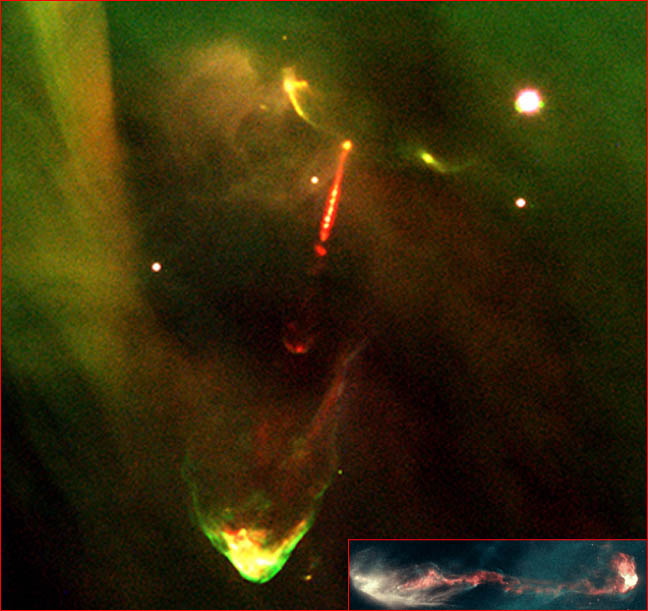
As to the source of energy in a quasar, Lerner stated it is "the rotational energy of an entire galaxy, augmented by the gravitational energy released as the galaxy contracts," "converted to electrical power by the disk-generator action and concentrated in the smaller filaments moving towards the galaxy core." He said that without the periodic release of energy from the plasmoid, galaxies would not even form. He went on to suggest that a similar phenomena is probably responsible for the jets coming from objects such as protostars since in forming they have to shed rotational and gravitational energy, as well, and he notes that black holes cannot be used to explain those jets. Can anyone yet explain Herbig-Haro jets like this
in a completely non- electromagnetic cosmology? I don't think so.
Check out the book "Colliding Galaxies: The Universe in Turmoil" by Barry Parker, copyright 1990. I don't think this author had any bias towards plasma cosmology as he didn't mention anything but gravity and black holes. And I don't believe the picture of the galaxy he presented has significantly changed. In a section titled "At The Core" in a chapter titled "Is Our Galaxy Exploding", Parker noted that "Kwok-Yung Lo of the University of Illinois has been studying" the region near the core "for the last several years. He recently made a detailed radio map of it using the VLA." Lo is quoted as saying "The whole cavity inside the ring of whirling matter is filled with streams of ionized gas." Parker then writes that "the most intense energy source, both in radio and infrared regions, is right at the center of the clear region." He states that astronomers once thought that the mass of the object at the center was over a million solar masses but as the region has been studied in more detail, this figure has become controversial. Now, "According to Lo the mass range for the object at the center is between a few hundred solar masses and a million. Lo and his colleages have shown that the radio source at the center is exceedingly small. 'It's only about the size of the solar system,' he said. 'This seems to be evidence in favor of a black hole.'" But as I just noted, black holes are not the only theory where horrendous amounts of energy are produced in a very small region.
A section titled "Filaments" in the above book is also intriguing. It shows evidence of the type of currents and magnetic fields postulated by plasma cosmologists. Even back in 1990 they had evidence of these ... unlike dark matter, dark energy and strings. Parker wrote the following: "Another strange feature of the central region is the presence of huge filaments. In 1984 Mark Morris of UCLA and Farhad Yusef- Zadeh and Don Chance of Columbia University, using the VLA, discovered three enormous parallel arks of gas approximately 10-20 light-years thick. They are over 150 light-years long and project out from the plane of the disk. Studies soon showed that arcs of this type had to be composed of high-speed particles trapped by extremely strong magnetic fields. ... at this time we still do not know what causes them." "Soon after these filaments were discovered, much larger filaments were discovered by a Japanese team of radio astronomers of the University of Tokyo's Radio Observatory. They are horseshoe- shaped, and rise about 700 light-years above the galactic plane. They resemble the giant arches of gas that are sometimes seen on the sun, but they are, of course, billions of times larger. It is believed that they are high-speed particles trapped in magnetic fields."
Note that there is an artist's illustration in the book depicting the core region. What struck me back then is that it looks very much like the plasma device photograph and plasmoid model that Lerner has in his book "The Big Bang Never Happened". In other words, it depicts multiple filaments that fountain out of a small central core then loop around and reenter on the opposite side of the core ... just like Alfven, Lerner and Peratt postulated. Furthermore, if the mass is near the lower end of the range Lo mentioned, I see no reason why Lerner's plasma model could not be valid. The central plasmoid hypothesized by Lerner would certainly be a very massive object.
So, tell me, do you know whether the group advocating black holes in the last 20 years has come up with an explanation for these "filaments" based on gravity alone and without resorting to some other mathematical construct or substance that can't even be detected? Because Plasma Cosmology could explain them more than two decades ago with a highly coherent model. In fact, this should count as a prediction by plasma cosmologists that's been satisfied. After all, Lerner submitted his paper describing such features in galaxies well before the VLA results were ever published.
Let me repeat. Lerner's book, Peratt's writings and Donald's Scott's books are actually full of referenced data showing the existence of currents and magnetic fields at all scales. They describe *observed* filamentary phenomena starting at laboratory scale all the way up to radio telescope data that proves the existance of filaments in our own galaxy that are over a hundred light years long and several light years wide. Peratt states that those fields are "nearly identical in geometry and strength with simulations of Birkeland currents in studies of galaxy formation." He and Lerner go on to indicate that there is no "known" reason to preclude the existance of filaments of much larger size and suggest that the large scale "bubble-like" grouping of galaxies may be evidence that such filaments exist. Something to that effect. If you accept that "super" filaments carrying "super" currents exist, then they contend that they will naturally produce galaxies and quasars, based on known electromagnetic and plasma physics. Without having to resort to missing mass or any other esoteric notion.
So I challenge you to check out the foundations for plasma physics before simply dismissing it. You will see that not only are electromagnetic forces sufficently powerful to form and shape galaxies, but this fact has been demonstrated in large scale computers models that produced results that explain a number of observations in the universe that Big Bang cosmology has failed to explain ... and without inventing black holes in every object, missing mass, inflation, super strings, dark energy, or cosmological constants and physics that change over time. Alfven and others have already shown that the physics we understand scale from the laboratory to the earth's magnetosphere (a factor of a billion). By scaling these physics another billion, Anthony Peratt "formed" galaxies with computer models that match observations of ordinary and radio galaxies in terms of structure, rotation, jetting and other features. Experiments at Los Alamos confirmed that the same phenomena apply to currents from microamps to megaamps, a trillion fold jump. So the physics necessary to explain even the formation and behavior of galaxies is there at all scales. Not without gravity but with the HELP of gravity. And with, at least, forces and physics we are sure exist.
Therefore, I think it is wise to keep an open mind rather than simply declare Big Bang Cosmology "the reality". The truth is that if anyone is ignoring facts and physics, it is the Big Bang cosmologists. The various sites which propose the gravity only solution never even mention the alternative ... never even mention the effect of phenomena like
http://public.lanl.gov/alp/plasma/CIV.html "IMMENSE FLOWS OF CHARGED PARTICLES DISCOVERED BETWEEN THE STARS". The proof is that I can pick up most books on big bang cosmology and never find the words plasma or electromagnetism listed in the index. You can barely find the word plasma on NASA's websites (but they sure like to talk about black holes). They almost always refer to "gas" when when they are actually talking about are plasmas. Don't let them keep you in the dark. Educate yourself.