• Quick note - the problem with Youtube videos not embedding on the forum appears to have been fixed, thanks to ZiprHead. If you do still see problems let me know.

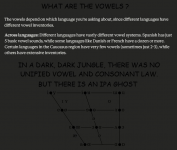
there is a law inside the alphabet

5b001e895e829a29322d067dbb6fe1778f954a7d_2_1024x723.png
 
When untrained and/or cheerily daft people set out to create an alphabet,
they're apt to come up with a syllabary, as Sequoyah did with Cherokee.
Interestingly (or not), I feel that we see elements to a syllabary approach in Vixen's post
#244, above.

The Myceneans famously applied a woefully inappropriate syllabary to the
problem of writing Greek: ti ri po do for tripodos. Of course, theirs was
a case of barbarians making do rather than inventing anything.
I picture a not-overclean Mycenean chieftain shouting at a Minoan
captive, "You, islander! Make your mud plate say, 'King has three tripods
in his store!' Do it!" and the scribe, rendering Basic Greek as well as he can,
draws a crude grapheme of a tripod followed by his syllabic form of writing. The
chieftain grunts and lets him live another day.
 
Last edited:
When untrained and/or cheerily daft people set out to create an alphabet,
they're apt to come up with a syllabary, as Sequoyah did with Cherokee.
Interestingly (or not), I feel that we see elements to a syllabary approach in Vixen's post
#244, above.

The Myceneans famously applied a woefully inappropriate syllabary to the
problem of writing Greek: ti ri po do for tripodos. Of course, theirs was
a case of barbarians making do rather than inventing anything.
I picture a not-overclean Mycenean chieftain shouting at a Minoan
captive, "You, islander! Make your mud plate say, 'King has three tripods
in his store!' Do it!" and the scribe, rendering Basic Greek as well as he can,
draws a crude grapheme of a tripod followed by his syllabic form of writing. The
chieftain grunts and lets him live another day.
Only because the OP is syllabary. My linguistics approach would be to look at the family group. Far more interesting but outside the scope.
 
Only because the OP is syllabary. My linguistics approach would be to look at the family group. Far more interesting but outside the scope.

NOTHING is outside the scope of this thread.

So, as the RAF says when transmitting in clear, "Jolly good, bash on."
 
@alphabetlaw2018, allow me to introduce you to Lojban.

Lojban is a constructed language (conlang) designed from the ground up to be syntactically unambiguous. It's letters are always pronounced the same (with allowances for speakers from different language backgrounds) and its grammar is based on pure logic. I think you'd love it.

This is Article 1 of the Universal Declaration of Human Rights, in English:

All human beings are born free and equal in dignity and rights. They are endowed with reason and conscience and should act towards one another in a spirit of brotherhood.

This is the same two sentences, run through a Lojban translator:

ro remna cu jbena zifre gi'e dunli lo ka nolylazni je lo ka jetnu .i dunli lo nu krinu je lo nu consciji gi'e bilga lo nu drata zu'ai lo nu bruna
 
On the other hand, @alphabetlaw2018, let me introduce you to Toki Pona.

This is another constructed language, designed to be minimalist and easy to learn. It's complete dictionary contains no more than 140 words made up of nine consonants and five vowels, most of which have multiple related meanings and can be used in a wide variety of ways to express complex concepts.

Here is the same Article translated into Toki Pona:

jan ale li kama lon la ona li ken ala awen poki.
ona li sama lon suli pi jan en lon ken pi pali.
ona li jo e sona pi lawa en pilin pi pona en ike,
la ona li wile pali tawa jan ante lon pilin pi jan sama.

In Toki Pona (lit. Language of Good), you can call me jan Wol.
 
That’s the first time I’ve seen that phrase with pluralised foxes.
They seem redundant as one fox does the trick?
IIRC, the intent is to use all the letters of the alphabet in the shortest possible sentence. Pluralizing fox to foxes eliminates the initial "the" and removes the "s" from "jumps", thus making the sentence shorter by two letters..
 
If you persist long enough in training to become an actor, you learn how to approach different dialects and accents. This then helps you work with dialogue coaches for some specific project because you then have a shared vocabulary for talking about sounds your voice makes. Most American actors (beyond the amateur level) are taught Received Pronunciation for British English.

Similarly most Americans can easily identify their regional accents, just as those from the U.K. can for their regions—and in fact native speakers of any language. But at the same time, you have to spend at least a little time in the American South to distinguish a Texas accent from a North Carolina accent. Similarly I'm not sure I could distinguish Lancashire from Yorkshire, but with attention an American can recognize them both as from the north.

Here's a testimonial video clip from a large home services company in my region.

There are three discernible Utah accents in this video. Can you hear them? After living here for many years, I can. But they're very nuanced. Now for ordinary communication purposes it doesn't matter. The distinct way "service" is pronounced in these accents doesn't affect communication or orthography.

But linguists are interested in such differences. And they want to be able to represent them in writing, hence we have an alphabet that captures all that subtle nuance. So when someone asks, "How many vowels does a language have?" you have to ask in turn, "For what purpose?" The first syllable in "service" has distinct sounds in Utah, Boston, and Milwaukee. Hence there needs to be at least those three ways to write down the difference. In linguistics those might be considered separate sounds. But we don't spell those words differently from region to region, and any competent English speaker will ignore differences in pronunciation. That doesn't mean you can simply ignore those differences in your mad rush to impose an universal "law inside the alphabet," especially if your goal in doing so is to claim you've done a better job than linguists of graphically representing sound. It's like saying you've found the "law" of colors by ignoring all the various shades and saying there are only six colors—and put that in your hat, Mr. Munsell.
 
Last edited:
I am still trying to figure out what the "law" in all this is, other than an apparent recognition that alphabets tend at least to try to reflect the sounds we make when we speak, but what else that law says seems elusive.
 

Back
Top Bottom