Norman Alexander
Penultimate Amazing

This changes everything! You are vindicated!Who get the credit for giving the definition of what is a vowel ?
View attachment 67543
Uh, no.

This changes everything! You are vindicated!Who get the credit for giving the definition of what is a vowel ?
View attachment 67543

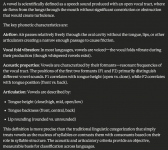


Some sort of AI?[Citation needed]
The Op or the quote?Some sort of AI?

Why yes, linguists exist.Who get the credit for giving the definition of what is a vowel ?

the blindmen and the elephant: The first one happened to put his hand on the elephant's side. "Well, well!" he said, "now I know all about this beast. He is exactly like a wall."And again; linguists only try to describe vowels, and all the other building blocks of spoken languages - the actual language comes first, and linguists only ever come trotting behind, trying desperately to keep up with their ever-changing subject. They do not lay down the law on anything, they just report on the rules set the users of languages.
Linguist do not claim to describe the whole alphabet soup, with or without elephants (and if with, you should always allow it to simmer for as long as possible, by the way, in order to make their derms less pachy), you know. Have you ever actually read up on what linguists do? You may be surprised.the blindmen and the elephant: The first one happened to put his hand on the elephant's side. "Well, well!" he said, "now I know all about this beast. He is exactly like a wall."
Except that linguists are hardly the equivalent of blind men. They are quite able and eager to broaden their horizons and expand their understanding, even while admitting they will always be a reactive field of study.the blindmen and the elephant: The first one happened to put his hand on the elephant's side. "Well, well!" he said, "now I know all about this beast. He is exactly like a wall."
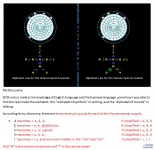
What predictions does this 'law' make?With only moderate knowledge of English language and Vietnamese language I was able to find the law inside the alphabet of symbols, for writing, and the alphabet of sounds, for talking.
I don't think so. And that includes the OP.Anyone actually know what the OP is trying to say?
Best I've been able to do is try to unravel this post.Anyone actually know what the OP is trying to say? Can you translate for me?
It is interesting how Vietnamese works. And quite simple compared to other languages.
Yes, and ... ?
Which particular English accent is he talking about?Best I've been able to do is try to unravel this post.
It is interesting how Vietnamese works. And quite simple compared to other languages.Yes, and ... ?
Since ancient time, it has always been the central intention of the “alphabet people” for symbols to represent the speech sounds; since ancient time “alphabet people” has been looking into the human speech sounds for discovering the vowels and consonants, just like panning for the gold element. They knew those were the elemental sounds of the human speech.
Latin Based Alphabets:
Both English Alphabet and Vietnamese Alphabet are Latin based Alphabets...
In it he seems to say that the formal study of linguistics has been unable to find a "unified law in the alphabet" and hence must rely upon the International Phonetic Alphabet to express a plethora of vowel sounds. The alphabet he's referring to is the English alphabet, the basis of writing both the English language and (with diacritical markings) the Vietnamese language. He admits only a rudimentary understanding of English—as if that's not obvious in his writing—and claims an unspecified understanding of Vietnamese (which I'm assuming without evidence is his native language).
According to the text in the graphic, he claims he has discovered a "law inside the alphabet" by which vowels can be simplified into three variations on each of five elemental vowel sounds. He has given symbols to each of these: the canonical five English vowel letters each with (1) no diacritical mark, (2) a circumflex ˆ, and (3) a breve ˘. The rest of his argument seems to be sneering at linguists (= "the alphabet people") for not being as clever as he is in discovering this miraculous law.
Exactly. It's a "law" that holds only if you simplify away all the important differences.Which particular English accent is he talking about?
I still want to know what predictions it makes. Without that it isn't even a hypothesis.Exactly. It's a "law" that holds only if you simplify away all the important differences.
Thank you.Best I've been able to do is try to unravel this post.
It is interesting how Vietnamese works. And quite simple compared to other languages.Yes, and ... ?
Since ancient time, it has always been the central intention of the “alphabet people” for symbols to represent the speech sounds; since ancient time “alphabet people” has been looking into the human speech sounds for discovering the vowels and consonants, just like panning for the gold element. They knew those were the elemental sounds of the human speech.
Latin Based Alphabets:
Both English Alphabet and Vietnamese Alphabet are Latin based Alphabets...
In it he seems to say that the formal study of linguistics has been unable to find a "unified law in the alphabet" and hence must rely upon the International Phonetic Alphabet to express a plethora of vowel sounds. The alphabet he's referring to is the English alphabet, the basis of writing both the English language and (with diacritical markings) the Vietnamese language. He admits only a rudimentary understanding of English—as if that's not obvious in his writing—and claims an unspecified understanding of Vietnamese (which I'm assuming without evidence is his native language).
According to the text in the graphic, he claims he has discovered a "law inside the alphabet" by which vowels can be simplified into three variations on each of five elemental vowel sounds. He has given symbols to each of these: the canonical five English vowel letters each with (1) no diacritical mark, (2) a circumflex ˆ, and (3) a breve ˘. The rest of his argument seems to be sneering at linguists (= "the alphabet people") for not being as clever as he is in discovering this miraculous law.
