I do my small part for keeping them in the supply chain.Batteries don't need to be disposed of. The can be reused for other purposes, and maybe after three different purposes they are recycled for their valuable mineral content.

You are using an out of date browser. It may not display this or other websites correctly.
You should upgrade or use an alternative browser.
You should upgrade or use an alternative browser.
Cont: Electric Vehicles II
- Thread starter acbytesla
- Start date
-
- Tags
- electric cars
Roger Ramjets
Philosopher

The 'fields of abandoned EVs' in China turned out to be cars owned by ride-sharing companies that went bust after incentives were removed.Its just this nonsense being pushed from the US that the EV world is 'in trouble'- no, no its not.....
EV sales are rising month by month all around the world, far from a 'glut' of excess batteries being 'disposed of' there is a SHORTAGE of batteries- they can't make them fast enough....
Same with the EV's (be they full or hybrid EVs) they again can't make them fast enough, the stories (pushed almost exclusively from the far right in the US) about 'fields of abandoned EVs' and the nonsense that the EV manufacturers are 'desperate to move stock' to the point of falsifying sales is ridiculous...
Only the most ignorant and uneducated would believe such garbage... oh right so all trump supporters believe it then.....
The US media has a LOT to answer for.....

Problem is that many 'journalists' are pushing an agenda. Perhaps they are Luddites trying to buck the new technology, or anti-China activists hoping for economic collapse - or simply stoking outrage to get clicks. Hard to blame their viewers for believing what they are told by a media that pretends to be on their side (which goes double for 'alternative' media).
Not to say there isn't currently a glut though. Markets are constantly adjusting for technological changes, consumer tastes and other factors. At any one time chances are there will either be a shortage or an oversupply. Earlier this year Tesla suffered a shortage of Model Y's as they retooled for the new model (I guess they figured it was a good time to do it with Musk's antics damaging the brand). Now production is back up and the Model Y is once again the top selling EV in Europe.
As for the US, indications are that removal of the EV tax credit hasn't had much effect. A recent survey by J. D. Power found that nearly 60% of new vehicle shoppers are considering an EV, up from 52% in September. 94% of current EV owners say they will buy electric again. Meanwhile some legacy automakers have scaled back production of EVs in anticipation of a huge drop in demand. Will Tesla end up a winner by filling in the gap? Will Ford's halting production of the F-150 Lightning help Cybertruck sales? Whatever happens I'm betting overall EV sales in the US will increase, not decrease.
Record electric vehicle sales show American demand – will U.S. automakers deliver or retreat?
We are already seeing this in New Zealand, with the BYD Dolphin being thousands of dollars less than a Toyoto Corolla hybrid. Price parity is a powerful incentive to adopt a newer technology. When a vehicle costs about the same and is much cheaper to run and nicer to drive it's a 'no brainer' for anyone who isn't afraid of trying something new.November 17, 2025
This is the exact wrong moment for automakers to lose their nerve in the transition to electric vehicles (EVs). A decade of consistent growth has culminated in record-breaking EV sales. More than 1.2 million new light-duty EVs were sold through the first three quarters of 2025, higher than any prior year...
The expiration and reduction of federal tax credits for EVs have effectively increased the upfront cost of electric vehicles in the United States. But the economics still favor EVs:.. As battery prices continue to fall due to global competition and economies of scale, EVs are on pace to soon reach cost parity with conventional vehicles, making the economic advantage even more compelling.
Last edited:
Rolfe
Adult human female

I think there's an active campaign to rubbish EVs, funded by oil companies and legacy car makers who don't want to stop making internal combustion engines. (Yes, Toyota, I'm looking at you.) Sounds like a CT until you remember the tobacco industry's campaign to play down/deny the cancer risk, and the similar cover-up by the asbestos manufacturers.
malbui
Beauf

- Joined
- Nov 8, 2004
- Messages
- 4,677
I've had my TM3 for getting on for seven years of utterly effortless motoring and even now am being told at dinner parties that they're a dangerous fad and that I'll be helpless when all electrical infrastructure melts down. To echo Josh Homme, I just smile and move on.
dirtywick
Penultimate Amazing

- Joined
- Sep 12, 2006
- Messages
- 10,129
I think there's an active campaign to rubbish EVs, funded by oil companies and legacy car makers who don't want to stop making internal combustion engines. (Yes, Toyota, I'm looking at you.) Sounds like a CT until you remember the tobacco industry's campaign to play down/deny the cancer risk, and the similar cover-up by the asbestos manufacturers.
well, they have and continue to conspire against climate science findings, they hire "mercenary" scientists to produce fake studies and run propaganda campaigns. they are, in fact, performed by the same people who did the same on behalf of tobacco companies.

Frederick Seitz - Wikipedia

Fred Singer - Wikipedia
it's just more of the same imo
Dabop
Master Poster

Interestingly we have been having some extremely wild weather for the last few days (which has left over a hundred thousand homes in SE Qld without power) after storms ripped through the entire SE corner of the state- our local power was out for two days- our local EVs were all charging from their rooftop solar arrays, while the local ICErs were on Facebook begging for lifts back home- cause neither of the local servos could sell fuel without power lolI've had my TM3 for getting on for seven years of utterly effortless motoring and even now am being told at dinner parties that they're a dangerous fad and that I'll be helpless when all electrical infrastructure melts down. To echo Josh Homme, I just smile and move on.
Seems the EVs might be the only ones running if the power stays out....
It also shows the downside of relying on petrol powered gennies for home backup- its alright as long as you can get fuel..... if you can't- they are useless.... meanwhile my systems hit sunset today at 100% full battery storage despite all the storms, and I'm enjoying power as usual..... I can hear the neighbours genny puttering away if I go outside so I know the powers still out lol
We have had storms every day since Sunday.... Sunday hit inland where I am, Monday hit us again AND over towards Brissy, and we just had another big storm here again just a few minutes ago- its heading back to the coast and so Brissy is likely to cop a third night of major storms....

Just down the road from me about 30 mins drive away on Sunday...


And tonights storms....

Plenty still without power and likely more by tomorrow, as tonights storms are likely to take out more of the grid....

Glad I run offgrid solar here, and cant wait until I get my EV lol
Rolfe
Adult human female
On Thursday I'm getting a small extension added to my system so that I'll have emergency access to the power in my home battery in the event of a power cut. It will power my kerosene-fuelled heating boiler and give me a couple of 13A sockets for lights, TV, WiFi, kettle, microwave, whatever. Enough to tide me over for a few hours.
I could also run an extension lead indoors from the car charging port and run things from the VtL. The limitation is that I can't run the boiler from VtL (that's why I'm getting the modification that will), but it's better than nothing.
The holy grail is to be able to recharge my home battery from the car, but my electrician doesn't seem to know how to do that. If that was achievable then I'd be good to go indefinitely so long as the power cut was local enough that I could drive to a working charger.
I could also run an extension lead indoors from the car charging port and run things from the VtL. The limitation is that I can't run the boiler from VtL (that's why I'm getting the modification that will), but it's better than nothing.
The holy grail is to be able to recharge my home battery from the car, but my electrician doesn't seem to know how to do that. If that was achievable then I'd be good to go indefinitely so long as the power cut was local enough that I could drive to a working charger.
Filippo Lippi
Philosopher

- Joined
- Nov 28, 2002
- Messages
- 5,354
Fully Charged on Octopus' "free driving" V2G offer
UK only
I signed up as "interested," and I receive email updates, but still not sure when it will launch. The lease on the eNiro ends in March, the range on the Leaf in the cold weather is not great, so there's a bit of jeopardy.
UK only
I signed up as "interested," and I receive email updates, but still not sure when it will launch. The lease on the eNiro ends in March, the range on the Leaf in the cold weather is not great, so there's a bit of jeopardy.
Last edited:
Filippo Lippi
Philosopher
- Joined
- Nov 28, 2002
- Messages
- 5,354
Seriously considering a Hyundai Ioniq 6, the Kia EV4 is just too expensive
Rolfe
Adult human female
Keep us posted.
Roger Ramjets
Philosopher
I can't be bothered watching the whole video, so I will just comment on the first segment.
interesting video on the economic problems western ev adoption faces. cutting subsidies, dropping regulatory standards and blocking competition, and chinese dominance
Yes, it's true that EV adoption has 'stalled' in some countries (eg. New Zealand) due to governments walking back support. But this is not important because the largest market by far - China - is not doing so. We also see many countries where EV adoption is accelerating.
World Car Markets 2025. The Top 50 Countries
That's the market share for all cars, but for EVs it's even more stark:-Looking at YTD figures country-wise, China remained the largest global market, up by 5.3%. This huge market accounted for 29.9% of all global sales.
USA ranked 2nd gaining 2.6% in sales volume. The country held a 18.5% share of the global market.
India ranked 3rd with a 5.1% share (+1.5%) followed by Japan which secured a 5.1% share as well (+4.3%).
Ranking 5th, Germany was still the largest European market, with a 3.2% share of the total
China is a big player in emerging markets, and will be in the US and Europe too once trade barriers are eased.Globally, EV sales are growing quickly, reaching a share of about 16% of total vehicles sold up to October 2025 and growing by 16.2%.
China remained the absolute leader, with about 70% of the sector at the global level (+15.6%). EVs stagnated in the US (-7.2%) but reported growth in key european market including Germany (+39.7%) and the Netherlands (+13.6%), despite shrinking in the UK (-12.1%).
Notably, several emerging markets are reporting breakout growth, especially Brazil (+31.4%) and Vietnam (+203.2%).
The biggest factor affecting EV adoption is price. Companies like BYD and Geely are now producing affordable EVs with good range that make them a viable alternative to gas cars. At the same time battery manufacturers like CATL are developing cheaper, higher capacity, longer lasting batteries that will reduce prices even more. Many EV makers are also adopting more efficient designs and manufacturing processes that are possible with EVs. Soon an EV will be not only be much cheaper to operate, but also significantly cheaper to purchase. When that happens the foodgates will truly open.
It's true that Tesla has been a driving force for EV adpotion, showing other automakers what can be done. But the video's assertion that legacy automakers were 'mesmerized' by Tesla's success is plain wrong. They were surpised by it for sure, but continued to underestimate Tesla as they proceded to make EVs which they claimed would take over the market - while still producing gas cars whose sales they would be cannibalizing.
Most legacy automakers planned on a slow transition, and many are doing the minimal possible to achieve it. This is a losing strategy. Some have realized this and are pulling back, an even bigger mistake. They can only hope to ride on the coattails of industry leaders when manufacturing costs come down. But many legacy automakers are in trouble anyway. The shift to EVs is inevitable and every bit of the market they take over leaves less for gas cars. At the same time gas cars have become more expensive and less reliable as they try to reduce emissions and improve efficiency.
Ford sells the most popular vehicle in the US, the F-150 'light truck'. This may sound like they lead the industry, but in fact it only accounts for 3% of the US vehicle market. This alone tells you that Ford is in a vulnerable position, as they don't have any other compelling vehicles to suit the the majority of buyers.
Ford Made A Huge Mistake Killing Its Two Most Affordable Models
US automakers thought they would quickly kill Tesla when they introduced their own EVs. They had decades of experiance and infrastucture in place, while Tesla had nothing. All they had to do was slap an electric motor and battery into an existing design and they would trounce Tesla. But that didn't happen. They couldn't make EVs cheap enough in small volumes to compete, and they had teething problems due to unfamiliarity with the different technology. Dealers weren't keen on selling them due to lower after-sales revenue and a general reluctuance to change.Ford, GM, and Stellantis all justified discontinuing their small models due to sales declines, but did they all make their decisions prematurely? Gas prices have decreased since hitting a record high in mid-2022, but they are still up from pre-pandemic levels. Combined with inflation wreaking havoc on prices, most Americans can no longer afford a new vehicle, especially as the average price of a new car has now jumped past $50,000 for the first time in history.
Despite the competition, Tesla still holds over 40% share of the US EV market. This is the proximate reason that some other US automakers are pulling back - not that they were 'mesmerized' by Tesla, but simply that they couldn't make a competitive product. But does that mean there's no market for affordable EVs in the US? Not at all:-
While the US government continues to put a 100%+ tariff on Chinese EVs, US automakers can take their time intruducing more affordable models. But how long will this last? Tesla isn't standing still either. The Cybercab enters production in 2026. It will almost certainly have a manual option via 'drive by wire' steering wheel and pedals. Tesla will offer this to get their production volumes up, and I predict it will be a big hit. Legacy automakers are going to once again be caught flatfooted.Consumers clearly have an appetite for affordable EVs, as evidenced by the Chevrolet Bolt EV having its best sales year ever in 2023 (62,044 units). Sadly, this didn't stop GM from discontinuing it last year. Chevy will beat Ford to the low-cost EV segment with the next-generation Bolt, which is set to arrive in 2027. Perhaps this could be Ford's way of reviving those ever-popular affordable models, because as it stands, Ford's most affordable EV is the Mustang Mach-E, which sits awfully close to $40,000 before any options are ticked.
A compact Focus EV, or Bolt-rivaling Fiesta, could be the perfect entry-level electric option that Ford needs to reintroduce affordability into its line-up, and to stop ignoring the market space it once used to dominate so comfortably.
The situation is Europe isn't as bad as the video makes out either. The ban on gas cars has only been slightly relaxed to allow for the small demand that will still exist in 2035, and any automaker who thinks they will be the one to dominate that 10% of the market is stupid. EVs are growing in popularity in most European countries. Some automakers are struggling because they make overpriced unrelaible vehicles - both EVs and gas cars. Volkswagen have a massive debt and a commitment to EVs that was forced onto them by Dieselgate. Nevertheless if they could just make a good reliable EV they would do well in Germany, as Germans tend to prefer locally made cars. Tesla (or should I say Musk) is helping them there too!
Last edited:
Dabop
Master Poster
PMSL- I could tell it was a US based storyline before it even started- the facts are the US is the only one seeing this 'decline' with EV sales in all other western countries rising rapidly....
interesting video on the economic problems western ev adoption faces. cutting subsidies, dropping regulatory standards and blocking competition, and chinese dominance
Even here in Australia, BEV and PHEV sales made up nearly 1/3 of all new car sales in 2025, a significant increase over 2024...

The ONLY EV manufacturer thats been struggling worldwide is (you guessed it) the US owned Tesla brand- funny that- outing yourself as a far right fascist proved to be a big sales loser for its ceo- it might play well in the trump USA, but far less so in - well- everywhere else...
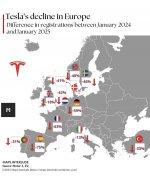
I mean, who would have thought doing this

might prove unpopular in Europe?????
Its not as if they ever had anyone making that salute do anything bad in Eur... oh wait....

(and despite all the frantic whitewashing by the trumptards- it was far from the first time he had publicly supported or shown support for the neonazi's... it was the 'last straw' in a string of similar incidents....)
dirtywick
Penultimate Amazing
- Joined
- Sep 12, 2006
- Messages
- 10,129
I can't be bothered watching the whole video, so I will just comment on the first segment.
Yes, it's true that EV adoption has 'stalled' in some countries (eg. New Zealand) due to governments walking back support. But this is not important because the largest market by far - China - is not doing so. We also see many countries where EV adoption is accelerating.
World Car Markets 2025. The Top 50 Countries
That's the market share for all cars, but for EVs it's even more stark:-
China is a big player in emerging markets, and will be in the US and Europe too once trade barriers are eased.
The biggest factor affecting EV adoption is price. Companies like BYD and Geely are now producing affordable EVs with good range that make them a viable alternative to gas cars. At the same time battery manufacturers like CATL are developing cheaper, higher capacity, longer lasting batteries that will reduce prices even more. Many EV makers are also adopting more efficient designs and manufacturing processes that are possible with EVs. Soon an EV will be not only be much cheaper to operate, but also significantly cheaper to purchase. When that happens the foodgates will truly open.
It's true that Tesla has been a driving force for EV adpotion, showing other automakers what can be done. But the video's assertion that legacy automakers were 'mesmerized' by Tesla's success is plain wrong. They were surpised by it for sure, but continued to underestimate Tesla as they proceded to make EVs which they claimed would take over the market - while still producing gas cars whose sales they would be cannibalizing.
Most legacy automakers planned on a slow transition, and many are doing the minimal possible to achieve it. This is a losing strategy. Some have realized this and are pulling back, an even bigger mistake. They can only hope to ride on the coattails of industry leaders when manufacturing costs come down. But many legacy automakers are in trouble anyway. The shift to EVs is inevitable and every bit of the market they take over leaves less for gas cars. At the same time gas cars have become more expensive and less reliable as they try to reduce emissions and improve efficiency.
Ford sells the most popular vehicle in the US, the F-150 'light truck'. This may sound like they lead the industry, but in fact it only accounts for 3% of the US vehicle market. This alone tells you that Ford is in a vulnerable position, as they don't have any other compelling vehicles to suit the the majority of buyers.
Ford Made A Huge Mistake Killing Its Two Most Affordable Models
US automakers thought they would quickly kill Tesla when they introduced their own EVs. They had decades of experiance and infrastucture in place, while Tesla had nothing. All they had to do was slap an electric motor and battery into an existing design and they would trounce Tesla. But that didn't happen. They couldn't make EVs cheap enough in small volumes to compete, and they had teething problems due to unfamiliarity with the different technology. Dealers weren't keen on selling them due to lower after-sales revenue and a general reluctuance to change.
Despite the competition, Tesla still holds over 40% share of the US EV market. This is the proximate reason that some other US automakers are pulling back - not that they were 'mesmerized' by Tesla, but simply that they couldn't make a competitive product. But does that mean there's no market for affordable EVs in the US? Not at all:-
While the US government continues to put a 100%+ tariff on Chinese EVs, US automakers can take their time intruducing more affordable models. But how long will this last? Tesla isn't standing still either. The Cybercab enters production in 2026. It will almost certainly have a manual option via 'drive by wire' steering wheel and pedals. Tesla will offer this to get their production volumes up, and I predict it will be a big hit. Legacy automakers are going to once again be caught flatfooted.
The situation is Europe isn't as bad as the video makes out either. The ban on gas cars has only been slightly relaxed to allow for the small demand that will still exist in 2035, and any automaker who thinks they will be the one to dominate that 10% of the market is stupid. EVs are growing in popularity in most European countries. Some automakers are struggling because they make overpriced unrelaible vehicles - both EVs and gas cars. Volkswagen have a massive debt and a commitment to EVs that was forced onto them by Dieselgate. Nevertheless if they could just make a good reliable EV they would do well in Germany, as Germans tend to prefer locally made cars. Tesla (or should I say Musk) is helping them there too!
he talks about china quite a bit in the video

No, the biggest factor affecting EV adoption is the availability of charging stations. It is a hen/egg situation: charging stations aren't set up when there are few EV's, and people are not buying EV's when they can't get their EV charged easily. I have an EV and I chose it because it was cheap(ish), and because everywhere I go there are charging stations. My family in Austria wants to buy EV's but wait until enough charging stations are dotting the land. Soon I am going to Austria for a month, and I have rented a fossil car for the same reason as my family.The biggest factor affecting EV adoption is price.
Dabop
Master Poster
Hell, most EVs could cross Austria on a single charge.....No, the biggest factor affecting EV adoption is the availability of charging stations. It is a hen/egg situation: charging stations aren't set up when there are few EV's, and people are not buying EV's when they can't get their EV charged easily. I have an EV and I chose it because it was cheap(ish), and because everywhere I go there are charging stations. My family in Austria wants to buy EV's but wait until enough charging stations are dotting the land. Soon I am going to Austria for a month, and I have rented a fossil car for the same reason as my family.
Hell we have them crossing AUSTRALIA on a regular basis these days...
To give you an idea- assuming you HAD to only use the public charging network, there's certainly quite a few chargers there...

And considering that the Atto3 I am looking at (pretty much one of the cheapest brands available in Australia) has a range of 420km per charge, with a 20-25 min recharge time from 20% to 80% (giving a 'refill' of 350km in about 20 minutes) and Austria is only about that from east to west- you are looking at 'maybe' needing a single recharge east to west, none needed north to south at all lol

To give you an idea- heres what the 'elcheapo' Atto3 can do here in Australia... 420km per charge...

That's how much I could drive from my place on a single charge....
If I had spent the night in Vienna, and was leaving with a 100% full charge on board the next morning, this is how far I could go on a single charge before looking for one of those chargers up above lol

'Oh noes, no EV could EVA manage that- it would be stranded with a dead battery for sures!!!'
Said no EV owner ever lol
PMSL....
You can easily check yourself- go to https://www.plugshare.com/ type in Vienna Austria and you get this

Note the distance indicator bottom right thats 2km (1.2 miles)
There's definitely no way you could ever run an EV there lol......

Last edited:
acbytesla
Penultimate Amazing

- Joined
- Dec 14, 2012
- Messages
- 39,400
I know. Right? I was sure that Steenkh was taking a piss after he said Austria.Hell, most EVs could cross Austria on a single charge.....
Hell we have them crossing AUSTRALIA on a regular basis these days...
To give you an idea- assuming you HAD to only use the public charging network, there's certainly quite a few chargers there...
View attachment 67396
And considering that the Atto3 I am looking at (pretty much one of the cheapest brands available in Australia) has a range of 420km per charge, with a 20-25 min recharge time from 20% to 80% (giving a 'refill' of 350km in about 20 minutes) and Austria is only about that from east to west- you are looking at 'maybe' needing a single recharge east to west, none needed north to south at all lol
View attachment 67399
To give you an idea- heres what the 'elcheapo' Atto3 can do here in Australia... 420km per charge...
View attachment 67400
That's how much I could drive from my place on a single charge....
If I had spent the night in Vienna, and was leaving with a 100% full charge on board the next morning, this is how far I could go on a single charge before looking for one of those chargers up above lol
View attachment 67402
'Oh noes, no EV could EVA manage that- it would be stranded with a dead battery for sures!!!'
Said no EV owner ever lol
PMSL....
There are definitely places in middle America and the Mountain West where there are too few chargers. But Austria isn't one of them.
Last edited:
Dabop
Master Poster
I don't know why the US has such issues (well I 'DO' lol)I know. Right? I was sure that Steenkh was taking a piss after he said Austria.
There are definitely places in middle America and th Mountain West where there are too few chargers. But Austria isn't one of them.
Its basically the same size as the US, has a tiny population in comparison- and yet we can STILL do it...
Like I said, Australia has a large EV presence these days (and yes BYD is the biggest by far, basically selling two vehicles to every Tesla sold here lol)
Plugshare again, this is Australia's EV charger networks

And theres a LOT more, keep zooming in and they just keep popping up....
(again note the 200km marker bottom right- thats half the range of the Atto3.....)
Try it for fun- click on https://www.plugshare.com/ and type in Australia lol- keep zooming in and watching more and more charge points popping up....
My little towns in there- 1500 people, 7 EVs and a public charge point- in the middle of the Aussie bush, with literally an hours drive at 110kph to the next town!!! (its a 'big town'- its got a McDonalds there lol, and 20000 people- and NINE public chargers...
Mind you the public chargers are basically for tourists or those needing a quick topup really- most people charge at home instead- its a LOT cheaper, hell a lot of locals that are using EVs are offgrid completely- and still manage home charging for free from the sun lol- a Atto like I am looking at needs about 60kWh to fully recharge from 'dead empty' to 100% full- here that can be readily achieved by a 15kw or larger array- which is quite cheap really- about $9000 Au or about $6000US fully installed....
Of course that means I'd be driving over 400km a day if I needed to recharge that amount each and every day- or I spent half as much time driving to and from work as I did AT work- that would get old fast.... (2 hours drive to work, 8 hours at work and 2 hours back home again- I'd be looking for a job closer to home lol)
acbytesla
Penultimate Amazing
- Joined
- Dec 14, 2012
- Messages
- 39,400
It totally depends on where you live in the US. And yes, it is the home charging costs that make it attractive and affordable. But you have to look at the entire equation to decide that it makes sense for you.I don't know why the US has such issues (well I 'DO' lol)
Its basically the same size as the US, has a tiny population in comparison- and yet we can STILL do it...
Like I said, Australia has a large EV presence these days (and yes BYD is the biggest by far, basically selling two vehicles to every Tesla sold here lol)
Plugshare again, this is Australia's EV charger networks
View attachment 67404
And theres a LOT more, keep zooming in and they just keep popping up....
(again note the 200km marker bottom right- thats half the range of the Atto3.....)
Try it for fun- click on https://www.plugshare.com/ and type in Australia lol- keep zooming in and watching more and more charge points popping up....
My little towns in there- 1500 people, 7 EVs and a public charge point- in the middle of the Aussie bush, with literally an hours drive at 110kph to the next town!!! (its a 'big town'- its got a McDonalds there lol, and 20000 people- and NINE public chargers...
Mind you the public chargers are basically for tourists or those needing a quick topup really- most people charge at home instead- its a LOT cheaper, hell a lot of locals that are using EVs are offgrid completely- and still manage home charging for free from the sun lol- a Atto like I am looking at needs about 60kWh to fully recharge from 'dead empty' to 100% full- here that can be readily achieved by a 15kw or larger array- which is quite cheap really- about $9000 Au or about $6000US fully installed....
Of course that means I'd be driving over 400km a day if I needed to recharge that amount each and every day- or I spent half as much time driving to and from work as I did AT work- that would get old fast.... (2 hours drive to work, 8 hours at work and 2 hours back home again- I'd be looking for a job closer to home lol)
Rolfe
Adult human female
I'm a moderator on an EV forum that has a lot of members who drive in Europe a lot. They're unanimous that charger availability is excellent, significantly better than in Britain, and cheaper too.
Well, charger availability in Britain is pretty much excellent these days. There may be one or two lean spots, but I've driven from top to bottom several times in my short-range MG4 (51 kwh) and never had the slightest problem finding a charger when I needed one.
On Monday I drove to Yorkshire for Christmas. I'd had a bit of hassle in previous years because chargers were busy, but realised that planning to stop at a popular site for lunch was actually not clever. I timed my stop for mid-afternoon, and still found all eight chargers occupied. If I'd waited five minutes maybe someone would have come out and vacated a bay, but I just turned and went on to the next service station 12 miles further on. Got a free plug immediately, went for a coffee, 20 minutes later back on the road. And that's on one of the busiest days of the year. There are literally 6-12 ultra-rapid chargers every 10 to 20 miles on the main road, plenty to choose from.
And get this, this is the first time I've used a public charger since the beginning of November. I charge at home, for buttons, full battery every morning for the trouble of 15 seconds to walk round the car and plug in.
On the way home I'm spoiled for choice again. Tebay? Southwaite? Carlisle? Todhills? Gretna? Which has the best coffee?
I appreciate that the USA has problem areas, but anywhere else, anyone who says they're waiting for public charging to improve before getting an EV is simply making excuses.
Well, charger availability in Britain is pretty much excellent these days. There may be one or two lean spots, but I've driven from top to bottom several times in my short-range MG4 (51 kwh) and never had the slightest problem finding a charger when I needed one.
On Monday I drove to Yorkshire for Christmas. I'd had a bit of hassle in previous years because chargers were busy, but realised that planning to stop at a popular site for lunch was actually not clever. I timed my stop for mid-afternoon, and still found all eight chargers occupied. If I'd waited five minutes maybe someone would have come out and vacated a bay, but I just turned and went on to the next service station 12 miles further on. Got a free plug immediately, went for a coffee, 20 minutes later back on the road. And that's on one of the busiest days of the year. There are literally 6-12 ultra-rapid chargers every 10 to 20 miles on the main road, plenty to choose from.
And get this, this is the first time I've used a public charger since the beginning of November. I charge at home, for buttons, full battery every morning for the trouble of 15 seconds to walk round the car and plug in.
On the way home I'm spoiled for choice again. Tebay? Southwaite? Carlisle? Todhills? Gretna? Which has the best coffee?
I appreciate that the USA has problem areas, but anywhere else, anyone who says they're waiting for public charging to improve before getting an EV is simply making excuses.