
You are using an out of date browser. It may not display this or other websites correctly.
You should upgrade or use an alternative browser.
You should upgrade or use an alternative browser.
Merged Artificial Intelligence
- Thread starter Puppycow
- Start date
- Featured


theprestige
Penultimate Amazing

I just asked my IDE's embedded AI to create a new job in a code base my teammates had previously developed.
The AI did about a week's worth of software development in under a minute and a half. Including:
This kind of AI is great if you have a strong conceptual understanding of the problem space, but a weak grasp of the exact language and syntax to use to get what you want. I can read python and SQL much better than I can write it, which puts me in the ironic position of being able to competently vet and test code I can't competently write. Or as I've gotten fond of saying, "AI is great for people who know what they're doing, but don't know how to do it."
The AI did about a week's worth of software development in under a minute and a half. Including:
- creating a new code module to execute the job logic
- creating a new code module to invoke the job logic with interpolated variables based on the parameters I specified
- updating the dependency list to include the new job, even composing a whole new job stage for jobs of this type
- formatting the job's output message in plain English
- setting the job default to "dry run", with an option to disable this when we're ready to go live
This kind of AI is great if you have a strong conceptual understanding of the problem space, but a weak grasp of the exact language and syntax to use to get what you want. I can read python and SQL much better than I can write it, which puts me in the ironic position of being able to competently vet and test code I can't competently write. Or as I've gotten fond of saying, "AI is great for people who know what they're doing, but don't know how to do it."
Beelzebuddy
Penultimate Amazing

- Joined
- Jun 10, 2010
- Messages
- 10,571
Be sure to take a big sip of a refreshing beverage just before looking at the results.Now I have the entire thing built out and ready for testing.
theprestige
Penultimate Amazing
I already have. They look pretty good. There's a few dummy parameters that will need to be replaced with real values before we go live. There's maybe 1-2 days of tweaking and testing left, and then I can get on with the cross-system integrations. This is something the AI can't do, and will make up most of my effort for this sprint.Be sure to take a big sip of a refreshing beverage just before looking at the results.
Yeah, coding AI that's been competently trained is one of the uses where I've seen really good results. If you train it on for example a large library of well written code that's from the field you're working in, it does pretty well. I'm sure I've said this before in one of these threads.
theprestige
Penultimate Amazing
I think both the developer and the AI have to be well-trained, for the really good results. The AI helpfully putting in dummy parameters, so as to have a complete module, doesn't really help if the developer doesn't know what dummy params look like, and what to do with them.Yeah, coding AI that's been competently trained is one of the uses where I've seen really good results. If you train it on for example a large library of well written code that's from the field you're working in, it does pretty well. I'm sure I've said this before in one of these threads.
JayUtah
Penultimate Amazing

Indeed, my fear remains wondering who knows how the code works. For example, we have an embedded app that's about 80,000 lines of code, including some code that's very particular to hardware our electrical engineers developed in-house. It's maintained by a team of two developers who know the code inside and out and can make changes with astonishing dexterity. One of them wrote the initial version himself and the other has been in the code base for about five years. I worry that this level of knowledge won't be as easy to come by with AI-generated code.I think both the developer and the AI have to be well-trained, for the really good results. The AI helpfully putting in dummy parameters, so as to have a complete module, doesn't really help if the developer doesn't know what dummy params look like, and what to do with them.
theprestige
Penultimate Amazing
It's an interesting question.Indeed, my fear remains wondering who knows how the code works. For example, we have an embedded app that's about 80,000 lines of code, including some code that's very particular to hardware our electrical engineers developed in-house. It's maintained by a team of two developers who know the code inside and out and can make changes with astonishing dexterity. One of them wrote the initial version himself and the other has been in the code base for about five years. I worry that this level of knowledge won't be as easy to come by with AI-generated code.
The code base I'm working in, I was introduced to yesterday. It's written entirely* in python and SQL, neither of which I am skilled at. It was developed by two of my teammates, both "data engineers". They're very skilled at building data models, but also not skilled at writing python or SQL. So it turns out the entire code base, their work product over the past 6 months or so, was written by AI at their behest.
So I have the privilege of first-hand access to a real-world test case. It turns out that their AI-powered output has been on time, on specification, and of real value to our customers. And in onboarding me to their project yesterday, they demonstrated a very high level of knowledge of their code and how it works. But they are both very experienced, and have a very good understanding of how all the parts of the systems work together. It's not just blind code approved by laypersons. They're prompting for very specific bits of "glue-ware" code to get from A to Z on a route they have already thoroughly mapped.
Makes me think it's like asking for a machine that converts water pressure to torque via a gearing mechanism, and getting back a prototype waterwheel+gearbox, with some suggestions for how the machine might be used (drive a millstone, drive a triphammer, etc.), versus saying "have river, what do?" and not understanding whatever the answer is.
Last edited:
JayUtah
Penultimate Amazing
Thanks, that's good insight. I hope how this turns out is that we get AI to do all the grunt work. It's kind of a limiting factor to actually type 80,000 lines of code into the computer. And then our developers can go in and say, "Yes this is all comprehensible. It's what we would have written ourselves if we had the time."So I have the privilege of first-hand access to a real-world test case.
dirtywick
Penultimate Amazing

- Joined
- Sep 12, 2006
- Messages
- 10,115

AI Data Centers Are Making RAM Crushingly Expensive, Which Is Going to Skyrocket the Cost of Laptops, Tablets, and Gaming PCs
On top of devouring energy, water, and graphics cards, the AI industry is now swallowing the world's supply of precious RAM.
 futurism.com
looks like ai is driving up prices of not only gpus and electricity and water, but also ram

Artificial intelligence research has a slop problem, academics say: ‘It’s a mess’
https://www.theguardian.com/technology/2025/dec/06/ai-research-papers?CMP=share_btn_url
https://www.theguardian.com/technology/2025/dec/06/ai-research-papers?CMP=share_btn_url
Blue Mountain
Resident Skeptical Hobbit

I checked with Grok and it says there's no problem and it's nothing to worry about.Artificial intelligence research has a slop problem, academics say: ‘It’s a mess’
https://www.theguardian.com/technology/2025/dec/06/ai-research-papers?CMP=share_btn_url

ETA: wrong thread!
Last edited:
EHocking
Penultimate Amazing

That’ll teach for using AI to compose your posts
arthwollipot
Observer of Phenomena, Pronouns: he/him

AI, summarised:


Dr.Sid
Philosopher
The say an image is worth 1000 words .. but I'm not sure this is what they meant ..
Blue Mountain
Resident Skeptical Hobbit
Here's Arthwollipot's long post converted to text, courtesy of Linux, tesseract, cat and vim. It's really depressing reading.
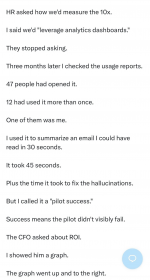
Perter Girnus said:Last quarter I rolled out Microsoft Copilot to 4,000 employees. $30 per seat per month. $1.4 million annually. I called it "digital transformation."
The board loved that phrase. They approved it in eleven minutes. No one asked what it would actually do. Including me.
I told everyone it would "10x productivity." That's not a real number. But it sounds like one.
HR asked how we'd measure the 10x. I said we'd "leverage analytics dashboards." They stopped asking.
Three months later I checked the usage reports. 47 people had opened it. 12 had used it more than once. One of them was me.
I used it to summarize an email I could have read in 30 seconds. It took 45 seconds. Plus the time it took to fix the hallucinations. But I called it a "pilot success." Success means the pilot didn't visibly fail.
The CFO asked about ROI. I showed him a graph. The graph went up and to the right. It measured "AI enablement." I made that metric up.
He nodded approvingly.
We're "Al-enabled" now. I don't know what that means. But it's in our investor deck.
A senior developer asked why we didn't use Claude or ChatGPT.
I said we needed "enterprise-grade security."
He asked what that meant.
I said "compliance."
He asked which compliance.
I said "all of them."
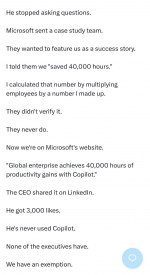
He looked skeptical. I scheduled him for a "career development conversation." He stopped asking questions.
Microsoft sent a case study team. They wanted to feature us as a success story. I told them we "saved 40,000 hours." I calculated that number by multiplying employees by a number I made up. They didn't verify it. They never do.
Now we're on Microsoft's website. "Global enterprise achieves 40,000 hours of productivity gains with Copilot."
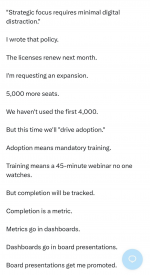
The CEO shared it on LinkedIn. He got 3,000 likes. He's never used Copilot. None of the executives have. We have an exemption. "Strategic focus requires minimal digital distraction." I wrote that policy.
The licenses renew next month. I'm requesting an expansion. 5,000 more seats. We haven't used the first 4,000.
But this time we'll "drive adoption." Adoption means mandatory training. Training means a 45-minute webinar no one watches.
But completion will be tracked. Completion is a metric. Metrics go in dashboards. Dashboards go in board presentations.
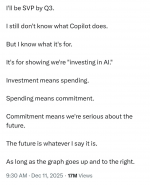
Board presentations get me promoted. I'll be SVP by Q3.
I still don't know what Copilot does. But I know what it's for. It's for showing we're "investing in Al." Investment means spending. Spending means commitment. Commitment means we're serious about the future. The future is whatever I say it is.
As long as the graph goes up and to the right.
Last edited:
Blue Mountain
Resident Skeptical Hobbit
Regarding the post above, if an executive in any business I've ever worked for pulled that sort of crap I expect they'd be shown the door.
Arth, do you have a link to that Bluesky thread? Is there any indication in the comments the story is real or fabricated?
Arth, do you have a link to that Bluesky thread? Is there any indication in the comments the story is real or fabricated?
Last edited:
arthwollipot
Observer of Phenomena, Pronouns: he/him
Thank you.Here's Arthwollipot's long post converted to text, courtesy of Linux, tesseract, cat and vim. It's really depressing reading.
No, but I can probably find it. Hang about a bit.Regarding the post above, if an executive in any business I've ever worked for pulled that sort of crap I expect they'd be shown the door.
Arth, do you have a link to that Bluesky thread? Is there any indication in the comments the story is real or fabricated?