• Quick note - the problem with Youtube videos not embedding on the forum appears to have been fixed, thanks to ZiprHead. If you do still see problems let me know.

What book is everyone reading at the moment? Part 2.

Audio book of 'A Very British Coup', it seems relevant. Real book (well, Kindle) of 'So What Do You Do?' by Norman Baker, I thought I'd remind myself of Handsy's past and finances.

 
Drink Your Way Sober: Science Based Method to Free Yourself from Alcohol by Katie Herzog.

Short version, there's a drug called naltrexone that when used in a particular way has a 75-80% success rate at getting people to stop drinking.

I was on an antibiotic over the Xmas before last where I was warned that even one drink would cause severe nausia and possibly heart palpitations. I didn't test it (bloody great Christmas) but I think that would probably do the job.
 
I was on an antibiotic over the Xmas before last where I was warned that even one drink would cause severe nausia and possibly heart palpitations. I didn't test it (bloody great Christmas) but I think that would probably do the job.
Not sure about that, I know lots of folks that don't let nausea keep them from drinking.
 
Ghost Stories: The Definitive Collection, Stephen Fry
I have been driving a good bit lately and listening to this audiobook, splendidly read by Stephen Fry. I don't know if it's really definitive, but the selection is eclectic and entertaining. Stories include "The Legend of Sleepy Hollow" by Washington Irving (with acceptable American accents, though the tale has zero lines of actual dialogue); "Lost Hearts," M.R. James; "The Empty House," Algernon Blackwood; "The Body Snatcher," Robert Louis Stevenson; and other stories by other hands, including Poe, Amelia B. Edwards, Charlotte Riddell, and Bram Stoker. Some are light-hearted, some take a pragmatic, skeptical view ("The Open Door"), and one or two are dark and foreboding, such as Stoker's "The Judge's House."

Fry uses his voice like a musical instrument. At this Halloween season, he offers appropriate entertainment
 
Ghost Stories: The Definitive Collection, Stephen Fry
I have been driving a good bit lately and listening to this audiobook, splendidly read by Stephen Fry. I don't know if it's really definitive, but the selection is eclectic and entertaining. Stories include "The Legend of Sleepy Hollow" by Washington Irving (with acceptable American accents, though the tale has zero lines of actual dialogue); "Lost Hearts," M.R. James; "The Empty House," Algernon Blackwood; "The Body Snatcher," Robert Louis Stevenson; and other stories by other hands, including Poe, Amelia B. Edwards, Charlotte Riddell, and Bram Stoker. Some are light-hearted, some take a pragmatic, skeptical view ("The Open Door"), and one or two are dark and foreboding, such as Stoker's "The Judge's House."

Fry uses his voice like a musical instrument. At this Halloween season, he offers appropriate entertainment

If you like that type of thing I heartily recommend 'The Classic Ghost Story Podcast' with Tony Walker, I subscribe to his lowest Patreon tier which doesn't get me anything but since I listen regularly while walking I feel like I should give something back. Mostly Victorian and Edwardian stories out of copyright, occasionally living authors let him do their stuff and he sometimes does longer stories in multipart. He follows the stories with a bit of background and general chat, but I tend to avoid that bit as he's rather woo woo at times and I get irritated listening to him telling everyone that scientific materialism has been disproved or such like.

A few years ago he read a story I suggested, 'Boomerang' which was a bit of a departure as it's a very early example of body horror and not supernatural.
 
Meddling Kids by Edgar Cantero.

Now, with a title like that you'd think it would be a pleasant young adult-type novel. No, it's more of a college-age read (lots of sex and death and swearing.) It's a mystery (!) why so many references were made, you may guess to what because of the title -- there's even a "Zoinx River", ffs.
Some adults who were in their own detective club as kids (capturing guys in masks) get involved in what turns out to be a world-ending Lovecraftian event, and it is really bad. Oh, and there's a dog too. Yes, he talks at the end.
It's interminable, and just horribly written. Similes (like this one) are slathered literally on almost every page like too much cream cheese on an everything bagel. Halfway through my eyes gave up rolling and I just plogged through to the end.
 
Anne of Green Gables, Lucy Maud Montgomery
Another re-read, this is of course the golden oldie, published in 1908 and since then dramatized about 391 times on stage, radio, the movie screen, as animated cartoons and anime, and as puppet shows. It developed a fandom that included Mark Twain and Elizabeth II.

It is the story of Anne Shirley, a lonely orphan who hates her red hair, skinny frame, and freckles and who whiplashes from darkest despair to heady elation. She talks a mile a minute in a vocabulary advanced beyond her age and yearns for a home, a family, and at least one bosom friend.

We meet her when, at eleven, she is sent by the orphanage to the Cuthbert farm, Green Gables, on Prince Edward Island. Marilla and Matthew Cuthbert, siblings in late middle age who have no experience in raising children, at first want to send her back because they had asked to adopt a boy to help with farm work. Anne's personality persuades first Matthew and then his younger sister to take a chance.

For five years the book follows Anne as she gets into trouble, becomes an avid student (except for geometry), finds her bosom friend, and works het way into the readers' hearts. It is a great book, and my wife and I once visited PEI and the house that inspired Montgomery. My wife identified every landscape from the Lake of Shining Waters to the Haunted Wood. We bought a facsimile first edition in the museum, and that was when I read the book for the first time. I think this marks my tenth read-through, but good books are like good friends, always fun to revisit.
 
The Skeptical Botanist, 2025, By John Entwisle.

Debunking the myths about plants and gardening. The author is the former head of the Sydney and Melbourne Botanic Gardens, and also held a senior role at Kew Gardens. This is a collection of writings from the past 30 years, updated, and some new pieces.

I'm a quarter of the way through and enjoying it so far.
Finished this. A collection of articles and essays in a sequence that flows as logically as the arguments within. Science with a sense of humour!

I found myself mentioning different topics to friends several times over the past 2 months.

The only complaint I have is the copy editing could have been more thorough - I came across several typos or missing words.

I still enjoyed it a great deal.
 
Last edited:
A Bright and Guilty Place: Murder, Corruption, and L.A.’s Scandalous Coming of Age, Richard Rayner

An informal but well-documented social history of Los Angeles from the 1920s through the 1940s, Rayner’s book delivers what the subtitle promises. At the outset, L.A. is a Mecca for Americans seeking the fabled climate and, perhaps, abundant oranges. Gradually, things go south, the decline started by the spectacular and tragic failure of the St. Francis Dam and a resulting flood that took away much property, hundreds of lives, and the reputation of William Mullholand, the dam’s designer. Chinatown may come to mind ….

Lives intertwine with people like Leslie White, a photographer who documented the drowning victims and later became a self-taught forensics expert for the LAPD as well as a moderately successful pulp writer. There’s also Dave Clark, WWI hero and public prosecutor, who falls into corruption as the mob increasingly muscles its way into California’s balmy clime. A rogue’s gallery of thugs, mugs, hustlers, and murderers, with abundant weaponry and bribe money, fills out the cast.

But we also meet Erle Stanley Gardner, a Ventura county attorney who spends his days in court and his nights cranking out 4,000 words every day of pulp fiction; Raymond Chandler, an oil executive who augments his income by writing short stories and novels that bear the imprint of the things he witnessed; Dashiell Hammett, Pinkerton detective who is at least the godfather of hard-boiled crime fiction In addiion, the reader sees small, often tragic appearances by Clara Bow, Charlie Chaplin, and Lincoln Steffens.

Reading the book encouraged me to read a short story by Leslie White, “The City of Hell!” Not very well-written, it’s packed with resentful venom against the mobsters who invaded his once-beloved city. Events like the murder of Ned Doheny, the son of oil millionaire E.L. Doheny (a crime that was never solved) inspire specific novels and stories of Chandler and others. The really surprising thing is that L.A.’s real history is bloodier and more violent than any pulp writer’s imaginings.

Recommended.
 
Last edited:
Tombstone: An Iliad of the Southwest, Walter Noble Burns

When Walter Burns wrote this history in 1927, Wyatt Earp was hanging around Hollywood and acting as a production advisor on Western movies. Texas John Slaugher had died just five years previously. In addition to consulting living legends such as these, Burns had access to court and other public records in Tombstone and went through the files of newspapers from that era.

Thus, the book is an accurate history. Um, no. Not quite. The old newspapers were about evenly divided between seeing the Earps as heroes and the Clantons as villains, or vice-versa, and Wyatt in his old age sort of polished up his accounts. Still, though its style is old-fashioned, the viewpoints often bigoted, and the prose occasionally so purple that one fears it is verging on an aneurysm, this is a fun read.

Figures such as all the Earp boys (more than are in the Tombstone and Wyatt Earp movies, even!), Old Man Clanton, younger Ike Clanton, and all the little Clantons, Doc Holliday, Johnny Ringo, Curly Bill Brocius, and just about every owlhoot and gunslinger that passed through Tombstone show up. Holliday says, “I’m your huckleberry,” but alas, Wyatt does not say “Skin that smoke-wagon and see what happens,” but instead, “Jerk your gun and use it!” He does say to a scared Ike Clanton, “Go to fighting or get away!”

Burns draws such details from his sources, though one must keep in mind that those sources are biased one way or the other. Clearly, though, a whole passel of screenwriters mined this book for material over the years.

In sum, it’s a good read but its veracity should be politely doubted on key points. There is a “whatever became of” chapter in the more civilized setting of the early 20th century, with this valediction: “Tombstone flames no more. Its wild days are a tale that is told. It lives with its memories and its ghosts. Sunshine and peace are now its portion. Once it was romance. Now it’s a town.”
 
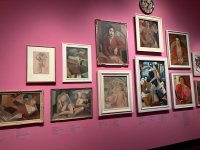
Dangerously Modern: Australian Women Artists in Europe 1890-1940 (2025)

I saw this exhibition at the Art Gallery of South Australia in August, and this is the accompanying volume, filled with quality reproductions of the artworks and engrossing commentary on the works and the artists.

It presents 50 trailblazing women who studied, worked, and exhibited in Europe's art scene, and how many were ignored by the Australian art scene.

I loved Dorrit Black's cubist forms and lively linocuts, Grace Crowley's futurist shapes, and Hilda Rix Nicholas' and Ethel Carrick's light-filled streetscapes.

I will be revisiting this book's writings and pictures again and again as a valuable reference to new-to-me art from often unsung skilled professionals.

Eta photo

IMG_3531.jpeg
 
Last edited:
Currently reading Antony Beevors Ardennes 1944. Previously I've read Keegans 6 Armies at Normandy, Beevors Arnhem so this is a continuation of the 1944-45 west front timeline. Probably finish it off with his Berlin book later.
 
Last edited:
Farewell, Summer, Ray Bradbury

This was Ray Bradbury’s last published novel before his death. It’s also a sequel to one of my favorite books, Dandelion Wine, a lyrical tribute to one particular summer when the protagonist, Douglas Spaulding, was twelve and the world offered endless horizons, eternal hope, and life was bright and beautiful.

The sequel took over fifty years to appear, and reading it is like catching up with an old friend after decades have passed. We’re back in Green Town, with its spooky and mysterious ravine separating the well-to-do section from the rest of town. We meet again Douglas’s grandmother, grandfather, and younger brother. The mood is more somber, the pace a little slower, but the sweet music of Bradbury’s prose still takes us through the story.

Much of the story ponders Youth and Old Age, presented here as a change rung on the Civil War, the gray city elders plotting against the lively young boys of the town and vice-versa. Douglas’s brother Tom decides he doesn’t want to grow old, ever, and the obvious answer is to throw a monkey wrench into the town clock. Meanwhile, the elderly members of the School Board conspire to take away more and more time from the kids of the town. The two sides collide in a series of battles. In the end an Appomattox results in a kind of loss and a kind of victory.

Throughout, gradually Douglas becomes aware that girls are not as boring as he thought, and in fact growing up offers fascinating possibilities. Dandelion Wine had a loose structure, like perfect little short stories shuffled together like a deck of cards and dealt out in an order that took on meaning only when all lay face-up. This is similar and yet different. Farewell, Summer has humor, moments of suspense, occasional eeriness, and the haunting, wonderful voice of an expert storyteller.

Thank you, Mr. Bradbury.
 
Last edited:
Three Weeks, Elinor Glyn
Young English aristocrat Paul Verdayne is naughty and gets caught in compromising circumstances with the person's daughter. His parents exile him abroad so he can learn to control his passion. Big mistake.

He encounters a mysterious older woman who at first sight gets his interest up, and before long she invites him to her apartment and her bed, and for three weeks they constantly make whoopee, while the lady (she never tells him her name) instructs him about politesse, technique, and why what they are doing isn't what the vile rabble call sinning, but something higher, much higher, and a little to the left, darling. Then she goes away, Paul wanders lovelorn for five years, the lady bears his son, and her husband murders her, the way they do

This was hot stuff in 1907, and it has its moments now, but the characters don't quite come fully to life. The story's a bit quaint and artificial, though it's a fairly interesting curio.
 
The Nice and Accurate Good Omens TV Companion, Matt Whyman
Always a big Terry Pratchett fan, I really liked the TV adaptation. This is a heavily illustrated, lightweight, but fun behind-the-scenes account of the production. Best parts are the detailed interviews with the cast and crew, who all show a fond affection for the material. No big surprises, but many good moments. Neil Gaiman, prior to the fall from grace, speaks warmly of Terry Pratchett always wanted a film or TV adaptation of the book and seems sincere in wanting to do justice to Pratchett's vision.

Example: the kids who played Them, the young Antichrist's gang talk about their favorite and least favorite moments. They all disliked the bit when they're all eating ice cream, because (A) nobody got a flavor they liked and (B) they had to do a dozen takes and got brain freeze. An outstanding memorable moment? When Ollie, playing a hellhound, bit David Tennant.

Could have been Neil Gaiman.
 
Trying to get into Gone Girl, but I just find the main character to be incredibly annoying.
 
Arundhati Roy, Mother Mary Comes to Me, an exceptional book, about her, about her mother, and about modern India. It's funny - funny sharp, funny sad, and funny zany - irreverent, analytical, and warm as well as intensely unsettling. And the writing makes me want to die and be reborn as her. The God of Small Thing is one of my favourite books, this gives me a deeper understanding of it. It is sometimes brutal, since it describes a brutal world, but the author looks at it all with such clear eyes, that all the layers that make people who they are, and make them act the way they do, are laid bare, and understandable.

I started reading it today, and had to force myself to stop, since I want to save it, and not just wolf the whole thing down straight away. But it's fine, even if I finish it tonight (which i will. I know me),; this is a book to reread, and not just once.
 

Back
Top Bottom