• Quick note - the problem with Youtube videos not embedding on the forum appears to have been fixed, thanks to ZiprHead. If you do still see problems let me know.

Cont: The sinking of MS Estonia: Case Reopened Part VI

Status
Not open for further replies.
The ship was sailing in an environment it was never designed to operate, under conditions which would be challenging for most oceangoing vessels of her size.

Not quite.
It was designed to operate in those conditions, but, at the time it was designed there were no standards or real data on the design of roll on roll off ferries with lifting bow visors.

It was recognised that Estonia had problems after earlier incidents with both her and other ships.
Also her overall condition wasn't good with problematic repairs and operation.
Another factor at the time Estonia was constructed was Sweden allowed quite lax domestic certification for ferry construction.

Because of this Estonia was later limited to coastal operations.
 
Söderarm is 73nm from wreck, Tallinn 94 nm. The full distance Tallinn to Söderarm is 163nm. The mathematical halfway point is 83nm.* In other words 21nm or 10nm from the Söderarm side of the midpoint and 11 from the Tallinn end.

10 nm is roughly within 6% of the entire journey. As an analogy, if it was based on one hour, say, rather than distance, then 6% would be equivalent to a time frame of 3.6 minutes either side of the allotted expected time. Which is pretty tight. Bearing in mind the foibles of the waves and the wind speed.

In case you are asking, how come it doesn't add up to 73 + 94 = 167, this is because in Steve Morse's distance calculator, he adjusts for the fact that latitude is only exactly 60nm per 1º at the Equator. Due to earth being globe-shaped, his distance calculations include an adjustment for latitudes and longitudes further north and south of the equator. So one short journey might add up to X nm and a continuation, to Y nm, but the entire journey combined, X + Y might throw out a curve ball result based on this inherent mathematical adjustment.

So when your original number is so far off, you decide to make new calculations? Does not bode well for your 'military precision'. By the way, it would still be accuracy and not precision.

Vixen said:
He didn't say it was 'detuned' he said they were 'untuned'. This was a surprise as they had been inspected by the ships electricians the week before as being in working order.

Or as I showed in a different translator, they were unarmed. This makes perfect sense if you actually understood how they worked.
 
Or as I showed in a different translator, they were unarmed. This makes perfect sense if you actually understood how they worked.

That still makes no sense, they are always 'armed' and ready to go at the flick of a switch. Or, in the case of immersion models as soon as the sensor is wet.
 
That still makes no sense, they are always 'armed' and ready to go at the flick of a switch. Or, in the case of immersion models as soon as the sensor is wet.

I think the translation is saying unarmed as not turned on. The manual switch is in the off position, so it was not transmitting or not armed. Makes much more sense than untuned.
 
I think the translation is saying unarmed as not turned on. The manual switch is in the off position, so it was not transmitting or not armed. Makes much more sense than untuned.

That's how I understood it.
 
So when your original number is so far off, you decide to make new calculations? Does not bode well for your 'military precision'. By the way, it would still be accuracy and not precision.


"I have learned from my mistakes, and I am sure I can repeat them exactly." — Peter Cook.

Now that's precision.
 
Last edited:
I think the translation is saying unarmed as not turned on. The manual switch is in the off position, so it was not transmitting or not armed. Makes much more sense than untuned.

Indeed, neither "armed" nor "tuned" is strictly accurate.

"Tuned" is right out if it means adjusting the frequency. EPIRBs must transmit on either 406.025 MHz or 406.028 MHz with a variance not more than 2 ppm for several hours in order to be certified for sale. That narrow tolerance is so that we can Doppler-locate a signal that doesn't have GPS or whose GPS data is unusable. You can only get that tolerance in the factory. There is absolutely no field adjustment for frequency.

"Armed" is still inaccurate because it implies it can be disarmed. There is no user control that will make an immersion-activated model not activate when the sensor gets wet. That would effectively defeat the purpose of immersion activation. There is the immersion switch and there is the manual-on switch. It's always armed in the classical sense of arming.
 
re: the photo of Viking Sally/Estonia with the bow visor slightly raised, there's a pretty good chance the photo was taken at the entrance to either Turku or Mariehamn. Hell, given that it was the 80's, it might even have been Stockholm itself.

And for those so inclined, the first couple of minutes of the linked YouTube video shows the opening and operation of the bow visor on the last train ferries across the Great Belt in Denmark. It even shows the lock disengage.

(And for those into those sort of things, these particular train ferries only allowed operations though the bow. The rear of the train deck was fitted with couplers for the trains).
 
Not quite.
It was designed to operate in those conditions, but, at the time it was designed there were no standards or real data on the design of roll on roll off ferries with lifting bow visors.

It was recognised that Estonia had problems after earlier incidents with both her and other ships.
Also her overall condition wasn't good with problematic repairs and operation.
Another factor at the time Estonia was constructed was Sweden allowed quite lax domestic certification for ferry construction.

Because of this Estonia was later limited to coastal operations.

I'm guessing the standards were changed after the sinking.

The first investigation and the new one are both looking at the bow, and ramp details. I know changes were mandated after the disaster. The MS Estonia had only sailed in rough weather one other time, according to the history. I don't know if this was luck, or out of caution. So many sinkings are a result of a ship getting lucky in a bad storm, and the captain, and shipping company assuming they can push their luck in the future.
 
Nobody said it is Sweden's fault. A communications block meant Stockholm MRCC - which has a major naval base BTW with helicopters at the ready in 15 minutes notice - prevented more help from arriving earlier. The water temperature was a mild 10ºC. Hypothermia was not inevitable but for time delay.


I have to think that you have never spent much time in 10ºC water. Certainly not much more than a half hour to an hour, tops, because that's how long it would take to render you unconscious.

There is nothing "mild" about it.
 
I have to think that you have never spent much time in 10ºC water. Certainly not much more than a half hour to an hour, tops, because that's how long it would take to render you unconscious.

There is nothing "mild" about it.

My guess is Vixen thinks that because a 10oC temperature for the weather is mild then it must be the same for water.

That this is a hilariously stupid idea doesn't alter my assumption.
 
My guess is Vixen thinks that because a 10oC temperature for the weather is mild then it must be the same for water.

That this is a hilariously stupid idea doesn't alter my assumption.

Add water temperatures to the list of things that Vixen has no idea of....
10C is not 'mild'- in fact it is literally on the very edge of 'dangerously low' temperatures for swimming in...

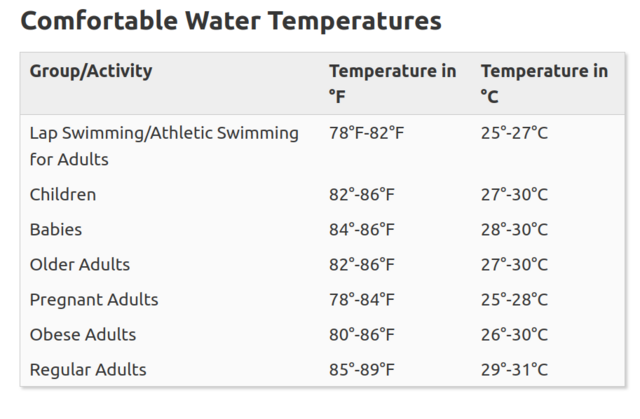
Most people would find it 'bloody freezing'- 25C to 30C is comfortable...
Screenshot-from-2023-10-04-12-41-06.png


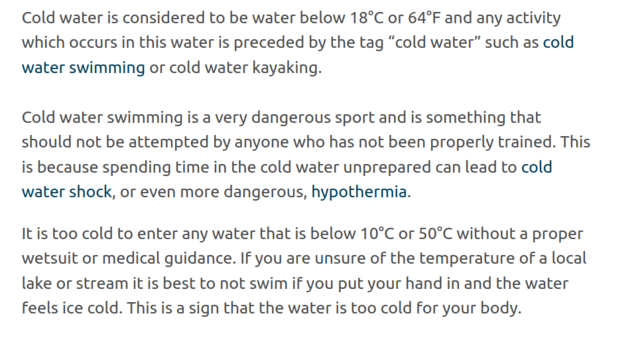
Cold water swimming is considered 'dangerous' and is anything under 18C (nearly double Vixens 'mild water' temperature...

Screenshot-from-2023-10-04-12-42-28.png

Anything under 15C to 16C it is recommended you wear a wetsuit...

https://seatemperatures.net/blog/swimming-temperature-guide/
:boggled:
 
I have swum in water under 18C without a wetsuit before. Once. For about 2 minutes until I got back to land from the boat that I had been in.

It was hell. I spent about half an hour warming up and wishing I was dead.
 
10 ºC is the lower boundary of the cold-shock response. That's when you enter the water (unexpectedly) and involuntarily inhale sharply. This is often a cause of drowning, as the victim inhales water.
 
Status
Not open for further replies.

Back
Top Bottom