• Quick note - the problem with Youtube videos not embedding on the forum appears to have been fixed, thanks to ZiprHead. If you do still see problems let me know.

What is art?

I am an artist and painter, but I find art to be a completely subjective term. There are levels of craftsmanship and subtlety in technique that are tangible and have merit. I myself love drawing and capturing form with marks and lines. When one can reproduce the sense of form as well as capture the behavior of light well, I consider that a truly gifted artist. The examples shown of modern abstract art for the most part I do not have much respect for. I do appreciate good composition however, and much of the abstract art that is making an effort to balance composition I can appreciate.
I would not call subtle technique and craftsmanship with form and light and composition arbitrary, and I would also posit that there are degrees of subtlety it's impossible to appreciate without sharing a propensity for the trade one's self. I am absolutely fascinated by the the way a mind can recreate a three dimensional scene using representations on a two dimensional canvas.
 
It is the most expensive painting ever sold.
But is it art?
What makes it art?
The artist doesn't manifest (my guess: he doesn't have) an above average ability to imagine and illustrate forms and shapes. What the ancient masters (Michelangelo, Ilya Repin etc.) did is something that only a minimal fraction of people are capable of doing, no matter how much time you give them to practice the skill and then perform the task.

Average humans, even below average humans (my guess: the painter might be one of them) are capable of creating something a bit similar to this painting. But it is not quite so easy as one might think, I actually once bought paints and canvases with the intention of making some modern / abstract art to sell in some gallery. Everything what I created looked so silly and uninteresting that I threw them all to the trashbin without showing them to anyone else than my wife, who laughed enough at my creations. So there evidently is a skill involved in making also this style of abstract art.
 
The artist doesn't manifest (my guess: he doesn't have) an above average ability to imagine and illustrate forms and shapes. What the ancient masters (Michelangelo, Ilya Repin etc.) did is something that only a minimal fraction of people are capable of doing, no matter how much time you give them to practice the skill and then perform the task.

Average humans, even below average humans (my guess: the painter might be one of them) are capable of creating something a bit similar to this painting. But it is not quite so easy as one might think, I actually once bought paints and canvases with the intention of making some modern / abstract art to sell in some gallery. Everything what I created looked so silly and uninteresting that I threw them all to the trashbin without showing them to anyone else than my wife, who laughed enough at my creations. So there evidently is a skill involved in making also this style of abstract art.

I was going to say how Jackson Pollock's work was better than random splashes of paint because it was fractal. I remembered an old news item about some academic who analysed Pollock's work and found lots of similar repeating patterns at different scales and how he used this technique to authenticate disputed paintings.

http://discovermagazine.com/2001/nov/featpollock

http://www.maa.org/mathland/mathtrek_9_20_99.html

Then I saw this: http://www.physorg.com/news84452049.html

So now I don't know any more.

**** art! Let's dance.
 
To me, it's about the expression, creativity, and originality of the artist. It's about technical expertise, knowing how to use the tools. It's about shape, form, and colour, and making the best use out of them. It's the intent of wanting to be able to express things which cannot be expressed in words.

It's combining all these aspects to create a piece which provokes a reaction in the viewer. It could be emotional, or visceral, or somehow telling a story. In the case of Pollock's work, it's hard to state the impact of seeing one in real life. Much different than viewing a low-res copy on a computer monitor.

I just don't get why some people who are so insulting about things they don't understand. I have often heard comments like 'anybody could do that.'

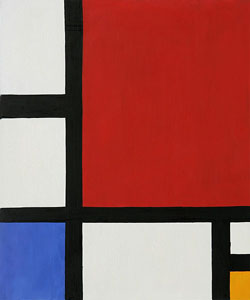
The point is that anybody didn't do it. These works are the result of one person thinking in ways no one else did. Artists like Pollock, or the deceptively simple Mondrian were the first to do what they did. They had original ways of expression that spawned all sorts of imitators, and were hugely influential to those who followed.

Yes, it's easy to look back at such pieces now and think 'I could do that.' Maybe you could, but it wouldn't be the same. You would just be imitating, not innovating.
 
28rftvp.jpg


The hoax appears to be hastily thrown together sponge or roller blotches on a wall but I still enjoy looking at it.


Congratulations!
You were the only one brave enough to offer an opinion. :)
I also enjoyed the painting, which is why I chose it.

Of course, I would agree with you that it has nothing on the Jackson Pollock.

I chose this painting from a site that contains a collection of 105 paintings from a similar source. From memory, they range in price from $300 to $4000 and, from memory, this one has a $300 price tag. In my opinion, it was closest to what I thought might appeal to an above average intelligent person as genuine art. I suppose it could regard it as "accidental art". Unless we accept that elephants can produce genuine art.

Yes, it's an example of elephant art.
But not so fast...

There is a human element at two levels:
There are 27 elephants producing an average of 4 paintings each. Their owners have no doubt selected the most artistic looking of who knows how many paintings those elephants have produced in total. Out of those 105 paintings, I have selected what I consider to be the single most artistic looking painting.

Therefore I think it qualifies as art.
And, hey, perhaps elephants do have a rudimentary aptitude for art expression.
 
Last edited:
As a test of the above hypothesis, I would invite everyone who is interested in this question to peruse all the examples at that site and see if you agree with me that this one best fits both of my criteria of being abstract like the Pollock and the most artistic.

If you do, that itself would suggest that this particular painting has some artistic merit. Otherwise why would we select it over and above the others? If you choose a different picture the same conclusion applies.

If you think they are all trash, then I would invite you to compare my selected painting with the Jackson Pollock. And I would defy you to say that the Jackson Pollock is, similarly, trash and has no merit above and beyond my selected example of elephant art.
 
...I suppose we might call art anything that conveys something to the viewer. Some emotion or feeling.


But, of course, then there is art that has more of an intellectual appeal than an emotional appeal.
Maybe this is an example:

picasso_the_guitar_player.gif


("The guitarist" by Picasso)


I'm of the opinion that art should also require some degree of skill or process or planning as well...
But obviously much of modern art does not require that addition.
What about the above example?
What about the Jackson Pollock?
 
Billy Joe, I have seen a very very very similar "piece of art" at the local paint shop...
I doubt it.
But I'm willing to be shown a photo for comparison. ;)

Can I retrieve that thin slice of ground and sell it 140 M$ ? I doubt it. That should tell it all the story.
Even accepting your assessment of that painting, as someone else has pointed out, it is not original but a mere reproduction of someone else's original idea.

Because the other one was declared to be art by some "artist" it suddenly has a bigger value, and because "some" ""expert"" (eleventy scary quote) declared its value to be so high, it suddenly is.
Well, most of the time, it doesn't quite work that way.
I mean there would need to be a conspiracy of many "experts" from many diverse backgrounds and countries over many decades.
That Jackson Pollock dates back to the 60s.

IMHO a piece of art that joe-average can make with a few can of different color, within a few minutes of spare time, by splashing color at random, is not art.
Whatever you may think of the Jackson Pollock, it cannot, by any stretch of the imagination, be considered random splashes of paint. There is a symmetry in that painting that defies randomness. Throw a coin a hundred times and see if you get symmetry.

Something you could CONFUSE with TRASH if you are not warned in advance is *NOT* art.
It depends on who threw it out
A garbage collector is likely to see garbage everywhere.
I've pulled my wife's specially selected plants out of her garden whilst weeding. It just means I have no clue, not that her precious plant is bv||$#!+.

You would never confuse a Monet with trash. That above ? trash.
A Monet is obviously beautiful.
But some types of art require more from the viewer - which is not to belittle the Monet.
They are just different types of paintings, that's all.
 
A piece should stand on its own. When you look at a piece, you should be able to tell if its art or not.

When I first heard some Kate Bush songs many years ago, I thought they were all crap (except perhaps for "Wuthering Heights"). It was decades later when I happened to hear her rendition of the Welsh song "Mna Na H-Eireann" that I suddenly realised that she had something special. I have since listened to all her songs and, in my opinion, the album entitled "The Dreaming" is a work of pure genius. Yet I would not have recognised that a couple of decades ago. One particular song on that album "Night of the Swallow" fairly filled my eyes with tears. But it was not untill I'd listened to it about the third time that it affected me that way. It was incredible to me that someone could produce something so beautiful.

But why not straight away?
Why did it take so long for me to appreciate Kate Bush's art?
Why did it take three listens for me to appreciate that particular song which I now regard as her most impressive?

Some forms of art are just not as immediately accessible as others.
Monet is easy to appreciate - again, not to belittle it.
Pollock and Picasso demand more of the viewer.
 
I actually once bought paints and canvases with the intention of making some modern / abstract art to sell in some gallery. Everything what I created looked so silly and uninteresting that I threw them all to the trashbin without showing them to anyone else than my wife, who laughed enough at my creations. So there evidently is a skill involved in making also this style of abstract art.


I would invite all the art cynics to do this simple test.
It will surprise you how difficult it is to produce a piece of abstract art that appeals even to yourself, let alone the "experts".
If you think it's just a matter of random splashes, you're in for quite a surprise.
 
Sorry, but that's nonsense. A piece should stand on its own. When you look at a piece, you should be able to tell if its art or not. You shouldn't have to read the description or title or artist bio to know if its art. You don't hear a song and say, "I'm not sure if that is good or not. First let me read the CD liner and do some research on the performers. Only then will I be able to determine if its a good song."

To you it's nonsense. Much like the question "what is art", we don't have to agree and I say you are wrong. Find the programme in question then identify the individual who made the remark and take it up with him as I can't speak for him.

There is no mention of a requirement to read a description or title or artist bio in the story I told, so why mention them in support of your assertion that "that's nonsense"?

If I had to be critical of the statement I refer to in my story I would say it smacks of elitism but otherwise I think it is sound.
 
To me, it's about the expression, creativity, and originality of the artist. It's about technical expertise, knowing how to use the tools. It's about shape, form, and colour, and making the best use out of them. It's the intent of wanting to be able to express things which cannot be expressed in words.

It's combining all these aspects to create a piece which provokes a reaction in the viewer. It could be emotional, or visceral, or somehow telling a story.
:)

In the case of Pollock's work, it's hard to state the impact of seeing one in real life. Much different than viewing a low-res copy on a computer monitor.
Yes, good point.
Fortunately we have Pollocks "Blue Poles" right here in Melbourne. :)

I just don't get why some people who are so insulting about things they don't understand.
Yes, it's annoying.
It's like someone not understanding Quantum Physics but, instead of admitting their ignorance, they call it crap.

I have often heard comments like 'anybody could do that.'

The point is that anybody didn't do it. These works are the result of one person thinking in ways no one else did. Artists like Pollock, or the deceptively simple Mondrian were the first to do what they did. They had original ways of expression that spawned all sorts of imitators, and were hugely influential to those who followed.

A typical example:

mondrian1.jpg


But he has some interesting semi-abstract pieces as well.
Here is a series of increasingly abstract pieces on a similar theme:

mural-29-c.jpg


Mondrian-red-tree.jpg


mondrian-grey-tree.jpg


Mondrian-apple-tree.jpg


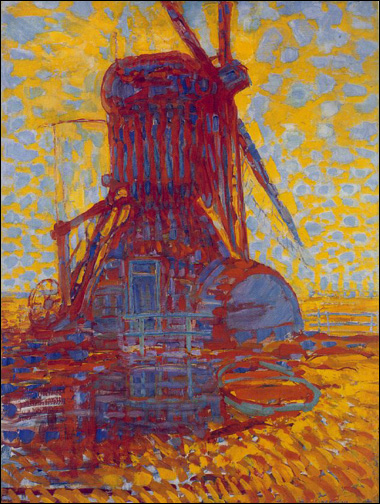
And is anyone not moved by these pieces:

molenmillmillinsunlightbypietmondrian.jpg


2rp7gas.jpg


Yes, it's easy to look back at such pieces now and think 'I could do that.' Maybe you could, but it wouldn't be the same. You would just be imitating, not innovating.
Except that most who shrug it off with an 'I could do that" are just bv||$#!++!^g themselves.
 
<snip>

Whatever you may think of the Jackson Pollock, it cannot, by any stretch of the imagination, be considered random splashes of paint. There is a symmetry in that painting that defies randomness. Throw a coin a hundred times and see if you get symmetry. <snip>


This is a little bit thought provoking in a sense that you may not have intended.

The more times you flip an unbiased coin, the more closely the results will approach 50/50. Is that randomness in pursuit of symmetry?

There is something of a dichotomy here that may be false. Humans often find pleasing symmetry in randomness. It is said that our brains are hardwired to seek out pattern even when it doesn't exist. This does not affect the pleasure derived from that seeking even the least bit.

Art (or not-art) is all about perception as well as intent. The weight given to either or both of those elements is purely a matter of opinion, which I think is why efforts to quantify or define "art" are doomed to discord as well as failure. The closest anyone ever seems to come is to say "This person agrees with me, and that person doesn't, so I'm going drinking with this person instead."

As has been pointed out already in this thread, and the many others like it, the question of the dollar value attached to any particular piece of art is generally irrelevant to an intrinsic value, and arguably unrelated to anything but the worth attributable to whatever the current wave of social approbation provides. Much of the time the price tag itself is the sole and sought after measure, i.e.; someone's ability to show that they have that much money to spend on something which neither feeds nor shelters them.

My personal definition of art has to include "art to me" with the emphasis on "to me". I either like it or I don't, and whether one other person or many others agree or not is completely unimportant, although occasionally interesting. There's lots of music out there I don't care for either, but I don't consider someone else wrong just because they like it.

If a framed five year old's fingerpainting on the wall gives pleasure to the resident and their visitors then it is serving its function as art. If someone is willing to pay $140M for it that is a valuation of a different sort.
 
:)

Fortunately we have Pollocks "Blue Poles" right here in Melbourne. :)

If anyone goes to see it, the painting is 3D. Look at it edge ways and you will see what I mean. This is something reproductions do not have. Nor do most other paintings. This painting has several layers of thick paint.
 
The more times you flip an unbiased coin, the more closely the results will approach 50/50. Is that randomness in pursuit of symmetry?

No. I meant the actual sequence of coin tosses.
Here is a random sequence of 200 ones and zeros:

11001000001111111010100100100110101011101101101110100111111
00100000000010100011011000000100101100011111000101011000111
10001011101000100011111111111010000010010101010111001000010
100101100001101011101101

There is no pattern whatsoever in a random sequence.

On the other hand, if you ask someone to fake a sequence of 200 coin tosses you will tend to get a sequence that contains greater patternicity and (therefore) less randonmness. Because, as you say, humans are pattern seeking (and making) creatures.

The Pollock painting is not a random spattering of paint - precisely because it has pattern. That was my point to the cynics: you cannot produce a Pollock painting by a random spattering of paint. The Pollock painting only looks like what would result if you were to produce a random spattering of paint. That's why the cynics think they could (though they never actually do so) produce a Pollock painting by randomly spattering paint.

...the question of the dollar value attached to any particular piece of art is generally irrelevant to an intrinsic value, and arguably unrelated to anything but the worth attributable to whatever the current wave of social approbation provides.
No argument.

There's lots of music out there I don't care for either, but I don't consider someone else wrong just because they like it.
The idea is to try to put yourself in the other persons shoes and try to understand why they like it. Surely you are not so different from them that you are incapable of appreciating their music.

If a framed five year old's fingerpainting on the wall gives pleasure to the resident and their visitors then it is serving its function as art.
Same for the example of elephant art?
Are you comfortable calling that art as well?
 
There is no mention of a requirement to read a description or title or artist bio in the story I told, so why mention them in support of your assertion that "that's nonsense"?

Quote you posted mentioned the "intent", the "motivation" and whether or not the creator is an "artist". I gave some examples on how one would find out these things about a musician.

But why not straight away?
Why did it take so long for me to appreciate Kate Bush's art?
Why did it take three listens for me to appreciate that particular song which I now regard as her most impressive?

Upon further listening of the song, you formed a different opinion. It didn't take you finding out what sort of life she had or what her intentions were when she wrote her songs or what kind of child hood she had. You experienced the art in the medium in which it was created and changed your mind based on the art itself, not external factors.

...There is a symmetry in that painting that defies randomness...

I apparently don't have an eye for that sort of thing, or I am just too shallow, but I definitely don't see any symmetry in that piece. Can you explain to me where it is?
 
Last edited:
"It is rubbish, it is not at all artistic because you had no intent behind the piece, you had no real motivation to make it and cannot describe what emotion you would like to invoke with your piece. Most of all, it is rubbish because you, my dear, are not an artist."

Obviously that is not word for word but it is close enough. It always stuck with me because it allowed me to see through my art ignorant eyes just how some of the more abstract pieces and installations do have merit and worth and even on one or two occasions I have "got" what the artist was going for.

I think it would have caused me to see that even the experts don't see any objective merit in some of this stuff and it would have made me thing the critic was ignorant. (And, by the way, I like art and prefer the abstract - I just think some of it is paint thrown on canvas for money).
 
Last edited:

Back
Top Bottom