
• Quick note - the problem with Youtube videos not embedding on the forum appears to have been fixed, thanks to ZiprHead. If you do still see problems let me know.

War versus Welfare

Tricky

Briefly immortal
Joined
Nov 24, 2001
Messages
43,750
Location
The Group W Bench
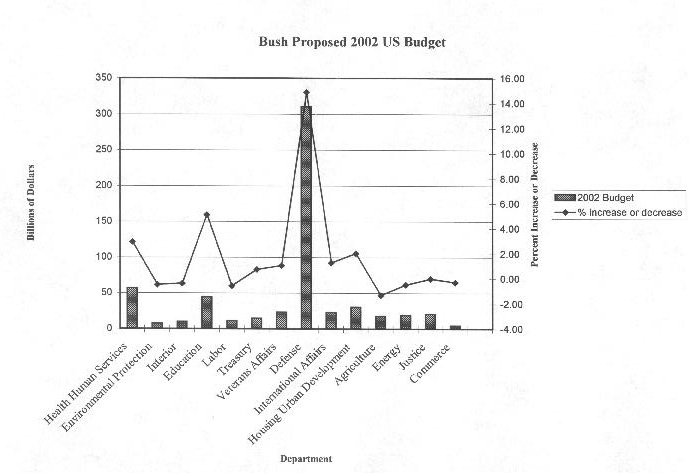
Some of the war discussions made me wonder about how our taxes (in the US) are spent. I tried Googling for budget statistics and this was the only understandable thing I found.
USbudget02b.jpg

For many years now, welfare has been one of the big things that conservatives complain about, but what does it really cost? How is the cost related to the return? After all, almost all welfare dollars do in fact make it back into the economy. The same cannot be said for defense spending.

How does the cost of the Iraq war compare with welfare spending? I'm betting that the cost of the war is many times greater and the return is many times less.
 
Perhaps its because war and defense are the only constitutionally mandated "government programs"?
 
Well the money spent on defense has to end up somewhere, Some to the defense companies, distributed to shareholders, some to the wages of the employees, and the employees of subcontractors. Right the way down to the guys digging the ore out of the ground for the raw materials. Some of that will be within the US, some outside.

That money must subsequently be spent and so the cycle goes on. I admit its not as direct as putting cash into welfare, but it does still go through the cycle. I always felt, especially at time of peace, that it was a bit akin to the old "paying people to dig holes and fill them in again".

This is in no way me justifying the amount spent (speaking here for the UK), since the same rule would apply making kidney machines, building new hospitals, staffing these etc....

Fear has always been the big motivator for military spending, back to the overestimation of Soviet capability after WW2 and the continual (IMO) overestimation of threat today.
 
Reginald said:
Well the money spent on defense has to end up somewhere, Some to the defense companies, distributed to shareholders, some to the wages of the employees, and the employees of subcontractors. Right the way down to the guys digging the ore out of the ground for the raw materials. Some of that will be within the US, some outside.

That money must subsequently be spent and so the cycle goes on. I admit its not as direct as putting cash into welfare, but it does still go through the cycle. I always felt, especially at time of peace, that it was a bit akin to the old "paying people to dig holes and fill them in again".

This is in no way me justifying the amount spent (speaking here for the UK), since the same rule would apply making kidney machines, building new hospitals, staffing these etc....

Fear has always been the big motivator for military spending, back to the overestimation of Soviet capability after WW2 and the continual (IMO) overestimation of threat today.
Good points. A lot of the defense money does in fact make it back into the economy. Even more if you count kickbacks as part of the economy. But a great deal of it goes into hardware which is rarely used. Do we need this? Of course. Do we need as much as we have? Highly doubtful.
 
My estimate from the graph is that 'defense' takes up a full 50% of the US Federal budget. In contrast, a country such as Australia allocates about 5%.

A large part of the US defense budget is really for offensive purposes, or perceived threats that have no basis in reality. For example, the new generation fighter and strike jets. No enemy country has a capability in aircraft that can meet that of the US with it's current generation of aircraft. Iraq actually buried it's aircraft in sand rather than try to face the US with them.

Some basic questions.

Just how many aifcraft carriers are needed for defensive purposes, given that they are only used for offensive reasons, that is, 'projecting power'. (Not to mention the massive overhead in auxialliary craft they need). They are becoming just as obsolete now as the battleship once was. In recent exercises, an Australian new generation conventional submarine sunk an American aircraft carrier.

The money is not just filling in holes in the ground. There is very worrying news coming out regularly about nuclear weapons research into new areas. For what purpose?

What use is the current set up of the US military? It is great at 'shock and awe', no question. How about, 'let's live in peace now'? Not so good.
 
Tricky said:

Good points. A lot of the defense money does in fact make it back into the economy. Even more if you count kickbacks as part of the economy. But a great deal of it goes into hardware which is rarely used. Do we need this? Of course. Do we need as much as we have? Highly doubtful.

Well the hardware has to be purchased, or rather was purchased at some point, even maintaining it puts money in pockets.

A for the need for it all. I would doubt it too. It appears that there never was a need for as much as you guys (as a nation) and we (as an alliance) had/have.

Knowing that the Soviet Union did collapse as a result of struggling to meet western arms spending (amongst other things), it's diffecult to say how things would have turned out had spending not been so high historically.

I know from experience (having worked in an engineering company that build for the MoD) that money is seldom spent wisely. A typical example being a simple cover plate with a handle, cost to maunfacture and paint approx. 2GBP. Typical cost to a commercial sector buyer 2.20 GBP. Cost to the ministry of defence 200GBP (admittedly a little more paper work involved, but not that much). Imagine that multiplied up many thousand fold. That's why I still think of it as filling in holes.

:)
 
a_unique_person said:
My estimate from the graph is that 'defense' takes up a full 50% of the US Federal budget. In contrast, a country such as Australia allocates about 5%.

whoa there!!!! I think you will find tricky's graph is a percentage increase graph.....I thinki Australia's defence spending is a shade under 2% of GDP and the USA is 2.5 to 3% anyone know for sure?
 
The Fool said:

whoa there!!!! I think you will find tricky's graph is a percentage increase graph.....I thinki Australia's defence spending is a shade under 2% of GDP and the USA is 2.5 to 3% anyone know for sure?

I think it is both at once, the left scale is actual expenditure, the right percent increase over previous year.
 
still no sure how you get a figure of 50% of budget spent on military......
From....

http://www.theage.com.au/articles/2003/07/16/1058035069317.html

Australia currently spends 1.9 per cent of its gross domestic product on defence. This figure has usually hovered around the 2 per cent mark, only edging up to 2.6 per cent during Vietnam.

With the US spending more in the 3.5-4 per cent range


3.5 to 4%..... Looks like Hal misses out on his solid gold desk
:)
 
The economy simply cannot be the justification for the military or military spending.

"Beware the military-industrial complex" --Dwight D. Eisenhower

Of course we require a strong military and military spending will impact the economy and must be considered when making cuts or increases.

For many years now, welfare has been one of the big things that conservatives complain about, but what does it really cost? How is the cost related to the return? After all, almost all welfare dollars do in fact make it back into the economy. The same cannot be said for defense spending.
My number one complaint with welfare is that it creates dependency and can do far more harm than good to both the economy and those on welfare. I applauded Bill Clinton for realizing this and making real and significant changes to welfare. Also, pumping money into an economy via welfare does not necessarily improve it (the economy). The economy is best served when individuals are made productive putting into the economy goods and services and not just redistributing wealth, which is what welfare ultimately, is.

If you run a store and the state taxes you and gives part of your taxes to an individual who buys goods at your store then there has been no real increase.

If on the other hand you are taxed and part of the money is given to someone for providing "real" goods or services that are needed and wanted in the community then there is a real increase. Of course there is a limit to the amount of money that can be redirected this way. There simply is a point of diminishing returns.

How does the cost of the Iraq war compare with welfare spending? I'm betting that the cost of the war is many times greater and the return is many times less.
I'm not an expert but wars should not be fought on the basis that the military spending would improve the economy.

In addition, the purpose of welfare should not be to improve the economy. IIRC the facts indicate welfare to be a false economy and only of value when it is used for a short period of time to help people over difficult periods.

Following the initial “war on poverty” the rates of poverty fell dramatically but have seen been virtually unchanged for decades with only small incremental changes. Again this is based on my recollection. There is a measurable amount that you can reduce poverty through welfare however there is a very real limit that can affirmatively be helped by government assistance before the state, the individuals on welfare and the economy suffer.
 
RandFan said:
The economy simply cannot be the justification for the military or military spending.

"Beware the military-industrial complex" --Dwight D. Eisenhower

Of course we require a strong military and military spending will impact the economy and must be considered when making cuts or increases.

My number one complaint with welfare is that it creates dependency and can do far more harm than good to both the economy and those on welfare.


Now, try and tell me that there aren't virtual welfare dependents out there in the defence industry.
 
a_unique_person said:
Now, try and tell me that there aren't virtual welfare dependents out there in the defence industry.
I don't disagree. I will go you one better, there are also corporate dependants. You will get no argument from me on that one.

I take Ike's warning to heart. I am all for mitigating such dependency.
 
Let's not confuse percent of the federal budget with percent of the GDP, which is obviously apples and oranges. I bet that Australia's federal budget is a significantly higher percent of the country's GDP (pure speculation), so a smaller percent of the budget would still equate to a similar percent of GDP. Still, I wouldn't expect that Australia, like other US allies, spends nearly as much on defense as a percent of GDP. Maybe they would, if the US did not.

Anyway, I think it's impossible to calcluate the cost-benefit of the war, or of welfare. However, we didn't take money from welfare to pay for the war, so the comparison is a bit of a false choice. You might as well compare the cost of maintaining the Hubble Space Telescope with the cost of road repair in tha National Parks. We don't always need to choose one or the other.
 
I seem to recall some sociological studies that showed defense spending has the lowest rate of economic benefit per dollar spent and that any form of spending is better than defense spending for helping the economy.

What gripes me is the cost of the weapons per unit. It would have taken the cost of three cruise missles to save the Americorp program.

Isn't it part of our defense to have a healthy population of recruits?
 
Dancing David said:
I seem to recall some sociological studies that showed defense spending has the lowest rate of economic benefit per dollar spent and that any form of spending is better than defense spending for helping the economy.
Personally I doubt it. I would love to see the supporting data. In fact I would love to see the numbers to support any or all of my contentions on this thread. Maybe I'll do some research if I have the time.
 
The Fool said:
still no sure how you get a figure of 50% of budget spent on military......
From....

http://www.theage.com.au/articles/2003/07/16/1058035069317.html

Australia currently spends 1.9 per cent of its gross domestic product on defence. This figure has usually hovered around the 2 per cent mark, only edging up to 2.6 per cent during Vietnam.

With the US spending more in the 3.5-4 per cent range


3.5 to 4%..... Looks like Hal misses out on his solid gold desk
:)

Fool, I think AUP was using the left axis and the bars to determine the 50-50 split. If you add the approximate dollars of all the departmental budgets except defense and then compare that number to the defense budget - in raw dollars - you do come pretty close to 50-50. I added all the other departments together in a quick and dirty calculation and came up with $297B. The graph looks like defense is about $310B. Its not exactly 50-50 but pretty close.
 
RandFan said:
Personally I doubt it. I would love to see the supporting data. In fact I would love to see the numbers to support any or all of my contentions on this thread. Maybe I'll do some research if I have the time.

This was the contention of a not so liberal professor at the Uof I in 1980. She szid it has to do with the way that defense spending is structured with a lot of high paying jobs instead of a lot of low paying ones, and the fact that there is a very high profit margin built into defense contracts. She said that there were figures that defense spending was 60% efficient at economic benefit compared to NASA.

So I don't know, but the way way the defense industry is structured, it wouldn't suprise me. Just like which creates more jobs, a dollar spent on your new car or a dollar spent at the grocery store?
 
Dancing David said:
I seem to recall some sociological studies that showed defense spending has the lowest rate of economic benefit per dollar spent and that any form of spending is better than defense spending for helping the economy.

This is actually hard to quantify, because it could be argued that inadequate defense spending could lead to the entire country being defeated, and how do you put a price on that?

As a result, I am in favor of a strong US military, though I do wish that maybe just a few of those billions be spent on domestic items instead.
 
Dancing David said:
This was the contention of a not so liberal professor at the Uof I in 1980. She szid it has to do with the way that defense spending is structured with a lot of high paying jobs instead of a lot of low paying ones, and the fact that there is a very high profit margin built into defense contracts. She said that there were figures that defense spending was 60% efficient at economic benefit compared to NASA.
I'm a bit confused. How efficient is NASA?

Did she compare military spending with welfare?

So I don't know, but the way way the defense industry is structured, it wouldn't suprise me. Just like which creates more jobs, a dollar spent on your new car or a dollar spent at the grocery store?
I don't know either. As I have said before, military spending must be for the sake of national defense. Any economic justification above and beyond that is wrong. IMO such considerations are moot. We either need the spending for defense or we don't.
 

Back
Top Bottom