USS Liberty

Also, I did my wonderful cool map in statute miles, which is disaster if the IDF was using nautical. It would mean the location of return was about aat Lib's loc - but speed and heading are still suspiciously off, there's still two-ship reports, and the suspected shelling to explain...

I think it was in nauticals...
 
I think it was in nauticals...

I would guess so as well which means I'm an idiot for not considering that. It doesn't change anything for the whole story, just blows up my alternate return area 8 mi away thing.

Fezzic: I think that's probably what happened here. Not too professional for a Navy court, but no harm I can see... yet. ;)

Resp to Klimax earlier:
Not that it is not interesting,but it is at the end of a realy long queue of other interests...

Fer sure, it's just cool to me you even find this interesting enough to chat about.

What the hell would be second USN ship do it there and not be in docs?If there would be sort of secret op,then all bets off.

To clarify, I was talking radio jamming, and was thinking from the air - the surveillance planes that recorded the attack - er, the time right after it. Just a side thought I've had, don't even know if it's possible let alone makes sense - shouldn't have even mentioned it.

Cannot parse.6x between??? :confused:
Liberty reported and uncontested speed at the time: 5 knots, which is about as fast as I can walk on land. Radar return speed was 28, which is almost 6 times that, or 6X, meaning 6 times the distance between radar returns. If radars can be off by 560% like that, project a target further and further from where it truly is, why did anyone even bother using them to gauge speed? Especially when that speed seems to be the only tip-off you needed to decide who to sink.

And since jets found Liberty,radar return had to be sufficiently close to correct position,that figthers could find it.
Acc. to the second ship theory, yes, that would be the idea. I don't think there was, at least not physically. [ghost ship anyone?]

At least in CR no college debt.(It's relativly free)
And it seems to work - your English is way better than my Czech. I've been wondering where and how to finish my degree... what's rent like there? :D

You can show details impossible,but yet there is error of equipment or error in measurment.

Once MI -> FFI!
With that no FFO needed.
There are problems with that formula I don't feel like cataloguing right now.

Some optical illusion.But not sure myself,but optics can be quite tricky...

Jets couldn't jamm.TB didn't have it and were not there.And what jamming equipment would be needed to "blind" ship like Liberty("electronic warfare"!)
Or how to operate(shelling) while being small enough to escape radar detection.
I won't argue these points. I know only the barest basics of anything involved...

I'll see what equipment/ships were available,but it will take some time.
Finals!
 
I would guess so as well which means I'm an idiot for not considering that. It doesn't change anything for the whole story, just blows up my alternate return area 8 mi away thing.

Depends what story...

Fer sure, it's just cool to me you even find this interesting enough to chat about.

You're welcome. :D

To clarify, I was talking radio jamming, and was thinking from the air - the surveillance planes that recorded the attack - er, the time right after it. Just a side thought I've had, don't even know if it's possible let alone makes sense - shouldn't have even mentioned it.

Maybe,but theoretically... putting it aside.

Liberty reported and uncontested speed at the time: 5 knots, which is about as fast as I can walk on land. Radar return speed was 28, which is almost 6 times that, or 6X, meaning 6 times the distance between radar returns. If radars can be off by 560% like that, project a target further and further from where it truly is, why did anyone even bother using them to gauge speed? Especially when that speed seems to be the only tip-off you needed to decide who to sink.

That clarified it.(I took it originally 6X times between,but points? distance? and not realising you took it little differently :o)
Aside from technical standpoint,maybe some false return(your ghostship?) from sea or like that.

Needs check!

Acc. to the second ship theory, yes, that would be the idea. I don't think there was, at least not physically. [ghost ship anyone?]

Possible,but see above-needs check!

And it seems to work - your English is way better than my Czech. I've been wondering where and how to finish my degree... what's rent like there? :D

But does it speak positively about my english or your czech? ;)
Rent depends on place.Prague is expensive(obviously...),but dormitory/college is good choice there.Rest of cities with universities are not that bad regarding rent.

There are problems with that formula I don't feel like cataloguing right now.

Would like to see them sometime.I cannot find any.(not suprising ;))

I won't argue these points. I know only the barest basics of anything involved...

Not that I am expert as well...


I know.That's why I said "takes time". :D
Don't worry,my intentions are not to get thrown out of universities for second time...
 
Some insights:
Capt McGonagle to NCOI:
LTJG PAINTER came onto the bridge after general
quarters to assume the watch as the officer of the deck. As he assumed
the officer of the deck watch, he indicated that he was having
difficulty in obtaining an accurate ship's fix. At that time, and the
time was approximately 1400, I personally sighted the Minaret at El Arish
to be on a bearing of 142 from the ship and the range as I recall from
the radar was approximately 25.5 miles. I do not know that this radar
range can be verified from the records available at this time.
Confirmation that the bearing log from 12:00 on is not "available."

Ensign David Lucas, who was apparently in charge of surface lookouts, told the NCOI between 12:00 and 1300, “more smoke was visible and the land itself was barely visible. This was through the telescope or high powered binoculars on the 04 level.”
That's just about 20 nmi. How about ships? How far away? Lucas on lookouts:
"They had received refresher training, this was sometime since we left Rota on.the 2nd of June, and had been refreshed on reporting all surface contacts to include relative bearing, approximate range, and target angle. Had also been given refreshers on reporting aircraft properly, on elevation, what angle, other factors pertaining to properly reporting all surface and air contacts to the officer of the deck. This had been stressed heavily in the first week in June, before we did reach our operating area.”
Officer of the deck's notes show no reports of surface craft on June 8 prior to the attack. The main deck log does mention two ships sighted June 7, in this same vigilant mode:
1420 sighted unidentified merchant ship bearing 198, distance about 4800 yards. Identified asmerchant ship as Bencleugh, registry unknown. […] 1430 sighted merchant ship Ioanis Asptiotis Greek registry, bearing 019, distance about 1500 yards.
These were about 2.37nm and 0.74nm distant. There were almost certainly other ships around further out, but these were apparently too far away to notice or care about. So lack of visual contact is not much of a problem.

But, their radar had a range of up to 24.5 miles anyway, judging by ranges given in the chart. This was for a large object called "nearest land (N.L.), not a piddling warship. I hear the Liberty did pick up the MTBs at a range of about 16-18 mi, have to dig that back up. A ship of any size then would have to be probably 20 mi plus away, to not show on radar.

So it's a little ambiguous, but not looking too good for the second mystery ship hypothesis, leaving one wondering where prolonged shelling reports and two ships approaching reports came from in the minutes just after Liberty was erased from the IDF combat info system. The strange radar reading grossly off in all other ways is also left mysterious without another ship, and being in about the right location for Liberty another ship would be ruled out anyway unless under Romulan cloaking shield.

So, the apparent second ship is actually comprised of nothing but a floating ball of random errors, but with set properties, location, speed, direction, and quite uncanny timing! The ball lightning of the earth's coincidence field! The Liberty, like other such politically potent placements of naval units, as always, was the lightning rod.

 
Note naval radars don't give speed. They give direction/bearing and distance. They are not like police radar guns used for speed enforcement.

Remember this was back in 1967 way before the home PC and such. The IDF picked up equipment surplus and made do with what they could get. It seems unlikely that they would get some kind of super radar system that would read out all kinds of minutely accurate information, much less put it into a MTB.


As far as the repos of the deck log and such go... I don't think the repos were considered supremely important to the Court of Inquiry and, anyway, they had access to the originals if it should turn out to be necessary.
 
Note naval radars don't give speed. They give direction/bearing and distance. They are not like police radar guns used for speed enforcement.

Remember this was back in 1967 way before the home PC and such. The IDF picked up equipment surplus and made do with what they could get. It seems unlikely that they would get some kind of super radar system that would read out all kinds of minutely accurate information, much less put it into a MTB.

Regarding equipment failure, I'd like to ask has anyone ever seen an explicit explanation offered by a reputable source? We've had a couple of opinions thrown out by commenting IDF individuals, but these mean little. The IDF itself I'd consider reputable, in that they'd rather not straight up lie about a verifiable technical issue. So what have they offered? That 1982 official history by Algon had every opportunity to explore the issues with their own equipment. The best they could offer was
"In retrospect, it is clear that the data dealing with target speed were incorrect since the "Liberty" was not capable of cruising at such high speeds. However, it is astounding that the same target speed was measured independently by two torpedo boats: T204 (with the Division commander aboard) and T203 which estimated target speed at 25 - 28 knots."
[emph mine]

The "since" presumption is based on the Liberty's top speed, 18 kts, well under the 28 they got. It's still "astounding." How much more astounding would it be if the "since" was followed with "the Liberty was traveling at only five knots."?
 
The "since" presumption is based on the Liberty's top speed, 18 kts, well under the 28 they got. It's still "astounding." How much more astounding would it be if the "since" was followed with "the Liberty was traveling at only five knots."?


Do not forget that measurments by two boats ,which are close to themselves cannot be taken as two completely independent measurments as the angle for radars was too small making error checking by them useless.For perfect check you'd need around 10 to 20 degrees I think,but this is calculatable.

Good,another thing to be checked out...
 
Do not forget that measurments by two boats ,which are close to themselves cannot be taken as two completely independent measurments as the angle for radars was too small making error checking by them useless.For perfect check you'd need around 10 to 20 degrees I think,but this is calculatable.

Good,another thing to be checked out...

Ach! You screwed up what I was imagining to be the awkward silence of the stumped. It makes sense that if one did it wrong the other might too, I'll grant that, since they're close together. But... I wish you luck figuring out the problem they had better than the IDF's official explanation was able to. After finals, win a big prize by demonstrating how this all lines up honestly with legitimate radar returns. I'm willing to assist but no promises! So far, my guess is the 30 knots dash to Port Said came from somewhere other than their radar screens. Somewhere more - ephemeral.
 
Last edited:
Ach! You screwed up what I was imagining to be the awkward silence of the stumped. It makes sense that if one did it wrong the other might too, I'll grant that, since they're close together. But... I wish you luck figuring out the problem they had better than the IDF's official explanation was able to. After finals, win a big prize by demonstrating how this all lines up honestly with legitimate radar returns. I'm willing to assist but no promises! So far, my guess is the 30 knots dash to Port Said came from somewhere other than their radar screens. Somewhere more - ephemeral.

Will see to it.And silence was due to problems in RL(like BSOD in Win7 due driver),than being stumped.(there are very few things which would do it.)
 
I read that both boats, prior to the torpedo attack, identified the Liberty as that Eyptian ship, "El Q-something or other", however.

I also read, by Cristol so YMMV, that the speed determination was done from the command boat by the CIC officer on it. He made a calculation and passed along that target (Liberty) was doing 30 kts and (according to Cristol's recital) was told to confirm it, redid the calculation and came up with 28 kts.

Cristol said that anything over 20 kts was normally considered a warship so confirming the speed of a target would be reasonable.

He also said that the radars on the MTBs were WWII surplus Kevin-Huges radars and only one was true motion (looked up what that meant and didn't know that kind of radar existed).

It might have been helpful if the IDF had documented the CIC officer's calculations. Probably very embarassing to the young guy though.
 
I read that both boats, prior to the torpedo attack, identified the Liberty as that Eyptian ship, "El Q-something or other", however.

Yes, this is a good point - no radar error was responsible for their visual misidentification. So we know something is wrong with their eyes, translating things into Egyptian warships. So when the radar says - to their eyes - that thing is jetting to Port Said, I'm not so sure it's a technical problem with the radar.

I also read, by Cristol so YMMV, that the speed determination was done from the command boat by the CIC officer on it. He made a calculation and passed along that target (Liberty) was doing 30 kts and (according to Cristol's recital) was told to confirm it, redid the calculation and came up with 28 kts.

Cristol said that anything over 20 kts was normally considered a warship so confirming the speed of a target would be reasonable.

All that jives with how I understand it, more or less. The 'over 20 knots' thing, IMO, has something to do with the 'radar problem.'

He also said that the radars on the MTBs were WWII surplus Kevin-Huges radars and only one was true motion (looked up what that meant and didn't know that kind of radar existed).

Thanks for that, I'll check on what "true motion" means.

It might have been helpful if the IDF had documented the CIC officer's calculations. Probably very embarassing to the young guy though.
I didn't know they didn't, but it's somehow not surprising.
 
About the ship ID, they probably had the IDF Navy ship identification book of Egyptian and other possible enemy ships onboard. Given that they don't realize the possibility of the "unknown" being a USN ship, they would hurriedly search the book for a likely identification and come up with "El Q-whatsis".

The relatively sizes of Liberty and El Q would not matter all that much, if they were not steaming side by side, and they would be looking for points of similarity rather than points of differences. Fine differences would have been overlooked as they see, "yep, one stack, superstructure about admidships, etc."

Naturally, if one of the boat commanders or crewmen were very familiar with the El Qes... whatever, they might have spoken up saying, "the ship there is too big to be El Qsdffsd" but obviously none of them were that familiar with it.
 
Yes, this is a good point - no radar error was responsible for their visual misidentification. So we know something is wrong with their eyes, translating things into Egyptian warships.

All that jives with how I understand it, more or less. The 'over 20 knots' thing, IMO, has something to do with the 'radar problem.'

Visual ID I leave aside.Radar is below.

I read that both boats, prior to the torpedo attack, identified the Liberty as that Eyptian ship, "El Q-something or other", however.

...

He also said that the radars on the MTBs were WWII surplus Kevin-Huges radars and only one was true motion (looked up what that meant and didn't know that kind of radar existed).

Kevin-Huges radar from WW2.I think source of first error found...

For some interesting basic info:
http://en.wikipedia.org/wiki/RADAR
(See Interference,clutter and jamming)
 
True motion radar:
A radar set which provides a true-motion radar presentation on the plan-position indicator, as opposed to the relative-motion, true-or-relative-bearing, presentation most commonly used.

Representation:
A radar plan-position indicator presentation in which the center of the scope represents the same geographic position, until reset, with all moving objects, including the user's own craft, moving on the scope.

Source:http://www.answers.com/topic/true-motion-radar and http://www.answers.com/topic/true-motion-radar-presentation

True-motion patent:
http://www.google.cz/patents?hl=cs&...AAEBAJ&oi=fnd&dq=United+States+Patent+3085241

But there was something more interesting:
http://www.flightglobal.com/pdfarchive/view/1968/1968 - 1058.html

Relative-motion radar displays are extremely difficult to interpret.Boats, buoys, and islands race across the screen. A stabilised truemotion display would increase radar effectiveness greatly.
 
Last edited:
ETA: fezzic: Good points on visual comp - well-put, I'll come back to it. I think it's El Quseir, or just EQ for nickname.
Kevin-Huges radar from WW2.I think source of first error found...

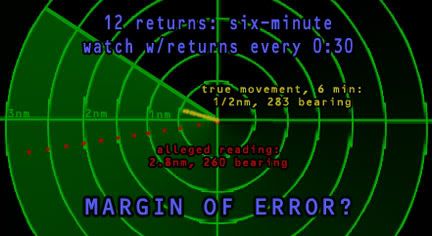
I think I missed the part where it was shown that Kevin-Hughes radar from WWII is known to be prone to such magnificent errors. That is cool we at least have a lead that's Google-able. Just so we understand what we're asking this glitch to do:
radar_6min_comp.jpg
[just for proportion of error - I don't know its rate of return or anything]
If this IS a known problem, then it's verging on a war crime for the IDF to have employed these in deciding who to sink.

On your research for radar, That last link is great - I think we're all in a little over our heads here, but that passage - from 1968 to boot! - helps explain the difference. As I read it, the center of the radar plot/plan is you, so the center moves, and different objects probably at different rates - like looking out the window of a speeding car. whereas true motion shows you everything moving as it is, like a satellite view. ??. It seems to me, as it mentions buoys and such zipping by, that the problem is less with distant, slow-moving objects you're steadily gaining on. That one of these would appear to be racing ahead of you at about your pace, it would have to appear to keep hovering near the same spot or slowly inching towards you, when in Reality it's getting way closer.

If it's so that one MTB had true motion radar, and that that system had a better chance of getting an accurate reading, I'd wager a guess, just my own opinion, that the first reading and the corroboration were done on the other two without ever being checked by the third. Or, better yet, since it's new technology, claim you did check it, it said five knots and you dismissed this fancy new junk, no way it's going THAT slow! That's what I'd say.
 
Last edited:
I think I missed the part where it was shown that Kevin-Hughes radar from WWII is known to be prone to such magnificent errors. That is cool we at least have a lead that's Google-able. Just so we understand what we're asking this glitch to do:
[qimg]http://i133.photobucket.com/albums/q62/chainsawmoth/127-911/radar_6min_comp.jpg[/qimg] [just for proportion of error - I don't know its rate of return or anything]
If this IS a known problem, then it's verging on a war crime for the IDF to have employed these in deciding who to sink.
Don't know this ATM.One thing,it might not be know at that time and coupled with clutter,it could result in unpredictable readings.Or radar could return relativly correct info,but operators did error...

On your research for radar, That last link is great - I think we're all in a little over our heads here, but that passage - from 1968 to boot! - helps explain the difference. As I read it, the center of the radar plot/plan is you, so the center moves, and different objects probably at different rates - like looking out the window of a speeding car. whereas true motion shows you everything moving as it is, like a satellite view. ??. It seems to me, as it mentions buoys and such zipping by, that the problem is less with distant, slow-moving objects you're steadily gaining on. That one of these would appear to be racing ahead of you at about your pace, it would have to appear to keep hovering near the same spot or slowly inching towards you, when in Reality it's getting way closer.

If it's so that one MTB had true motion radar, and that that system had a better chance of getting an accurate reading, I'd wager a guess, just my own opinion, that the first reading and the corroboration were done on the other two without ever being checked by the third. Or, better yet, since it's new technology, claim you did check it, it said five knots and you dismissed this fancy new junk, no way it's going THAT slow! That's what I'd say.

It mentions boats as well.And don't forget that ship doing radar search was speeding quite a lot.

Just a thought,couldn't operator misread radar thinking that target has same or greater speed than themself? (So far I cannot formulate thought properly)
(If you substract from TB speed Liberty's speed,result looks closer to reported speed)

Just for completness:
High speeds and relatively short radar ranges (low flight profile) are typical operating conditions that make it difficult to determine true motion.
 
Found online that sample the book thing which showed me pages from The Liberty Incident by Jay Cristol.

In the book, in one presumed chapter?, he apparently talked with the CIC officer about what happened. It was not a dialog though.

Anyway, the radar had an 18 inch diameter scope so if the max range was, say 24 miles, that was represented by the 9 inches from the center to the edge.

The CIC had a dead reckoning tracer, motor driven, that displayed the boat's position on a map table. The radar operator told the CIC officer range and bearing to the target then a short time later would give an updated range and bearing. The CIC officer marked the map and then measured the distance between the two marks. Then depending on whether this was a one minute or two minute, etc. interval would multiply by appropriate conversion to get speed.

When the CIC officer first calculated speed, he came out with 30 kts. When he was ordered to confirm the speed, he recalculated (it seems from the same marks he had made) and came up with 28 kts. The CIC officer told Cristol he thought the initial information must/might? have been incorrect (after the fact). No way to prove that now -- either the radar operator gave the wrong bearing or the CIC officer marked it wrong, but who would want to admit that.

Presumably based on how big the radar screen was, the probable maximum range that could be displayed, one could figure out how badly the operator had to screw up in order to accidentally mislead everyone.

It would seem likely that the operator made an error in the target's bearing as range was probably less subject to error. That could make the distance between the two marks long enough to get a 30 kts result when calculating the target's speed. Since the boat commander likely was upstairs running the boat, he would probably not normally see the plot and any error as to course might then disappear as he navigates by eyeball. The only time he needs to refer to the CIC would be to get a course to go somewhere, say back to base.

I might have to actually get that book, hopefully in paperback and cheap. :)
 
Found online that sample the book thing which showed me pages from The Liberty Incident by Jay Cristol.
Got it now too. Worth a read, some nice details... I have to make fun of Cristol a little bit tho:
The radar operator watched a round radar screen shaped much like a large dinner plate. [...] The round radar screen is about 18 inches in diameter.
Good, good, it's round, big and round like a big plate, has a diameter, so it's round... :D
Also, referring to the tiny movements of the blips on screen:
"If the target was moving at five knots, it would move away 1/32 of an inch [per minute on the screen]. Dealing with such tiny measurements [...] is a recipe for error."
When you're squinting at those blips moving barely perceptible tiny fractions of an inch, it's only natural to think -what, that's still the first dot? The thing isn't moving at all? It's escaping towards Port Said, bearing 260, 30 knots, gonna need backup? This stuff just isn't helping so far.


I'll look at that conversation you cited. It's bound to be interesting. Technical points, no comment til then, or at least tomorrow, too late now.

The CIC officer told Cristol he thought the initial information must/might? have been incorrect (after the fact). No way to prove that now -- either the radar operator gave the wrong bearing or the CIC officer marked it wrong, but who would want to admit that.

Must/might, huh? They've how long to figure this stuff out? I'll reserve further comment...
 
Last edited:
So the book says one guy read the screen and orally told the other guy - CIC officer Yifrah, the range and bearing. Yifrah plotted these out on the big table, used the differences times whatever, maybe again times 6, or something. Mistakes happen, usually in bundles of hundreds.

Otherwise, bump for a thread that's growing in views but not comments. Considering the gravity of the subject, I'd call that silence awkward.
 
So the book says one guy read the screen and orally told the other guy - CIC officer Yifrah, the range and bearing. Yifrah plotted these out on the big table, used the differences times whatever, maybe again times 6, or something. Mistakes happen, usually in bundles of hundreds.

Otherwise, bump for a thread that's growing in views but not comments. Considering the gravity of the subject, I'd call that silence awkward.

It's quiet.

Almost......too quiet.

Que scary music.

I just check in every day to verify that this thread is still going.
And in such detail.

Soldier on guys.
 

Back
Top Bottom