• Quick note - the problem with Youtube videos not embedding on the forum appears to have been fixed, thanks to ZiprHead. If you do still see problems let me know.

Unix v4 tape found

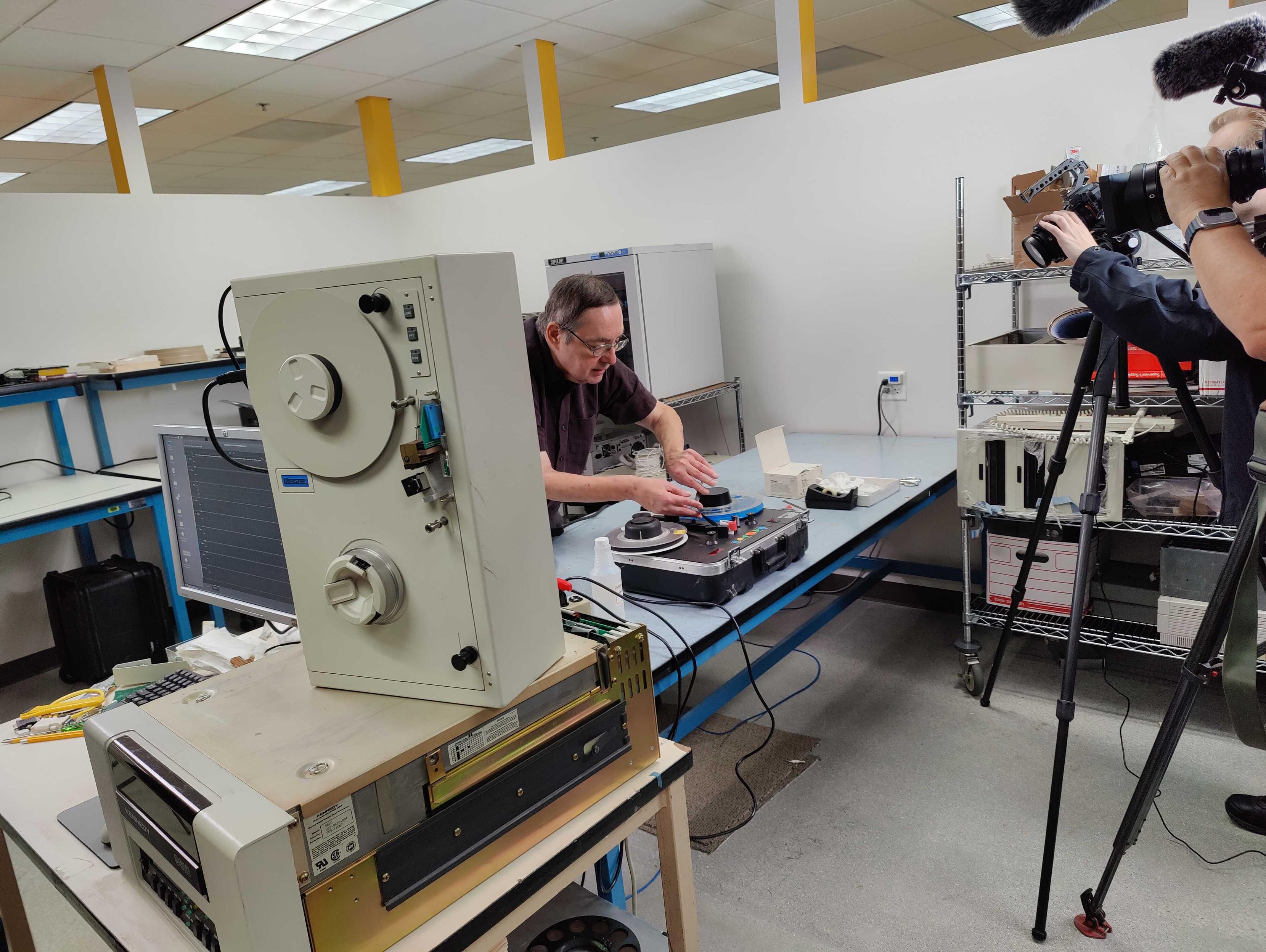
I can't see any details as to what the format of the tape is. Is there any reason to think it is anything other than a BCD-encoded, 7-track. 200bpi tape? From the images that looks quite possible.

Quite a discovery in any case.
 
Others have recognized the handwriting on the label as that of Jay Lepreau. I remember Jay very well. Not only did we share a name, our offices at the university were initially on the same floor. (He later got moved to the penthouse.) I don't recall any of the computer science department's equipment having tape drives, although they did have a lot of retired PDPs in storage rooms. I really hope they can read this tape. Having learned of its connection to a former colleague, I would really like this to have a nostalgia-positive outcome.
 
The tape apparently is from 1973. That predates my first experience with using a computer.
Mine too. My first was via a teletype in 1976, IIRC. My first encounter with UNIX was around 1984 with an ICL/Three Rivers PERQ running PNX, based on UNIX v7, and most of my subsequent career involved UNIX and Linux systems, though never anything as ancient as v4!
 
My first home computing was with a Dragon 32 in around 1982. My first encounter with UNIX was DEC-Ultrix boxes as an undergrad a few years after that.
 
Running on a simulated PDP/11

Wow, the good ol' Motif window manager! It's running under PDP-11 emulation on a Silicon Graphics. This sounds like a job for the retro tech thread. I had an SGI Indigo, one of my favorite computers.

My first actual computer experience was MTS running on the IBM System/370 accessible via teletype. My first Unix was V5 running on various AT&T pieces of gosa. Someone convince my boss to take a bunch of 3B5s and 3B15s (minicomputers) off his hands because they had enormous disk storage capacity. Unfortunately the disks were proprietarily connected to CPUs with the apparent computing power of a hamster wheel operated by an overweight, unmotivated hamster. These were the minicomputers that ran AT&T's first digital phone switches. They did have 9-track tape drives, though, and all my work from that company is on a 9-track 6250 BPI tape in my attic. If anyone wants to see a hamster try to do fluid dynamics analysis, I'll try to read it. AT&T made a single-user workstation called the UNIX PC that also ran V5. It was such an unusable computer that they ended up being given away free and lots of them ended up as movie props. You can see one in Skip Tyler's office in The Hunt for Red October.

Later we got a VAX 11/780 and put BSD on it. Its console was a DECWriter, probably the nosiest teletype-like machine ever invented. Then we augmented that with a Harris HCX-9 which initially used V5 and then later our IT guys put 4.2 BSD on it. Then we moved to a long series of engineering workstations running one of SunOS/Solaris, IRIX, HP-UX, and AIX.

We used FreeBSD as an embedded OS for a while because its license made it essentially free. Now we use a either Free RTOS or Linux with real-time kernel extensions. All our supercomputers run Linux.

If I'm reading the comments correctly, the contents of the tape are now available for download.

ETA: download here http://squoze.net/UNIX/v4/README (warning, not an HTTPS URL)

 
Last edited:
I tried O Grade Computing at school in 1976 but writing code on a sheet of paper to be posted to a college and getting back a compilation error due to a missing ";" (IIRC) wasn't my idea of fun. Twice in my psych degree I used computers but with no real understanding then I was persuaded to do a 1 year PostGrad diploma in CS (3 year BSc syllabus crammed in 1 year) and was away. I learned on a couple of VAX 11/7xx running BSD unix. Pascal and a smattering of ADA, COBOL and C - 2 lecturers were on the Pascal standards committee. Passed and joined IBM in 84 as a sysprog writing assembler on MVS/370 and XA on IBM 4300 boxes - also some PL/I and PL/AS. I was told I write very clean assembler, even when writing PL/I. When I left HSBC in 2016 (with head held high and feet held higher*) I believe, with some justification, I was the last person in the group writing assembler - a REXX to MQ bridge and some exits for TWS/OPC job scheduler.

*tip of hat to Spike Milligan
 

Back
Top Bottom