lobosrul5
Philosopher

... Kim Jung-Un, Vladimir Putin, Ali Khamenei.When you find an example of the first kind of person, let me know.

... Kim Jung-Un, Vladimir Putin, Ali Khamenei.When you find an example of the first kind of person, let me know.

... Kim Jung-Un, Vladimir Putin, Ali Khamenei.

... Kim Jung-Un, Vladimir Putin, Ali Khamenei.
Nope.
They are only okay with State Control because they are the ones controlling it, not because they ideologically believe it should be so for everyone, including themselves.
Economically, sure. But that same communist could easily have very "libertarian" views on sex and drugs and so on, while someone with libertarian views on the economy might be a fundamentalist Christian.Exactly. A more apt example would be a run-of-the-mill communist.


There are two kinds of people in the world: those who ninja, and those who get ninja'd.There are 10 types of people in the world: Those who know binary, and those who don't.


There are 10 kinds of people in the world: those who can read binary and those who cannot.
Ho hum, some nerd had to do the binary joke.There are 10 types of people in the world: Those who know binary, and those who don't.


You must really hate our current administration and the platform they ran on.Oh, I definitely work from the libertarian end. Freedom is the default principle. The state should infringe only when strictly necessary.
Hating political compromise all day every day is no way to go through life.You must really hate our current administration and the platform they ran on.
Acknowledging the elephant in the room.Ho hum, some nerd had to do the binary joke.
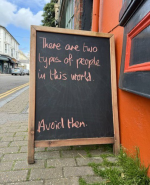
I just thought it would be me...


Given those two choices, I'm firmly in the latter camp. I'm not sure that I've ever met someone who actually believes the former.... Those that believe the government should prohibit everything, and make exceptions only when strictly necessary for the greater good...
... And those that believe the government should prohibit nothing, and make exceptions only when necessary for the greater good.
Which kind of person are you?