alphabetlaw2018
New Blood

With only moderate knowledge of English language and Vietnamese language I was able to find the law inside the alphabet of symbols, for writing, and the alphabet of sounds, for talking. Since ancient time, it has always been the central intention of the alphabet people for symbols to represent the speech sounds. Since ancient time people has been looking into the human speech sounds to discover the vowels and consonants, similarly, think of the elements in chenistry.
English Writing uses mostly Spelling, abracadabra, for it's orthography, because it has only 26 symbols for alphabet letters.
While, Vietnamese Writing uses mostly phonetic (=each alphabet letter represents only one speech sound, a vowel or a consonant). Because Vietnamese Writing has three levels of sounds for each of the five vowels: a â ă, e ê iê, u ư ưa, o ô ơ, i y ... adorning them with diacritics, and plus, it has five diacritics for the six tones, so, there is less of a need for Spelling.
Vietnamese Alphabet Writing has it's foundation laid down by Francisco De Pina, a Portuguese Jesuit missionary who arrived to Vietnam in 1617.
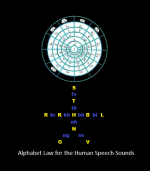
So, in the year of 2018, I found H to be the central consonant of other consonants, forming the body of the human figure; and "I" to be the central vowel of other vowels, forming the head of the human figure.
English Writing uses mostly Spelling, abracadabra, for it's orthography, because it has only 26 symbols for alphabet letters.
While, Vietnamese Writing uses mostly phonetic (=each alphabet letter represents only one speech sound, a vowel or a consonant). Because Vietnamese Writing has three levels of sounds for each of the five vowels: a â ă, e ê iê, u ư ưa, o ô ơ, i y ... adorning them with diacritics, and plus, it has five diacritics for the six tones, so, there is less of a need for Spelling.
Vietnamese Alphabet Writing has it's foundation laid down by Francisco De Pina, a Portuguese Jesuit missionary who arrived to Vietnam in 1617.
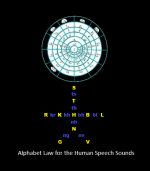
So, in the year of 2018, I found H to be the central consonant of other consonants, forming the body of the human figure; and "I" to be the central vowel of other vowels, forming the head of the human figure.