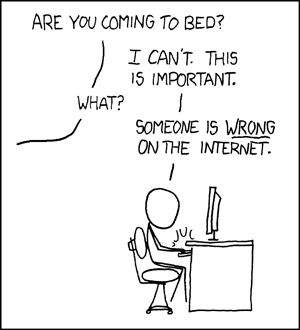
My entire argument is that the evidence in place doesn't support the conclusion that the identity theory is proven.
Well, one could argue that the evidence in place doesn't truly support the conclusion that the entire Universe is billions of years old, either. What if it was all created only last Thursday, and it just FEELS like we have memories before that time period?
I argue that Last Thursdayism is just about as testable as the idea that thoughts arise from something
other than brain functions, right now.
A most interesting point, which would tend to refute any hypothesis that thoughts are mappable to neuron firings.
It might be more accurate to argue that thoughts are mappable to PATTERNS of neuron firings. The specific neurons used are generally less important. Though the brain region might be, depending on the circumstances of the thoughts.
We are only in the early stages of studying what is called the
Connectome, right now. That is: Mapping how connections in the brain make us who we are. Analogous to the genome, in certain ways. Perhaps you should read up on that.
An author named Sebastian Seung has a good, introductory book on the subject. The book deals mostly with the
process of how we are mapping the brain, and how technologies to do so improve over time. It barely scratches the surface on any kinds of conclusions or significant discoveries made, yet. But, as I said: We are only in the early stages of doing these sorts of things. So, give the science some time!
Though, any good, modern book on neuroscience gets the general message I am trying to get across: That the brain is being studied as if that is the sole source of thoughts. And, that no other approach has ever been productive.
Another book I like, tangently related to these topics, is
The Self Illusion by Bruce Hood. He introduces various ways social behavior shapes our thoughts. Though, ultimately, they still boil down to brain processes in the end.
(Sorry I don't have any good web references. When it comes to bulk knowledge acquisition, I tend to be a book reader much more so than a web site reader.)
The first I learned about experiments with emotional illusions was from the book
Subliminal: How Your Unconscious Mind Rules Your Behavior by Leonard Mlodinow. He covers it in chapter 9.
Sure. Suppose the mind is an infinite and eternal proposition. Perhaps we can use the analog of an infinite series of rooms, with infinitely varied contents. Further suppose that consciousness is the sum total of perceivable phenomena in one of these rooms.
What physical forms would the "rooms" take? (At least hypothetically.)
In such a case, consciousness would perceive its room to be the totality of existence, and any data coming from the room would appear to be evidence that the totality of existence were limited to its confines. In such a case, no such evidence would refute the fact of the infinite series, and would not support it either...
This oddly sounds like you are reinventing Homunculus Theory. If I am wrong, explain how this is different. If that assessment right, how do you resolve the problems of infinite regression?
I'm orders of magnitude more willing to surmise that the sun will rise in the east tomorrow than I am to surmise that the brain and the mind are one and the same.
That is probably only because you haven't read up on all of the knowledge we've gained about the brain, so far. We know a LOT more about how the brain works, how emotions work, how thoughts work, how consciousness arises, than most people realize. Granted, we do NOT know everything. But, everything we DO know points quite explicitly with the brain and the mind being one in the same.
One more book I would like to recommend:
Self Comes to Mind, by Antonio Damasio. It is one of my favorites! It steps you through the process of how conscious thought
could have evolved in the brain, based on the best evidence available, today. There is a fairly good chance some of his ideas could be wrong, which he acknowledges. (Again, we are only in the early stages of sorting these things out.) But, even so: You might be amazed at just
how much science has already gone into these endeavors!
I would love to see someone just
try to be anywhere near as productive in unraveling the mysteries of the brain, with theories that thoughts do NOT come from brain processes, alone! The so-called "noetic sciences" have been trying to do that for a looooooong time, even before modern neurology existed, and even they still have a CUBIC TON of catching up to do! (I heard they are still obsessing over how weird Egyptian hieroglyphics are, or something. I dunno.)