• Quick note - the problem with Youtube videos not embedding on the forum appears to have been fixed, thanks to ZiprHead. If you do still see problems let me know.

String Theory is Doomed - offshoot from Null Physics thread

You are right - 9Be is the only stable isotope. I should had said 7Be and 8Be (and mentioned 10Be to 14Be)


It may be we are chasing the wrong element. After all, the Jupiter is an Electron Theory paper does admit the sun represents either 4 or 5 protons. So, we could be looking at either the 8Be atom or 9B+ cation.

Since the calculations and assumptions for beryllium seem to be unraveling, it may be time for a different fiasco involving boron. Sadly, though, 9B has a half-life of 8x10-19 seconds, even shorter than 8Be. We are all doomed!
 
It may be we are chasing the wrong element. After all, the Jupiter is an Electron Theory paper does admit the sun represents either 4 or 5 protons. So, we could be looking at either the 8Be atom or 9B+ cation.

Since the calculations and assumptions for beryllium seem to be unraveling, it may be time for a different fiasco involving boron. Sadly, though, 9B has a half-life of 8x10-19 seconds, even shorter than 8Be. We are all doomed!
Then MainframeX is also inconsistent.
The full e-book on his site has Chapter 15: Quantum & Celestial Relativity on page 160 that starts with a diagram where the nucleus is the inner solar system, electrons are gas giants, protons are "rock planets", electron shells are outer planetary orbits of gas giants and 4/5 neutrons are the Sun/Star.

Which leads to another question for MainframeX: How do "electrons" (gas giants) in their separate orbits duplicate in any way the electronic structure in the Bohr model (or real atoms) which has multiple electrons per shell?
MainframeX: FYI Beryllium (you obviously need to read something about Be) has an electronic configuration of 1s2 2s2 (2 shells of 2 electrons each)
 
Is there any good reason MainframeX is using a 95 year-old model of atomic structure?

The Bohr atom is a useful toy model to introduce the idea of energy quantization to undergraduates but has serious failings when used to model the behaviour of real atoms.

MainframeX, why aren't you using a quantum mechanical treatment of the Beryllium atom for your comparison?

You do know that electrons don't orbit like tiny planets don't you?
 
I don't understand, if S has any meaning at all, why it can't be used to give the mass of Saturn (by multiplying by the charge of an electron), or the mass of the earth (by multiplying by the charge of a proton).

I mean, isn't it the "holy grail of physics" which allows us to unite charge and mass?

Moreover, regarding scaling: 1kg * 1000 = 1000kg.
1 kg * 1000 <> 1000 C

PS How was neptune discovered?
 
Is there any good reason MainframeX is using a 95 year-old model of atomic structure?

The Bohr atom is a useful toy model to introduce the idea of energy quantization to undergraduates but has serious failings when used to model the behaviour of real atoms.

MainframeX, why aren't you using a quantum mechanical treatment of the Beryllium atom for your comparison?

You do know that electrons don't orbit like tiny planets don't you?

I'm not using the Bohr model. I'm using the actual Solar System (and recent remote star system data with common properties to our star system such gas giant exoplanets) as my working model. I just make reference that Bohr was the first to have that incredible insight to use the our Solar System in his initial modeling. I'm just continuing that insight and expanding on it to contain all of the star system's characteristics.

Anyway, while I was away I had a discussion with a friend regarding string theory and he made a good point in regards to something I said some time ago. Basically he quoted a hypothesis I wrote a while back that if anyone of us developed a conceptual tool as an aid (any concept at any level of imaginary complexity such as the dynamics of a cup of water or shoe lace) to in envision and interpret abstract physics (the physics of the unseen such as quantum realm and cosmology, too small or too far to see and easily "relate" too) and run it on the premise of relativity as everything relates to everything else and attempt to extract the actuality of physics from this conceptual tool that all of us would derive at the same results and conclusions but not necessarily at the same time. So in defense of string theory, my friend threw this back to me and he's right as it pertains to my hypothesis. So being the devils advocate I replied that depending the initial level of imaginary complexity in the conceptual aid and the if they have to run the premise of relativity (we relate all we know to other things we tangibly know). If the level of imaginary complexity is very high and relativity is omitted than any theory with any a conceptual aid of this type will result in imaginary or no conclusions and predictions and this is where string theory is currently. String theory's conceptual aid is a string with some using closed-loop strings. Other string thoeries develop complex imaginary geometric contraptions revolving around the conceptual aid of a string in order to "stuff in" validated physics. What it lacks is any form of relativity and I'm not talking solely about Einstein's relativity which is being stuffed into imaginary contraptions developed by string theorists. I'm talking about relativity of relating the abstract to something we know tangibly much like how Bohr envisioned the atom (which can't be seen by the naked eye, is mysteriously abstract and "feels" like something foreign) as something similar to are Solar System which had been observed "tangibly" via microscopes for centuries even though it was still wondrous. I continued by saying this is exactly why over the course of 40s years string theory has not evolved anything or predicted anything in physics, in the actuality of physics (not some imaginary concept). It notably has advanced mathematics, but again physics is not a representation of mathematics. Mathematics is a representation of physics.
 
Last edited:
It may be we are chasing the wrong element. After all, the Jupiter is an Electron Theory paper does admit the sun represents either 4 or 5 protons. So, we could be looking at either the 8Be atom or 9B+ cation.

Since the calculations and assumptions for beryllium seem to be unraveling, it may be time for a different fiasco involving boron. Sadly, though, 9B has a half-life of 8x10-19 seconds, even shorter than 8Be. We are all doomed!

I suspect that our Solar System is a stable 9Be atom bonded in a celestial molecule to other star systems. I say this because of the inclusion of our Moon and the dwarf planet of Ceres.
 
I'm talking about relativity of relating the abstract to something we know tangibly much like how Bohr envisioned the atom (which can't be seen by the naked eye, is mysteriously abstract and "feels" like something foreign) as something similar to are Solar System which had been observed "tangibly" via microscopes for centuries even though it was still wondrous.

You mean telescopes right?
 
Only our moon?

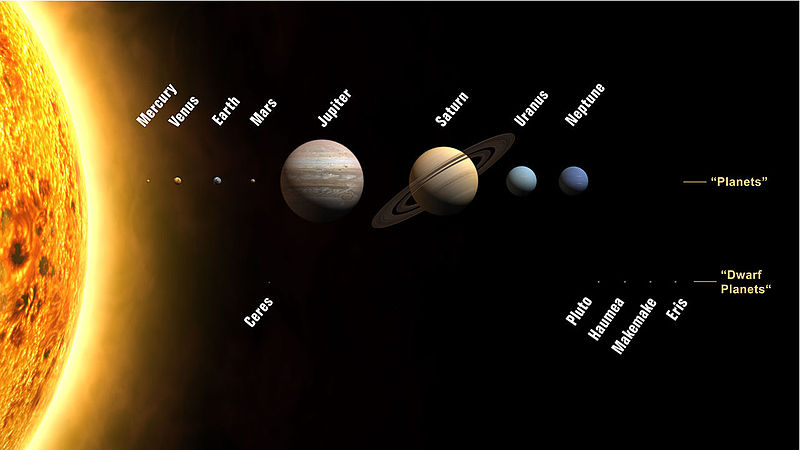
Here is an image that visual expresses my reasoning for the Be atom.

800px-Planets2008.jpg
 
Perhaps I am completely missing the point here but what effect would changing the number of gas giants in a system have on how it interacts with another system?
 
Perhaps I am completely missing the point here but what effect would changing the number of gas giants in a system have on how it interacts with another system?
MainframeX has a crackpot theory that the solar system is a celestial atom of beryllium (Be) where gas giants are celestial electrons, rocky planets are celestial protons and neutrons somehow are included in the Sun. He thinks that you can put mass equal to charge just by multiplying by a scaling factor.

He ignores little things like:
  • Planet is not a scientific term. It is a description that was just resently codified. Thus Pluto used to be a planet and now is not. So before that the solar system must have been an atom of boron!
  • Gas giants are heavier than rocky planets but electrons are lighter than protons.
MainframeX:
  • From GPofR: Gas giants are celestial electrons. They move at a low velocity and so we can use a simplified version equation on page 81: S2C = 1kg.
    For Jupiter (if we ignore basic physics and make a value in mass equal to the same value in charge) the result is your Jupiterquantum = 1.898*1026kg/S2 = 1.56*10-19kg.

    This is of course nowhere near the real value of the charge on an electron which just happens to be negative, i.e. -1.602176487(40)*10-19C.

    The next problem is that Saturn, Uranus and Neptune have much lower masses than Jupiter (which is 317.8 Earths), e.g. Saturn has a mass of 95.152 Earths. This means that they are even worse matches (ignoring the sign problem above) than Jupiter.

    Thus your theory fails its predictions and is false.
    I will not even get into the way off values for rocky "planets" considered as protons.
  • Exactly how many neutrons is the Sun and how did you calculate it?
  • How do "electrons" (gas giants) in their separate orbits duplicate in any way the electronic structure in the Bohr model (or real atoms) which has multiple electrons per shell? FYI Beryllium (you obviously need to read something about Be) has an electronic configuration of 1s2 2s2 (2 shells of 2 electrons each).
ETA: Since your scaling factor converts all of the mass of the planets to charge does this mean that electrons and protons do not have any mass?
 
Last edited:
MainframeX has a crackpot theory that the solar system is a celestial atom of beryllium (Be) where gas giants are celestial electrons, rocky planets are celestial protons and neutrons somehow are included in the Sun. He thinks that you can put mass equal to charge just by multiplying by a scaling factor.

He ignores little things like:
  • Planet is not a scientific term. It is a description that was just resently codified. Thus Pluto used to be a planet and now is not. So before that the solar system must have been an atom of boron!
  • Gas giants are heavier than rocky planets but electrons are lighter than protons.
MainframeX:
  • From GPofR: Gas giants are celestial electrons. They move at a low velocity and so we can use a simplified version equation on page 81: S2C = 1kg.
    For Jupiter (if we ignore basic physics and make a value in mass equal to the same value in charge) the result is your Jupiterquantum = 1.898*1026kg/S2 = 1.56*10-19kg.

    This is of course nowhere near the real value of the charge on an electron which just happens to be negative, i.e. -1.602176487(40)*10-19C.

    The next problem is that Saturn, Uranus and Neptune have much lower masses than Jupiter (which is 317.8 Earths), e.g. Saturn has a mass of 95.152 Earths. This means that they are even worse matches (ignoring the sign problem above) than Jupiter.

    Thus your theory fails its predictions and is false.
    I will not even get into the way off values for rocky "planets" considered as protons.
  • Exactly how many neutrons is the Sun and how did you calculate it?
  • How do "electrons" (gas giants) in their separate orbits duplicate in any way the electronic structure in the Bohr model (or real atoms) which has multiple electrons per shell? FYI Beryllium (you obviously need to read something about Be) has an electronic configuration of 1s2 2s2 (2 shells of 2 electrons each).
ETA: Since your scaling factor converts all of the mass of the planets to charge does this mean that electrons and protons do not have any mass?

You're good Reality Check which makes this much more assuming. I "think" I have a theory and it's a pretty good one compared say to string theory. Why? Think for second my "theory" is correct, which the very simple numbers validate as much as you'd like to argue against it (which is a huge coincidence if anything at all). But just for sec think I'm right. Let your mind open to the possibility which I know you're capable of. So follow me on this. What would that mean? That clearly means there is a difference in scale between Solar System and Be atom. Scale pertains to the concept of "space". So there is a difference in space. Awesome! So what?! But electrons in are a hazy cloud around the nucleus. Why? Because they travel very, very fast. So you mean along with a difference in space there is a difference in the passage of time? Interesting. So there's a difference in space-time at the quantum scale in reference to our space-time frame of reference. Taking space-time as a pliable substance that can be distorted affecting size (space) and the passage of time then it can be considered a form of space-time density. So space-time density is "denser" at the quantum scale compared to the celestial scale. So a system that appears completely unrelated to our Solar System is not. It's all a matter of perception.

Now, not all gas giants are equal in mass. Based on Newtonian mathematics? First off, size is not indicative of mass and to think that is down right stupid. For example, compare a clay ball to a lead ball to see what I mean "tangibly". But lets go with the current mass of gas giants. Neptune and Uranus are similar in mass and significantly different than Jupiter and Saturn. Grant that so ok. But accounting for the possibility that our Solar System is member atom to a celestial molecule, you'd have to consider how molecular bonds work. You're adept in physics so you should know. Valence electrons are shared with other atoms. But how are they shared exactly? Do you know all the research pertaining molecular bonds? Their "charge" is shared between systems. Charge in my theory equates to mass. So perhaps...just maybe...Neptune and Uranus are in a mass sharing bond with another star system. Which means their masses are somehow split (and this is what I'm currently working on) between other star systems.

If I'm wrong kukos to you, but really doubt it. At least you can visual conceptualize my theory. Try doing that with string theory. Oh wait I can visual conceptualize string theory too...that's right I worked with string theory. I almost forgot that.

Yes I'm being sarcastic if you couldn't tell. I mean no malice. If you dish it, I'll make it pretty and give it back. Buddy I've dealt with all kinds (in and out of physics) and to me this becomes a sport in the psychology of others which I totally find amusing. We can reason each other to death, but honestly I don't have the time. To me this forum is a form of entertainment which I do at my leisure. I'm usually very busy. By applying a negative connotation to me by frivolously calling me a "crack-pot" is a cop-out. I expect better from you and the term is so relatively subjective it's unreal. Yes I've called others "crack-pot" too. No where in physics does it say implicitly that the atom is not relative to a star system. Am I going against the current paradigm? No. I make no claims of that. Even if I was I wouldn't care but the fact remains that I'm not. Give me some credit I'm a lot smarter than you may think. Yes now I've left myself opened to attack by anyone in offense to me gloating on my intellectual capacity. There's no need to reply regarding that and if you do it just proves my point. The fact is, Neils Bohr makes a the initial hypothesis and analogy that the atom and Solar System were alike. Yes, Mr Bohr was the god-father of quantum physics. So in physics there is room for such a theory.

I like you reality check. From the stuff I've read I actually tend to agree with most of what you write. You have a powerful mind its obvious so put it to some powerful use...not on this forum. Forum's are for chumps. I mean in the real world.

BTW, if you read my paper rocky planets are neutrons not protons.

 
Last edited:
I just make reference that Bohr was the first to have that incredible insight to use the our Solar System in his initial modeling. I'm just continuing that insight and expanding on it to contain all of the star system's characteristics.


Yes, Bohr was first to have the insight that atoms may be like little solar systems. This helped enormously in explaining phenomena like the Lyman Series of emission lines in the spectrum of atomic Hydrogen. It explained why there were discrete energies at which electrons hopped from one orbit to another.

However, the Bohr model was superceded by the Schrödinger atomic model as this explained many more features of the behaviour of atomic hydrogen. Those who are interested in the shortcomings of the Bohr model and how these were overcome by the Schrödinger solution should read up on the Zeeman effect (splitting of emission lines in a magnetic field).

My point is that you cannot claim that the solar system is like a giant Beryllium atom, with planets in defined elliptical orbits being electrons, when it has been conclusively shown that electrons in real Beryllium atoms do not behave in this manner.

tl;dr

Atoms aren't like little solar systems. Electrons don't orbit like planets.
 
Here is an image that visual expresses my reasoning for the Be atom.

[qimg]http://upload.wikimedia.org/wikipedia/commons/thumb/c/c4/Planets2008.jpg/800px-Planets2008.jpg[/qimg]

Erm. I don't see how. Aside from the fact that neutrons are bigger than electrons where as the analogues in your model are the reverse, neutrons do not, in general, have "orbits" outside of protons in the nucleus.
 
MainframeX:
How much orbital angular momentum do the gas giants have?
How much orbital angular momentum do the electrons in Be atoms have?
 
By applying a negative connotation to me by frivolously calling me a "crack-pot" is a cop-out.

Would you prefer wingnut? Crank? Nutjob? Loonytune? Fruitloop?

You're an interesting case, because your theory is one of the most blatantly stupid I've seen. Usually crank theories at least involve some big nonsense words and vague mysticism (e.g. "null" physics with its axioms) to fool the credulous. This one hasn't even been wrapped up in that...

Mainframe, since you worked on string theory, answer this - what's the content of the right-moving ghost sector of the E(8)XE(8) heterotic string?
 

Back
Top Bottom