Racism is baseless

caveman1917 said:
if all societies are violent then violence is probably a human predisposition and not just a cultural artefact.

From falsehood everything follows.

You're the proverbial one-trick pony, aren't you caveman? Everything you can't reply to you dismiss with general nice looking one-line snippets.
 
comments inline

"it" = the propensity for violence is passed along a parent-offspring relation, specifically as an explanation for the spread of a propensity for violence throughout a population.

That sounds like you were onto the topic, but I regret to say you're completely off. Are you looking for evidence of a long gone past in the modern world? Tell me where do you expect to find starving populations and groups attacking other groups without any external intervention

You won't hear an argument from me that starvation isn't a cause of violence, in fact, as you may recall, I've provided evidence for natural calamities affecting food availability being a good predictor for warfare.

and among all of it, statistically significant studies of violence-leaning behaviour in parents and offspring.

Suppose there are two groups, A and B, initially peaceful. A becomes violent and attacks B. It may very well be true that, rather than B being taken out of the gene pool and A's offspring "taking over", that B in response becomes violent itself - thereby explaining the spread of violence amongst the totality of both A's and B's offspring. Now you might say that, because B having become violent they stopped being peaceful, your claim at first sight remains true, but then you'd be ignoring that the spread of violence occurred by cultural exchange and not along a parent-offspring axis.
 
Last edited:
I agree a new thread is warranted.

Well it went from "early human societies had the social structure of gorillas because muh genes" over "early human societies as a rule practiced warfare" to "humans are genetically predisposed to violence" where the goal posts seem to be eternally, slowely but surely, moving.
 
Last edited:
You're the proverbial one-trick pony, aren't you caveman? Everything you can't reply to you dismiss with general nice looking one-line snippets.

I've given evidence of at least one society which wasn't violent, thereby refuting the premise of "if all societies were violent". If one's argument can be easily refuted by a one-line snippet then one should work on one's argument rather than whine about the refutation.
 
Well it went from "early human societies had the social structure of gorillas because muh genes" over "early human societies as a rule practiced warfare" to "humans are genetically predisposed to violence" where the goal posts seem to be eternally, slowely but surely, moving.

Yes, it wandered from the OP, and the new discussion is still a worthy topic for separate discussion, more so IMO than an extended taxonomy debate.
 
Last edited:
The problem with defining race is the definition varies from culture to culture and from historical period. I have read articles on the concept of race over the years from the Journal of American History and some anthropological sources to support this. There is a fairly comprehensive article in the American History Oxford Research Encyclopedias on concepts of race in the United States throughout US history. Race in the US has been defined differently depending on the time period and region. Because it varies depending on the culture and and historical period, this implies the concept is cultural, social, and political and not scientific. This is not to say scientists have not tried to create scientific definitions and justifications for those definitions, it just means that there is no clear and succinct definition. Every definition I have seen is entirely dependent on either pseudo science from the 19th century or other cultural, political and social norms.

In returning to the OP, I am not sure if the person being considered racist would argue that they are not racist and simply arguing natives have certain cultural traits that predispose them to certain negative behaviors. However, I am always deeply suspicious of this argument. People who will in one conversation state that Jews are cheap and love money. Then when pressed, they will make an argument that it is a Jewish cultural tradition to be cheap and that they are not racist because they understand this. Similarly, it reminds me of someone I worked with a long time ago who said he wasn't racist but if he saw women dating an African American he would ask that woman if her mother knew what she was doing.
 
Yeah - bigotry doesn't require slicing and dicing. There are cultures I do not like and think are dangerous...misogynist ones in particular...even Japanese xenophobia is dismaying tho done politely.

It's the idjits claiming a biological basis for their bigotry that do the most damage.
There are pluses and minuses for most cultures....the minus for "persons" of colour in too many nations including Canada is systemic bigotry they like to think is based in biological science rather than their own ignorance.

Negative aspects of culture such as misogny need to be addressed with education -even a few in this thread could use a dose of understanding the damage done by supporting race as a valid meme.

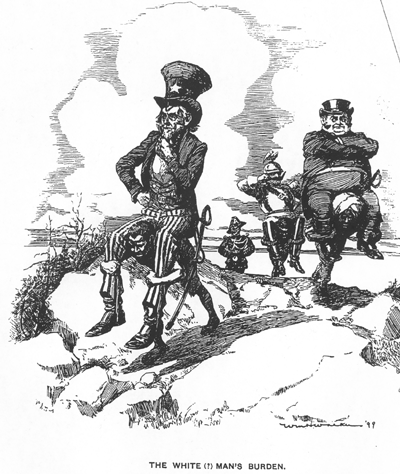
It's even more odious now than when the Brits and the likes of Kipling propped up their notions of empire with it. Nor are the Brits the only ones.

The_white_mans_burden.gif
 
Last edited:
the new discussion is still a worthy topic for separate discussion

Increasingly less so to me, to be honest, as the discussion is moving towards an undefined notion of "violence" which seems to be "aha, someone got mad and killed someone else - what a violent society". If the goalposts are going to move to the point where finding at least one instance of such violence in a society counts as a "goal" then sure, I'll agree that you'll probably be able to find such an instance in every society. I'll also say that I'm not particularly interested in debating that.
 
Last edited:
They are semi-agricultural if they practice agriculture alongside hunting/gathering. The are horticultural if they practice horticulture. If they practice hunting/gathering but have the relevant social characteristics of agricultural societies then they are complex hunter-gatherers. Population level doesn't even come into it.

And even if you, for some reason, want to argue nomenclature then it still holds that, in assessing the claim of genetic predisposition of violence, the relevant aspect is their social and cultural characteristics - irrespective of whether you want to call them complex hunter-gatherers, semi-agricultural, horticultural or whatever.

My only point being this and to a few others:

The extant historical hunter-gathers we know of a about 6 groups at best, those who are not strictly H-G may have the resources to engage in something other than the usually (not always) non-lethal raiding behaviors. However in general most of the H-G groups of which we have a semi-accurate records for are notably non-aggressive, possibly because they are too concerned with survival to engage in more than raiding. If we look at the Khoi-San and Inuit they are notably non- aggressive, and in fact do not engage in raiding. They also live in very inhospitable environments which may make the cost of aggression very high. The other H-G groups we have records or were also in contact with aggressive horticultural and agrarian societies.

So just a word of caution, we do not have evidence that the actual groups that engage in only H-G behaviors are aggressive and engage is lethal behaviors, the few examples we have are risk aversive, except in the presence of neighbors who are attacking them and pushing into their territory.

And that we really can't conclude that they did not engage in inter group aggression because the remaining H-G groups for which we have records lived in hostile environments that may have made them risk aversive.

All because of resources, the abundance of food resources and then food storage technologies seems to go along with the development of aggression between groups. Prior to the development of horticulture and mixed agriculture the idea is that the risk of aggression was to high in relation to the benefits.

However without a time machine we will never know what level of aggression lethal and non-lethal that there was.
 
"it" = the propensity for violence is passed along a parent-offspring relation, specifically as an explanation for the spread of a propensity for violence throughout a population.

I didn't say such a simplistic thing. Violence is attached to the success of the group, then culture interferes in the gene pool. Your "it" is a wrong one.

You won't hear an argument from me that starvation isn't a cause of violence, in fact, as you may recall, I've provided evidence for natural calamities affecting food availability being a good predictor for warfare.

That isn't related in any way to what I said in the text you quoted. Do read it this time and try to answer the question.

Suppose there are two groups, A and B, initially peaceful. A becomes violent and attacks B. It may very well be true that, rather than B being taken out of the gene pool and A's offspring "taking over", that B in response becomes violent itself - thereby explaining the spread of violence amongst the totality of both A's and B's offspring. Now you might say that, because B having become violent they stopped being peaceful, your claim at first sight remains true, but then you'd be ignoring that the spread of violence occurred by cultural exchange and not along a parent-offspring axis.

You continue to evade what I said (I think you didn't read it, you just skimmed a few isolated words and tried a "reply"). You have a double problem here: conceptual and methodological. You're making a false dichotomy between genetic and cultural proclivity to violence, or at least you're vacating the middle. The fact is that there are different characteristics in individual behaviour that make violence a successful trait for the group, like loyalty to a chief. I don't think you understand that the evidence you hope you'll find won't explain what you think it does.

But I now confirm that you didn't read my words and you dismissed them lightly because you felt doing so, not because of a rational reason. The problem, as I asked you, stands: where are you going to find current studies on starvation and resource depletion without external intervention and at the same time studying the genetic transmission of certain treats in exactly the same human context? That is impossible to do and it doesn't replies what you think it does.

You have anthropological and historical studies to do so, and modelling to account for the genetic component -provided you can provide a good set of descriptors for reasonable factors-.

But, what the hell does this have to do with "race"?
 
I've given evidence of at least one society which wasn't violent, thereby refuting the premise of "if all societies were violent". If one's argument can be easily refuted by a one-line snippet then one should work on one's argument rather than whine about the refutation.

Yes, in Scotland there's just one sheep and it's black on one side of it ... I know, I know.

Does you social-gathering rhetorical trick invalidate what Roboramma said?
 
<snip> ...However without a time machine we will never know what level of aggression lethal and non-lethal that there was.

I tend to agree. Population density was extremely low, almost laughable by today's standards. I imagine there were groups who thought they were alone in the world and entirely unique. In other cases, people may have totally flipped out when they discovered another tribe, and then been overcome more by curiosity than fear after the initial shock. I wonder, too, if Nature wouldn't favor the behavior of seeking out strangers for mating to avoid inbreeding. Interbreeding among sapiens and Neanderthals may also have been aided by this sort of thing.

On the other end of the spectrum, the first continent to experience high density has also been the most extremely violent, Europe. It's often been said that most wars are over privileged access to resources.
 
Yeah - bigotry doesn't require slicing and dicing. There are cultures I do not like and think are dangerous...misogynist ones in particular...even Japanese xenophobia is dismaying tho done politely.

It's the idjits claiming a biological basis for their bigotry that do the most damage.
There are pluses and minuses for most cultures....the minus for "persons" of colour in too many nations including Canada is systemic bigotry they like to think is based in biological science rather than their own ignorance.

Negative aspects of culture such as misogny need to be addressed with education -even a few in this thread could use a dose of understanding the damage done by supporting race as a valid meme.

It's even more odious now than when the Brits and the likes of Kipling propped up their notions of empire with it. Nor are the Brits the only ones.

What you're saying is that people must repress certain tendencies for "the greater good" which is no novelty and it's in the very nature of human beings, hence we have culture and communities and countries, and even an outline of United Nations. How do you think guilt and taboos like incest came about if not both hardwired and useful for survival?

What continue to be false in your preach is that not having a biological base. You simply inserting insults within erratic argumentations.
 
Primarily Mexico, Guatemala and Columbia, but then they hung out with my father. So that may be an influence.

That's good by one hand. But take into account that those people receive their high education from the United States, hence their language is plenty of Anglicisms and their thinking is heavily influenced by the USA. From Ecuador to Tierra del Fuego it's a different thing.
 
My only point being this and to a few others:

The extant historical hunter-gathers we know of a about 6 groups at best, those who are not strictly H-G may have the resources to engage in something other than the usually (not always) non-lethal raiding behaviors. However in general most of the H-G groups of which we have a semi-accurate records for are notably non-aggressive, possibly because they are too concerned with survival to engage in more than raiding. If we look at the Khoi-San and Inuit they are notably non- aggressive, and in fact do not engage in raiding. They also live in very inhospitable environments which may make the cost of aggression very high. The other H-G groups we have records or were also in contact with aggressive horticultural and agrarian societies.

The highlighted seems to contradict the evidence on hunter-gatherers which do not live in resource-deprived contexts yet are also non-aggressive, such as the earlier mentioned !kung.

So just a word of caution, we do not have evidence that the actual groups that engage in only H-G behaviors are aggressive and engage is lethal behaviors, the few examples we have are risk aversive, except in the presence of neighbors who are attacking them and pushing into their territory.

I know that, I have not argued anything of the sort that H-G's were aggressive. On the contrary, I am using H-G's as a counterargument against the notion of humans being genetically predisposed to the things people have claimed them to be, including aggression.

And that we really can't conclude that they did not engage in inter group aggression because the remaining H-G groups for which we have records lived in hostile environments that may have made them risk aversive.

As far as I know the evidence suggests that H-G's displayed a whole range of social behaviours, from non-violent to warlike, from egalitarian to hierarchical, and sometimes a single group switching between these. Define "having records".

All because of resources, the abundance of food resources and then food storage technologies seems to go along with the development of aggression between groups.

As far as I know the evidence suggests that agricultural societies were not necessarily more prone to abundance of food resources, and in at least some cases were more prone to food shortages than H-G's.

Aggression does seem to go along with resource accumulation, hence why the use of a "moar is better!" statistics (nevermind sampling bias or anything) is so flawed since - given that we are doing a "genetics vs cultural" debate - H-G's are the relevant cultural context and they physically couldn't engage in resource accumulation even if they wanted to, because they have to carry "their" stuff around all the time.

Prior to the development of horticulture and mixed agriculture the idea is that the risk of aggression was to high in relation to the benefits.

Whose idea? Theirs?

However without a time machine we will never know what level of aggression lethal and non-lethal that there was.

That doesn't mean there's no good evidence against the "genetically predisposed violence/hierarchy/warfare/..." hypotheses.
 
Last edited:
Population density was extremely low, almost laughable by today's standards.

Since always there were as much population as the combination of each land and culture could sustain. Never forget that. People starved periodically and how to deal with it, both intra-culture and externally was something everyone who left descendants was forced to manage quite well.

When I have compared with others our heritage -same one or different- I always jokingly said "I descend from those who took the right decision". I mean, I descend from a lineage of an average of about 150 generations of farmers, hence, they periodically faced famine and had to take the decision of eating the seed for the next harvest -in low technological contexts the ratio between crops and seeds is as low as 4 to 7- or letting one or two of their children starve to death. They did the last, consistently, hard as it always was, or did any tricky action they needed to do to avoid the first, so I'm here. That means, my life is sort of a privilege of a high cost, and I always think about the future and analyse present decisions in the light of future consequences, all for a good reason.

That treat make me similar to Bolivians from the Highlands. We're completely different to Bolivians from the Lowlands and Paraguayans: they are descendants of hunter-gatherers with a little horticulture. They are used to make the most of the present. Every of us has a little of that, for instance, when some people eat cookie after cookie until the tray or box is empty, then they find they're no longer hungry. These peoples more focused in the shorter terms are much dependent on chiefs and big kahunas to take the long term decisions. They are fiercely loyal to their chiefs. That's one of the reasons why democracies in Latin America, Africa and South East and West Asia tend to tumble: they are much dependent on hetmans, so they are easy victims of demagogues.

I had the great opportunity of having a crew of Paraguayan labourers working for me. It was a great experience, and how both them and me learnt how to deal with each other in the most constructive way. Of course, I had to do the most of adaptation, but I came to love and respect them, to never let them down, and I learnt a lot of things including how to cease the day and look at it with good eyes. Call it racial interchange, ethnic interchange, cultural interchange or whatever you want. It only can be enlightening.

 
I didn't say such a simplistic thing. Violence is attached to the success of the group, then culture interferes in the gene pool. Your "it" is a wrong one.

If you think you have been misunderstood, feel free to define your terms and somewhat formalize it.

You continue to evade what I said (I think you didn't read it, you just skimmed a few isolated words and tried a "reply"). You have a double problem here: conceptual and methodological. You're making a false dichotomy between genetic and cultural proclivity to violence, or at least you're vacating the middle. The fact is that there are different characteristics in individual behaviour that make violence a successful trait for the group, like loyalty to a chief. I don't think you understand that the evidence you hope you'll find won't explain what you think it does.

If you want to make a claim about a genetic component then it's up to you present your evidence.

But I now confirm that you didn't read my words and you dismissed them lightly because you felt doing so, not because of a rational reason.

The reason is very rational indeed.

The problem, as I asked you, stands: where are you going to find current studies on starvation and resource depletion without external intervention and at the same time studying the genetic transmission of certain treats in exactly the same human context? That is impossible to do and it doesn't replies what you think it does.

Are you suggesting that it is impossible to find an example of an aggressive society meeting a non-aggressive society, and the non-aggressive society becoming aggressive as a result even though this result is clearly not due to everyone starting to bang each other and mixing their genes?

And again, why would I need to go find your evidence for you?

You have anthropological and historical studies to do so, and modelling to account for the genetic component -provided you can provide a good set of descriptors for reasonable factors-.

I've got nothing to do to show you wrong. Make a well-defined claim and provide evidence.

But, what the hell does this have to do with "race"?

Absolutely nothing. People were asserting ******** about substituting chimps for early humans and it went flying off from there.
 

Back
Top Bottom