Questions for "Evolutionary Christians"

DialecticMaterialist said:
Well they still accept the Bible, which includes a story you may have heard of called Genesis.

OK, so your position is the complete either, or the complete or.

Either you accept everything in the Bible, or you reject everything in the Bible.

Since I read the Bible as an obvious evolution of a race of people's understanding of God, I see no reason why I should accept everything, or reject everything, as you would have me do.

Except now its a metaphor or misunderstanding (but still revealed truth from God.)

It is how human's understand. How a human expresses an encounter with God is dependent upon the human. It is up to every individual to judge such encounters as put on paper.

Listen, I'm not going to try to persuade you to read any portion of the Bible and see what I see. You make your own judgments, I'll make my own judgments. If you chuck the whole Bible in the trash, fine. You *must* be able to comprehend, however, that other people see no reason to act in the complete acceptance/complete rejection fashion.

If I open a bag of trail mix, is it not possible for me to throw away the raisins and eat everything else?

(Personally I wouldn't throw any part of the Bible away, I would just draw truth from each part in different ways).

And now God directs things by means of the cruel and inefficient process of evolution...because He is mysterious.

I don't believe God directs evolution, though I am open to entertaining the notion that he does, and may one day change my mind and think that he does. Who knows.

Some people do believe God directs evolution. Life is cruel, so I don't know why evolution should not be cruel. Life is inefficient, so I don't know why evolution should be efficient. We have the realities of daily existence, which Christian dogma explains, yet you would have the realities of evolution not have the same features of the realities of daily existence. Meaning, if daily life was *not* cruel, or *not* inefficient, I would think you have an excellent point here.

And the process is telological in a subtle untestable way. Also a soul was added during human evolution, though it has no impact on anything we experience.

Was? No, continues to be. Every time a human is born. Whether or not you feel it has an impact is up to you.

Superfluous entities? Naawww.

You don't have to be all sarcastic. Look, I understand your worldview. Yes, God is a superfluous entity in your worldview. If you want to construct a worldview based solely on limiting superfluous entities that is fine.

Superfluous is a matter of reasoning implemented so we don't make stuff up. It is only a matter of perspective in so far as that perspective adds enough data to make the viewpoint necessary.

And I consider abiogenesis making stuff up. You think I make up superfluous stuff, I think you make up superfluous stuff. It is entirely a matter of perspective. You add data that was never observed, could never be observed, etc. And so do I.

Taste has nothing to do with it. (Unless you are a cognitive relativist.)

I am glad you don't find my beliefs distasteful. A lot of people on this forum do.

If you think there are superfluous entities in evolution tell me what they are.

The entities that must have existed, but are not represented in the fossil record. You're the gradualist, not me. There have to be more entities in a gradualistic mindset, right?

-Elliot
 
try to look at it this way: The bible is not to be taken literally, but as a book of fables to teach people how to live morally and love one another.

By genocide, hate, worship, self demeanment and uncritical thought?

Yup...lotsa loving going on there...
 
"Hi Darwin.

Does it make sense that an individual may accept anything and everything in evolutionary theory, be it just the most micro of micro-evolutionary thinking, to origin by descent, and yet reject abiogenesis?

I have certain degrees of rejection. I would, as an evolutionary Christian, reject certain things with more absoluteness of rejection than others.

I don't know of any young-earth creationist (YEC I guess is the term) who says that a micro-evolution does not take place. So this sort of person will agree to the evolution that is observed by humans in nature (not necessarily in laboratory conditions), while rejecting the evolution ideas that would have occurred before human history and observation."

It is very hard to take YEC´s seriously,for me that is.
The reasons they reject things for,does have less to do with science than they would like you to think.


"Exactly. It is an extrapolation. I see no reason why I have to accept that extrapolation. Combine that with reasons that I feel go against the notion of extrapolation, and you can understand where I cam coming from. As for "form a fairly accurate picture", since we can't travel back in time I don't know how a fairly accurate picture can possibly be formed, that would make people like me content with the theories of people like you. That you are content with your pictures and notions of a few million years ago is apparent, and I accept that your position is reasonable to yourself and millions of others."

I see.But what a theory refers to,by it´s definition,is something that has been proven over reasonable doubt.
I do not know if you have a problem with that,and I still do not know why.
You are still right in saying that we cannot travel back in time and that´s true.But modern science has allowed us to investigate and learn about things that would seem to be even further out of our reach.Some people ignorant of evolution,for an example,may attack it by saying "well,nobody was there to explore so...".While "skeptics" may always giggle at the probability that everything about the past cannot be known,we can certainly try.
Geology and paleontology for example,can tell us wonders about the past.As a great paleontology enthusiast,I might note that the rocks may not tell everything,but they never ever lie.
 
Hey Darwin. Are you like me, and believe that your granddaddy Erasmus doesn't get the shake he deserves? Now Erasmus, that was a character. And how is Julia. Nice lady.

Darwin said:
It is very hard to take YEC´s seriously,for me that is.
The reasons they reject things for,does have less to do with science than they would like you to think.

You are correct. Their primary position is not founded on science.

I see.But what a theory refers to,by it´s definition,is something that has been proven over reasonable doubt.
I do not know if you have a problem with that,and I still do not know why.

What is the universal measurement for reasonable doubt?

We are, I think, both reasonable persons. Yet our reasonable doubts differ. I have reasonable doubts about abiogenesis among many things. You have reasonable doubts about the supernatural. As for why I have problems, it is more like I have less of a problem with supernatural creation than I do for abiogenesis. That and the fact that it is self-evident (to me) that a genetic code implies a designer.

You are still right in saying that we cannot travel back in time and that´s true.But modern science has allowed us to investigate and learn about things that would seem to be even further out of our reach.Some people ignorant of evolution,for an example,may attack it by saying "well,nobody was there to explore so...".While "skeptics" may always giggle at the probability that everything about the past cannot be known,we can certainly try.

Don't get me wrong, I admire your effort. Yours is hardly an unreasonable faith.

Geology and paleontology for example,can tell us wonders about the past.As a great paleontology enthusiast,I might note that the rocks may not tell everything,but they never ever lie.

I like that. :)

Note I am resisting the urge to pun on the word *lie*. :)

-Elliot
 
elliotfc said:

quote:Originally posted by Darwin
--------------------------------------------------------------------------------
Geology and paleontology for example,can tell us wonders about the past.As a great paleontology enthusiast,I might note that the rocks may not tell everything,but they never ever lie.
--------------------------------------------------------------------------------


I like that.

Note I am resisting the urge to pun on the word *lie*.

-Elliot

Please note that data (ie. geological and fossil record in this case) do not "lie". Data can, however, be misinterpreted and misused.

Interpretation of geological record shows us 4.5 billion years of changes in Earth and in the various species that lived on it. This can not be refuted. If someone does not accept this, he/she should seriously consider the fact that he or she is reading these letters on a computer that was built with plastics and metals. And that these materials were extracted from deposits found using methods based on this very interpretation.

I can´t remember a single ore deposit found using a sacred text. But maybe I´m just ignorant.
 
Correa Neto said:
Interpretation of geological record shows us 4.5 billion years of changes in Earth and in the various species that lived on it. This can not be refuted.

Sure, if you follow constant extrapolation. And you have no reason to not follow constant extrapolation, so you do.

Whether I follow constant extrapolation or not, whether the earth is 5 billion years old or 5 million, that doesn't mean much to me.

Of course various species have lived on Earth, even YEC's believe that.

If someone does not accept this, he/she should seriously consider the fact that he or she is reading these letters on a computer that was built with plastics and metals. And that these materials were extracted from deposits found using methods based on this very interpretation.

People can believe what they see, but what does that have to do with what happened, as you say, 4.5 billion years ago?

I can´t remember a single ore deposit found using a sacred text. But maybe I´m just ignorant.

No, you're not ignorant. The Bible should not be used to look for rocks. Or it should be. There are better tools to look for rocks, in my opinion.

-Elliot
 
elliotfc said:
OK, so your position is the complete either, or the complete or.


Nope, just that it is reasonable to go by what's parsimonious and the Bible is not. At least on matters of religion and such.

Either you accept everything in the Bible, or you reject everything in the Bible.

In principle one should either accept the parsimonious or allow the superfluous. Otherwise you just apply such principles when conveniant.

Since I read the Bible as an obvious evolution of a race of people's understanding of God, I see no reason why I should accept everything, or reject everything, as you would have me do.

Parsimony is not a reason?


You make your own judgments, I'll make my own judgments. If you chuck the whole Bible in the trash, fine. You *must* be able to comprehend, however, that other people see no reason to act in the complete acceptance/complete rejection fashion.

I'm not merely positing an either/or. That would be fallacious. However I am positing that such beliefs are superfluous, a very different thing.

If I open a bag of trail mix, is it not possible for me to throw away the raisins and eat everything else?

That's a matter of taste not belief. I can like raisin, and you can dislike them. Both can be true at the same time.

However there cannot be a God and not be a God at the same time.


I don't believe God directs evolution, though I am open to entertaining the notion that he does, and may one day change my mind and think that he does. Who knows.

Well you may not, but many Xians do. Also, what do you think God did then?

In principle what's different from your belief and the belief that, lets say, there is an invisible fairy in the corner of my house, that cannot interact with the physical world in any way?

Some people do believe God directs evolution. Life is cruel, so I don't know why evolution should not be cruel. Life is inefficient, so I don't know why evolution should be efficient. We have the realities of daily existence, which Christian dogma explains, yet you would have the realities of evolution not have the same features of the realities of daily existence.


But one must wonder why any sort of God would work through such means.


And I consider abiogenesis making stuff up. You think I make up superfluous stuff, I think you make up superfluous stuff.

In principle certain theories of abiogenesis work quite wellm giving us the most parsimonious explanations at the moment.


You add data that was never observed, could never be observed, etc. And so do I.

Add data that could never be observed? I'm not sure what you are saying here.

What irrational data have I added?


The entities that must have existed, but are not represented in the fossil record. You're the gradualist, not me. There have to be more entities in a gradualistic mindset, right?

-Elliot

Well perhaps there has to be more entities but they are necessary, seeing as the chance of beneficial mutations by saltations is very, very improbable.


It's like if I can focus my microscope by just making one or two big turns of the knob, I would prefer to do that. However that will in all likelyhood not work, so I make small adjustments.

This means I prefer as few entities as possible when I can get away with it, but sometimes I can't so I have to accept a lot more then I prefer.
 
Hey DM

DialecticMaterialist said:

Nope, just that it is reasonable to go by what's parsimonious and the Bible is not. At least on matters of religion and such.

In principle one should either accept the parsimonious or allow the superfluous. Otherwise you just apply such principles when conveniant.

Parsimony is not a reason?


If you mean parsimony in the Ockham's razor sense, I have never been able to understand how Ockham's razor would make something true, or make something not true. It's a nice thought.

I don't consider anything in the Bible superfluous to my belief, not just my theological beliefs, but my historical and anthropological interests really compel me to treat the Bible seriously. Of course I don't have to have the interest in the Bible that I admit to having. I want to understand people, and God, and any recorded interactions, whether or not they are completely contrived or completely legitimate.

I'm not merely positing an either/or. That would be fallacious. However I am positing that such beliefs are superfluous, a very different thing.

Do you see how I consider your beliefs to be superfluous?

That's a matter of taste not belief. I can like raisin, and you can dislike them. Both can be true at the same time.

However there cannot be a God and not be a God at the same time.

Good point. My belief in God, however, does not start, or end, with the Bible.

Well you may not, but many Xians do. Also, what do you think God did then?

I'm not exactly sure what God did. I just see him as the Ultimate Creator. I will say that he creates every individual soul, and he was behind the design of all life on Earth. Honestly I don't know how far I would extend God's actions. I am glad that science would explain the machinations of the universe leaving God out of the equation. The theories science generates are available for me to accept or reject, or to partially accept/reject. Just like the Bible. I have to make meaning out of what is available to me. Nothing out there is inherently meaningful outside what humans make of it. There is existence, but I think of meaning as separate from existence.

In principle what's different from your belief and the belief that, lets say, there is an invisible fairy in the corner of my house, that cannot interact with the physical world in any way?

Nothing I guess. I may pressure you to explain to me why you think there is a fairy, or if anyone shares your belief, or if your belief brings any amount of edification to yourself or humanity. See, in principle you would have to have reasons for the expressed belief. As long as you had those reasons, you are correct in that it wouldn't be all that different from my beliefs or any theological beliefs.

But one must wonder why any sort of God would work through such means.

You stated the above in response to my declaration that life as we know it is cruel and inefficient. This is the state of the fallen creation. God is not working through fallen creation, creation is in rebellion. He tolerates this rebellion, and works in spite of it.

In principle certain theories of abiogenesis work quite well giving us the most parsimonious explanations at the moment.

If you say so, but you cannot tell me the exact genetic code of the first *living* organism, or any of the genetic codes of the countless billions if not trillions if not quadrillions of organisms which resulted from this first life. So I could see those as superfluous elements from my way of looking at it.

Add data that could never be observed? I'm not sure what you are saying here.

What irrational data have I added?

Nothing irrational. Did you observe the first *life* on Earth? The abiogenetic incident that started the whole thing? Nothing irrational about the idea. It's very rational, and it's very unobservable.

Well perhaps there has to be more entities but they are necessary, seeing as the chance of beneficial mutations by saltations is very, very improbable.

You got that right. They are improbable, and necessary for your theory. I think you left out about 2800 or so verys.

Heck, maybe you're right DM. Who knows. I'll stick with what makes sense to me. If I'm wrong, it doesn't really matter. I guess I may eventually brainwash my children into thinking like me. Then it might matter, particularly if they have kids and brainwash them. The species must manage in spite of all of this.

-Elliot
 
Some Friggin Guy said:
Hello, Yahweh (wow, I never thought I would ever use that combination of words! Guess the local priest in my home town may have been right....nah!)

You said this (which I'm sure you remember, but I love the quote feature.)


Actually, it is a pretty interesting concept. The way I figure it, only by allowing ourselves to think illogically and realize it, can we truly understand the importance of logic in our thinking.

But, then again, I think the world would be a much happier place if everyone, every day, went up to a random person and gave that person a fish-stick.

I'm anaphylactically allergic to fish. I would not appreciate a fish-stick.
 
"Hey Darwin. Are you like me, and believe that your granddaddy Erasmus doesn't get the shake he deserves? Now Erasmus, that was a character. And how is Julia. Nice lady."

They are fine.I think Erasmus could have had more recognition for starting to get things right,so to speak.

"What is the universal measurement for reasonable doubt?"

Well,you can pick on this one if you wish but to since we were originally talking about a theory (which is where the term "reasonable doubt" kicked in) I raised it for the fact that a theory should have,by definition,considerable amount of evidence for it´s support (and evolutionary theory certainly has,from many branches of science).Having said this,I´ll leave it for you to decide,whether this is proof over reasonable doubt in your opinion.I,and most of the scientific community feel it is.

"We are, I think, both reasonable persons. Yet our reasonable doubts differ. I have reasonable doubts about abiogenesis among many things. You have reasonable doubts about the supernatural. As for why I have problems, it is more like I have less of a problem with supernatural creation than I do for abiogenesis. That and the fact that it is self-evident (to me) that a genetic code implies a designer."

Reading your replies,I would consider you a fairly reasonable person for my standards (considering that you are a christian).
I have come to notice a few things concerning these doubts you bring up.It seems that certain other theistic evolutionists (as called) place a lot of their doubt on abiogenesis too.I recall someone saying that "my position is actually the one supported by data" (or something like that).I suppose this must be the part of theirs,when a divine force needs to kick in to get things done? (I cannot see though,why we could not argue that it was through or before abiogenesis?) I´m yet to see it countered by actual demonstration.
Then there are,of course,the people who would simply tell you how "improbable" it all is or just how bizarre the whole idea is-"from molecules to me?" or "Give garbage enough time and mice will appear". :) (Strawmen).It is my idea that the latter at least,has great (or greater) ideological problems with the theory.

And now,this site has been referred to a great many times in JREF,but it´s all I can redirect you to right now (if books would not count) This is on abiogenesis;
http://www.talkorigins.org/faqs/abioprob/abioprob.html Considering that many actually be objected a strawman version of abiogenesis (or anything about evolution) it can be beneficial to read up.
BTW,I still do not know why,exactly,are you objected to abiogenesis.

Since you are wise to point out that "it is self-evident (to me)..." concerning genetic code,I do not think I need to comment on that.
Creationists (which I cannot treat you as) might as well interpret the fact of common DNA (as used as evidence for evolution from the ultimate common ancestor,world before DNA not counting) as evidence for creation,just like vestigial structures were referred to as the creators fondness of,say,"symmetry" and so on.
Without doing their own research,creating testable hypotheses or anything to that direction,they may pass anything off as "evident design/creation-".Where one sees "irreducible complexity",another may only spot the flaws of it.

"Don't get me wrong, I admire your effort. Yours is hardly an unreasonable faith."

I´m not sure whether I am following.

"I like that.

Note I am resisting the urge to pun on the word *lie*. "

Go ahead! :wink:
 
Darwin said:
And now,this site has been referred to a great many times in JREF,but it´s all I can redirect you to right now (if books would not count) This is on abiogenesis;
http://www.talkorigins.org/faqs/abioprob/abioprob.html Considering that many actually be objected a strawman version of abiogenesis (or anything about evolution) it can be beneficial to read up.
BTW,I still do not know why,exactly,are you objected to abiogenesis.

Perhaps we can turn the talkorigins abiogenesis faq into a separate topic? I read it a couple years ago, I can read it again.

My objection to abiogenesis starts with the fact that life comes from life, and I have no reason to believe, or need to believe, that at any point in the history of the universe that was not the case.

My objection to abiogenesis continues with my understanding of how code-based programming implies a designer.

My objection to abiogenesis ends with it being a mythology that has to compete with other mythologies, and the other mythologies that I accept (or am more accepting of) have more explanatory power for the questions that I have.

-Elliot
 
elliotfc said:


Sure, if you follow constant extrapolation. And you have no reason to not follow constant extrapolation, so you do.
-Elliot

Please define exactly what is "constant extrapolation". Are you refering to the constant related to radioactive isotope decay? If I understood correctly, then there are plenty of reasons to belive in it, since they can be measured and the efects of radioactive decay can be seen and measured

elliotfc said:

Whether I follow constant extrapolation or not, whether the earth is 5 billion years old or 5 million, that doesn't mean much to me.

Of course various species have lived on Earth, even YEC's believe that.

-Elliot

But the measured time frame for species appearance and extinction is not consistent with YEC ideas. And accepting the current estimates for the Earths´age (which are a little bit -that´s sarcasm- more precise than what YEC people use) means that parts of the Bible have to be taken as mith or lore, and not as litteral truth. Therefore, if someone consider the Bible the basis of your beliefs, or at least an important book to it, the age of earth must mean something to he or she.

elliotfc said:

...
People can believe what they see, but what does that have to do with what happened, as you say, 4.5 billion years ago?
...
-Elliot

Simple, its a domino effect. Ore and oil deposits take time to be formed, and they can also be dated by geochronolgy, using isotope decay ratios. The vast majority of oil and ore deposits are quite older than, say 5 million years and this is not compatible with YEC ideas. And if you don´t trust these half-life estimates, well, all that I can say is that they can be measured, and if the theory behind isotope decay is flawed, then someone must find a new way to explain how atomic bombs and nuclear reactors work, along many other things.

elliotfc said:

No, you're not ignorant. The Bible should not be used to look for rocks. Or it should be. There are better tools to look for rocks, in my opinion.

-Elliot

Therefore the Bible should not be used to provide anwers regarding the age of the Earth, the formation of the earth and to examine the paleontologic record. And this brings me to the very first point I made (or tried to)- all evidence we have is not compatible with the genesis as it is stated in the Genesis and many other sacred texts.
 
Correa Neto said:


Please define exactly what is "constant extrapolation". Are you refering to the constant related to radioactive isotope decay? If I understood correctly, then there are plenty of reasons to belive in it, since they can be measured and the efects of radioactive decay can be seen and measured.


Yes it can be measure and calculated, and we can see things in our current time perspective. Nothing unreasonable about extrapolation. If the earth is 4.5 billion years old or 450,000 thousand years old it doesn't make much difference to me.

But the measured time frame for species appearance and extinction is not consistent with YEC ideas. And accepting the current estimates for the Earths´age (which are a little bit -that´s sarcasm- more precise than what YEC people use) means that parts of the Bible have to be taken as mith or lore, and not as litteral truth. Therefore, if someone consider the Bible the basis of your beliefs, or at least an important book to it, the age of earth must mean something to he or she.

Correct. I don't know why they are so hung up about using the Bible to find an exact age of the earth. That's silly.

Simple, its a domino effect. Ore and oil deposits take time to be formed, and they can also be dated by geochronolgy, using isotope decay ratios.

As an aside, do you consider oil to be a fossil fuel?

The vast majority of oil and ore deposits are quite older than, say 5 million years and this is not compatible with YEC ideas. And if you don´t trust these half-life estimates, well, all that I can say is that they can be measured, and if the theory behind isotope decay is flawed, then someone must find a new way to explain how atomic bombs and nuclear reactors work, along many other things.

You misunderstand me. Yes, abombs and nuclear reactors are based on radioactive decay. And those things are created within the human historical record, and obviously work quite well. With the uniformitarian perspective, there is no reason not to extend that back in time. The caveat is *uniformitarian* perspective. That is an assumption that contains assumptions, all of which are reasonable. The link below is simply another way of looking at it. If you put a gun to my head Correa, I'd say that I think you are more right than the are, but I see where both of you are coming from.

http://www.giftofeternallife.org/books_articles/books/facts_fallicies/03.shtml

Therefore the Bible should not be used to provide anwers regarding the age of the Earth, the formation of the earth and to examine the paleontologic record. And this brings me to the very first point I made (or tried to)- all evidence we have is not compatible with the genesis as it is stated in the Genesis and many other sacred texts.

You are right, we should not use the Bible to determine the age of the Earth.

The Bible is such a small book it can hardly contain, or deal with, all the evidence and ammunition of science. For that reason it should be used for other things, things that I believe it was meant to do. I don't think guys like Moses and Hosea were very interested in proving how old the Earth was.

-Elliot
 
elliotfc said:


My objection to abiogenesis continues with my understanding of how code-based programming implies a designer.

My objection to abiogenesis ends with it being a mythology that has to compete with other mythologies, and the other mythologies that I accept (or am more accepting of) have more explanatory power for the questions that I have.

Funny about those "mythologies" that repeat themselves in a lab.

RNA self-replicates, it's just a chemical process. No magic necessary. The chemicals just do it.

Just because you don't understand bio-chemistry is no reason to suppose a miracle to fill your lack of knowledge.


Code requires a designer?!!? WHOOO BOY.

Just because you call it code, doesn't make it a computer program created by a programmer.

That's the problem with scientific analogies written for laypeople. They take them too far, then have belief in the analogies rather than the data. Or attack them based on an analogy that THEY took too far.
 
Silicon said:


Funny about those "mythologies" that repeat themselves in a lab.

RNA self-replicates, it's just a chemical process. No magic necessary. The chemicals just do it.

Just because you don't understand bio-chemistry is no reason to suppose a miracle to fill your lack of knowledge.


So tell me the exact sequences of the first abiogenesetic incidences.

If this mythology has been repeated in a lab, you should be able to give me all of the details.

There's nothing funny about this. :)

-Elliot
 
I checked the article. It has several errors, misconceptions and out-of-the-context sentences.

Initially, I would say that the writer really does not understand some concepts like error margin and calibration data, as well as the different uses of the various methods cited. It also is very outdated when it comes to currently avaliable geochronologic methods. It does not cites how material is collected, how its analized, what types of methods are adequate for what and what is assayed.

Error margins- Every measure instrument or methodology has an inherent error margin. Values used in science are usually given in a format like 1,555+15. This means that the actual value may be something between 1570 and 1535 (angstroms, light years, calories, years, seconds, etc.) - an error margin of 30 units. The actual precison of an age determination will depend on several things (analytical instruments precision, contamination and calibration). The author seems to use this as an evidence that geochronology is unrealiable. Error margins increase when you reach the upper and lower age limits for a given method, because there will be just small ammount of the parent or daughter isotope present on the sample. Also contamination of the sample may increase the error margin. The use of a given determination based on the error margin will depend on your objectives- 200 years of error on a 2000 years age may be OK to place something in an overall historical context, but not precise enough to place it within the timeframe corresponding to the lifetime of an individual (say, the pottery could or not have been from the time when Christ was alive- use this as an evidence that it was and you will be subject to fire, say it may have been and its OK).

C14. This type of dating can only be used up to evaluate relatively recent material. And this is not just because of the lack or calibration charts, but also due to the increase in error margin due the resolution of analytical methods. The ammount of radioactive isotope just becomes so small that its hard to detect. I also find quite intriguing why people use these techniques and accept its results when it provides dates that fit with events or facts that can be correlated with biblical passages, but when it points to an age older than what they belive earth was formed, the data and the method are said to be inadequate or faulty.

The other methods are not used to evaluate ages in organic material, but in rocks and minerals. When a igneous rock crystallizes from lava or magma, its minerals have say, 100% of isotope A. But isotope A decays to B at a constant rate, and this happens just below a certain temperature. Above this homogeneization temperature, you´ll have just isotope A. If you heat the rock, you´ll get a resetting of the system, that may be partial or complete. As you can see, chances are that you will get an younger rather then an older age in this case. And even these younger ages are quite older than what YEC avocate. To get an age that is older then that of crystallization of the rock, you will have to contaminate the magma or lava with older material (there are some documented cases).

K/Ar is no longer being routinelly used. That´s mainly because better methods (Pb/Pb, Sm/Nd for example) are nowdays avaliable. But they are still sometimes reffered to in the scientific litterature. Its also more sensitive to be altered by later heating events, thereby offering a date that is younger than the actual one. And even these are quite older than what YEC avocate.

Regarding the uniformitarian approach. C isotopes ratios varies with time. This is true. A supernova explosion there, intense wildfires, pollution, etc, all of this can change the ratios. There are, however, calibration charts for C14 that are quite precise, so changes in the proportion of C isotopes is fairly well know. How? Taking sample from from various independent sorces, that can even include gas trapped in bubbles within ice from glaciers.

Sorry but I can not see how an universal deluge (for which there are absolutely no evidences, by the way) could alterate isotopic rates. Suppose Earth has passed trhough a period where there was a grater abundance of a given radioactive isotope. This would not affect the age determinations, unless our planet was bathed in one of the isotopes used in geochronology. Even then the effect would not be big, because (1) we would be able to date the event, since dating is based on decay rates and (2) most rocks older then the event would not have its original isotopic composition altered by the event.
Geochronology is not based on the abundance of isotopes, but on the decaying rate of the isotopes, and there is no evidence that the decaying rate have changed.

And just because someone spoke about the shortcomings of the methods (as I just did, just as every single scientist does), it does not means that they are inherently wrong. Isolated declarations, out of their original context, have no meaning. And its not ethical to use this sort of proceedure.

At last, I have no intention of pointing guns to someone´s head...
 
Correa Neto said:
And just because someone spoke about the shortcomings of the methods (as I just did, just as every single scientist does), it does not means that they are inherently wrong. Isolated declarations, out of their original context, have no meaning. And its not ethical to use this sort of proceedure.

At last, I have no intention of pointing guns to someone´s head...

No, there is nothing inherently wrong about what you express, and I probably lean more your way than the other way. Thanks for reading and responding to the article as you did, it will give me something to think about over lunch.

I'm glad you aren't going to put a gun to my head.

-Elliot
 
elliotfc said:


So tell me the exact sequences of the first abiogenesetic incidences.

I do that, and I win the Nobel prize! The exact sequence of that first self-replicating RNA that we all come from is probably lost to the memory of time.


But RNA self-replicates. It's just a chemical process. The fact that you don't understand it, or choose not to, may just be lazyness on your part. Much easier to postulate a miracle.

If this mythology has been repeated in a lab, you should be able to give me all of the details.

Or you could learn about it yourself, rather than make us teach you.


From time immemorial, Religion has answered all of the questions.

God creates the lightning.
God creates disease.
God creates volcanos.

Then folks come in and try and figure out the phenomenon. Before they figure it out, the religious shout "That is GOD'S WORK! IT is sinful to look into it!"

Then they learn that lightning is electricity, and disease is caused by germs and volcanoes are functions of geothermic processes.

Then the religious folks damn the scientists to eternal hell for speaking blasphemy. Torture, the rack, etc.

And eventually, once a couple of generations have passed, the religious change their tune:

"GOD CREATES LIGHTNING THROUGH HIS DIVINE MECHANISM OF ELECTRICITY! GLORY BE TO GOD!"


How many generations until "Evolution is GOD's Mechanism!!!"? We'll see. Already happening with a lot of people. I guess abiogenesis is the current dark corner for these folks to answer with a miracle. Does that mean you're done arguing over the Monkey thing?


Religious explanations of scientific questions are the END of all inquiry into the natural world.

We might have ended with lightning, disease, tornadoes, earthquakes, life-science, but we haven't.

If we're content to postulate a miracle for everything we don't understand yet, we'd never understand ANYTHING. All learning would stop.

Do you WANT to go back to the dark ages, Elliotfc?


Abiogenesis link:

http://www.talkorigins.org/faqs/abioprob/abioprob.html


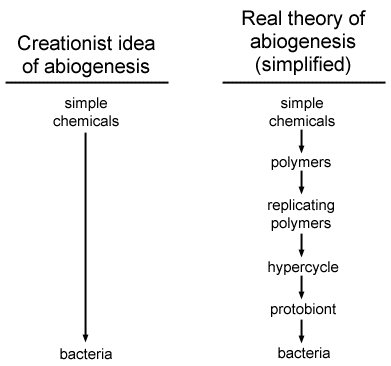
Here's a couple of graphics and a quote that I rather like:


views.gif


"Note that the real theory has a number of small steps, and in fact I've left out some steps (especially between the hypercycle-protobiont stage) for simplicity. Each step is associated with a small increase in
organisation and complexity, and the chemicals slowly climb towards organism-hood, rather than making one big leap."
 
Silicon said:
But RNA self-replicates. It's just a chemical process. The fact that you don't understand it, or choose not to, may just be lazyness on your part. Much easier to postulate a miracle.

Of course RNA self-replicates. What was the first RNA though? I've taken molecular biology and biochemistry, but they didn't teach about the origin of RNA, I think there were some general theories in the textbooks but they weren't talked about in the lectures. Self-replication doesn't explain origin, does it?

Or you could learn about it yourself, rather than make us teach you.

I'm not sure if you get my drift. If RNA is life, how did the first RNA come about, what was the initial base-pair sequence, etc etc etc.

From time immemorial, Religion has answered all of the questions. Then they learn that lightning is electricity, and disease is caused by germs and volcanoes are functions of geothermic processes.

Right. Lightning happens all the time, and so does disease. Volcanoes happen sometimes. These are all contemporary phenomenon, and I'm not taking issue with contemporary phenomenon. Other people may, and I'll join you in poking them with the stupid-stick.

How many generations until "Evolution is GOD's Mechanism!!!"? We'll see. Already happening with a lot of people. I guess abiogenesis is the current dark corner for these folks to answer with a miracle. Does that mean you're done arguing over the Monkey thing?

Interesting. I don't know what will be going through the heads of the religious 100 years from now. I have set up a distinction between current phenomenon, and past phenomenon that have been reasoned to occur. Perhaps we can discuss whether such a distinction is a real one. Sorry, not following you about the monkey thing, are you referring to the Scopes incident?

Religious explanations of scientific questions are the END of all inquiry into the natural world.

I believe in free inquiry, and am thankful for the results. I won't be placed into a either/or with religion or science. I'll take both, and I think millions and billions of reasonable people do the same.

If we're content to postulate a miracle for everything we don't understand yet, we'd never understand ANYTHING. All learning would stop.

I don't want to postulate miracles for everything. I am glad that there exists a non-miraculous explanation for origins. I'm quite familiar with it, and I do not wish to stamp it out of existence. Why should I? Competition of ideas is healthy, and as far as I can tell it makes people think harder, makes the concepts sharper, and works against intellectual stagnation.

Do you WANT to go back to the dark ages, Elliotfc?

Sometimes. Sometimes I think that in a less complicated time I could very well be happier than I am today. So many things that I feel are important are only important because of the complexity of the world. Plus I do enjoy medieval literature, both religious and secular. If I lived in the dark ages I reckon I'd be married by now, have kids, etc. Plus I have many questions about facts about medieval life that I could verify first hand.


Replicating polymers? Protobionts?

Do such things exist today? Just wondering, they weren't covered in the university level biochem and molecular bio courses I took. But that was back in 2000, and they say scientific knowledge increases exponentially. Please forgive my ignorance.

-Elliot
 
Silicon said:
Code requires a designer?!!? WHOOO BOY.

Code doesn't require a designer?

Just because you call it code, doesn't make it a computer program created by a programmer.

It isn't me who calls it a code, I didn't come up with that word or associated idea.

No, I don't think that DNA or RNA is a computer program, but it's a terrific analogy. Of course God's *computer program* would be much more extraordinary than our computer programs, and on a totally different level. Yet analogous, nonetheless.

In other words, if we were to discover a computer code from thousands of years ago, we'd scratch our heads wouldn't we? And we see a genetic code, and we are not supposed to scratch our heads?

I'm not saying that we should scratch our heads and don't even try to analyze or study, or yes EVEN EXPLAIN DNA/RNA. I'm talking about origins, so don't accuse me of saying we should completely ignore anything about DNA/RNA and not try to scientifically explain it. And I'm glad there is a scientific explanation for the origin of DNA/RNA, and I hope you guys continue to improve upon that explanation.

That's the problem with scientific analogies written for laypeople. They take them too far, then have belief in the analogies rather than the data. Or attack them based on an analogy that THEY took too far.

Funny, replace scientific with theological and I KNOW EXACTLY HOW YOU FEEL.

-Elliot
 

Back
Top Bottom