
• Quick note - the problem with Youtube videos not embedding on the forum appears to have been fixed, thanks to ZiprHead. If you do still see problems let me know.

Please critique this argument against miracles

Huh? That makes as much sense as Depok Chopra or Jordan Peterson.
Claiming that an argument is nonsense (because somebody as clever as you "can't understand it") is another fallacious argument.

The simple fact is that the claim "God exists" is unfalsifiable and the claim "God doesn't exist" is also unfalsifiable.
You might not like that both claims can be lumped into the same category but your feelings don't matter a whit in logic.
You might argue that one claim is "truer" than the other but "truer" has no meaning in logic.
You might argue that one of the claims is more likely to be true than the other but that is a new claim which needs supporting evidence (and fallacious "proofs" for the other side is not supporting evidence).
 
Wow. You are trying to pretend that your knowledge of logic is superior to mine but you not only don't know what "=>" means, you can't infer its meaning from the context in which it has been used.

FYI x => y is equivalent to any of the following:
"x implies y"
"if x then y"
"x only if y"
"y is necessary for x"
"x is sufficient for y"
Then it is not an appropriate connector for symbolic logic. A propositional connector has one, and only one, unambiguous meaning. "x implies y" is not an equivalent statement to "x only if y" or "y is necessary for x". I'm not even sure how I'd render that last statement in a propositional calculus. You're not using logic, you're using intuition and calling it logic.
 
Then it is not an appropriate connector for symbolic logic. A propositional connector has one, and only one, unambiguous meaning. "x implies y" is not an equivalent statement to "x only if y" or "y is necessary for x". I'm not even sure how I'd render that last statement in a propositional calculus. You're not using logic, you're using intuition and calling it logic.
Go read a book on elementary propositional logic (not calculus) then come back and explain which of the statements are not equivalent to "if x then y" and why.
 
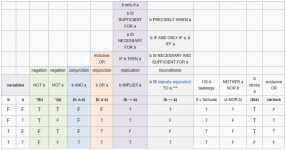
Have a look at this table that I found in about thirty seconds on Wikipedia. You're blurring the middle two columns.

1751618066621.png

But let's go back to the beginning because we're once again in muddy waters. You said:

An even more fundamental point would be to examine if a nexus between God and miracles exists in the first place.
Does the existence of God imply that miracles exist?
Does the existence of miracles imply that God exists?

If both these statements are true then you CAN use one to prove the other. But it isn't hard to come up with theoretical counter-examples that disprove both statements (God not performing miracles or miracles caused by other than God).

Your first statement: Does the existence of God imply that miracles exist? If x = "God exists" and y = "miracles exist" then you are asking whether IF x THEN y is true. Your second statement asks whether IF y THEN x is true. Then your conclusion states:

IF ( IF x THEN y ) AND (IF y THEN x ) THEN x AND y.

This proposition assumes the truth value of x and y, but it can be equivalently stated that:

IF (IF ¬x THEN ¬y) AND (IF ¬y THEN ¬x) THEN ¬x AND ¬y.

Do you agree with this?
 
Have a look at this table that I found in about thirty seconds on Wikipedia. You're blurring the middle two columns.

View attachment 62233
Look again. That table is saying exactly what I said (but it uses b for x and a for y).

Your first statement: Does the existence of God imply that miracles exist? If x = "God exists" and y = "miracles exist" then you are asking whether IF x THEN y is true. Your second statement asks whether IF y THEN x is true. Then your conclusion states:


IF ( IF x THEN y ) AND (IF y THEN x ) THEN x AND y. if we can show that one of the variables is true then the other variable is also true. Conversely, if we can establish that one of the variables is false then the other variable is also false.
I know that you don't like FTFYs but I had to delete your strawman and put in what I actually posted.

Note that (IF x THEN y ) AND (IF y THEN x ) is logically equivalent to (IF ¬x THEN ¬y) AND (IF ¬y THEN ¬x)
 
Last edited:
Claiming that an argument is nonsense (because somebody as clever as you "can't understand it") is another fallacious argument.

The simple fact is that the claim "God exists" is unfalsifiable and the claim "God doesn't exist" is also unfalsifiable.
You might not like that both claims can be lumped into the same category but your feelings don't matter a whit in logic.
You might argue that one claim is "truer" than the other but "truer" has no meaning in logic.
You might argue that one of the claims is more likely to be true than the other but that is a new claim which needs supporting evidence (and fallacious "proofs" for the other side is not supporting evidence).
Who said God doesn't exist? Not once have I made such a claim. I REJECT the god claims that have been proposed. There is a very distinct difference.

Until I am presented with credible evidence for a God, I reject it as a candidate explanation

I try and use that epistemology for every existential claim. Not just the dumb as dirt God claims.
 
Last edited:
Claiming that an argument is nonsense (because somebody as clever as you "can't understand it") is another fallacious argument.
Nope. The argument is nonsense because it is nonsense. It is unprovable. And unfalsifiable. It is pulled out of one's ass.
The simple fact is that the claim "God exists" is unfalsifiable and the claim "God doesn't exist" is also unfalsifiable.
True
You might not like that both claims can be lumped into the same category but your feelings don't matter a whit in logic.
As I and others have said many times before. Not believing is not a claim. It is the rejection of a claim. It is why juries do not find defendants innocent. They find them not guilty. They don't have to prove they are innocent. They only have to prove the prosecution failed to prove guilt. A defendant is considered not guilty until they have been found guilty. Never ever before. I find God NOT GUILTY of existing. Hell, there isn't even probable cause.

You might argue that one claim is "truer" than the other but "truer" has no meaning in logic.
Nope I can argue that one claim is pure unadulterated Bovine Excrement. The other claim is the default.
You might argue that one of the claims is more likely to be true than the other but that is a new claim which needs supporting evidence (and fallacious "proofs" for the other side is not supporting evidence).
I'll tell you what I can prove. The Holy Bible is bull. It is nonsense piled on top of nonsense on top of nonsense.
 
Last edited:
"God doesn't exist" is also unfalsifiable.
I'll probably regret joining this absurd discussion...but ??? If God comes down and does some mutually-agreed-upon god-defining things, that statement has been falsified.
 
The simpler point is that "God" is a nonsense term with amorphous and purposefully unspoken characteristics, and "Yahweh" is a fictional character.

In terms of falsifiability, the first one is on the level of a word I made up, and the second one is on the level of Superman.

Perhaps the logic buffs in this thread can tell me whether "Xyohget doesn't exist" and "Superman doesn't exist" are logically sound?
 
Last edited:
I'll probably regret joining this absurd discussion...but ??? If God comes down and does some mutually-agreed-upon god-defining things, that statement has been falsified.
Good luck on that one.

I think that it is problematic on many levels.
The first would be getting people to agree on what those God defining things would be.
The second would be knowing why they could do those things. How would you know it was because the being was a god or just a very advanced race?
 
Yes. I cannot prove Big Foot doesn't exist. That is an unfalsifiable claim. Absence of evidence is not evidence of absence. That said, the absence of evidence when evidence should exist points to a higher likelihood of absence. But that is not conclusive.

And this is reason for me not to believe in gods. There would be evidence. Not stories of talking snakes or flying to the moon on a winged horse.
 
The simpler point is that "God" is a nonsense term with amorphous and purposefully unspoken characteristics, and "Yahweh" is a fictional character.

In terms of falsifiability, the first one is on the level of a word I made up, and the second one is on the level of Superman.

Perhaps the logic buffs in this thread can tell me whether "Xyohget doesn't exist" and "Superman doesn't exist" are logically sound?
You've nailed it. They are all characters in books of fiction. The difference however, is that the indoctrinated among us insist that the Bible, the Quran, the Book of Mormon, the Vedas, Greek, and Nordic stories, etc are not fiction and somehow warrant being treated as if they are real.
People, should be laughing and rolling their eyes when told of the talking snake, the talking donkey and Noah, not teaching the stories every Sunday.

IMV, the Superman claim would be logically sound.

This is story written by Jerry Siegel. He never represented it as nonfiction. I have no idea who or what Xyohget is.
 
You've nailed it. They are all characters in books of fiction. The difference however, is that the indoctrinated among us insist that the Bible, the Quran, the Book of Mormon, the Vedas, Greek, and Nordic stories, etc are not fiction and somehow warrant being treated as if they are real.
People, should be laughing and rolling their eyes when told of the talking snake, the talking donkey and Noah, not teaching the stories every Sunday.

IMV, the Superman claim would be logically sound.

This is story written by Jerry Siegel. He never represented it as nonfiction. I have no idea who or what Xyohget is.
Xyohget is a word I made up. You wouldn't know him, but he's like a super awesome ... thing. Shiny. No, I can't tell you anything else, but he totally exists.

Whether something is presented as nonfiction or not, or whether the author is known or not, seems irrelevant, at least when it comes to logic, since Jerry Siegel would also have had the ability to lie.
 
Wow. You are trying to pretend that your knowledge of logic is superior to mine but you not only don't know what "=>" means, you can't infer its meaning from the context in which it has been used.

FYI x => y is equivalent to any of the following:
"x implies y"
"if x then y"
"x only if y"
"y is necessary for x"
"x is sufficient for y"
The first and last statements are not equivalent to each other. Neither of them is equivalent to the other three. Your usage of "=>" does not clarify. It obfuscates.

Meanwhile, the logic of atheism is quite sound:
  1. The claim is that God exists.
  2. There is no evidence to support this claim.
  3. Therefore, the claim is dismissed for lack of evidence.
It's hard to imagine an example of logic that is more straightforward and more soundly applied than this.
 
Yes. I cannot prove Big Foot doesn't exist. That is an unfalsifiable claim. Absence of evidence is not evidence of absence. That said, the absence of evidence when evidence should exist points to a higher likelihood of absence. But that is not conclusive.

And this is reason for me not to believe in gods. There would be evidence. Not stories of talking snakes or flying to the moon on a winged horse
You reversed the statements. I have no quibble with the rock solid idea that you can't prove a negative. This is about falsifying--disproving--a negative. If God reveals himself --your own words "There would be evidence"--then that statement "God does not exist" would be disproven.
I think that it is problematic on many levels.
The first would be getting people to agree on what those God defining things would be.
The second would be knowing why they could do those things. How would you know it was because the being was a god or just a very advanced race?
Of course it's problematic. But I mildly disagree with your conclusion--because *all* statements of fact or evidence are arguable, as this forum and every other human discourse proves. Someone will always claim that the Yahweh creature who appears and starts throwing galaxies around like frisbees, bends time and space, makes Donald Trump a likable guy--is not really God, but some other force or entity. Who cares? If it is able to do all the godlike things that centuries of humanity have largely agreed are things that are godlike, that is good enough for me and most other sane people. Call it God, Alien, or whatever you want.
 
The first and last statements are not equivalent to each other. Neither of them is equivalent to the other three. Your usage of "=>" does not clarify. It obfuscates.

Meanwhile, the logic of atheism is quite sound:
  1. The claim is that God exists.
  2. There is no evidence to support this claim.
  3. Therefore, the claim is dismissed for lack of evidence.
It's hard to imagine an example of logic that is more straightforward and more soundly applied than this.
Of course, I agree completely. The problem arises when that semantics of that logic are questioned and muddied. First, the definition of God has to be agreed upon by all parties. God is not an identifiable species with specific characteristics, it is a subjective term. Second, what is the standard of evidence? Does circumstantial or anecdotal evidence count? If one declares that the definition of 'God' is: "That which created the universe" then clearly there is rock solid evidence that 'God' exists. You could then respond by equating "the laws of physics" with "god" (and many have done so) but it still calls into question the logical statements.
 
Xyohget is a word I made up. You wouldn't know him, but he's like a super awesome ... thing. Shiny. No, I can't tell you anything else, but he totally exists.

Whether something is presented as nonfiction or not, or whether the author is known or not, seems irrelevant, at least when it comes to logic, since Jerry Siegel would also have had the ability to lie.
Very good. You are right. I absolutely don't believe gods exist. At least not the ones that I am somewhat familiar with. That said, it is not practical to try and say that they don't. It is assuming a burden of proof that is unnecessary to dismiss the claim.

Ever have these discussions with theists? It is like wrestling with jello. They tend to define God not what he might be, but what he isn't. Which is totally nonsensical. They say he is timeless Huh? That he is spaceless. Again huh? He is spirit. What? The language theists employ make their god impossible to disprove. That's why I concede their unfalsifiability. But I would also argue that any claim that is unfalsifiable is not worthy of belief.
 
Of course, I agree completely. The problem arises when that semantics of that logic are questioned and muddied. First, the definition of God has to be agreed upon by all parties. God is not an identifiable species with specific characteristics, it is a subjective term. Second, what is the standard of evidence? Does circumstantial or anecdotal evidence count? If one declares that the definition of 'God' is: "That which created the universe" then clearly there is rock solid evidence that 'God' exists. You could then respond by equating "the laws of physics" with "god" (and many have done so) but it still calls into question the logical statements.
The logic is sound. Whether it applies to a particular definition or standard of evidence is something each atheist needs to decide for themselves on a case by case basis.

There's no need to equivocate about this. Psion0's both-sides-ism is misguided.
 
The first and last statements are not equivalent to each other. Neither of them is equivalent to the other three. Your usage of "=>" does not clarify. It obfuscates.
Somebody else who doesn't know the first thing about logic.

Arthwollipot tried to make the same denial. He even put up a chart from Wikipedia to try and prove me wrong (https://internationalskeptics.com/f...rgument-against-miracles.375399/post-14608164).

And guess what? The chart confirmed word for word that all of the statements I posted about x=>y are indeed equivalent to each other.
 

Back
Top Bottom