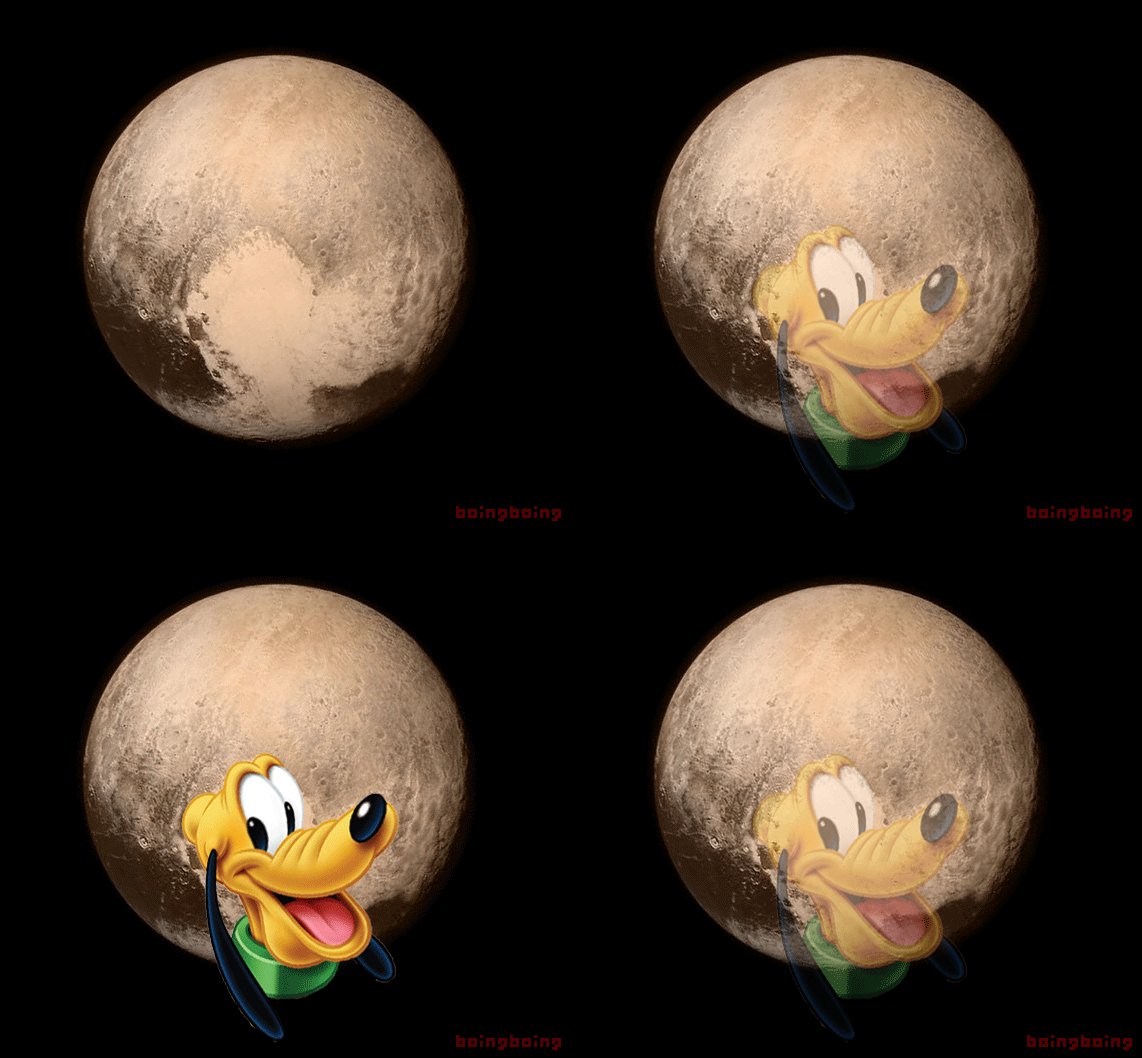
Does anyone have a link to a countdown? Aologies if there's already one posted.
NASA TV, though you may get better throughput via their UStream channel.

Does anyone have a link to a countdown? Aologies if there's already one posted.

I did a little engineering support for the refurbished RTG which is powering P-NH to the ninth planet* and beyond. Wow, time flies when you're a small spacecraft starting out on a big honkin' rocket. It's great to finally see the awesome science and beautiful images. Exciting stuff.
* Yes, I said planet. Old school!
Believe it or not, we're still in contact with both Voyagers. 11 or 12 billion miles away, roughly.
http://voyager.jpl.nasa.gov/where/index.html

Do RTG's put out the same amount of energy continuously or can they be throttled back so that the RTG is only getting used up when energy is required?
How would it become stable (by which is presumably meant circular) in anything short of cosmic periods of time? Tidal forces? Braking by Pluto's atmosphere?How much longer would the trip have been if they'd tried for an orbit. (Crazy patterns* allowed, but at least one realistic scenario, please.)
*Swing by, loop waaaay out, get pulled back, swing by loop waaay in, oscillate until orbit is stable?

Possibly. Basically you'd have to carry sufficient "fuel" to brake from constant velocity, so either a slower coast or a far bigger probe. I'm unable to crunch the numbers atm but back-of-the-envelope suggests many times larger.How much longer would the trip have been if they'd tried for an orbit. (Crazy patterns* allowed, but at least one realistic scenario, please.)
*Swing by, loop waaaay out, get pulled back, swing by loop waaay in, oscillate until orbit is stable?
That's tending towards an OCP, I expect it'd shake money loose and not just for NASA.I've wondered this myself... what would we do if we spotted something coming in, maybe a kilometer across, and spectroscopically determined that it was metallic. Not many natural metallic objects way out there... we'd have to consider the possibility that it was artificial. Biggest news of the millennium, right there.
A 1km3 sphere of neutron degenerate matter would mass ~2.1E26kg, more than thirty five times as much as the Earth or about one-ninth as much as Jupiter; it's gravitational pull would be noticed quickly.What if it's pure neutronium?
Yep L1 is the Lagrange point between the primary and secondary masses, i.e. between the Earth and Luna in this case.Nice:
J002E3WP
eta: Cool animated gif:
[qimg]https://upload.wikimedia.org/wikipedia/commons/3/39/J002e3f_orbit.gif[/qimg]
L1 is a Lagrange point?
Hopefully it'll become part of a space station at some point.That'd cause a stir on the collector's market. Worth a short story ...
RTGs rely on radioactive decay, so technically the heat produced is always slowly decreasing. There's no way to alter this bar manipulating the nuclear force in some manner we cannot currently achieve.Do RTG's put out the same amount of energy continuously or can they be throttled back so that the RTG is only getting used up when energy is required?


That's tending towards an OCP, I expect it'd shake money loose and not just for NASA. [\QUOTE]
OCP ? Omni-Consumer Products ?
I'll never understand the human obsession with dead remains.


How would it become stable (by which is presumably meant circular) in anything short of cosmic periods of time? Tidal forces? Braking by Pluto's atmosphere?
L1 is a Lagrange point?
Yep L1 is the Lagrange point between the primary and secondary masses, i.e. between the Earth and Luna in this case.
That's tending towards an OCP, I expect it'd shake money loose and not just for NASA.
OCP ? Omni-Consumer Products ?
Outside Context Problem
It's a gesture. One of those strange human things.I'll never understand the human obsession with dead remains.
D'oh, my bad.is it? in the animation it seems 3-4 times farther from earth than the moon, I'd rather say L1 for sun-earth
I believe it is now transmitting data back to earth. Will take awhile to get here though.