New Horizons at Pluto

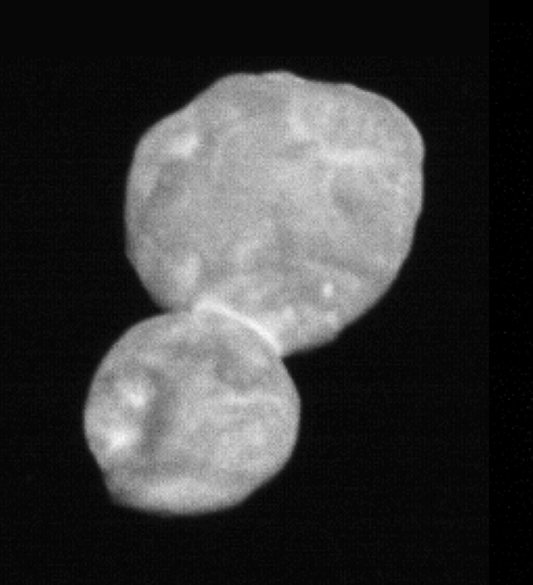
First Images of Ultima Thule!


https://solarsystem.nasa.gov/news/808/nasas-new-horizons-mission-reveals-entirely-new-kind-of-world/

Very unique object. Basically there is nothing like it in the inner solar system AFAIK.


2235_20190102-pr.png
 
Last edited:
It's a contact binary, and there are in fact similar objects in the inner solar system. For example, comet 67P. That counts as inner solar system, doesn't it?
A few comments on the link:
1. The article's title image looks like the object was formed by two smaller objects coming together so sort of like Ultima Thule, however the pieces that make it up seem to be much less spherical than the pieces that make up Ultima Thule. Possibly comet 67P would have looked more like Ultima Thule before it got close enough to the sun to heat up enough that part of it melted.

2. There is a very nice user controlled 3D image of comet 67P about midway down in the Wikipedia article. Very cool. Overall it shows clearly why it is believed that that comet 67P was created when two large pieces came together.
3. Also in the same article there's a short gif showing bits of the comet detaching from itself. Also pretty cool I thought.

How does the size of comet 67P compare with Ultima Thule?
Ultima Thule: 31 x 19 km
Comet 67P 4.3 x 4.1 km

Maybe the larger size of Ultima Thule caused the individual lobes to self assemble into more spherical like shapes than the pieces that make up comet 67P?

A general question about comets: Are they more similar chemically to each other than meteors are to each other? When Iomiller said that AFAHK the object was very unique and that there was nothing like it in the inner solar system was he wrong as far as the chemical make up of Ultima Thule? Is it similar to other comets except that the comets in the inner solar system have been affected by the heat of the sun?

I was surprised by the brown color of Ultima Thule. What's with that?

Defense of Iomiller's comment:
1. The pieces that make up Ultima Thule are more sphere like than the comets I have seen images of. Do all the comets that make it in to the inner solar system have ragged surfaces caused by solar heating?

2. It's brown. I don't remember seeing any comet images that were brown before.

 
Last edited:
Ultima Thule is not a comet, so I'm not sure what the confusion could be over the color. It isn't supposed to be anything like 67P, but the reference to comet 67P was only made due to the shape.
 
Last edited:
Ultima Thule is not a comet, so I'm not sure what the confusion could be over the color. It isn't supposed to be anything like 67P, but the reference to comet 67P was only made due to the shape.


So it's an asteroid? is the density more comet like or meteroid/asteroid like? I had this notion that KBO s were made up of a lot of water ice and were comet like because that's where at least some comets come from.
 
Last edited:
A few comments on the link:
1. The article's title image looks like the object was formed by two smaller objects coming together so sort of like Ultima Thule, however the pieces that make it up seem to be much less spherical than the pieces that make up Ultima Thule. Possibly comet 67P would have looked more like Ultima Thule before it got close enough to the sun to heat up enough that part of it melted.

2. There is a very nice user controlled 3D image of comet 67P about midway down in the Wikipedia article. Very cool. Overall it shows clearly why it is believed that that comet 67P was created when two large pieces came together.
3. Also in the same article there's a short gif showing bits of the comet detaching from itself. Also pretty cool I thought.

How does the size of comet 67P compare with Ultima Thule?
Ultima Thule: 31 x 19 km
Comet 67P 4.3 x 4.1 km

Maybe the larger size of Ultima Thule caused the individual lobes to self assemble into more spherical like shapes than the pieces that make up comet 67P?

A general question about comets: Are they more similar chemically to each other than meteors are to each other? When Iomiller said that AFAHK the object was very unique and that there was nothing like it in the inner solar system was he wrong as far as the chemical make up of Ultima Thule? Is it similar to other comets except that the comets in the inner solar system have been affected by the heat of the sun?

I was surprised by the brown color of Ultima Thule. What's with that?

Defense of Iomiller's comment:
1. The pieces that make up Ultima Thule are more sphere like than the comets I have seen images of. Do all the comets that make it in to the inner solar system have ragged surfaces caused by solar heating?

2. It's brown. I don't remember seeing any comet images that were brown before.

Yeah it’s the fact that it’s 2 very spherical objects that makes it interesting, not the fact that it’s made up of what were originally 2 separate objects. These two objects obviously came together at very low speeds.
 
A general question about comets: Are they more similar chemically to each other than meteors are to each other?

Meteors can certainly vary a lot. Not sure how much variability there is in comets. But comets aren't the only binary contact objects in the inner solar system, there are asteroid binary contacts as well.

When Iomiller said that AFAHK the object was very unique and that there was nothing like it in the inner solar system was he wrong as far as the chemical make up of Ultima Thule?

I don't think we have much info yet about Ultima Thule's composition.

I was surprised by the brown color of Ultima Thule. What's with that?

Probably tholin compounds.
 
Yeah it’s the fact that it’s 2 very spherical objects that makes it interesting, not the fact that it’s made up of what were originally 2 separate objects. These two objects obviously came together at very low speeds.

Are they actually connected, or just together?

If they are connected, how did they get that way? They must have come in at high enough speed for them to exchange materials in some way to get them to fuse?

If someone went over and gave the smaller lobe a push, would it move away (and then return under the force of gravity)? Or is it all solid?
 
So it's an asteroid? is the density more comet like or meteroid/asteroid like? I had this notion that KBO s were made up of a lot of water ice and were comet like because that's where at least some comets come from.

The team behind the project are hoping to get a measurement of mass and density in the next few weeks. They're examining the photos as they arrive to see if Ultima Thule has a moon or moons.
 
There are lots of asteroids that are contact binaries. It has been speculated that a fast spinning, loosely held body (for example as a result of a collision) could separate into two bodies that then end up as a binary. There are also lots of asteroids that are actual binaries, and it is probably formed by the same process.
 
The team behind the project are hoping to get a measurement of mass and density in the next few weeks. They're examining the photos as they arrive to see if Ultima Thule has a moon or moons.
Crawtator's comment that Ultima Thule wasn't a comet got me to look into this issue a bit:

Before actual facts passed my brain I thought most comets came from the Kuiper Belt and the objects in the Kuiper Belt were mostly comet like low density ice type objects that occasionally got sucked up into orbits that brought them into the inner solar system where they developed comet like features because of out gassing as their ices were melted by the sun.

Some of this seems to be true. Kuiper belt objects are believed to be composed largely of frozen volatiles (termed "ices"), such as methane, ammonia and water.

However there are some nuances. The Kuiper Belt is no longer believed to be the source of most of the comets that make their way into the inner solar system. The Kuiper belt is divided into two sections: 1. Objects that are too far out to be affected by Neptune's gravity and 2. Objects that are in resonant orbits with Neptune. Plutinos are object with a 2:3 resonant Neptune orbits and my favorite fact: objects with 1:2 resonances are called twotinos. My daughter introduced me to the term, portmanteau, and I know she would like that term.

Regardless, objects in both sections of the Kuiper belt have stable orbits that may have lasted since the beginning of the solar system. Comets come from something called the "scattered disk" and periodically some object floating around in it can get sucked into the inner solar system. I guess these things might be objects that were in the Kuiper belt but at some time in the distant past got sucked out of the Kuiper belt by Neptune.

There is also a terminology issue here. I was comfortable calling Kuiper belt objects comets because I thought they were chemically similar to comets that make their way into the inner solar system. But maybe I was wrong and cometness requires that an object as some point in time traversed the inner solar system? I didn't find an unequivocal answer to this issue.
 
So it's an asteroid? is the density more comet like or meteroid/asteroid like? I had this notion that KBO s were made up of a lot of water ice and were comet like because that's where at least some comets come from.
Technically no. It's a Kuiper Belt Object. The point is we have a lot to learn about the theoretical speculating about comets and KBOs. Might turn out to be like an asteroid but we don't know yet.
 
Last edited:
Are they actually connected, or just together?

If they are connected, how did they get that way? They must have come in at high enough speed for them to exchange materials in some way to get them to fuse?

If someone went over and gave the smaller lobe a push, would it move away (and then return under the force of gravity)? Or is it all solid?

And interesting question. Reminds me of this YT vid. Farting to the Moon.https://youtu.be/iaN0xg2VQSo
 

Back
Top Bottom