No, her point was that things are only objective if they have the same properties regardless of circumstances. That's clearly false.
That was not Earthborn's point. Please re-read that post; I think you will see your misunderstanding.
Knowing Shanek, he probably still doesn't understand it, so I'll clarify.
Something that is objective does not have to have all the same properties under all circumstances. It should however have all the properties it has been defined as.
For example, if we define 'water' as a molecular substance with two hydrogen atoms and one oxygen atom per molecule, then rain, watervapor and ice are all objectively water. If however it loses one of the properties from the definition, for example it is put under circumstances that split the molecule into hydrogen and oxygen, then it is no longer objectively 'water'.
The definition lists all the properties it
must to be the objective thing. All other properties it might have do not change it from being that thing, but if it loses properties from the definition then it is no longer that thing.
We can objectively define 'ice' as 'solid water', but if we put it under circumstances where it is no longer solid (a higher temperature) it is no longer objectively ice.
You cannot objectively define something by providing a list of properties it may or may not have and which other things also may or may not have. That makes it impossible to distinguish the thing from other things objectively.
In such a case it is better to define the thing intersubjectively: Music is what people consider music. Tonal music is music that is similar to music that people consider tonal.



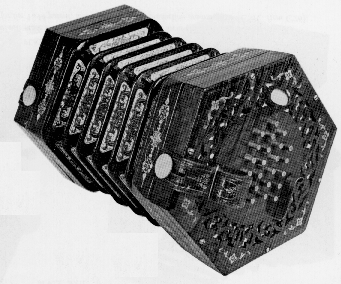


 ...) are the ones that musicians understand to be 'harps'.