• Quick note - the problem with Youtube videos not embedding on the forum appears to have been fixed, thanks to ZiprHead. If you do still see problems let me know.

Intelligent Design

I don't know what this is, but it frightens me.
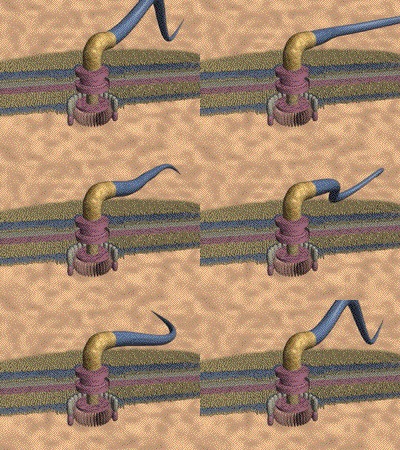
flag_dithani.gif
 
Dr. A, that is an irreducibly complex mechanism. Of course, first you have to decide which definition of irreducibly complex you're using:
  • An IC mechanism is one that, when you remove a component, no longer serves any purpose.
  • An IC mechanism is one that, when you remove a component, no longer serves its original purpose.
Pick your stupidity.

~~ Paul
 
Paul C. Anagnostopoulos said:
  • An IC mechanism is one that, when you remove a component, no longer serves its original purpose.
Pick your stupidity.

Why is this a stupidity? It may not serve its original purpose, it would merely serve some other purpose. But I don't see how this can be used as an argument against evolution - in fact, quite the opposite.

Or am I missing something?
 
This notion of life being "too complex" always irritates the hell out of me. My response to that is, "Complex compared to what?" How do we know that life is complex or simple? We've got nothing to compare it too. There is no benchmark, or rather we are the benchmark. Therefore, we are of perfectly average complexity until we can observe an alternate reality to give a frame of reference.

Even if we concede that life is indeed complex in the extreme, it can be easily argued that this only points to evolution being the likely cause, not creation. Because nature builds on what is already there rather than starting from scratch each time, the tendency is toward complexity, not simplicity. In the creatism model, life forms should be much simpler, more like masses of animated protoplasm with no internal organs or bones or anything at all--completely homogenous, rather like an animated stone golem. Life would indeed more more difficult to explain then.

The more complex something is, the easier it is to see how and why it works and to puzzle out how it got to be that way. So in the true manner of a good scientific theory, evolution predicts things we can look for to test its validity. One thing it predicts is that life forms will become more complex over time, not simpler. And when we make the observations, that is exactly what we find.
 
Psi Baba said:
This notion of life being "too complex" always irritates the hell out of me. My response to that is, "Complex compared to what?" And when we make the observations, that is exactly what we find.

You're not reading the creationist literature closely enough. "Too complex," in context, means "too complex to have arisen by natural processes," or "too complex to have been produced via a set of small, 'evolutionary' changes."

Even evolutionary biologists have no qualms with this concept as a good starting point for things that are impossible to evolve. For example, Richard Dawkins (one of the featured speakers at TAM, and himself a point man in the war on woo-woo spiritualism) has an extensive discussion of this point in Climbing Mount Improbable; there are a number of body forms that are impossible, not because the forms themselves won't work, but because there is no evolutionary path that can get to there from here. A macro-scale wheel may be one of those forms, because there's no way to get blood vessels, nerves, &c. through the hub of a freely rotating wheel without having them get all tangled up. A blindspot-free human eye may be a better example; although the eye design without a blind spot demonstrably works, H. sapiens is "trapped" in a local evolutionary maximum and will probably not be able to evolve away the blind spot.

The problem is not with the concept of complexity, but with the formulation they used. Old-school creationists would simply say that "life is too complex to have evolved" and leave it at that, largely without evidence or even a formalization of complexity. The ID proponents have produced the formalism of "irreducible complexity," where a system is irreducibly complex if removal of any component breaks it. (This is the old "what use is half an eye?" canard, wearing a cheap tuxedo.) And like the half-eye, the ID proponents are making the mistake of analyzing the current structure instead of the historical development. An arch is "irreducibly complex," but can be easily designed and built using scaffolding. After the building is complete, you no longer see the scaffolding, but that doesn't mean the arch didn't have it at some point.
 
aargh57 said:
What do IDers say seperates ID from traditional creationism other than a fancy name? Any idears?
One difference is that they dont claim a specific God or any God at all is the universal designer. Not publically anyway.Though what else could such a designer be? Assuming the pose of *objectivity*[compared to creationism anyway], it's less obvious they're pursuing an agenda. A creative new approach to religious propagandizing.

The ID movement has grown out of a creationist tradition which argues against evolutionary theory from a religious (usually Christian) standpoint. Although ID advocates often claim that they are only arguing for the existence of a "designer", who may or may not be God, all the leading advocates do believe that the designer is God, and frequently accompany their allegedly scientific arguments with discussion of religious issues, especially when addressing religious audiences. In front of other audiences, they downplay the religious aspects of their agenda.

Lawyer and creationist Phillip Johnson is usually credited with having founded the Intelligent Design movement, with the avowed intention of overthrowing "materialist science", and replacing it with "theistic science". This agenda is now being actively pursued by a well-funded body, the Center for Science and Culture (CSC), part of the Discovery Institute, a right-wing think tank funded by conservative Christians.

http://www.talkdesign.org/introfaq.html
 
new drkitten said:
the ID proponents are making the mistake

Oh, no, they don't.

They don't make a mistake. They know that they are wrong, they simply use false arguments. Knowingly.

Saying that they are merely making a mistake in itself lends a form of credibility to their claim. It's far worse than that: It's intentional deceit.
 
Dr Adequate said:
I don't know what this is, but it frightens me.

flag_dithani.gif
Eew....I've never seen a flagellum before. I agree with you Dr. Adequate, it's strangely disturbing. Maybe because it looks like something organic trapped in something mechanical.
 
CFLarsen said:
Oh, no, they don't.

They don't make a mistake. They know that they are wrong, they simply use false arguments. Knowingly.

Saying that they are merely making a mistake in itself lends a form of credibility to their claim. It's far worse than that: It's intentional deceit.
You're too harsh. They pass on the lies they've heard without bothering to find out whether they're true. It just doesn't occur to them. They are not insincere, but asincere. They don't know what intellectual honesty is.

If they were liars, they'd actually be better at it. I think we may have to face the fact that people are genuinely that ignorant, and that ignorant of their ignorance.
 
Dr Adequate said:
You're too harsh. They pass on the lies they've heard without bothering to find out whether they're true. It just doesn't occur to them. They are not insincere, but asincere. They don't know what intellectual honesty is.

If they were liars, they'd actually be better at it. I think we may have to face the fact that people are genuinely that ignorant, and that ignorant of their ignorance.

It's really, really hard to imagine that kind of ignorance.
 
Paul C. Anagnostopoulos said:
Dr. A, that is an irreducibly complex mechanism. Of course, first you have to decide which definition of irreducibly complex you're using:
  • An IC mechanism is one that, when you remove a component, no longer serves any purpose.
  • An IC mechanism is one that, when you remove a component, no longer serves its original purpose.
Pick your stupidity.

~~ Paul

I made the observation in another thread that IC, particulary where symbiotic relationships are concerned, seems to be an argument against intelligient design.

No backup? No redundancy ? What's intelligient about that?
 
CFLarsen said:
It's really, really hard to imagine that kind of ignorance.

As I'm fond of saying to creationists -- your inability to imagine something says more about your imagination than it does about the world. <evil grin>

I think there are definitely some creationists that are out-and-out knowingly deceitful frauds. But there are, as Dr. A pointed out, there are also a lot out there who are, at worst, willfully ignorant. Learning science is hard work, and a lot of people are willing to accept the strictures (e.g. their pastor telling them) placed upon them not to try.
 
Interesting that most fundies that try to explain the origin of the universe probably don't even know how many planets there are in the solar system.
 

Back
Top Bottom