• Quick note - the problem with Youtube videos not embedding on the forum appears to have been fixed, thanks to ZiprHead. If you do still see problems let me know.

Moderated Global Warming Discussion

Status
Not open for further replies.

Tricky

Briefly immortal
Joined
Nov 24, 2001
Messages
43,750
Location
The Group W Bench

Hello Members,

It has been noted that there have been a lot of threads created on the topic of global warming. A great number of these topics rapidly descend into bickering and other rule violations. Although one of the biggest threads was put on moderated status, it seems that many of the other threads have sprung up in order to avoid moderated status. That thread has now been closed.

Since many of the threads cover the same or similar ground, we've decided to keep only this thread for general Global Warming discussions, which will be moderated. Unless the topic is very different from the "general" discussion, new threads and posts about global warming will be moved to that thread if they satisfy the membership agreement.

Failure to confine general discussions to this moderated thread or starting other threads for general discussion will be treated as Rule 6 violations and subject to a series of escalating penalties just like any other membership violation.

We hope this will encourage civility in the discussion of global warming. We realize this topic inspires strong emotion, but please contain your emotion to those forms which are permissible under the Membership Agreement.

Thank you
JREF Moderation Team
Posted By: Tricky
 
Last edited:
I don't know if you guys have followed potholer54's channel on youtube, but his series of delightfully devastating and withering videos on climate science and creationism are something to behold. The latest in the series looks at the "scientists" that represent the denialist side in the climate "debate"

http://www.youtube.com/watch?v=qZzwRwFDXw0
 
Last edited by a moderator:
I'm aware of realclimate.org, have read a few articles and what not over the last few months.

The response was of course tongue and cheek, a commentary on the nonsense that you can't have a meaningful discussion without hot links. Hoepfully this new thread will promote just such discussions.

I don't see how, short of turning to nuclear entirely, how we can reduce CO2 levels without sequestering and GE. Not only that, but if you believe the current models to be accurate, we need to reduce the effects of CO2 now.
 
Has anyone looked into using rock such as peridotite to absorb CO2?

Sorry I can't post links but the article was at Miller-Mccune " A rock that helps out in a hard place"

The Earth's mantle is made of ultramafic rock and it protrudes through the crust in a few areas. I often wonder if it could be cost effectively pulverized with a powerful explosive and exposed to the atmosphere, captured CO2, or dumped in the ocean to absorb CO2? It is amazing that rock that absorbs CO2 is so abundant but we can't yet use it to help us.

Another article mentioned pumping it into deep formations but I wondered if the surface to the rock would convert some CO2 and then an equilibrium would be reached stopping further absorption. There were many other suggestions like fracturing the formations which I didn't think seemed economically viable.

As there are likely problems with altering huge surface areas where local populations may be affected I wonder if there are any areas where peridotite might be easily accessible on some underwater slopes where it could be blasted and pulverized underwater to absorb the CO2? There would be no need to move the rock and the cost would be the drilling of the hole for the explosives and the explosives themselves. This would seem to need to happen in the upper levels of the ocean that have absorbed the CO2.

There may be some simple reason this wouldn't work that I am unaware of but IMHO the more ideas we look at hopefully the sooner we may find a solution or combination of solutions.

?
 
CO2 solutions

AARGGHH It now occurs to me that huge blasts underwater would kill a lot of marine life and likely damage their senses for many miles.

Now I'm thinking of blasting in underground cavities in the peridotite and circulating the CO2 depleted water back into the ocean.

This whimsical idea might work by using directional drilling to drill two holes into a large cavity in a formation in peridotite. One hole would be for seawater to be pumped into the cavity, and the other hole would be an outlet hole back into the shallow ocean. The inlet hole would be deep enough to be in stable water but as shallow as possible for relatively easy access for a pump, or pipe, or whatever is needed to move seawater into the hole.. The outlet hole would need to be drilled in the upper part of the formation and on downslope where it enters the cavity in order to avoid the hole becoming plugged by blasted rock. A third hole would be drilled straight down from above to allow directional drilling of smaller holes for placing the explosives at the top of the cavity.

Pumping water through the formation would not need a lot of energy as the water is not being lifted. Rather than trying to fracture the formation using pressure injected from a rig on the surface instead just blast the rock with explosives and let it fall to the bottom of the cavity. The top drill pipe would have to be out of the hole during blasting and a lot of seawater would gush upward but the drilling gear up top could be moved away from the hole. The pump moving the water through the formation would have to be moved out of harms way as well.

So blast and shatter a lot of peridotite in the formation and let the rock settle. Use the pump to circulate seawater through the formation and back into the ocean now CO2 depleted. During the periods that the rock is absorbing the CO2 from the seawater and being pumped use directional drilling from above to make the holes for the next round of explosives.

Liquid CO2 could also be pumped into the cavity for a certain amount of dwell time for absorption and then pushed out by seawater.

I hope these random ideas stimulate some better thoughts on the potential possibilities. It's about cost effectively getting the peridotite and CO2 together.

All the best!
 
May 29th. It's snowing today. I'm in the northern hemisphere, just north of the 49th parallel.
 
Here's the link to the peridotite infomation

http://www.miller-mccune.com/science-environment/a-rock-that-helps-out-in-a-hard-place-10909/

"The problem Krevor and other researchers must surmount is that ultramafic rock sequesters CO2 very slowly — over tens of thousands of years. “This process is important on geological time scales in buffering the CO2 concentration of the atmosphere, but on a year-to-year time scale it doesn’t keep up,” he said. “So the question is: Is there a way to speed the process up so that it’s fast enough to counteract the emissions from industrial processes?”
In 2003, a group of researchers at the Albany Research Center, a laboratory in Oregon funded by the Department of Energy, attempted to answer that question. They focused on two traditional methods of accelerating chemical reactions in minerals — pulverizing them into tiny particles, and heating them to extreme temperatures. Both methods worked, but there was a problem: They required so much energy to enact that they produced more CO2 than they sequestered."

Again the ideas is rather than mining and moving all the rock, pulverize it underground using explosives and circulate seawater through it.

A simple schematic is here
http://picasaweb.google.com/wave77xx6543/Peridotite#5476772366239020194

?
 
The article rather glosses over the fact that to make this rock into an effective CO2 absorber, it needs to be processed. This means we are talking about mining and pulverizing (and possibly chemically treating) an entire mountain range worth of rock. Furthermore, we would then have to store the carbonated minerals somewhere where they would not exposed to even the mild acids prevalent throughout our environment (rain, groundwater, soils, etc.,.) as this triggers the release of the the CO2 from these minerals. So now we are not only talking about mining, processing, exposing, transporting and disposing of a monumental mass of material with no innate or profittable return on invested labor. Its not that such is impossible, merely that it is an expensive and difficult task with little individual benefit to motivate its accomplishment. If you can find a way to make a profit off of the process it might be a more viable option, as it stands, however, and lacking alturistic world governance, it would seem beyond the scope of any single national government, corporation or group movement.
 
University of Virginia petition courts to squash Cuccinelli's anti-science witch hunt. Read the full text:

PRELIMINARY STATEMENT

Academic freedom is essential to the mission of our Nation’s institutions of higher learning and a core First Amendment concern.1 As Thomas Jefferson intended, the University of Virginia (the “University”) has a long and proud tradition of embracing the “illimitable freedom of the human mind” by fully endorsing and supporting faculty research and scholarly pursuits.2 Our Nation also has a long and proud tradition of limited government framed by enumerated powers, which Jefferson ardently believed was necessary for a civil society to endure.

The Civil Investigative Demands3 (“CIDs”) issued to the University by the Office of the Attorney General of Virginia (the “Attorney General”) threaten these bedrock principles. The CIDs are deficient under the Virginia Fraud Against Taxpayers Act, Va. Code § 8.01-216.1 et seq. (“FATA”), and their sweeping scope is certain to send a chill through the Commonwealth’s colleges and universities. For these reasons, the Rector and Visitors of the University of Virginia, pursuant to Va. Code § 8.01-216.18, respectfully petition this Court for an order setting aside the CIDs.
 
a better approach methinks


This looks very interesting as an approach to sequester carbon at source....

Improved Carbon Sponges to Strip Carbon Dioxide from Power Plant Exhausts

ScienceDaily (May 29, 2010) — Jeffrey Long's lab will soon host a round-the-clock, robotically choreographed hunt for carbon-hungry materials.
This looks very interesting as an approach to sequester carbon at source....

Improved Carbon Sponges to Strip Carbon Dioxide from Power Plant Exhausts

ScienceDaily (May 29, 2010) — Jeffrey Long's lab will soon host a round-the-clock, robotically choreographed hunt for carbon-hungry materials.
img link
http://www.sciencedaily.com/images/2010/05/100527171020-large.jpg
More than a football field of surface area in the palm of your hand. Can scientists fashion metal-organic frameworks, seen in this illustration, into carbon-absorbing sponges? Will the material work in a power plant? Berkeley Lab scientists hope to find out soon. (Credit: Image courtesy of DOE/Lawrence Berkeley National Laboratory)

http://www.sciencedaily.com/releases/2010/05/100527171020.htm

More than a football field of surface area in the palm of your hand. Can scientists fashion metal-organic frameworks, seen in this illustration, into carbon-absorbing sponges? Will the material work in a power plant? Berkeley Lab scientists hope to find out soon. (Credit: Image courtesy of DOE/Lawrence Berkeley National Laboratory)

Wonder if this lattice has applications in hydrogen storage? :confused:

 
From my local area.

Late spring runoff could wash out Tahoe rafting revenues

By Jason Shueh and Kyle Magin
Union News Service and The Union Staff Writer

As wet storms continue to buffet the Sierra this week — including snow in the high country — some local water sports companies are salivating. Others, based at higher elevations, are concerned runoff from a heavy snowpack could wash out revenues this year.

“This is an extremely late runoff right now, and it looks like this may be latest water runoff peak in 40 years,” said Chad Planchard, chief deputy water master for the Truckee River Operating

Agreement organization in Reno. Snowpack levels across the Sierra are at their highest levels in more than five years.

<snip>

Because of the unseasonably cold temperatures and high snowfall totals, the water flow from the Truckee into Reno hasn't fallen below 500 cubic feet per second, the minimum water level operators require to open reservoirs like Tahoe to flow into the Truckee River, Planchard said.
 
I was recently in contact with Eugenia Kalnay, one of the scientists misrepresented on Poptech's (you all remember him, right) list of papers that he claims support "skepticism" of anthropogenic global warming. She was naturally outraged to find her work misrepresented like that, and even more so when she took my advice and googled "700 Peer-Reviewed Papers Supporting Skepticism of "Man-Made" Global Warming Alarm" which is the title of the list. She asked me if I had any suggestions on what to do about this sort of thing. Naturally, I couldn't say, as I just didn't know, but I told her that my personal belief is that the IPCC and climate scientists in general are going to have to become increasingly aware that their work is being misrepresented by "skeptics", and that internet blogs are a major source of public understanding of science.

I'd like to ask people here for suggestions on what climate scientists can do to make sure their message reaches the public so that policy decisions are made on good science and not tarnished by denialist misrepresentation thereof.
 
May 29th. It's snowing today. I'm in the northern hemisphere, just north of the 49th parallel.

From my local area.
(stuff snipped)
Agreement organization in Reno. Snowpack levels across the Sierra are at their highest levels in more than five years.

<snip>

Because of the unseasonably cold temperatures and high snowfall totals, the water flow from the Truckee into Reno hasn't fallen below 500 cubic feet per second, the minimum water level operators require to open reservoirs like Tahoe to flow into the Truckee River, Planchard said.

Winnipeg is at 780 feet above sea level. Calgary is 3430 feet above sea level. Yet when I drive from Winnipeg to Calgary, every once in a while I actually drive down a hill!

DSo and brantc, how on Earth can this happen? How is it possible for me to drive down a hill even once when Calgary is 2,650 higher in altitude than Winnipeg? Shouldn't I be driving uphill all the way?
 
I'd like to ask people here for suggestions on what climate scientists can do to make sure their message reaches the public so that policy decisions are made on good science and not tarnished by denialist misrepresentation thereof.

That's the perennial question, isn't it? Joe Romm has a post over at CP on this very subject regarding a Newsweek piece. I certainly don't have an answer, except to say that we should stop beating around the bush and fight fire with fire, we need to stop using such measured and calculated language that befits a scientist and start seizing the issue by the throat. I know that scientists risk their scientific reputations by abusing the facts to create an on-point message, but really we need to adopt the same tactics used by the deniers if we're to have a hope of winning the PR war. We understand science better than they do, but they understand PR better than we do. We need to get ruthless imo.
 
Winnipeg is at 780 feet above sea level. Calgary is 3430 feet above sea level. Yet when I drive from Winnipeg to Calgary, every once in a while I actually drive down a hill!

DSo and brantc, how on Earth can this happen? How is it possible for me to drive down a hill even once when Calgary is 2,650 higher in altitude than Winnipeg? Shouldn't I be driving uphill all the way?

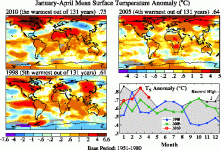
And then there is this;

http://data.giss.nasa.gov/gistemp/graphs/2010vs2005+1998.gif
 

Attachments

  • 2010vs2005+1998.gif
    2010vs2005+1998.gif
    21.4 KB · Views: 25
I was recently in contact with Eugenia Kalnay, one of the scientists misrepresented on Poptech's (you all remember him, right) list of papers that he claims support "skepticism" of anthropogenic global warming. She was naturally outraged to find her work misrepresented like that, and even more so when she took my advice and googled "700 Peer-Reviewed Papers Supporting Skepticism of "Man-Made" Global Warming Alarm" which is the title of the list. She asked me if I had any suggestions on what to do about this sort of thing. Naturally, I couldn't say, as I just didn't know, but I told her that my personal belief is that the IPCC and climate scientists in general are going to have to become increasingly aware that their work is being misrepresented by "skeptics", and that internet blogs are a major source of public understanding of science.

I'd like to ask people here for suggestions on what climate scientists can do to make sure their message reaches the public so that policy decisions are made on good science and not tarnished by denialist misrepresentation thereof.

The only consistent advice I have offered is for these researchers to devote a few hours a week toward exploring and commenting on the science blogs. This doesn't have to be a point-by-point debate battle on the political and psuedoscience blogs, it can just be a few posts discussing and clarifying past and current work, and even just general understandings of the science from their particular field of expertise on a couple of the relevent mainstream science blogs. Good information can be as viral as bad information, there is just a lot more bad information being kicked out there. Starting out at places like RealClimate, SkepticalScience, etc., building up a collection of 3-4 main participatory sites and then participating on them with at least a few posts/responses every week.
 
Status
Not open for further replies.

Back
Top Bottom