Moderated Global Warming Discussion

Status
Not open for further replies.
He is just pissed off for some reason that he cannot get access to the data without actually contacting the people who collected it!.

And whom he slandered without naming, I suppose.

That is the same old with all the neurotics in the world: they can't say "please" or "thank you" but in a stereotyped manner, and they never say "I'm sorry", as they'd melt like the Wicked Witch of the West (www) if they do so. They are crowd in fora, the most common type being those who get what they need by, I call that "symbolic rape", that is, they start a fuzz and make you argue what they need, so you are saying it "spontaneously" and they're doing you a favour.

Many here, even a few posts ago, are getting free consultation about basic physics -full meaning of basics- using that technique.
 
The sun supplies all the energy, but if the sun is not changing it's energy output to any significant degree, and the solar cycles have been weak, then it's not going to be the reason for any rise in temperature.

The scientists have also investigated the 'fingerprints' of AGW. They are there, they give the warming we are experiencing a different 'fingerprint' to warming due to solar 'forcing'.

One of the simplest 'fingerprints' is cooling in the stratosphere. If the warming was due to solar forcing, then the stratosphere would be warming. Instead, it has cooled, this is a Tyndall 'fingerprint'.

No one has ever said that CO2 can force warming by itself, without the solar radiation supplying the earth with heat in the first place. It is trivially true.
 
to some degree, and if it's not overwhelmed by variations in the solar flux.
Then maybe we can all agree with some basic science :eek: !
The warming not dominated by variations in the solar flux
Solar activity & climate: is the sun causing global warming?
In the last 35 years of global warming, the sun has shown a slight cooling trend. Sun and climate have been going in opposite directions. In the past century, the Sun can explain some of the increase in global temperatures, but a relatively small amount.

Thus it is is dominated by something else and this is our emissions of CO2 (unless you are going to regurgitate the climate myths we see from deniers)
The human fingerprint in global warming
Fundamental physics and global climate models both make testable predictions as to how the global climate should change in response to anthropogenic warming. Almost universally, empirical observations confirm that these 'fingerprints' of anthropogenic global warming are present.
 
to some degree, and if it's not overwhelmed by variations in the solar flux.

The Sun is remarkably stable, variation in solar output are small compared to the changes greenhouse gases make. Current forcing from CO2 is ~2W/m^2. Once you factor in albedo and the fact only one side of the earth revives sunlight it takes a change of about 11 - 12 W/m^2 to match that, which is about 5X - 10X greater than variations in solar output.
 
The Sun is remarkably stable, variation in solar output are small compared to the changes greenhouse gases make.
Trouble with that is, we have many examples of long spans of geological time when the Earth was considerably warmer or colder than today, before humans had any impact. If someone has cites to proxy measures of solar variability, I'd be interested. There's a decent "public goods" argument to make for tax subsidization of the study of sunlike stars and the search for Earth-crossing asteroides. It would be nice to get advanced warning.
 
Trouble with that is, we have many examples of long spans of geological ....
The trouble with this is it is just another climate myth: What does past climate change tell us about global warming?
Natural climate change in the past proves that climate is sensitive to an energy imbalance. If the planet accumulates heat, global temperatures will go up. Currently, CO2 is imposing an energy imbalance due to the enhanced greenhouse effect. Past climate change actually provides evidence for our climate's sensitivity to CO2.

The science about modern climate (in the last century not in the distant past) is simple enough for anyone to understand: Solar activity & climate: is the sun causing global warming?

As for the Maunder Minimum climate myth you are parotting: Are we heading into a new Ice Age?
The warming effect from more CO2 greatly outstrips the influence from changes in the Earth's orbit or solar activity, even if solar levels were to drop to Maunder Minimum levels.
 
Trouble with that is, we have many examples of long spans of geological time when the Earth was considerably warmer or colder than today,

Which are for the most part reasonably well understood based on greenhouse gases and some other factors like the position of the continents. (The Sun is very slowly warming up over geological time so "warm periods in the distant past are unlikely to have been related to solar output)
 
We agree, so far. Careful that your friends don't start calling you names and impugning your intelligence and/or education. Of course, we've agreed to discount geothermal heat. Given that, what happens if we wrap a thermometer, with no internal heat source, in insulation?

Nothing much, obviously.

But in both of our cases, we do have an "internal source", in the sense that there's an energy flow going outwards and varying amounts of insulation preventing that flow.

In the analogy's case, the source of outgoing flow is your body, the jacket is the insulation. In earth's case, the source of outgoing flow is the heat created by sunlight when it hits the ground, and the atmosphere is the insulation.

If we want to add geothermal heat to the calculation, we can add a little to the outgoing flow, but as far as i know, the amount is rather insignificant. One point of this analogy was explaining the equilibrium, which we now seem to agree on. Progress!!

We agree, again.

Excellent - so, maybe we can set this part of the discussion to rest: we all now agree that even the most vocal "critic" scientists agree with the fundamental science behind global warming.

to some degree, and if it's not overwhelmed by variations in the solar flux.

Excellent, progress again. You're of course correct that human activity is not the only force that affects the temperature. I changed the wording accordingly.

The warming influence of human activity can indeed be obscured by many natural forces, such as variations in the solar flux, the heat circulation between the oceans and the atmosphere and so on.

- You agree that the atmosphere traps heat.
- You agree that there is a greenhouse effect as described by mainstream science and that changes in the strength of the greenhouse effect can change the temperature on earth.
- You agree that there's an energy balance that will always seek a new equilibrium, when variables change.
- You agree that a change in the composition of gasses (like increasing CO2) in the atmosphere changes the strength of the greenhouse effect.
- You agree that a rising concentration of CO2 in the atmosphere will cause global warming.
- You agree that human activity is the main cause for the increase in atmospheric CO2.
- You agree that human activity causes a global warming influence.

In fact, your comment brings us to the next baby step. We both seem to agree that both "natural" and "man made" forces affect the temperature.

Next baby step: Do you agree that the man made warming influence can be obscured by other forces, sometimes even causing the global temperature to decline temporarily?

 
Last edited:
The warming influence of human activity can indeed be obscured by many natural forces, such as variations in the solar flux, the heat circulation between the oceans and the atmosphere and so on.

I will elaborate this point a little. One well known variable is the El Niño/Southern Oscillation, also known as ENSO. As the name suggests, it's an oscillation: it has no long term trend. I will use this as an example.

ensoindex.gif

http://cses.washington.edu/cig/pnwc/aboutenso.shtml

We can introduce an artificial rising trend by skewing the graph in photoshop:
ensoindex_trend.gif


As you can see, even with the steep rise, there are periods where the values remain somewhat the same for years, or even decline. Even though there is a clear trend, the natural variation of the values can obscure it for years in row - for example, see 1998 - 2010: if we examine only this period, we could easily make a false assumption that the trend is going downwards, not up, or at least that the up going trend has stopped.

This rings a bell - the graph looks oddly familiar, doesn't it? Yes, ENSO with an artificially introduced trend looks pretty similar to the global temperature graph:

ensoindex_temperature.gif

http://woodfortrees.org/plot/hadcrut3vgl/from:1950/mean:12/to:2010

And this gut feeling is of course correct - there's a pretty good correlation between the mangled ENSO graph and the actual global temperature record:

ensoindex_combined.gif


Whenever you hear someone say "there's no statistically significant warming in the last XXX years", remember this image.
 
Last edited:
Warmer Temperatures Make New USDA Plant Zone Map Obsolete
http://www.sciencedaily.com/


A similar zoning exercise for temperature-sensitive pests would be interesting to see.

Well the problem here is that the winter minimum is not expected to change much, the models are indecisive. There are many species that will over winter here as tender annuals, then a cold winter with a month of zero temps hits and they frost out.
 
I will elaborate this point a little. One well known variable is the El Niño/Southern Oscillation, also known as ENSO. As the name suggests, it's an oscillation: it has no long term trend. I will use this as an example.

<snipped by Mikemcc purely to save space>
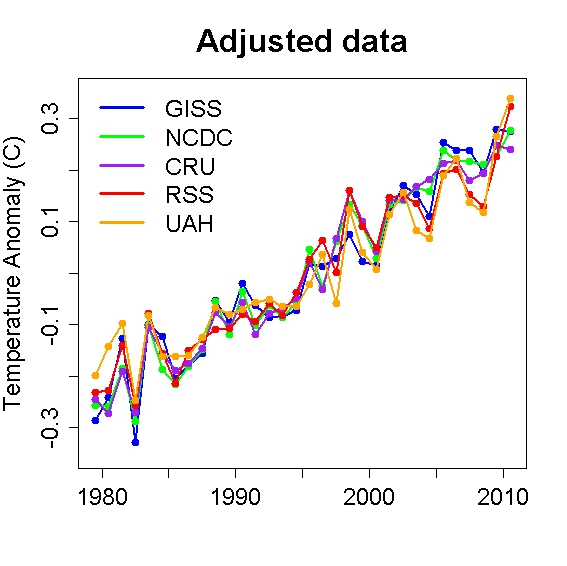
This is the basis of the Foster and Rahmstorf paper in 2011. They adjusted the data on the five main series of temperature data for ENSO, aerosols and TSI and arrived at this:

figure05.jpg

http://iopscience.iop.org/1748-9326/6/4/044022/pdf/1748-9326_6_4_044022.pdf

Tamino should know about all of the ins-and-outs of the paper, he's one of the authors!
 
...The Sun is very slowly warming up over geological time so "warm periods in the distant past are unlikely to have been related to solar output..
Trouble is, humans have only had the faintest what stars are and how they work in the last 100 years. We have direct observations of solar variation (sunspot counts) from the last few hundred years. Like climate cycles generally, the confidence limits around estimates of significant departure from the mean level depend on the amount (and quality) of information.
 
The trouble with this is it is just another climate myth: What does past climate change tell us about global warming?...The science about modern climate (in the last century not in the distant past) is simple enough for anyone to understand:... Solar activity & climate: is the sun causing global warming?
...As for the Maunder Minimum climate myth you are parotting: Are we heading into a new Ice Age?
Lot's of Skeptical Science here. If the "science is simple enough for anyone to understand"...Dyson, Giaever, Lindzen, etc. again. Here's another quote from one of your cites:
Simulations of the climate response if the sun did fall to Maunder Minimum levels find that the decrease in temperature from the sun is minimal compared to the warming from man-made greenhouse gases (Feulner 2010).
Simulations. Recall Dyson's criticism of climate models. Here, Skeptical Science takes one instance of solar variability and compares its effect to their calculated CO2 effect. The strength of the CO2 effect is the central point of contention in the argument between skeptics and believers.
 
Trouble is, humans have only had the faintest what stars are and how they work in the last 100 years. We have direct observations of solar variation (sunspot counts) from the last few hundred years.

Sunspot cycles are tiny compared to CO2 forcing. There is also a record going back ~1 million years that show correlation with the earths orbit, meaning there is no significant solar changes in that period.
 
Recall Dyson's criticism of climate models.

Recall, also, that he's not qualified to make those conclusions. We went over this multiple times with you.

The strength of the CO2 effect is the central point of contention in the argument between skeptics and believers.

The peer reviewed doesn't support a weak effect from CO2. In fact there are multiple lines of peer reviewed that show anything other than a strong effect is not plausible.
 
Status
Not open for further replies.

Back
Top Bottom