
You are using an out of date browser. It may not display this or other websites correctly.
You should upgrade or use an alternative browser.
You should upgrade or use an alternative browser.
I have a HP41CV, but it doesn't work. When it broke, I called HP to get it fixed and they said it would cost more to fix it than to buy one of their new models. I should have gotten it fixed anyway. RPN rules!roger said:HP41C - it's the calculator I am still using everyday, and I bought it back when it first came out. It's been dropped down a stairwell, and otherwise suffered abuse, and it is still working perfectly.

Zep said:"geek" came long before that stage, I'm afraid. You needed to have programmed one of these, in DOS BASIC only, to qualify:
Yay! Did that. My first ever paid programming job. Also wrote my own assembler in Basic to allow me to create code to access the expanded memory board. You had to map chunks of it in to the "regular" memory space. It was kind-of like having a very fast disk, but with no OS, so you had to handle it on the sector level yourself...
I also worked on a daily basis with PDP-11s with magnetic core memory, in my second paid programming job.
--Terry
Now, see? If you had learned BASIC from Davie Lien's User's Manual for Level I that came with the TRS-80, you would have known to space your line numbers out and wouldn't've had to rewrite anything!Cecil said:Does an Apple ][e count?
I remember the first Tic-Tac-Toe game I wrote in BASIC. I had to retype half the code partway through because I didn't space the line numbers out at the beginning.
Plus, you would've gotten to use a TRS-80 Model I, whose screen could display a mindboggling 128x48 graphics pixels.
Oh, we have many more of these gems in our collection. For example, if you have ever awk'd, grep'd and yacc'd, here's where it all started.

Rolfe
Adult human female

I'm with Zep here. I was taught to use one at school. Invaluable practice, both in keeping track of what you were doing (right order of magnitude), and not reporting silly numbers of "significant" figures.
But you can't add up columns of piglets born to a shed full of sows on one. When I was a student, the one girl in our animal husbandry class who had a calculator was the envy of us all (her father was a professor in the medical school).
Then two years later I started an advanced biochemistry course. I'd been doing medicine for three years and forgotten how to do logarithms - so they stuck me in remedial maths till I remembered. But at the same time I realised I really did need a calculator, and that I could actually afford one (I was a qualified vet by this time and had actually earned some real money.) I was in love. I wore out its first battery the first evening.
My lab partner, though, had paid twice as much a year previously for something which worked on "reverse Polish logic" (is that a real term?) and she kept getting the wrong answers. As they always made us BOTH repeat the sums when we didn't agree, I was less than enchanted (my new toy had a floating decimal point).
I managed to get through my PhD mostly with a scientific calculator, and as little use as I could get away with of a tape-drive computer which honestly wasn't much more than a programmable calculator. Ever worked out an RIA curve fit to a sigmoid curve on paper?
When I got a credit-card-sized calculator free with a packet of Betamax videotapes, I knew the future had arrived! But lookee here. Squillion mega-something Pentium 4, smaller than the desk calculator in my 1976 biochemistry class - and I still count on my fingers.
Rolfe (in nostalgia mode).
But you can't add up columns of piglets born to a shed full of sows on one. When I was a student, the one girl in our animal husbandry class who had a calculator was the envy of us all (her father was a professor in the medical school).
Then two years later I started an advanced biochemistry course. I'd been doing medicine for three years and forgotten how to do logarithms - so they stuck me in remedial maths till I remembered. But at the same time I realised I really did need a calculator, and that I could actually afford one (I was a qualified vet by this time and had actually earned some real money.) I was in love. I wore out its first battery the first evening.
My lab partner, though, had paid twice as much a year previously for something which worked on "reverse Polish logic" (is that a real term?) and she kept getting the wrong answers. As they always made us BOTH repeat the sums when we didn't agree, I was less than enchanted (my new toy had a floating decimal point).
I managed to get through my PhD mostly with a scientific calculator, and as little use as I could get away with of a tape-drive computer which honestly wasn't much more than a programmable calculator. Ever worked out an RIA curve fit to a sigmoid curve on paper?
When I got a credit-card-sized calculator free with a packet of Betamax videotapes, I knew the future had arrived! But lookee here. Squillion mega-something Pentium 4, smaller than the desk calculator in my 1976 biochemistry class - and I still count on my fingers.
Rolfe (in nostalgia mode).
arcticpenguin
Philosopher
- Joined
- Sep 18, 2002
- Messages
- 5,687
I have an 8" (20 cm) floppy disk on the shelf above my monitor.
I love this story.
reverse Polish notationOriginally posted by Rolfe
My lab partner, though, had paid twice as much a year previously for something which worked on "reverse Polish logic" (is that a real term?) and she kept getting the wrong answers.
Rolfe
Adult human female
herbaliser
New Blood
- Joined
- Oct 9, 2003
- Messages
- 22
69dodge said:I love this story.
Programmers can be artists when they do it on their own time. When a company is paying you to program, you program. Mel's sense of ethics is a little ridiculous.
Jim_MDP
Philosopher

herbaliser said:
Programmers can be artists when they do it on their own time. When a company is paying you to program, you program. Mel's sense of ethics is a little ridiculous.
And you have no soul.*

Thanks Dodge.
--
*when it comes to coding in Hex.
We've got boxes of these, many still sealed in their plastic. How many more do you need?arcticpenguin said:I have an 8" (20 cm) floppy disk on the shelf above my monitor.
PS. For those who wrangled the VAX 780 series, you will recall that it was 8in floppies that were put in the RX drives of the LSI-11, inside the left-hand door.

Paul C. Anagnostopoulos
Nap, interrupted.

- Joined
- Aug 3, 2001
- Messages
- 19,141
Rolfe said:
Zep, hasn't everyone use a TTY? What? Some people are younger than I am?!
~~ Paul
Are you talking about HP calculators? Doesn't everyone use them? Mine recently died and I replaced it with a TI just for a change of pace. It's the most annoying thing on the planet.My lab partner, though, had paid twice as much a year previously for something which worked on "reverse Polish logic" (is that a real term?) and she kept getting the wrong answers.
Zep, hasn't everyone use a TTY? What? Some people are younger than I am?!
~~ Paul
teddygrahams
Critical Thinker
- Joined
- Nov 25, 2001
- Messages
- 276
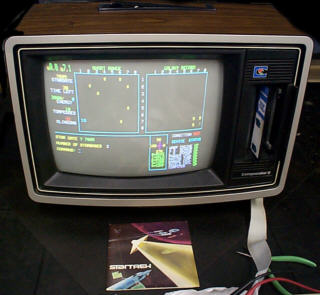
This was ahead of its time in 1979... color and floppy built in. But I used a TTY modem in school 3 years later.... the last year for that.
Is that a teletype machine? I remember writing code on those for a week once. The most annoying thing in the world is to get on a chat with someone on one. Then hold down your CTRL-G key. I think that was the "bell" key which would make their teletype bell ring, and it was an actual metal bell. Holding it down basically locked up their teletype as the bell rang. Childish, you betcha.Zep said:Mel would probably have used one of these, yes?
I don't use any HP calculators (or any other RPN devices). I find them to be the most annoying things on the planet.Paul C. Anagnostopoulos: ... HP calculators? Doesn't everyone use them? Mine recently died and I replaced it with a TI just for a change of pace. It's the most annoying thing on the planet.