• Quick note - the problem with Youtube videos not embedding on the forum appears to have been fixed, thanks to ZiprHead. If you do still see problems let me know.

Fossil 'disproves' evolution...?

However, it was after that that you then seemed to be saying that Farah was referring to subtle or genetic changes.
No. Farah's talking about "macro-evolution"... he even so much as uses the word. The octopus not having changed for 95MY supposedly is a problem for the theory of evolution. But the very fact that Farah even uses the term "macro-evolution" implies that he may not have issue with micro-evolution. Adding to his obvious equating of macro-evolution to the theory of evolution (standard fundie lore), and his explicit listing of traits that Fuchs identified that are the same, and it would appear that Farah wouldn't be impressed or shocked in the slightest if someone pointed out minor differences in the octopi Fuchs identified, and as such, it's a straw-man to imply that even Farah himself is talking about the fossils as being identical to modern octopi.

In fact, every time Farah compares them, he uses words like "looks just like", "how similar the specimens are", etc. And Farah mentions how they are similar... I quoted that as well, and won't quote it again.

Of course Farah's wrong. But he's not saying the octopi are identical.
 
No. Farah's talking about "macro-evolution"... he even so much as uses the word. The octopus not having changed for 95MY supposedly is a problem for the theory of evolution. But the very fact that Farah even uses the term "macro-evolution" implies that he may not have issue with micro-evolution. Adding to his obvious equating of macro-evolution to the theory of evolution (standard fundie lore), and his explicit listing of traits that Fuchs identified that are the same, and it would appear that Farah wouldn't be impressed or shocked in the slightest if someone pointed out minor differences in the octopi Fuchs identified, and as such, it's a straw-man to imply that even Farah himself is talking about the fossils as being identical to modern octopi.

In fact, every time Farah compares them, he uses words like "looks just like", "how similar the specimens are", etc. And Farah mentions how they are similar... I quoted that as well, and won't quote it again.

Of course Farah's wrong. But he's not saying the octopi are identical.

Farah is attempting to lead the reader. He parrots Fuchs because he must- but his attempt is in leading the believer to believe that the octopi are the same.
It almost sounds as though you are excusing him or making excuses for him.

I was prompted to say this:
Not quite.
Farah was very misleading in his article. Not only did he get much of his science downright wrong, he stuck to vague descriptions.
When you said this:
This is all a bunch of semantics. The octopus hasn't changed in its overall morphology in 95MY, which is the type of change talked about by Fuchs, and then Farah, and not you.
 
I was prompted to say this:

When you said this:
This is all a bunch of semantics. The octopus hasn't changed in its overall morphology in 95MY, which is the type of change talked about by Fuchs, and then Farah, and not you.
Okay. Is it cleared up for you yet? That was post 87. 87 was a reply to a question in 86 directed at the poster in 84. The similarities are specifically in terms of the morphological traits identified by Fuchs in terms of traits more similar to modern octopi than more primitive forms in the species he identified. Those similarities Farah recognized as similar and, as a standard crack fundie, thought had anything to do with the theory of evolution--though I still must point out that those similarities are actually similarities to modern octopi. frankvan said something in terms of this particular kind of lack of change. And you're arguing with me over what I am talking about.

Did I make my point that this is all semantics yet?

Edit: FYI, just pointing out that this is starting to bore me. Don't take it personally if I just bow out.

ETA: Another hint. You may have identified an improper antecedent to the pronoun "this" in my claim that this is all semantics.
 
Last edited:
Are you seriously trying to suggest that most species went extinct because of unsuccesful/harmful genome changes (which BTW, only occur in INDIVIDUALS and not entire species)?

Did the carrier pigeon go extinct because of unsiccesful genome changes, or because people simply started blowiing them out of the air with guns? Are guns now a "harmful mutation?

Ditto with the Dodo. Oh, and the Kakapo isn't almost extinct because of feral cats, it's because of genetic change? (Is a feral cat a harmful mutation?)

What about Dinosaurs? Genome change or a cataclysmic event? There alone is quite a few species that did not die due to a harmful mutation.

Norm

Never suggested that at all but it is all in perspective. Aren't the animals best suited for the new conditions after the impact that caused the extinction of the dinosaurs the ones that survived? Weren't their successful mutations gotten before the conditions existed?

You seem to think that I am blaming something here. There is no blame, this is simply a matter of a species being unable to cope with new environmental conditions whether that be climate change, introduction of foreign species, or an asteroid impact. The ones that survive have the mutations required for survival prior to the event, the ones that don't become extinct.
 
Edit: FYI, just pointing out that this is starting to bore me. Don't take it personally if I just bow out.
It had already bored me...

I pointed out that Farah was not really claiming the same thing as Fuchs. Farah parroted Fuchs and then added his own fundamentalist creation agenda.

I was merely pointing that out at the time- I had not expected you to defend it.
 
From Fark.com:
'WND claims that 95 million year old octopus fossil disproves evolution because "It looks just like a modern-day octopus".
Fossil don't show everything, like internal organs for one, there can be lots of changes that don't show up in fossils.

Paul

:) :) :)
 
Shadron, this is the statement that truethat objected to.

"The fact that the octopus hasn't changed for millions merely means that the design doesn't need changing. The octopus is superbly equiped for survival in a variety of undersea environments and apparently has been for tens of millions of years."

Note it does not say changed a bit, changed a lot. It simply says "not changed", implying that the 95 million year old Octupus is exactly the same as today's Octopus. In fact truethat agreed on the previous page of this thread, that the word "much, i.e. "not changed much" would be a satisfactory response to what was being objecting to. Did you read that bit?

Just a semantic argument? Maybe, but people jumped all over it without thinking, simply because they felt like a fight, and it turned out that they wanted to fight thin air over one word - "much".

Now note your most recent response:

The OP is about whether evolution occurred or not - the referenced article makes the claim that since the fossil is nearly identical to today's octopus, then evolution is a crock. Fine.

You are still making the same mistake. Note your qualifier. "nearly". Take that qualifier out, and that is what truethat was objecting to about the quote I cited above. That was the only objection made. Nothing else

Ma'am, you are half of this conversation. If you cannot follow it, then ... what? I'm not here o disparage your conduct but there has to be a reason you aren't understanding it. I do use proper American English, I believe.

*sigh* OK, let's start over. Prove that it was erroneous. Why cannot a biological family create member species that don't evolve very much in an almost unchanging environmental niche in which said family is comfortable?

Note your qualifiers. Take them out, re-read what you wrote, and that is what truehat was objecting to in the original passage I cited above. It was completely unqualified. There were no maybes, no very muches, no almosts. Again, that is what truethat was objecting to - an unqualified "the octopus has not changed in 95 million years?", when a qualified "the octopus has not changed much in 95 million years?" would have been enough.

People seemed to just jump on the "I smell a creationist (apparently not true BTW), let's attack, and once the feeding frenzy started they stopped reading the posts completely and imagined all sorts of meanings that were simply not in the posts. Not very good critical thinking.

Norm

 
Last edited:
People seemed to just jump on the "I smell a creationist (apparently not true BTW), let's attack, and once the feeding frenzy started they stopped reading the posts completely and imagined all sorts of meanings that were simply not in the posts. Not very good critical thinking.

Norm

Quite and thanks for an excellent demonstration of it(critical thinking):)
 
Never suggested that at all but it is all in perspective. Aren't the animals best suited for the new conditions after the impact that caused the extinction of the dinosaurs the ones that survived? Weren't their successful mutations gotten before the conditions existed?

Well, yes, animals alive after each catastophic event is, sort of, by definition, alive, and would carry their entire DNA (mutations and all) with them. But as your original argument was that most mutations result in death, this would appear to not support that argument.

You seem to think that I am blaming something here. There is no blame, this is simply a matter of a species being unable to cope with new environmental conditions whether that be climate change, introduction of foreign species, or an asteroid impact. The ones that survive have the mutations required for survival prior to the event, the ones that don't become extinct.

So you are withdrawing your statment that "Most mutations result in the death of an individual before they can pass those mutations on", because in this case you are arguing that the mutations in these animals were what kept them alive.

Norm
 
Last edited:
There's no law I know of that says an animal can't be "perfectly suited" to more than one environment. Why shouldn't octopi remain unaffected by whatever changes take place in 82 million years on the ocean floor?

Even though the overall form my remain mostly unchanged for a long time, evolution never pauses. Selection is always at work. Also, variation accumulates in the genome (from the sort of point mutation "clock" and genetic drift and so on).
 
If I understand Farah's argument correctly: he does not believe that the Earth is more than a few thousand years old. Scientists have arbitrarily labeled geological strata of being of a certain age- so it's inexplicable that a fossilized octopus, that looks like a modern octopus, could be 95 million years old. Therefore, evolution didn't happen. QED.

Of course, if Farah had a few more brains, he could be a half-wit. I would like to see a source, anywhere, that scientists are "baffled" by the fossil as Farah claims in his article.
 
And the quote he uses even states that the octopus fossil is different to modern day octopi i.e.:

.... yet one of the fossils is almost indistinguishable from living species....
If my post led anyone to believe that I'm not a staunch Darwinian evolutionist I apologise. I believe that all creatures develope by mutation and or random selection and this is true of all living things including this octopus. I do believe that since this octopus is several million years old and looks like a present day octopus speaks volumns for the design of said creature. I'm sure there have been changes in the octopus over the period of millions of years its just not apparent looking at the fossil.
 
If my post led anyone to believe that I'm not a staunch Darwinian evolutionist I apologise. I believe that all creatures develope by mutation and or random selection and this is true of all living things including this octopus. I do believe that since this octopus is several million years old and looks like a present day octopus speaks volumns for the design of said creature. I'm sure there have been changes in the octopus over the period of millions of years its just not apparent looking at the fossil.

No sweat, I just think it is important to be careful what is let slip by that would bolster the argument of ID by mistakes on the science end.

I was trying to point out that as a person without a science background the answer you posted made no sense to me at all to the point of being nonsensical.

I mean it took how long for the Grand Canyon to form? Supposedly 6 million years and yet you seemed to be suggesting that the environment of the octopus from 92 million years ago, never changed. That the animal had not evolved for 92 million years and the reason was it was "perfectly suited to the environment." Next question!

I often see these kind of "easy dismissive answers" bantered about on message boards and it to me, bolsters the arguments of the ID side of it because they are clearly wrong but rarely seem to be corrected by the science people on the threads.
 
Now don't jump all over me because I'm not an IDer and I do accept the theory of evolution. However I have to say this kind of scenerio, and it isn't the first time, has always confused me. I don't understand why an animal would not evolve at all for 82 million years. Even the shark changed in size. I mean "perfectly suited to the environment" would mean that the enviroment never changed in that time as well. It seems a little too slick of an answer.

Maybe explain it a bit more? For those of us who aren't afraid to admit they are dummies when it comes to evolution!

...a good point. I agree. Like you, I am not familiar with the controversy that is probably going on in science over that very issue, but you know, it is not a matter of whether life evolved or was created because creation is impossible so evolution itself is really not scientifically controversial. The whole question is understanding it and we will never have ALL the answers because we can never understand everything or even anything perfectly.

The whole issue is that we are always understanding it more. If we don't have the answer to how a octopus can manage to NOT evolve in all that time, we will later on.

By the way, my research points to us humans not evolving in the last some 40,000 years. Anatomically, we are credited with being unchanged for almost the last 200,000 years. Like the octopus, we don't need to change we are so successful as we are!

Of course, geneticists and other say we have evolved, because we get resistance to new diseases, we are perhaps more fine boned than Ancient Sapiens and have a slightly smaller brain case. I'll be such insignificant changes occurred in the octopus as well.
 
Last edited:
...a good point. I agree. Like you, I am not familiar with the controversy that is probably going on in science over that very issue, but you know, it is not a matter of whether life evolved or was created because creation is impossible so evolution itself is really not scientifically controversial. The whole question is understanding it and we will never have ALL the answers because we can never understand everything or even anything perfectly.

The whole issue is that we are always understanding it more. If we don't have the answer to how a octopus can manage to NOT evolve in all that time, we will later on.

By the way, my research points to us humans not evolving in the last some 40,000 years. Anatomically, we are credited with being unchanged for almost the last 200,000 years. Like the octopus, we don't need to change we are so successful as we are!

Of course, geneticists and other say we have evolved, because we get resistance to new diseases, we are perhaps more fine boned than Ancient Sapiens and have a slightly smaller brain case. I'll be such insignificant changes occurred in the octopus as well.
.
But we are also thwarting natural selection with our advances in medicine which prevent or delay deaths of people with what would be fatal afflictions, and which permit these people to keep their gene combinations in the gene pool.
Not that there's anything wrong with that, but it does push evolution off the pure natural selection path,... survival of the fittest with technical assistance, as it were.
 
...a good point. I agree. Like you, I am not familiar with the controversy that is probably going on in science over that very issue, but you know, it is not a matter of whether life evolved or was created because creation is impossible so evolution itself is really not scientifically controversial. The whole question is understanding it and we will never have ALL the answers because we can never understand everything or even anything perfectly.

The whole issue is that we are always understanding it more. If we don't have the answer to how a octopus can manage to NOT evolve in all that time, we will later on.

By the way, my research points to us humans not evolving in the last some 40,000 years. Anatomically, we are credited with being unchanged for almost the last 200,000 years. Like the octopus, we don't need to change we are so successful as we are!

Of course, geneticists and other say we have evolved, because we get resistance to new diseases, we are perhaps more fine boned than Ancient Sapiens and have a slightly smaller brain case. I'll be such insignificant changes occurred in the octopus as well.

A) The origin of life and the Evolution are entirely unrelated issue. Evolution is a well supported scientific fact. Even if life had been magically poofed into existence roughly 3 billion years ago, it has none the less evolved.

B) Anatomically, the remaining mantle of the fossilized octopus is much larger and more different shaped than a modern octopus. Just because the basic body plan is very old it does not follow that it hasn't evolved.
 
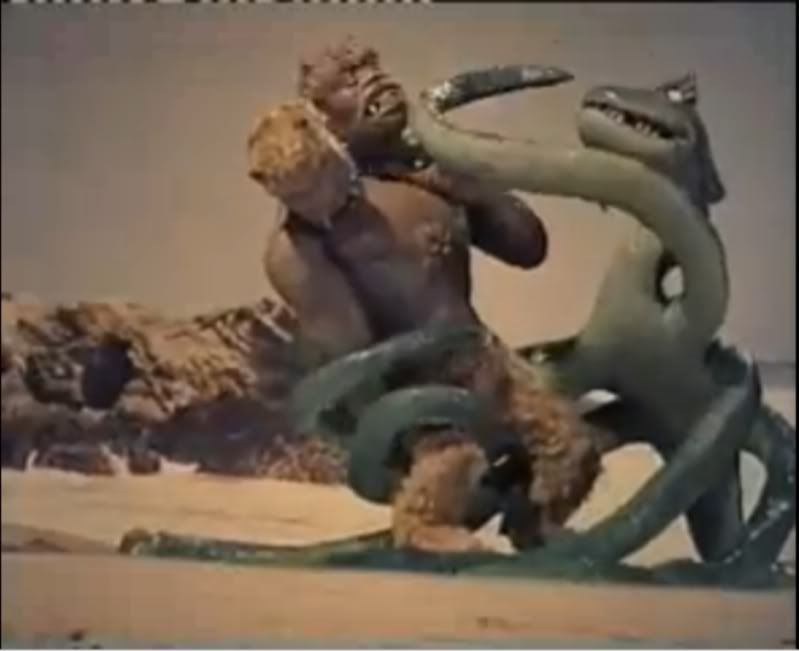
Well, you atheist Darwin worshippers, if evilution were real, a fossil octopus should look prehistoric, like the fellow at the right...

octolizzard6.jpg


Satan awaits your souls with HELLFIRE!

+10 geek bonus for those who figure out the movie, +20 for those who have seen it, +40 for those who saw it more than one time. And me should get a life...
 
No sweat, I just think it is important to be careful what is let slip by that would bolster the argument of ID by mistakes on the science end.

I was trying to point out that as a person without a science background the answer you posted made no sense to me at all to the point of being nonsensical.

I mean it took how long for the Grand Canyon to form? Supposedly 6 million years and yet you seemed to be suggesting that the environment of the octopus from 92 million years ago, never changed. That the animal had not evolved for 92 million years and the reason was it was "perfectly suited to the environment." Next question!

I often see these kind of "easy dismissive answers" bantered about on message boards and it to me, bolsters the arguments of the ID side of it because they are clearly wrong but rarely seem to be corrected by the science people on the threads.

Then you have a lifetime mission. Correcting things that are wrong on the internet. Might be a good cartoon there.
 

Back
Top Bottom