In my physics undergrad class our lecturer said that the physicists assumed that the mathematicians had proved the theories, whilst the mathematicians assumed the physicists had empirically demonstrated the theories to be true.
:D

I've always held the view that mathematics is a game, much like chess. You define axioms, say, what is a group, and then derive theorems from them. Any resemblance with the physical reality is pure coincidence.
 
fortuitous coincidence


ETA
Waay off topic but, with its possible to solve Schrodinger's equation analytically for a hydrogen atom yet nature calculates it instantaneously for molecules.
 
Last edited:
Many people would take issue with the phrase "fortuitous coincidence" as a tautology. I am not so. prescriptive. It is true that both mean "by chance" but fortuitous implies "good luck", so I would say it adds emphasis.

Many people would disagree with that usage.
 
Last edited:
Many people would take issue with the phrase "fortuitous coincidence" as a tautology. I am not so. prescriptive. It is true that both mean "by chance" but fortuitous implies "good luck", so I would say it adds emphasis.

Many people would disagree with that usage.

I thought the NAMBLA meme was dead.:duck:
 
Thank you for touching up my English.
http://www.thefreedictionary.com/touch+up

vb (tr, adverb)
1. to put extra or finishing touches to
2. to enhance, renovate, or falsify by putting extra touches to: to touch up a photograph.
3. to stimulate or rouse as by a tap or light blow
4. slang Brit to touch or caress (someone), esp to arouse sexual feelings
See 4. :blush:

"Serendipitous" is a favourite word of mine and oddly appropriate (in contrast to Trump's compulsive touching-up)

1. The faculty of making fortunate discoveries by accident.
2. The fact or occurrence of such discoveries.
3. An instance of making such a discovery.
:)
 
Many people would take issue with the phrase "fortuitous coincidence" as a tautology. I am not so. prescriptive. It is true that both mean "by chance" but fortuitous implies "good luck", so I would say it adds emphasis.

Many people would disagree with that usage.
I agree with your assessment FWIW. It's one of those many English words I know passively, but wouldn't quickly use actively because they're simply not at the front of your mind.
http://www.thefreedictionary.com/touch+up
vb (tr, adverb)
1. to put extra or finishing touches to
2. to enhance, renovate, or falsify by putting extra touches to: to touch up a photograph.
3. to stimulate or rouse as by a tap or light blow
4. slang Brit to touch or caress (someone), esp to arouse sexual feelings
See 4. :blush:
:D
 
And this is a bit where I struggle with why Nate needs simulations at all. You can only run a simulation when you have a probability distribution to begin with. The probability distribution for, say, Ohio, already rolls out of his model and is plugged into the simulation algorithm. Basically, already at step (3) you can say "Clinton has a 65.1% chance of winning Ohio". I surmise it's in the correlations between the various states that his model is too difficult to simply be calculated and that he needs a Monte Carlo run.


As you said, what Nate has, before he runs his simulations, is a probability distribution of the proportion of voters who will vote for each candidate in each state. His primary goal is to estimate the probability distribution of the number of electoral votes that each candidate will ultimately win. Let's imagine the simplest possible data that Nate could have that would permit direct calculation of this probability distribution: for each state, he takes the distribution of the vote outcomes and computes the probability that one candidate will win the state (and hence the state's electoral votes). Then his job would be to calculate the probability distribution of electoral votes from these probabilities (you say there would be 54 of them, fine).

If there are 54 such probabilities, then there are 2^54 possible election outcomes (ignoring 3rd-party candidates). Calculating the distribution of electoral votes directly would thus require more than 2^54, or quadrillions, of computer operations. And that's just for this highly over-simplified problem, where we have ignored third-party candidates and the 54*53/2 = 1400 correlation coefficients between pairs of states. Even for this simplified problem, this would be infeasible. In contrast, Nate gets stable results from just 20,000 Monte Carlo simulations.
 
As you said, what Nate has, before he runs his simulations, is a probability distribution of the proportion of voters who will vote for each candidate in each state. His primary goal is to estimate the probability distribution of the number of electoral votes that each candidate will ultimately win. Let's imagine the simplest possible data that Nate could have that would permit direct calculation of this probability distribution: for each state, he takes the distribution of the vote outcomes and computes the probability that one candidate will win the state (and hence the state's electoral votes). Then his job would be to calculate the probability distribution of electoral votes from these probabilities (you say there would be 54 of them, fine).
I get to the 54 by counting the congressional districts of Maine and Nebraska (which each award one elector) separately.
If there are 54 such probabilities, then there are 2^54 possible election outcomes (ignoring 3rd-party candidates). Calculating the distribution of electoral votes directly would thus require more than 2^54, or quadrillions, of computer operations. And that's just for this highly over-simplified problem, where we have ignored third-party candidates and the 54*53/2 = 1400 correlation coefficients between pairs of states. Even for this simplified problem, this would be infeasible. In contrast, Nate gets stable results from just 20,000 Monte Carlo simulations.
Thank you. Yes, of course, that explains it, the computational complexity blows up exponentially.
 
I get to the 54 by counting the congressional districts of Maine and Nebraska (which each award one elector) separately.

Thank you. Yes, of course, that explains it, the computational complexity blows up exponentially.

Not that it matters, but I don't think you get 54.

50 states
District of Columbia
2 Districts in Maine
3 Districts in Nebraska

Maine & Nebraska both allow 2 EV to the winner of the popular vote in the state, PLUS 1 EV each for the winner of each Electoral District. Not sure how he reaches his state totals, though. If he already works bottom-up by district it would mean just separating those projections. If he only works by state totals then he'd have to do those state total (thus, my count of 50 states) plus five districts.
 
Not that it matters, but I don't think you get 54.

50 states
District of Columbia
2 Districts in Maine
3 Districts in Nebraska

Maine & Nebraska both allow 2 EV to the winner of the popular vote in the state, PLUS 1 EV each for the winner of each Electoral District. Not sure how he reaches his state totals, though. If he already works bottom-up by district it would mean just separating those projections. If he only works by state totals then he'd have to do those state total (thus, my count of 50 states) plus five districts.
I got to 54 by not counting Maine and Nebraska as states: the state result is simply the (weighted) sum of the results in the congressional districts. So I didn't count the state as a separate probability distribution. Well, if there are fluctuations in turnout between the districts the sum is again not so simple... But, of course, I don't know how Nate models it, this is just how I think he does.
 
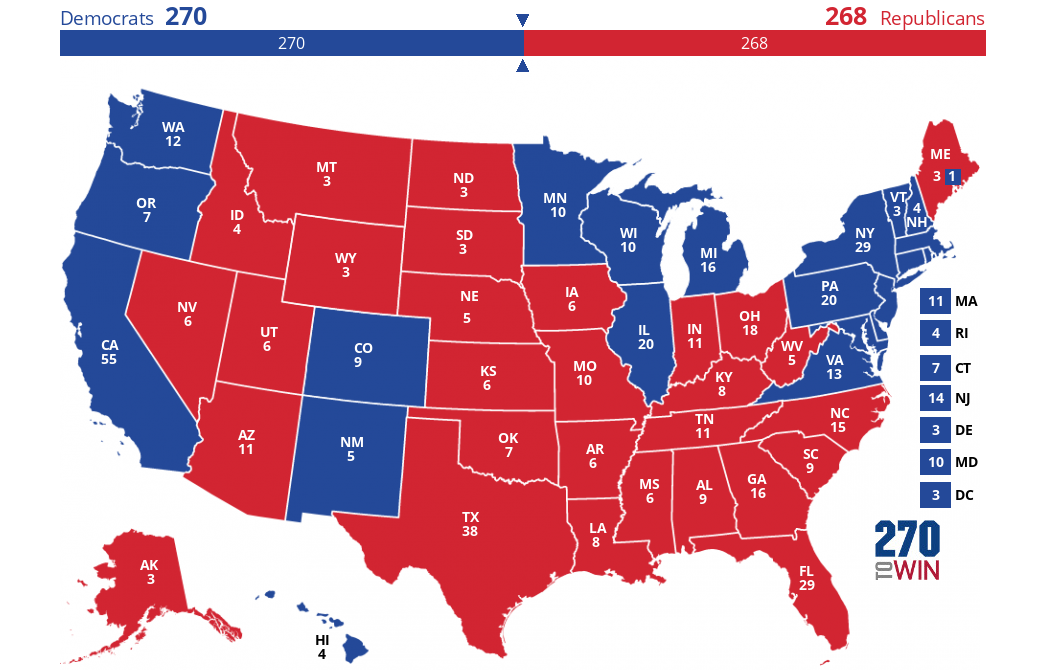
This is the most conservative Clinton win I can come up with, and I think it's going to be hard for Trump to be able to beat that. IMO, if Clinton takes PA, it's over.

3nWw2.png
 
This is the most conservative Clinton win I can come up with, and I think it's going to be hard for Trump to be able to beat that. IMO, if Clinton takes PA, it's over.

[qimg]http://www.270towin.com/presidential_map_new/maps/3nWw2.png[/qimg]

Pretty much. And the race in TEXAS is closer than it is in Pennsylvania.
 
Is it happening?

[Imgw=640]https://pbs.twimg.com/media/Cu-F-W_WAAAU21E.jpg[/imgw]

No, but I'll take it. The Dems can head-fake into Atlanta and not waste a cent. Michelle Obama speaking to a large black audience would be a good move. She gets national coverage wherever she goes, and Georgia blacks could use some motivation. Plus... all those dark faces scare the Breitbarties.

I think if Obama dropped a Tweet, you could get a few well-known Georgians up there. Biggest rally of the year: Ali's wife & kids, Herschel Walker, MLK's and Coretta's kids, the ghost of Ray Charles, Mr. & Mrs. James Earl Carter,... and that about exhausts my knowledge of famous Georgians.
 
No, but I'll take it. The Dems can head-fake into Atlanta and not waste a cent. Michelle Obama speaking to a large black audience would be a good move. She gets national coverage wherever she goes, and Georgia blacks could use some motivation. Plus... all those dark faces scare the Breitbarties.

I think if Obama dropped a Tweet, you could get a few well-known Georgians up there. Biggest rally of the year: Ali's wife & kids, Herschel Walker, MLK's and Coretta's kids, the ghost of Ray Charles, Mr. & Mrs. James Earl Carter,... and that about exhausts my knowledge of famous Georgians.

It's not just Georgia the Dems are head-faking into. Bernie and Chelsea are campaigning in Arizona this week. With the Orange Menace returning to the conspiratorial white identity politics that delivered his plurality in the primaries, there's an embarrassment of opportunities for the Dems to go after.
 
No, but I'll take it. The Dems can head-fake into Atlanta and not waste a cent. Michelle Obama speaking to a large black audience would be a good move. She gets national coverage wherever she goes, and Georgia blacks could use some motivation. Plus... all those dark faces scare the Breitbarties.

I think if Obama dropped a Tweet, you could get a few well-known Georgians up there. Biggest rally of the year: Ali's wife & kids, Herschel Walker, MLK's and Coretta's kids, the ghost of Ray Charles, Mr. & Mrs. James Earl Carter,... and that about exhausts my knowledge of famous Georgians.

Well according to 538, Hillary has over double the chance of winning Georgia that she does of losing the whole election and that's without factoring in that poll.
 

Back
Top Bottom