• Quick note - the problem with Youtube videos not embedding on the forum appears to have been fixed, thanks to ZiprHead. If you do still see problems let me know.

Debate! What debate?

As for the fires, there are many issues, such as fuel type and oxygen supply. I used a smoldering combustion model because that's the SLOWEST type of self-sustaining combustion there is. It also defines a minimum heat flux from which I derive a fuel consumption rate of about 2 kg/s. (I think, I need to check this!)

Hi Dr. Greening,

I can address that point. While smoldering in open air requires a certain minimum combustion rate to be self-sustaining, there is no minimum rate to speak of when the heat is thoroughly contained. Imagine a fire-brick kiln, containing a cellulose fire that has been sustained for long enough to have heated the fire-brick to an equilibrium condition; that is, the rate of heat flow through the brick equals that rate of heat radiation and convection from the outer surface which in turn equals the rate of heat release by the fire, less the rate heat is vented via smoke. A temperature profile through the thickness of the walls would be roughly linear except for a steeper drop toward ambient temperature near the outer surface.

Now imagine adding another layer of fire brick on the outside of the kiln, equal in thickness to the first. If the airflow is adjusted so that the temperature inside stays the same, a new equilibrium will be reached, in which the center (formerly the outer surface) of the wall will be approximately midway between the inside and outside temperature, and the slope of the curve, since it spans the same temperature range but now has twice the extent, will be less. This means the rate of heat flow through the container is reduced. Thus we must reduce the combustion rate (which we can do by reducing the air flow) in order to maintain the same inside temperature as before.

A similar effect occurs if we simply scale up the size of the kiln. Heat loss relative to the volume of the combustion region decreases, hence the rate of airflow per quantity of fuel, and the mean rate of combustion per quantity of fuel (that is, the time the fuel will last), will be less at a given interior temperature.

(An extreme example of this is the sun. It's the sun's thickness, not the rapidity of its nuclear reaction, that makes it, especially its interior, so hot. The heat release rate per unit volume is actually extremely low -- many orders of magnitude less than, for instance, the heat generated chemically by living tissue -- which accounts for how it can be expected to continue to burn for billions of years.)

Sustaining combustion requires only sustaining a temperature at which oxygen introduced will react with fuel. Sustaining a certain reaction rate is not, in and of itself, a requirement. The more effectively the heat is trapped, such as by thick masses of insulating debris and by trapping large combustion zones, the longer the fuel will last at a given interior temperature.

CC's approach of determining the combustion rate by the total amount of smoke released (somehow derived from the air quality measurements) is a whole different way to look at the problem. I'd be interested to see his calculations on that.

Respectfully,
Myriad
 
Myriad:

Thank you.

It's too bad NIST had nothing to say on this, or the USGS, or FEMA. (And the EPA is another story)

I am not convinced though... smoldering is smoldering and that's what was needed to keep the fires alive.

We need a self-sustaining fire as much as a self-sustaining collapse

or why didn't the fire just GO OUT?
 
Last edited:
R. Mackey/Myriad:

Some interesting papers...........

1. T. J. Ohlemiller “Modelling of Smoldering Combustion Propagation.” Progress in Energy and Combustion Science 11, 277, (1985).
2. M. T. Gratkowski. “Radiant Smoldering Ignition of Plywood.” MSc. Thesis, WPI, Aug 2004.
3. M. Kosik et al. “Thermal analytical Studies of Combustion of Cellulosics and Activity of Fire Retardants.” Journal of Thermal Analysis 23, 51 (1982).
4. F. Shafizadeh et al. “Oxidation of Chars During Smoldering Combustion of Cellulosic Materials.” Combustion and Flame 55, 171, (1984).
 
Myriad:

Thank you.

It's too bad NIST had nothing to say on this, or the USGS, or FEMA. (And the EPA is another story)


I think the issue with NIST or FEMA not discussing the fires in detail mostly comes down to no one thinking they had anything to do with the collapse. A long-smouldering fire is pretty much what they expected once the pile of debris was there, and so there wasn't any motivation to ask how long such a fire could be expected to burn.


I am not convinced though... smoldering is smoldering and that's what was needed to keep the fires alive.

We need a self-sustaining fire as much as a self-sustaining collapse

or why didn't the fire just GO OUT?


I think this is a question, unlike the collapses, which could be amenable to testing. A series of scale model fires insulated by various amounts of debris, and with different oxygen flow rates, and see how long you can sustain a fire, and with what minimum rate of fuel usage.

Not something I'd have the resources to do myself, but maybe somebody who does fire research could do it.
 
How did you calculate a burnout time of 30 days? It seems to me that such a calculation would be highly sensitive to errors in estimated heat loss, in turn governed by convection and insulation.

Forgive me for interrupting an ongoing conversation rather late, but IIRC convection and conduction, being linearly proportional to the temperature difference, are much less sensitive to small differences in initial conditions than radiation, which is proportional to the difference between the fourth powers of the absolute temperatures. Because of this, the higher temperatures are the greater the uncertainty of any heat transfer model.
 
or why didn't the fire just GO OUT?

Well from how I understand combustion from my limit experience with it, don't you need three things, heat, fuel and and oxidiser (generally oxigen, but any oxidiser will work.)

If you have only fuel and heat then you won't have combustion, until you add an oxidiser. Could we not have the situation were insulated pockets of fuel at combustion temperatures sit realitively dormant until such time as they are exposed to the air, causing them to burst into flame as the oxidiser is added?

Just another question to consider, because I have to admit I'm not totally familiar with your work.

A 767-200ER has a mass of just under 160 tonnes. Much of this mass would have been scattered about the impact floors of the towers. Have you included this increased loading to your collapse senarios?
 
Dr. Greening,

Thank you for your answer. However, even understanding that it is a brief overview suitable for discussion in a forum, I have several concerns about your derivation.

NIST’s key statement concerning the WTC collapse-initiating event, is:

The change in potential energy due to the downward movement of
building mass above the buckled columns exceeded the strain energy
that could be absorbed by the structure. Global collapse ensued

This statement could be interpreted as referring to the quasi-static collapse initiation, i.e. the very first floor collapse, or as describing the early dynamic collapse, i.e. the second and following floor collapses. I only point this out because it is vitally important not to confuse the two situations. Pursuant to your previous messages, we are only concerned with the former case, or what led to the first floor's collapse.


The NIST report suggests that the quantity Dd, the downward displacement in the upper section of each Tower, increased at a rate ~ 5 – 15 cm/hr after the aircraft impacts. This slow downward sagging of floors in the impact zone over a period of less than two hours, meant that a portion of the enormous potential energy stored in each Tower was slowly, but inexorably, converted into strain energy Es. This strain energy eventually exceeded the elastic limit of the structural steel and produced irreversible deformations of support columns immediately below the impact zones – columns that had a finite capacity to absorb strain energy.
There is a problem with this argument. Whether or not NIST makes this hypothesis, it is simply not correct to state that all of the increase in strain energy arises at the expense of gravitational potential energy.

What is missing is strain energy caused by the aircraft impact, and strain energy resulting from the fires. Let me consider only the latter, as the aircraft impact may have primarily destroyed everything it touched, the remainder never having reached the point of plasticity and rapidly returning to its new equilibrium. But the same cannot be said for the thermal energy.

As observed in both WTC towers, the fires led to buckling, one reason being thermal expansion. If we consider horizontal members exposed to heat, these members expand horizontally, exerting stress on columns and gradually assuming a bowed profile. This leads to significant strain throughout the structure, and this strain is not related to gravitational potential energy. Similarly, once heat is removed, the members again contract, possibly reducing strain energy but also potentially increasing strain energy still further, if the limits of elastic deformation were reached during heating -- a distinct possibility given the higher-than-normal loads experienced by the surviving structural elements while the fire raged.

If we restrict our view to vertical strain in the columns, this may well all be due to gravitational potential energy. However, this does not describe all of the damage or all of the displacement in the WTC towers. Heat is very much a factor here, and it can contribute much, much more energy.

Consideration of the conversion of potential energy into downward motion, first by reversible elastic yielding, then by irreversible column deformation, suggests the idea of a collapse-initiating energy equal to the maximum strain energy capacity Es(max) of the support columns on a single floor.

I have previously modeled the WTC collapse in terms of a quantity I called E1, the average energy needed to collapse one WTC floor. Clearly E1 is equivalent to the collapse-initiating energy Es(max) . In my report Energy Transfer in the WTC Collapse Events of September 11th 2001, Section 4.2, a value of about 0.6 gigajoules (0.6 x 10^9 joules) was estimated for E1. This is very close to the value estimated by Bazant.

I've read your paper and Bazant's. In your papers, you principally use energy E1 -- the collapse energy of a single floor -- as the threshold condition to collapse any undamaged floor. This argument is most useful as a global collapse argument, hence why I called attention to the possible confusion above.

This is less useful in considering the first floor, because it isn't undamaged. Nor are the floors truly homogeneous.

Energy E1 is not actually a constant. E1, dependent on the material properties of the steel as well as its size, will be a function of the floor as well as the temperature: E1 = E1(h, T). E1 for the first floor will be significantly less than E1 for other floors due to its being heated, even discounting impact damage.

Taken in combination with the observation above, your derivation (1) undercounts the strain energy and (2) overestimates the energy needed to destroy the collapse floor.

Using NIST’s values of Dd, namely 10 cm for WTC 1 and 30 cm for WTC 2, in the formula Es = E1 = Mg(Dh) (with g taken as 9.81 m/s2), we find:

E1(WTC 1) = 0.637 x 10^8 Joules and E1(WTC 2) = 3.96 x 10^8 Joules

These values for E1 are problematic because E1 should be essentially the same for each Tower.

I would view this "problem" as a warning sign that your derivation is overly simplistic.

Regarding the "smouldering" fire:

It's too bad NIST had nothing to say on this, or the USGS, or FEMA. (And the EPA is another story)

I am not convinced though... smoldering is smoldering and that's what was needed to keep the fires alive.

We need a self-sustaining fire as much as a self-sustaining collapse

or why didn't the fire just GO OUT?
Whether or not the fire went out is a function of heat retention. I still don't see enough information to conclude that it must have gone out. As others have remarked, extreme low-level combustion in underground fires is hardly a new thing.

Like you say, though, pity NIST had nothing to say on this. Still, I'm hardly ready to throw out their ultimate conclusions.
 
Forgive me for interrupting an ongoing conversation rather late, but IIRC convection and conduction, being linearly proportional to the temperature difference, are much less sensitive to small differences in initial conditions than radiation, which is proportional to the difference between the fourth powers of the absolute temperatures. Because of this, the higher temperatures are the greater the uncertainty of any heat transfer model.

While the normalized uncertainty in convective/conductive heat loss will be less than the corresponding uncertainty in radiative heat loss, convection and conduction are almost certain to be the dominant factors in this problem. This does not invalidate my concern.
 
While the normalized uncertainty in convective/conductive heat loss will be less than the corresponding uncertainty in radiative heat loss, convection and conduction are almost certain to be the dominant factors in this problem. This does not invalidate my concern.

Really? I'm not questioning you, just curious why radiation isn't as significant. Is it because the temps aren't high enough, or am I missing something else about the problem (certainly possible - my brain is fried right now)?
 
That's part of it, but the bigger factor is simply that the scale of the problem is so enormous. We've got a big ball of 1.7 million tons or so of lightly smoking rubble, and it's surrounded on five of six sides (more or less) by the old basement walls.

Radiative losses can only escape in one direction -- up. Also, most of that radiation will be captured by ambient air that is relatively close to the heated body. Air happens to be good insulator. This recapture will contribute to, and is essentially indistinguishable from, the convective losses.

The radiative component is only that part which escapes, and isn't recaptured by the air until it's a sizable distance from the rubble.
 
That's part of it, but the bigger factor is simply that the scale of the problem is so enormous. We've got a big ball of 1.7 million tons or so of lightly smoking rubble, and it's surrounded on five of six sides (more or less) by the old basement walls.

Radiative losses can only escape in one direction -- up. Also, most of that radiation will be captured by ambient air that is relatively close to the heated body. Air happens to be good insulator. This recapture will contribute to, and is essentially indistinguishable from, the convective losses.

The radiative component is only that part which escapes, and isn't recaptured by the air until it's a sizable distance from the rubble.

I forgot - this was New York City. Out here in the desert, air is pretty transparent to radiation (less humidity and 2500' altitude make a big difference, I guess). We actually get ice forming on surfaces under certain conditions at night even when the air temperature is several degrees above freezing - the radiative losses to the night sky are that significant. Your points are well taken, though - with only one direction (up) open for radiative exchange the losses would not be that great.

Thanks for answering.
 
As for liquid fuels I never see any mention of the parking under the towers. An average vehicle might contain 20 gallons of highly flammable gasoline plus another gallon of crankcase oil, a gallon of transmission fluid and smaller amounts of other liquid fuels plus 5 tires that would break down into flammable liquids and gases when heated.

Just going on the gasoline and assuming 100 vehicles crushed that's 2000 gallons of gasoline widely spread out and adjacent to the other less volatile liquids contained in the wreckage of the vehicles in a hot enviroment. That heat would vaporize much of the gasoline and more volitile components of other substances which would then migrate slowly through the debris until it came into contact with oxygen and, due to it already being above its ignition temp, burn. This could be occuring just under the surface(10-20 feet), and at any place where oxygen might come into contact with the rubble(sewers, PATH, conduit pipes) but at a rate that was masked by the smoldering below. This would have the effect of reducing heat lost from the hot mass underneath. It would be like wrapping Mackay's thermos bottle above in an electric blanket.

Its a handwaving conjecture but of all the fuels in the rubble pile, gasoline would be one of the most volatile.

What makes the rubble pile fires very different froma coal seam fire is the large array of fuels available. While conditions in one location might be less than ideal for one fuel type it might be different for others.
 
Last edited:
It's too bad NIST had nothing to say on this, or the USGS, or FEMA.
The USGS provided imaging services to help with firefighting efforts. NIST and FEMA weren't charged with responsibility for studying the fires in the piles. Your complaint is a bit like the conspiracists' complaint that the 9/11 Commission report "omitted" the collapse of WTC 7.
 
jaydee, most of the parking was between and around the towers. About 2,000 cars were in the underground lots. I'm not aware of any count of how many cars burned or how many were crushed, and where. Some parts of those vast lots were crushed, some weren't. Some of the crushed cars burned, some of the intact cars burned. In some places, far from the towers, the fires were hot enough to melt all but the steel on the cars.

I think its safe to day that the longest-lasting fires, which were near the tower cores, weren't greatly contributed to by the inflammable liquids in the cars. But the heat in the piles may have been augmented by the heat from burning vehicles contained and channeled by concrete ceilings of the lots.
 
jaydee, most of the parking was between and around the towers. About 2,000 cars were in the underground lots. I'm not aware of any count of how many cars burned or how many were crushed, and where. Some parts of those vast lots were crushed, some weren't. Some of the crushed cars burned, some of the intact cars burned. In some places, far from the towers, the fires were hot enough to melt all but the steel on the cars.

I think its safe to day that the longest-lasting fires, which were near the tower cores, weren't greatly contributed to by the inflammable liquids in the cars. But the heat in the piles may have been augmented by the heat from burning vehicles contained and channeled by concrete ceilings of the lots.

I think you have burning cars confused with thermite/thermate.
 
QUOTE=Apollo20;2470756]Thus we see that the measured chlorine was ten times higher that it should have been based on known sources of chlorine in the WTC concrete dust.[/QUOTE]

A lot of scientific sounding allegations. But no sale.

1. A number of peer-reviewed professional studies of the compounds released have been published and none describe any anomoly in the chlorine levels. WORLD TRADE CENTER:
Chemical Studies of 9/11 Disaster Tell Complex Tale of 'Bad Stuff' by Robert F. Service, cience 19 September 2003: Vol. 301. no. 5640, p. 1649, DOI: 10.1126/science.301.5640.1649; DNA Damage from Polycyclic Aromatic Hydrocarbons Measured by Benzo[a]pyrene-DNA Adducts in Mothers and Newborns from Northern Manhattan, The World Trade Center Area, Poland, and China. F. Perera, D. Tang, R. Whyatt, S. A. Lederman, and W. Jedrychowski (2005)
Cancer Epidemiol. Biomarkers Prev. 14, 709-714; "Levels of carcinogenic polycyclic aromatic hydrocarbons after the World Trade Center disaster." J. D. Pleil, A. F. Vette, B. A. Johnson, and S. M. Rappaport (2004)., PNAS 101, 11685-11688 . See "CHEMICAL ANALYSIS OF A DISASTER." October 20, 2003, Chemical & Engineering News , Volume 81, Number 42
CENEAR 81 42 pp. 26-30, ISSN 0009-2347 (discussing a lot of the sampling and research).

I seriously doubt that your analysis is predicated on any facts missed by dozens of others.

2. I doubt that you accurately calculated the chlorine sources in the WTC buildings. I have not check the data, but that would be the easiest way to create a bogus chlorine "spike."

3. It is not clear that everything in WTC sampling is from the WTC collapse. Sulphur and chlorine are both mentioned as possible spikes from other sources.

4. EPA seems to contradict your chlorine spike theory: "Using portable monitors, direct air readings were taken in and around ground zero on October 24. Low levels of chlorine below the OSHA permissible level were detected. NYU data was reported that contradicted the EPA. Who knows?

5. The assumption that explosives would have left high chlorine levels also seems unfounded given the volume of debris involved. I am unsure what explosives would leave chlorine. My literatue review was limited, but came up zero.

So I do not see any impressive lead on an alternative explanation here at all.

Randy Mott

Note: My URLs did not make the post, since I am a newbie.
 
Welcome to the forums, Randy. Here are links to those papers.

Chemical Studies of 9/11 Disaster Tell Complex Tale of 'Bad Stuff' by Robert F. Service, cience 19 September 2003: Vol. 301. no. 5640, p. 1649, DOI: 10.1126/science.301.5640.1649 http://www.sciencemag.org/cgi/reprint/301/5640/1649.pdf (subscription)

DNA Damage from Polycyclic Aromatic Hydrocarbons Measured by Benzo[a]pyrene-DNA Adducts in Mothers and Newborns from Northern Manhattan, The World Trade Center Area, Poland, and China. F. Perera, D. Tang, R. Whyatt, S. A. Lederman, and W. Jedrychowski (2005)
http://cebp.aacrjournals.org/cgi/reprint/14/3/709.pdf

Air Levels of carcinogenic polycyclic aromatic hydrocarbons after the World Trade Center disaster. J. D. Pleil, A. F. Vette, B. A. Johnson, and S. M. Rappaport (2004)., PNAS 101, 11685-11688. http://www.pnas.org/cgi/reprint/101/32/11685.pdf

CHEMICAL ANALYSIS OF A DISASTER October 20, 2003, Chemical & Engineering News , Volume 81, Number 42
http://pubs.acs.org/cen/NCW/8142aerosols.html
 
Gravy:

I like talking about the rubble pile because posters cannot make their usual appeal to NISTIAN authority! The rubble pile is uncharted territory – ideal for research unfettered by political agendas…

If you read the papers by Cahill you will find that the chlorine emissions from the rubble pile were very high. And take a look at the EPA data on VOC’s – lots of chlorinated species were detected. Some of them were undoubtedly from PVC combustion. I estimate as much as 0.2 x 10^14 J of energy were released from the combustion of PVC. And, by the way, PVC decomposition can also be anaerobic.

Another energy source to contemplate is the reaction:

3Fe + 4H2O = Fe3O4 + 4H2

There was plenty of iron AND WATER in the rubble pile! The reaction between iron and water (steam) proceeds nicely at 400 deg C releasing 2 x 10^9 J of energy per tonne of iron. The H2 would of course create more fuel.

And let’s not forget:

Al + H2O + OH- = AlO2- + 3/2 H2

Adding more fuel to the fire…..
 
Assumptions

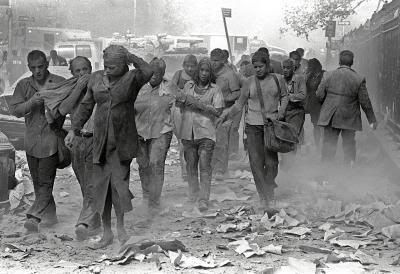
1. Everyone is assuming there were underground fires in the rubble. If the building contents were the fuel for these "fires", why was the "smoke" gray-blue, when the smoke from the fires in the standing buildings was thick and black? Presumably they would be from the same types of fuel, and the ground fires would have less oxygen, if anything.

Image313.jpg


Notice the "smoke" hanging around these people's feet. It sure doens't behave like any smoke from any fire I've seen.

Image39.jpg


Greening's CDCU model allows for about 20% of the mass of each tower to be shed outside the footprint, no more. Look at WTC2 above. Where is 80% of the mass of that tower?

More on the false assumptions in the Greening gravity collapse model later.
 
OMG.

Just when you bring up something I think is the most rediculous thing possible, you out do yourself. I am speechless.

TAM
 

Back
Top Bottom