• Quick note - the problem with Youtube videos not embedding on the forum appears to have been fixed, thanks to ZiprHead. If you do still see problems let me know.

Dead skin cells don't contain DNA?

Kestrel

Philosopher
Joined
Dec 7, 2007
Messages
6,258
Location
Colorado
In another thread, the assertion was made that dead skin cells don't contain DNA. Based on my knowledge, I can't see any support for this idea. Yet this fact was stated in court by a prosecution expert witness and accepted by the court as true. Rather than drag all the experts into a he said, she said argument about a crime, it seemed better to open a separate thread to discuss this.

Has anyone ever heard this before and is there a scientific basis for this claim?
 
This is not what was asserted in the other thread. Doubtless it's possible to find quotes where people were speaking imprecisely, but this is absolutely not the thrust of the argument.
 
Last edited:
Its exactly false. They do. It might be quite degraded, however.

How fast it degrades would depend on the conditions. But considering that a complete CODISWP profiles have been obtained from crime scene items stored for over a decade, the degradation rate can't be all that fast.
 
Actually, what Kestrel really wants to ask, is for confirmation for his contention that a complete DNA profile of an individual convicted of murder, ended up on a key piece of evidence via ambient 'dust' (the argument being, dust also contains dead skin cells along with many other things).

The evidence in question is a bra clasp that was hacked off of the bra of the murder victim. His DNA on the clasp is in the ratio of 1:6 of to that of the victim's. The volume of his DNA is 1.4 ng or 1400 picograms. The victim was murdered in the bedroom of her home in which the convicted individual was not a resident. He had visited the home on a very few previous occasions, spending no more then a total of several hours in her home. He also maintained he had never entered her bedroom on any previous occasion. The apartment was multiple occupancy (3 other residents). The individual convicted was the only other (then the vicyim's) complete profile found on the clasp.

It is Kestrel's assertion that this was via 'dust'.
 
Well; in human, skin cells are dead when they arrive to the surface.
Basically, they start as normal cells in the stratum germinativum and then start migrating toward the surface. In the process, they die and get emptied of most of their biological apparatus. Their nucleus is degraded; and the cells fill up with keratohyalin that dehydrate them and cross-link them with long chains of keratine molecules.
By the time they arrive to the stratum corneum they are mostly inert interlinked bricks of keratin.
They might still contain DNA, I don't know how complete the degradation process is, but it is no longer complete of functional. Might still be enough for some forensic, though, I really can't say...

Anyway; I think that is what the posters was about...
 
Actually, what Kestrel really wants to ask, is for confirmation for his contention that a complete DNA profile of an individual convicted of murder, ended up on a key piece of evidence via ambient 'dust' (the argument being, dust also contains dead skin cells along with many other things).

The evidence in question is a bra clasp that was hacked off of the bra of the murder victim. His DNA on the clasp is in the ratio of 1:6 of to that of the victim's. The volume of his DNA is 1.4 ng or 1400 picograms. The victim was murdered in the bedroom of her home in which the convicted individual was not a resident. He had visited the home on a very few previous occasions, spending no more then a total of several hours in her home. He also maintained he had never entered her bedroom on any previous occasion. The apartment was multiple occupancy (3 other residents). The individual convicted was the only other (then the vicyim's) complete profile found on the clasp.

It is Kestrel's assertion that this was via 'dust'.

Extremely unlikely. Unless he had handled THAT bra. You need more than one or two cells to drive PCR.
 
Essentially the issue is this:

The clasp of a bra was cut off during, or shortly after the Murder of Meredith Kercher. It wasn't collected but was left in the room that the murder took place in for 46 days before being collected. The entire appartment that the murder took place in was secure throughout that time.

When the bra clasp was collected it was tested for DNA. The DNA of the murder victim (was wearing the bra during the murder) was present, 6-10x (more accurate figures are available) weaker was the DNA of Raphaele Sollecito (recently convicted for the murder), weaker still was the DNA of his girlfriend Amanda Knox (also convicted), there was also the DNA of 2? females that was too faint to get a profile on. The rest of the bra returned a profile for Rudy Guede (also convicted).

Raffaele had only been to the appartment a couple of times before and never into the room in which the murder took place and the bra clasp was discovered. He claimed to have tried and failed to break down the door to the victim's bedroom where the body was later found. He has offered no explanation as to how

The forensic personel who processed the crime scene changed gloves between rooms, but not I think between items. The only other source of Raffaele's DNA that was discovered was a cigarette butt in the kitchen. There are claims that the bra clasp had moved between the initial visit to the crime scene and the return visit when the bra clas was collected.

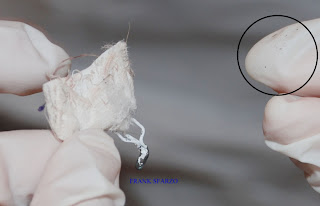
Footage of the collection of the bra clasp shows that there is a small amount of dust on the finger tips of the latex glove (photographs are available) holding the bra clasp. The claim as I understand it is that this is household dust, which presumably contains quite a lot of human skin cells. This dust is supposed to have contaminated the bra clasp with Raffaele Sollecito's DNA.

The argument that Kestrel summarizes is basically that it's kind of odd that only Raffaele Sollecito's skin cells contributed to this contaminating dust despite him hardly ever having been to the appartment and never into the murder room. It is also the understanding of the people who accept the bra clasp as evidence that household dust, while it may technically contain DNA, is not normally a contaminant to the degree implied.

The quantity of Raffaele's DNA was described by the prosecution expert as copious and the same expert claimed that it could only have come from vigorous contact.
 
Well; in human, skin cells are dead when they arrive to the surface.
Basically, they start as normal cells in the stratum germinativum and then start migrating toward the surface. In the process, they die and get emptied of most of their biological apparatus. Their nucleus is degraded; and the cells fill up with keratohyalin that dehydrate them and cross-link them with long chains of keratine molecules.
By the time they arrive to the stratum corneum they are mostly inert interlinked bricks of keratin.
They might still contain DNA, I don't know how complete the degradation process is, but it is no longer complete of functional. Might still be enough for some forensic, though, I really can't say...

Anyway; I think that is what the posters was about...
Thanks! Exactly the answer we've been looking for.
 
Actually, what Kestrel really wants to ask, is for confirmation for his contention that a complete DNA profile of an individual convicted of murder, ended up on a key piece of evidence via ambient 'dust' (the argument being, dust also contains dead skin cells along with many other things).

The evidence in question is a bra clasp that was hacked off of the bra of the murder victim. His DNA on the clasp is in the ratio of 1:6 of to that of the victim's. The volume of his DNA is 1.4 ng or 1400 picograms. The victim was murdered in the bedroom of her home in which the convicted individual was not a resident. He had visited the home on a very few previous occasions, spending no more then a total of several hours in her home. He also maintained he had never entered her bedroom on any previous occasion. The apartment was multiple occupancy (3 other residents). The individual convicted was the only other (then the vicyim's) complete profile found on the clasp.

It is Kestrel's assertion that this was via 'dust'.

Actually, that hasn't been my assertion. Others have however made that argument.

This thread was opened to discuss a specific question of science. if you want to discuss case details, may I suggest taking it back to the Amanda Knox thread?

ETA: My contention was the evidence technicians handled the item in question with visibly dirty gloves. If these gloves had previously touched places where material containing DNA had been deposited, DNA could be transferred to the item being collected.
 
Last edited:
Extremely unlikely. Unless he had handled THAT bra. You need more than one or two cells to drive PCR.

I want to put my opinion on this. Single-cell PCR is not uncommon nowadays (the latest in technology and all that). Difference is that the single-cell is living when the DNA is PCR-ed. Nevertheless, you only need a bit of DNA to drive PCR (which is why it is so powerful). The bigger question in this case is "Was the ratio of suspect's DNA higher or lower than contaminating DNA?" It is hard to tell, but the general rule in PCR is that if you have a mixed sample, the proportion of DNA that is the highest will override the reaction. That is to say, extremely small ratios may be lost in the noise. You would have to have a significant ratio in order to make sense of it. I am not a trained forensic scientist, but I think even I could get a PCR out of a few dozen cells. With training, specialized equipment, and rock solid protocols, it might even be lower. The big question remains how accurate the reading will be.
 
Actually, that hasn't been my assertion. Others have however made that argument.

This thread was opened to discuss a specific question of science. if you want to discuss case details, may I suggest taking it back to the Amanda Knox thread?
Surely this thread has been started to discuss an issue of science in order to apply it in the context of the Kercher case. Context is everything! Nobody on the other thread is seriously trying to claim that there can be no DNA in household dust as an absolute scientific fact. What people are claiming is that there is essentially no DNA in household dust for the purposes of generating contamination of the form that is being suggested.
 
Extremely unlikely. Unless he had handled THAT bra. You need more than one or two cells to drive PCR.

I have read that roughly 160 cells contain 1 ng. of DNA. The reliable limits of LCN profiling are in the 100 pg. range, or about 16 cells. Increasing the replication count would get a reading from one or two cells, but it's not considered reliable for forensic work.
 
How fast it degrades would depend on the conditions. But considering that a complete CODISWP profiles have been obtained from crime scene items stored for over a decade, the degradation rate can't be all that fast.

But a keratinized skin cell already has no nucleus, so extracting DNA will be very difficult, but a body cell properly stored with a nucleus will yield extractable DNA for a long time.

I guess there are two different meanings of "degrade" being used.
 
I have read that roughly 160 cells contain 1 ng. of DNA. The reliable limits of LCN profiling are in the 100 pg. range, or about 16 cells. Increasing the replication count would get a reading from one or two cells, but it's not considered reliable for forensic work.
The CPS (Crown Prosecution Service) in the UK say the limit of LCN is 5 cells, but I guess it depends on the cell and the condition.
 
While we're here and making such progress...

Another piece of evidence in the case is a knife from which the murder victim's profile was extracted by Low Copy Number (LCN) methods. One quarter of this sample was taken for blood testing using tetramethylbenzidine (TMB). It has been claimed that since the TMB test is more sensitive than LCN methods and, since it was negative, the DNA on the knife cannot be associated with the murder and must instead be from contamination.

The knife was recovered from the appartment of Raffaele Sollecito by a seperate team to the one that processed the crime scene. It has been claimed that the profile of the victim was either "touch DNA" that Amanda Knox walked back and then transferred to the knife, or due to lab contamination. Amanda Knox's profile did not show up on the LCN test the returned the profile of the victim, but was discovered by conventional DNA techniques on the handle of the knife.
 
Not that it matters, but here is the photograph of the dust we're talking about:
claspwcircle.jpg


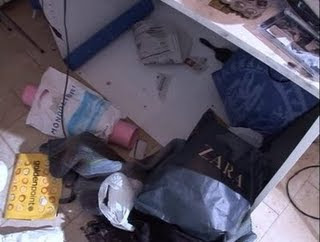
and here's where it was found:
dec_18_position.jpg


A quote from Science Spheres, which I believe is one of Kestrel's primary sources:

What would happen to any random object left on the same floor and kicked about for 47 days? Especially an object with cloth attached , making it a virtual dust mop. It would be covered with dust, and the DNA that comes with that dust. Raffaele was at the apartment visiting Amanda on several occasions. The presence of his DNA there means nothing.

Control experiments to check for this would have been simple. The clasp was retrieved from a pile of debris, shown in the picture, left by the fastidious investigators in Meredith’s room. Testing a few other items from that pile to see if they, too, had picked up DNA dust from the floor would tell us whether there was anything special about the clasp. Of course, that wasn’t done.

So we have “Raffaele’s DNA was found on Meredith’s bra clasp,” rather than, “Raffaele’s DNA, along with DNA from lots of other people, was found at various random locations throughout Amanda’s apartment, which he visited several times before the murder.” The first phrase sounds incriminating. The second, accurate phrase, shows how meaningless this test result is without a control experiment.
http://www.sciencespheres.com/
 
But a keratinized skin cell already has no nucleus, so extracting DNA will be very difficult, but a body cell properly stored with a nucleus will yield extractable DNA for a long time.

I guess there are two different meanings of "degrade" being used.

In the Peggy Hettrick murder caseWP, the DNA evidence that finally freed Tim Masters was collected from places where someone merely touched the victims clothing two decades earlier. The same is true of the touch evidence processed about a decade after the JonBenét RamseyWP murder.

Extracting DNA has little to do with the cell nucleus. The extraction process simply dissolves the rest of the cell.
 
Surely the nucleus is where most if the DNA is? If that's already had it before the skin cells even make it to the surface in order to drop off you're talking about quite small quantities of DNA.

Also, in the cases you quote, the DNA was transferred by touch. Here we are talking about household dust, not Raffaele Sollecito transferring his DNA by touching the bra clasp.
 

Back
Top Bottom